

With Australian household debt reaching 182% of disposable income, the most conservative loan choice for your portfolio might actually be the one that doesn’t pay down a cent of principal. Choosing between interest only vs principal and interest for investment properties is no longer just a matter of preference; it is a critical decision in a market defined by high interest rates and APRA’s 2026 debt-to-income caps. It’s completely natural to feel a sense of weight when considering these options, especially with the looming concern of repayment shock when an interest-only period ends.
We believe that property investment should provide a sense of security rather than a source of stress. You want to keep your monthly commitments manageable while ensuring every dollar works as hard as possible through smart tax deductions. This strategic guide will help you master the financial mechanics of interest-only lending to maximise your cash flow in the current climate. We will walk through the latest 2026 lending regulations, compare current market rates across our panel of over 36 lenders, and help you build a clear debt reduction plan that protects your long-term wealth.
Key Takeaways
- Understand how interest-only terms can preserve your capital for future property acquisitions while keeping monthly commitments low.
- Learn how to evaluate interest only vs principal and interest for investment properties by comparing total loan costs against immediate tax benefits.
- Discover the specific 2026 APRA serviceability rules and how to pass the bank’s “purpose test” for a successful application.
- Identify the hidden costs of interest-rate premiums and how to calculate the long-term impact on your 30-year wealth strategy.
- Develop a proactive 12-month exit strategy to manage the transition to principal repayments without financial stress or repayment shock.
What Is an Interest-Only Home Loan in the 2026 Australian Market?
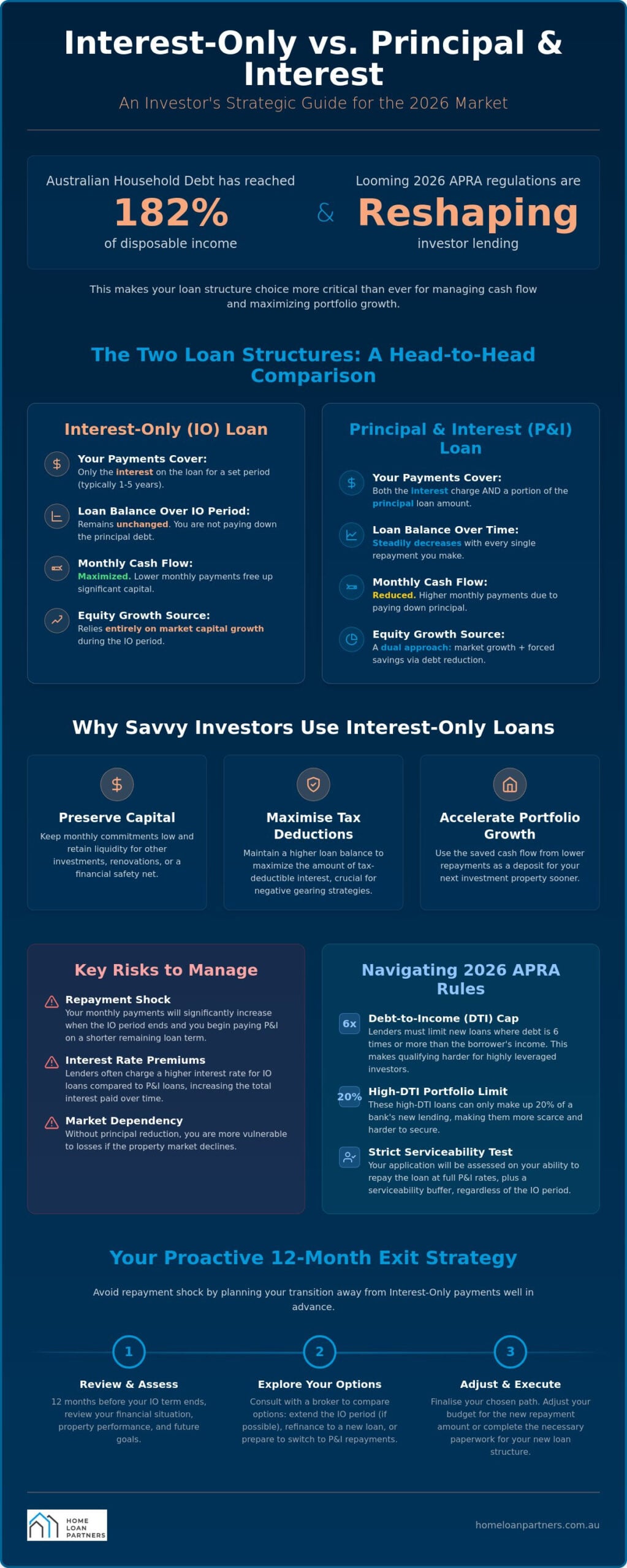
An interest-only home loan is a specific structure where your monthly repayments cover only the interest charged on the loan balance, leaving the original principal amount untouched. This differs significantly from a principal and interest (P&I) structure, where every payment chips away at the debt itself. In the Australian market, these interest-only periods typically last between one and five years, though certain lenders may offer longer terms for investment purposes depending on your strategy. Understanding the nuances of interest only vs principal and interest for investment is vital because your choice dictates your immediate cash flow and your long-term equity growth.
How the Interest-Only Period Works
During this set term, your loan balance remains static. While this means you aren’t building equity through debt reduction, it frees up capital that would otherwise be tied up in the property. For a foundational look at these mechanics, you can read more about What Is an Interest-Only Loan. This temporary reduction in commitments can be a lifesaver when managing multiple properties or funding renovations, but you must remember that the debt doesn’t disappear. Without the principal being reduced, you rely entirely on market capital growth to build your equity position during the term. Essentially, an interest-only loan serves as a tactical cash-flow management tool for the modern investor.
The 2026 Lending Landscape for Investors
The 2026 lending environment has become more nuanced due to APRA’s intervention. As of February 1, 2026, banks must cap high debt-to-income loans (those six times or more than income) at 20% of their new lending. This regulation makes it harder for highly leveraged investors to secure interest-only terms easily. Lenders now strictly assess your ability to repay the loan at P&I rates plus a serviceability buffer, even if you only plan to pay interest for the first few years. This ensures you can handle the eventual “repayment shock” when the interest-only period ends and repayments jump.
With interest rates showing continued volatility, having a steady hand to guide you is essential. Partnering with a professional finance broker allows you to compare options across 36+ lenders to find a structure that aligns with your specific goals. They can help you navigate the diverging policies regarding interest only vs principal and interest for investment where some lenders are becoming more conservative with their portfolio concentrations than others.
Strategic Benefits: Why Investors Choose Interest-Only Structures
Choosing the right loan structure is about aligning your debt with your long-term financial goals. While many see interest-only (IO) payments as a way to manage higher interest rates, savvy investors use them as a precision instrument to build wealth. The decision between interest only vs principal and interest for investment properties often hinges on where your cash provides the highest return. By only paying the interest component, you retain liquidity that can be redirected toward higher-priority goals, such as property maintenance or further portfolio expansion.
This approach isn’t about avoiding debt; it’s about managing it with purpose. Investors often face life transitions like parental leave or career changes where lower monthly commitments provide a much-needed safety net. By keeping mandatory outgoings to a minimum, you maintain a sense of control over your household budget while your investment asset continues to work for you in the background.
Tax Efficiency and Negative Gearing
In the Australian tax system, interest paid on an investment property loan is generally tax-deductible. If you choose a principal and interest structure, you’re effectively reducing your tax-deductible debt with every monthly payment. For many, maintaining a higher loan balance through an IO period is a deliberate move to maximise these deductions. This strategy is particularly effective when paired with negative gearing, where the costs of owning the asset exceed the rental income. If you’re just starting your journey, our guide on how to buy a house in Australia provides a solid foundation for these concepts. It’s also wise to review Australian government advice on interest-only loans to ensure you’re aware of the long-term cost implications of static principal balances.
Debt Recycling and Wealth Creation
One of the most powerful reasons to opt for an interest-only structure is debt recycling. Most investors carry both “non-deductible debt” (their own home loan) and “deductible debt” (their investment loan). By choosing an IO structure on the investment property, you can use the surplus cash that would’ve gone toward that principal to aggressively pay down your home loan instead. This allows you to:
- Prioritise Debt Reduction: Clear your non-deductible home loan faster to save on interest that isn’t tax-effective.
- Preserve Liquidity: Keep cash available for unexpected repairs or to act quickly when a new investment opportunity arises.
- Build a Buffer: Direct extra funds into an offset account to reduce interest costs while keeping the capital accessible.
Sophisticated investors don’t just pick a loan; they design a system that supports their lifestyle and future security. If you’re wondering how these structures might apply to your specific portfolio, our expert team is here to help you navigate the complexities of the 2026 market with a steady hand.
The Financial Math: Managing Costs and Repayment Shock
While the strategy of lower monthly commitments is appealing, it’s essential to understand the underlying costs. Lenders typically charge a premium for the flexibility of interest-only terms. As of July 2026, we see a clear divergence in pricing; for instance, ANZ’s Standard Variable Residential Investment loan sits at 8.09% p.a. for interest-only repayments at an 80% LVR. In contrast, principal and interest rates are often significantly lower. This interest rate gap, combined with the fact that you aren’t reducing your debt balance, means the total interest paid over a 30-year loan term will be higher. Our team focuses on helping you weigh these immediate cash-flow gains against the long-term interest expense to ensure the math supports your goals.
Eligibility for these terms is also heavily influenced by your Loan-to-Value Ratio (LVR). Most Australian lenders reserve their most competitive interest-only offers for borrowers with at least 20% equity. If your LVR is higher, you might face even steeper rate premiums or find that your choice of lenders is restricted. This is where the long-term relationship with a broker becomes invaluable; we help you monitor your equity levels so you can transition to better terms as your property value grows.
The Power of the Offset Account Synergy
For many of our clients, the “secret sauce” of an interest-only strategy is the use of an offset account. Every dollar you hold in a linked offset account reduces the interest charged on your loan while keeping that principal fully accessible for future investments or emergencies. This creates a powerful synergy. You benefit from the lower mandatory repayments of an interest-only structure, but you effectively reduce your interest costs as if you were paying down the principal. It provides the ultimate balance of liquidity and cost-efficiency, allowing you to remain agile in a shifting 2026 market without being locked into a rigid repayment schedule.
Interest-Only Calculation Example
To visualise the “repayment shock,” consider an A$600,000 investment loan. On a five-year interest-only term at 6.50%, your monthly payment would be approximately A$3,250. If you had chosen a principal and interest structure at a lower rate of 6.00% over 30 years, the payment would be roughly A$3,597. While the interest-only option saves you A$347 each month initially, the real change occurs at year six. At that point, the full A$600,000 principal must be repaid over the remaining 25 years. This causes your monthly payment to jump to approximately A$3,866, a “shock” of over A$600 per month compared to your initial IO payment. You can test these scenarios for your own portfolio using our home loan calculator to ensure your exit strategy is robust.
Qualifying for an Interest-Only Loan in 2026
Securing an interest-only loan in the current Australian market is more complex than it was just a few years ago. Banks are now under tighter scrutiny from APRA, especially regarding debt-to-income (DTI) ratios. As of February 2026, major lenders must limit loans where debt is six times the borrower’s income to just 20% of their total new lending. This means that even if you have a strong portfolio, you might find your usual bank is less flexible than before. Choosing between interest only vs principal and interest for investment requires passing a higher serviceability bar, as lenders test your ability to pay at a higher assessment rate on a principal and interest basis over a shorter remaining term.
Lenders also now require a “Purpose Test” for interest-only applications. You must demonstrate a clear strategic reason for wanting to delay principal repayments. Common acceptable reasons include managing cash flow for future property acquisitions, funding renovations, or prioritising the pay-down of non-deductible debt. Banks want to see that you aren’t simply avoiding the inevitable, but rather using the structure as a deliberate wealth-creation tool. Our role is to help you articulate this strategy clearly to ensure your application stands the best chance of approval.
Bank vs. Broker: Navigating 36+ Lenders
While a major bank might have a rigid policy, the broader market offers far more variety. Some non-bank lenders are more “investor-friendly” and may not be subject to the same DTI caps as authorized deposit-taking institutions. We provide access to over 36 lenders, allowing us to identify those with lower interest-only rate premiums and more generous serviceability models. Instead of a one-size-fits-all approach, we look for a partner that understands your specific long-term journey. This perspective is vital because the right lender can significantly increase your future borrowing capacity compared to a lender with more conservative assessment rules.
Refinancing to an Interest-Only Structure
You don’t always have to start with an interest-only loan. Many investors choose to switch their structure as their life circumstances or portfolio goals change. The process of refinancing your home loan to an interest-only term can free up thousands in monthly cash flow, but there are pitfalls to avoid. For example, you must ensure that any new interest-only period doesn’t reset your total loan term in a way that costs you more in interest over the long run. We help you weigh the benefits of interest only vs principal and interest for investment during the refinance process to ensure the move supports your overall financial security.
If you’re ready to see which of our 36+ lenders has the right policy for your strategy, reach out for a personalised assessment and let us handle the heavy lifting of comparing the market for you.
The Exit Strategy: Transitioning After the Interest-Only Period
The successful management of an interest-only loan depends entirely on a proactive exit strategy. We recommend starting your financial review at least 12 months before your interest-only term is scheduled to expire. This proactive window gives you enough time to assess your equity position and cash flow without the pressure of a looming deadline. When weighing interest only vs principal and interest for investment properties, the end of the term is the moment where your strategy must evolve to protect your portfolio’s longevity and your personal peace of mind.
You generally have three paths when the term ends. Option 1 is a seamless transition to principal and interest repayments. While we discussed the potential for repayment shock earlier, many investors choose this path to finally start building equity through debt reduction. Option 2 involves negotiating an extension. Keep in mind that major banks like Commonwealth Bank often limit interest-only periods to five years at a time, with a maximum of 15 years allowed over the life of the loan. Option 3 is refinancing to a new lender. This can reset your loan term back to 30 years, which may lower the required principal and interest repayments by spreading the debt over a longer period once more.
Preparing for Higher Repayments
If you plan to transition to principal and interest, you should begin “simulated repayments” immediately. Start by transferring the difference between your current interest-only payment and the future P&I payment into your offset account each month. This practice tests your budget and builds a healthy cash buffer simultaneously. If your ultimate exit strategy involves selling the asset to upgrade your portfolio, you might explore bridging finance as a way to manage the timing between your next purchase and the sale of your current investment property.
When an Extension Is Refused
In the 2026 market, some lenders may refuse an extension if your debt-to-income ratio has crossed the new APRA thresholds or if your financial circumstances have changed. If your bank says no, it doesn’t mean you’re out of options. We can help you look toward non-bank lenders who may have different serviceability assessment models or more flexible policies for experienced investors. In some cases, debt consolidation or a strategic property divestment might be the right path forward to maintain your financial security. Our team acts as your expert collaborator, ensuring that the transition between interest only vs principal and interest for investment structures is handled with precision. We are here to guide you through every milestone of your investment journey with a steady, reliable hand.
Secure Your Financial Future with Strategic Lending
Choosing between interest only vs principal and interest for investment properties isn’t a one-time decision; it’s a dynamic strategy that requires regular review. We’ve explored how interest-only structures can maximise your immediate cash flow and tax efficiency, while also highlighting the importance of a 12-month exit plan to avoid the stress of repayment shock. In a 2026 market defined by stricter APRA guidelines, the right loan structure depends entirely on your personal goals and your tolerance for risk. Every investor’s path is unique, and your lending should reflect your specific vision for wealth creation.
You don’t have to navigate these complex financial waters alone. Our team provides access to over 36 Australian lenders and offers specialist expertise in complex investment loan structures. We focus on building long-term relationships, providing the personalised long-term financial guidance you need to achieve your major life milestones with confidence. Book a free strategy session with The Home Loan Partners to ensure your portfolio is built on a foundation of steady, expert advice. Your investment journey is a marathon, and with a reliable guide by your side, you can move forward with clarity and peace of mind.
Frequently Asked Questions
Can I make extra repayments on an interest-only investment loan?
Yes, you can typically make extra repayments on a variable interest-only loan without penalty. Many investors choose to place these extra funds into a linked offset account instead of paying down the loan directly. This keeps your capital accessible for future property maintenance while still reducing the interest you pay. If your loan is on a fixed rate, you should check for annual repayment limits to avoid break costs.
Are interest-only loans always more expensive in the long run?
Interest-only loans are generally more expensive over the full 30-year term because the principal balance stays higher for longer. Since you aren’t reducing the debt during the initial years, interest is calculated on a larger amount. When evaluating interest only vs principal and interest for investment, you must also account for the higher interest rate premiums that lenders typically charge for the interest-only flexibility.
What happens if I cannot afford the higher repayments after the IO period ends?
You should reach out to your broker at least 12 months before the term expires to explore your options. We can help you apply for an extension of the interest-only period or look at refinancing to a new 30-year term with a different lender to lower the repayments. If these aren’t viable, we might discuss debt consolidation or a strategic sale of the asset to protect your financial security.
Can I get an interest-only loan as a first-time investor?
Yes, first-time investors can secure interest-only loans, provided they meet strict serviceability requirements. Even though your actual payments will be lower, the bank will test your ability to afford principal and interest repayments at a higher “stressed” interest rate. You will also need to provide a clear strategic reason for the interest-only period, such as prioritising the pay-down of non-deductible personal debt.
How long can an interest-only period last in Australia?
Most Australian lenders offer an initial interest-only term of between one and five years. Some major banks may allow you to extend this for up to 15 years in total over the life of the loan, though this is subject to a full credit assessment each time. We help you stay ahead of these deadlines so you can navigate the transition or extension with a steady, prepared hand.
Is the interest on an interest-only loan tax deductible for owner-occupiers?
No, the interest is generally not tax deductible if the loan is for your principal place of residence. Tax deductibility is determined by the purpose of the loan rather than the repayment structure. When comparing interest only vs principal and interest for investment, remember that the tax benefits only apply when the borrowed funds are used to purchase an income-producing asset like a rental property.
Will an interest-only loan affect my future borrowing capacity?
An interest-only loan can reduce your borrowing capacity because lenders assess your serviceability over a shorter period. If you have a five-year interest-only term on a 30-year loan, the bank assumes you will repay the entire principal over the remaining 25 years. This makes your “assessed” monthly commitment higher than if the debt were spread over the full 30-year principal and interest term.
Can I switch from interest-only back to principal and interest early?
You can almost always switch to principal and interest repayments before your interest-only term officially ends. Lenders are typically very supportive of this move as it reduces their risk and shows you are committed to reducing your debt. We can help you manage this transition to ensure your new repayment schedule fits comfortably within your current household budget and long-term wealth strategy.