

What if your student loan wasn’t the roadblock you’ve been led to believe, but a manageable factor in your path to home ownership? Many Australians feel a sense of unease as they watch their HECS balance grow with annual indexation, fearing it might derail their plans. You’re likely wondering, can you get a home loan with a HELP debt when your borrowing capacity feels squeezed? The answer is a reassuring yes, provided you have the right strategy in place.
We recognize the stress of balancing education costs with the desire for a stable future. It’s a complex puzzle where lender policies and repayment thresholds often feel like they’re working against you. This guide is designed to replace that confusion with a clear, actionable roadmap for 2026. You’ll discover exactly how banks view your debt, whether you should prioritize repayments over a deposit, and how to position your application for success. By understanding the levers of serviceability, you can take control of your financial journey and step into the property market with total confidence.
Key Takeaways
- Confirm your eligibility for a mortgage, as the short answer to can you get a home loan with a HELP debt is a definitive yes.
- Learn how compulsory repayments affect your net income, which directly influences how much a bank is willing to lend you.
- Understand the impact of the June 1st indexation deadline and how it differs from traditional interest on your total balance.
- Evaluate the strategic choice between paying down your student debt early or preserving your cash to build a larger deposit.
- Discover why different lenders treat HECS debt uniquely, making the guidance of an expert broker essential for a successful application.
Can You Get a Home Loan With a HELP Debt? (The 2026 Reality)
The simple answer is a definitive yes. Having a Higher Education Loan Program (HELP) balance doesn’t automatically trigger a rejection from Australian lenders. Unlike a defaulted credit card or a missed car loan payment, student debt isn’t viewed as a sign of poor financial character. Instead, banks see it as a predictable part of your financial profile. It’s a common scenario for thousands of professionals looking to enter the property market.
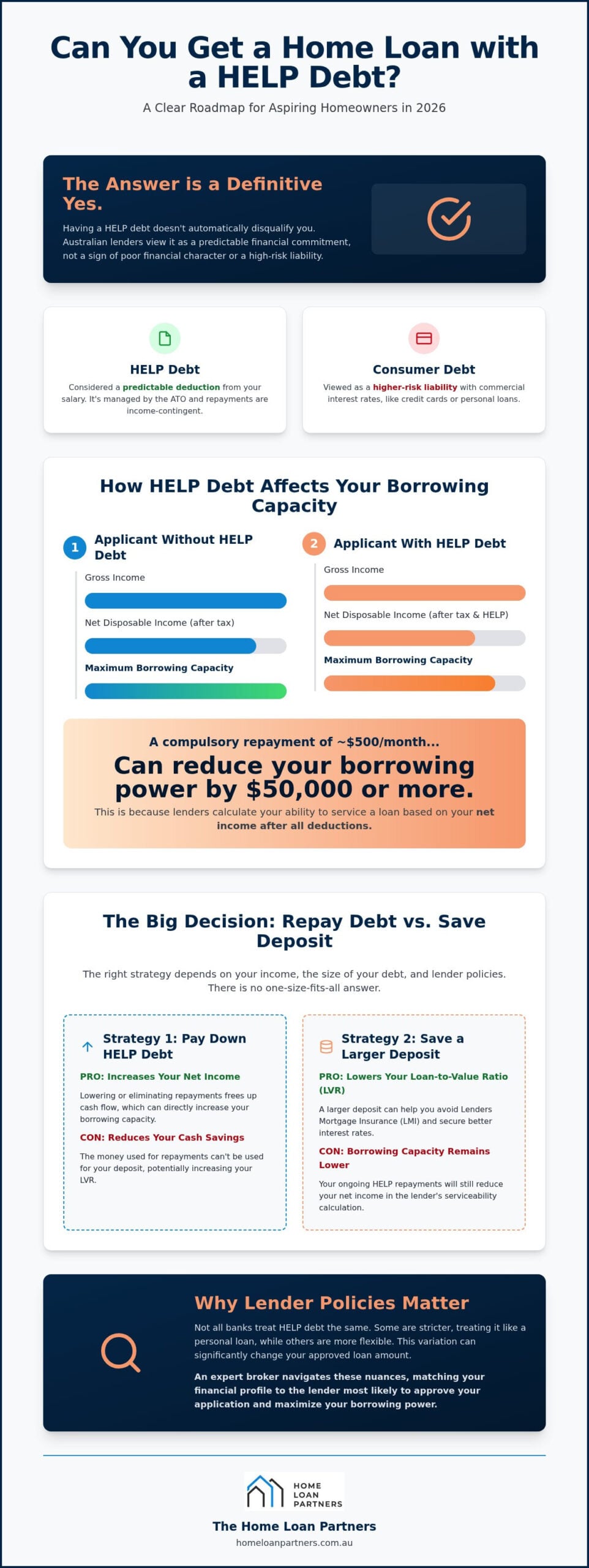
Lenders distinguish HELP debt from traditional consumer credit because it doesn’t carry a commercial interest rate. It’s managed by the Australian Taxation Office (ATO) and repayments only occur once you earn above a specific salary threshold. Because these payments are deducted directly from your salary, banks treat them as a reduction in your disposable income rather than a high-risk liability. When you ask, can you get a home loan with a HELP debt, you’re really asking about your borrowing capacity, not your worthiness as a borrower.
HELP vs. HECS: Understanding the Terminology
While many people still use the term HECS, it’s technically been part of the broader HELP umbrella for years. Whether you have HECS-HELP, FEE-HELP, or OS-HELP, the impact on your mortgage application remains largely the same. In the 2026 economic environment, lenders are more attuned to these balances due to recent shifts in indexation rates. They aren’t worried about the name of the loan; they’re focused on how much of your paycheck is redirected to the ATO before it hits your bank account. The repayment threshold is the only figure that truly moves the needle for a credit assessor.
The ‘Yes, But’ Factor: What Lenders Are Looking For
There’s a subtle distinction between being eligible for a loan and being able to borrow the amount you want. This is the serviceability gap. If your salary triggers a high repayment tier, your lender will reduce your maximum loan amount to ensure you can comfortably manage both the mortgage and the debt. For example, a significant annual repayment can sometimes reduce your borrowing ceiling by tens of thousands of dollars.
Transparency is your best tool here. Disclosing your debt early prevents surprises during the formal assessment. Because every bank has a different method for calculating these repayments, partnering with a broker is vital. Some lenders use your actual tax assessment, while others apply a flat percentage based on your gross income. We act as your steady hand, identifying which of our 36+ lenders will view your specific situation most favorably, ensuring your path to home ownership stays on track.
How HELP Debt Affects Your Borrowing Capacity
One of the first questions we often hear is can you get a home loan with a HELP debt, and while the answer is yes, the real impact is found in your borrowing ceiling. Lenders look at your financial life through the lens of net income. This is where the ‘Take-Home Pay’ trap occurs. Because your employer deducts HECS repayments before your salary reaches your bank account, a lender sees your disposable income as being lower than someone with the exact same salary but no study debt.
Small deductions create a significant ripple effect. For instance, a compulsory repayment of roughly $500 per month might seem manageable in your weekly budget. However, when a bank runs their assessment, that $6,000 annual commitment can slash your total borrowing capacity by $50,000 or more. This happens because that $500 is $500 less available to service a mortgage. It’s a mathematical reality that often catches first home buyers by surprise. Banks want to ensure you aren’t overextended if interest rates shift or your personal circumstances change.
Lender sensitivity varies across the Australian market. Some major banks apply rigid rules to HELP debt, treating it like a standard personal loan. Others are more flexible in how they calculate your surplus cash. This is why exploring multiple options is so beneficial. A tailored approach ensures you aren’t penalized by a bank that doesn’t fit your specific financial profile. If you’re worried about your limit, it’s worth seeing how different lender policies might work in your favour.
The Serviceability Calculation Explained
Serviceability is the lender’s measure of your ability to meet repayments without hardship. To find this number, banks take your gross income and ‘shade’ it, removing tax and compulsory HECS deductions to find your true surplus. In 2026, the updated tax brackets and repayment thresholds mean these calculations are more precise than ever. If your income sits just above a threshold, a small pay rise could actually lower your borrowing power by pushing you into a higher HECS repayment bracket. It’s a counterintuitive reality of the current system.
DTI Ratios and HELP Debt
Another critical metric is your debt to income ratio (DTI). Lenders use this to compare your total debt, including your HELP balance and future mortgage, against your gross income. Most banks view a DTI over six as high risk, which can lead to stricter approval conditions. Including student debt in this tally is standard practice, but the way it’s weighted depends on the lender’s internal policy. Understanding these ratios helps you present a stronger application from the start.
The Impact of Indexation on Your Mortgage Application
Indexation is often the most misunderstood part of a student loan. Unlike a car loan or credit card where interest is charged monthly, HELP debt is indexed once a year on June 1st. This process adjusts your balance to keep pace with the cost of living by using the Consumer Price Index (CPI). While it isn’t technically interest, the effect is the same: your total debt grows. When you’re asking can you get a home loan with a HELP debt, you must account for this annual jump, as it can shift your financial profile overnight.
A growing balance doesn’t just affect your initial application; it impacts your long-term equity. Every dollar added by indexation is a dollar of net worth eroded. If indexation outpaces your compulsory repayments, your debt could actually increase despite your hard work. This is why timing your entry into the property market is a strategic decision rather than just a matter of convenience. Lenders want to see that you have a handle on these fluctuations before they commit to a long-term mortgage.
Preparing for the 2026 Indexation Cycle
As we approach the 2026 cycle, keeping a close eye on CPI data is essential for accurate planning. To get a head start, log into your MyGov account to verify your current balance before meeting with a broker. Many Australians are surprised to find a hidden increase because the ATO applies indexation to the balance as it stood on June 1st of the previous year, before your most recent year of repayments are applied. Knowing your true figure allows us to build a more resilient loan structure that accounts for these administrative quirks.
Timing Your Purchase Strategy
Securing a loan before the June 1st deadline can be a powerful move. By applying early, you present a lower total debt figure to the bank, which may maximize your current borrowing power. You can use our home loan calculator to model how your repayments might change if your balance increases after indexation. It’s a simple way to visualize the impact before making a commitment.
Deciding whether to wait or act now requires a nuanced understanding of lender thresholds. A broker acts as your guide here, helping you weigh the benefits of a pre-indexation application against your personal savings goals. We help you navigate these timing-sensitive hurdles so you can move forward without the stress of unexpected balance hikes. It’s about making the system work for your timeline, not against it.
Strategy: Paying Off HELP Debt vs. Saving a Larger Deposit
Deciding whether to chip away at your student loan or boost your savings is a pivotal moment in your property journey. It’s often a choice between having A$20,000 less debt or A$20,000 more in your bank account. While the answer to can you get a home loan with a HELP debt is yes, the most effective path depends on your specific financial goals. A larger deposit can be the key to avoiding Lenders Mortgage Insurance (LMI), which could save you thousands of dollars over the life of your loan. Conversely, eliminating the debt entirely might be the only way to unlock the borrowing capacity required for your dream home.
We often see clients who have the income to support a large mortgage but are held back by compulsory repayment tiers. In these cases, paying off the balance acts as a ‘borrowing power boost’. However, there is an opportunity cost to consider. If you spend two years aggressively paying down debt, you risk being priced out of the market if property values rise during that time. It’s a delicate balance that requires a steady hand and precise calculations to ensure you aren’t sacrificing long-term growth for short-term debt reduction.
If you’re unsure which path maximizes your position, speak with our team for a personalized assessment of your borrowing potential.
When to Prioritize Paying Off HELP Debt
If your income is high but your borrowing capacity is strictly capped by your lender’s serviceability floor, clearing your debt might be the best move. This strategy removes the monthly repayment obligation, allowing the bank to count more of your salary toward your mortgage. There is also a significant psychological benefit to entering homeownership with a clean slate. Before making a lump-sum payment, consult a finance broker to model exactly how much extra you could borrow by eliminating that liability.
When to Focus on Your Deposit
Reaching a 20% deposit is a major milestone that eliminates the need for LMI and often secures more competitive interest rates. Since HELP debt doesn’t carry traditional commercial interest, it can be viewed as a more ‘tax-effective’ liability compared to a mortgage. Keeping your cash for a deposit provides a larger safety net and greater flexibility during the buying process. You can integrate this choice into your broader how do i buy a house in australia roadmap to see how it aligns with your long-term wealth strategy. For many, the security of a larger cash reserve outweighs the benefit of a slightly higher loan limit.
Navigating Lenders With a Professional Broker
A single bank often applies a rigid, one-size-fits-all approach to your application. If their internal policy views student debt through a strict lens, you might face an unexpected rejection or a significantly lower loan limit. This is where the question of can you get a home loan with a HELP debt becomes about finding the right partner rather than just any lender. Because every financial institution has its own appetite for risk, your choice of lender is just as important as your choice of property.
The core difference lies in how these institutions calculate your repayments. Some banks look at your actual tax assessment to see what you’re currently paying. Others use a fixed percentage of your gross income, which can sometimes overestimate your liability and unnecessarily restrict your borrowing power. With access to 36+ lenders, we can filter through these varying policies to find the one that aligns with your true financial position. Our goal is to close the gap between your current debt and your long-term property aspirations.
The Value of Lender-Matching
Identifying ‘HELP-friendly’ lenders is a specialized skill. These institutions often use more generous serviceability models that recognize your future earning potential rather than just your current balance. We present your application in a way that highlights your career trajectory and income growth, giving credit assessors a reason to look beyond the numbers. A mortgage broker acts as your advocate, translating your financial story for the lender’s credit team. This collaborative approach ensures you aren’t just another file in a stack, but a person with a clear path to success.
Next Steps for Your 2026 Property Journey
Starting your journey early is the smartest move you can make, even if you’re still managing your student debt. To begin, gather your latest MyGov statements and payslips so we have a clear view of your current standing. We invite you to book a zero-fuss consultation with The Home Loan Partners to explore your options without the pressure of a hard sales pitch. By understanding your capacity now, you can plan for the 2026 market with precision and peace of mind. Let us take the heavy lifting off your shoulders so you can focus on finding the perfect home.
Secure Your Property Future in 2026
Understanding the landscape of student debt is the first step toward achieving your homeownership goals. While compulsory repayments impact your borrowing power, they don’t have to end your journey. By carefully weighing the benefits of an early payout against the strength of a larger deposit, you can position yourself for a successful application. You no longer need to wonder can you get a home loan with a HELP debt; instead, you can focus on which lender provides the most favorable terms for your unique financial story.
We’re here to act as your steady hand through this process. With access to a panel of over 36 lenders, we provide unbiased advice tailored to your 2026 goals and personalized guidance for first home buyers. Don’t let uncertainty hold you back from the property market. Book a reassuring, expert consultation with The Home Loan Partners today to map out your stress-free path forward. Your dream home is closer than you think, and we’re ready to help you reach it.
Frequently Asked Questions
Does HECS/HELP debt affect my credit score in Australia?
HELP debt does not appear on your official credit report and therefore has no direct impact on your credit score. Unlike commercial loans or credit cards, the ATO manages these balances outside the traditional credit reporting system. However, when you ask can you get a home loan with a HELP debt, remember that lenders will still identify the debt through your payslips and tax assessments. They use this information to calculate your net income rather than checking your credit rating.
Can I hide my HELP debt from a mortgage lender?
You cannot hide your student debt from a mortgage lender; attempting to do so is a breach of your loan contract. Lenders verify your financial position by reviewing bank statements, payslips, and tax portals where HECS deductions are clearly visible. If a lender discovers undisclosed debt during the final assessment, it can lead to an immediate rejection. Honesty ensures we can find a lender whose policies align with your actual financial situation and long-term goals.
Should I pay off my HECS debt before applying for a home loan in 2026?
Deciding to clear your debt before applying depends entirely on whether your bottleneck is borrowing capacity or your deposit size. If you have a high income but a bank is capping your loan amount due to repayments, paying it off could be beneficial. If you are struggling to reach a 20% deposit, keeping that cash is often the smarter move to avoid Lenders Mortgage Insurance. A broker can run these specific numbers for you to find the best path.
How much does A$30,000 in HELP debt reduce my borrowing capacity?
A A$30,000 balance doesn’t reduce your capacity by exactly A$30,000; the impact is usually much larger. Because lenders focus on your reduced take-home pay, a compulsory repayment of A$400 a month could slash your borrowing limit by A$40,000 to A$60,000. The exact reduction depends on your income bracket and the specific lender’s serviceability floor. We help you model these scenarios to find the most effective strategy for your 2026 purchase.
Do lenders look at the total HELP debt amount or just the repayments?
Lenders primarily focus on your compulsory repayments to determine your ability to service a mortgage. However, the total balance is also a key variable in your debt to income ratio. Some banks set a hard cap on this ratio to manage risk across their portfolio. While the monthly deduction affects your daily budget, the total debt figure can influence which lenders are willing to offer you a high-leverage loan for your first home.
What happens to my home loan application if indexation increases my debt mid-process?
If indexation increases your balance on June 1st during your application, it typically won’t derail your approval if your repayment tier remains the same. Most lenders base their assessment on the income and debt figures provided at the time of your initial application. However, if the increase pushes you into a higher repayment bracket, it could slightly alter your final borrowing capacity. We stay ahead of these dates to ensure your application remains steady and predictable.
Can I include my HELP debt in my mortgage to pay it off faster?
You cannot directly combine your HELP debt into a home loan at the time of purchase. Student loans are unsecured government debts with unique repayment rules that banks cannot replicate. While you could theoretically use future equity from a refinance to pay off the balance, you can’t “roll” it into your first mortgage. If you’re still asking can you get a home loan with a HELP debt, the answer is yes, but they must remain separate liabilities.