

Could the loan that technically costs you the most in total interest actually be your most effective financial safety net in 2026? It’s a question many Australians are asking as they face a landscape of shifting interest rates and rising living costs. We know it’s stressful to look at a three-decade commitment and wonder if you’re simply signing up for a lifetime of debt. You want to feel secure in your home without sacrificing every spare dollar to the bank.
In this guide, we’ll walk through the pros and cons of a 30 year mortgage to see if this popular structure truly aligns with your future. You’ll discover how to treat a longer loan term as a flexible cash-flow tool that provides lower mandatory repayments while still allowing you to save hundreds of thousands in interest through smart repayment strategies. We’ll compare these long-term options against shorter alternatives so you can understand the financial trade-offs clearly. Our goal is to provide you with the steady expertise needed to choose a loan structure that protects your lifestyle today while building your wealth for tomorrow.
Key Takeaways
- Understand how a 30-year term acts as a financial safety net by keeping your mandatory monthly repayments at their most manageable level.
- Weigh the pros and cons of a 30 year mortgage to decide if the lower monthly costs are worth the increase in total interest paid over the life of the loan.
- Learn how to use tools like offset accounts and small extra repayments to effectively shorten your loan term without losing your financial flexibility.
- Discover why the 30-year standard remains a vital tool for first home buyers looking to maximise their borrowing capacity in the 2026 property market.
- Find out how a professional broker can compare options across 36+ lenders to ensure your long-term loan structure aligns with your specific wealth-building goals.
What Is a 30-Year Mortgage? The Australian Standard Explained
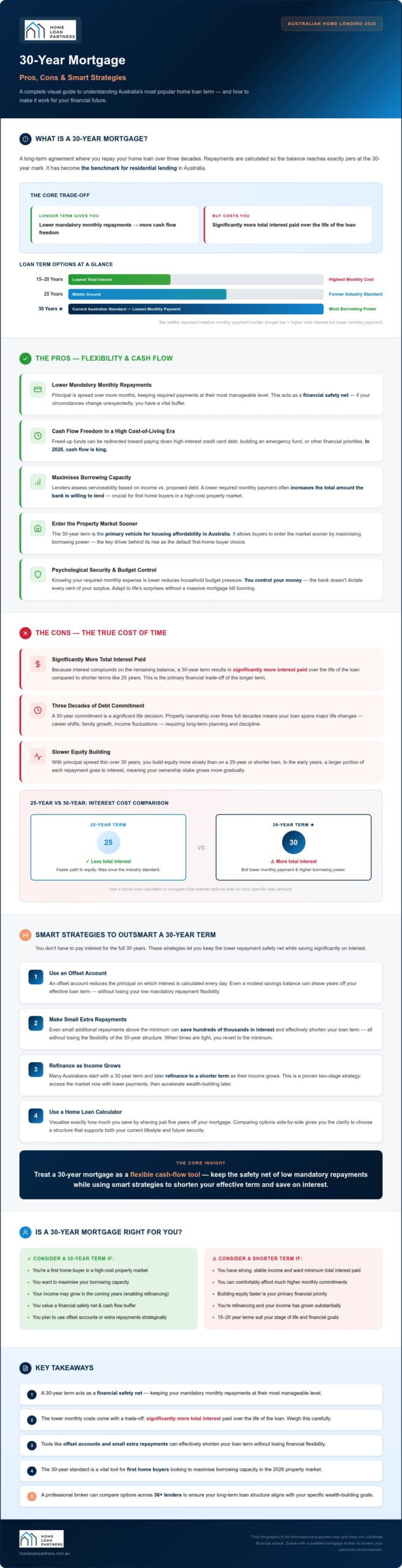
A 30-year mortgage is a long-term agreement where you repay your home loan over three decades. In the Australian market, this has become the benchmark for residential lending. When you take out a mortgage loan, your lender calculates repayments so your balance reaches zero exactly at the end of the 30-year mark. Understanding the pros and cons of a 30 year mortgage starts with recognising how this extended timeline affects your daily cash flow and your long-term wealth.
The relationship between your loan term and interest is a balancing act. A longer term spreads the principal repayment over more months, which naturally lowers the amount you’re required to pay each time. However, because interest compounds on the remaining balance, a 30-year term results in significantly more interest paid over the life of the loan compared to a traditional 25-year mortgage. When weighing the pros and cons of a 30 year mortgage, it’s vital to see it as a tool for flexibility rather than just a debt.
The Evolution of the 30-Year Loan Term
In previous decades, 20 and 25-year terms were the standard for Australian families. As property prices across the country have climbed, stretching the term to 30 years has become a practical necessity to keep repayments manageable. By 2026, this term has solidified its place as the default choice for first-home buyers facing a high-cost environment. The 30-year term serves as the primary vehicle for housing affordability in Australia. It allows you to enter the market sooner by maximising your borrowing power, providing a steady path toward homeownership that fits within a modern budget.
Standard vs. Non-Standard Mortgage Lengths
While 30 years is the most common path, it isn’t your only option. Depending on your financial goals, you might consider different “loan life cycles” that better suit your stage of life. Lenders often offer various lengths, including:
- 15 or 20-year terms: These slash total interest costs but require much higher monthly commitments.
- 25-year terms: A middle ground that was once the industry standard, offering a faster path to equity than a 30-year loan.
- Refinancing: Many Australians start with 30 years and later refinance to a shorter term as their income grows.
Using a home loan calculator is the most effective way to compare these options side-by-side. It helps you visualise exactly how much you can save by shaving just five years off your mortgage. This clarity allows you to choose a structure with confidence, knowing it supports both your current lifestyle and your future security.
The Pros of a 30-Year Mortgage: Flexibility and Cash Flow
Selecting a long-term loan is often a strategic decision about balance. While a shorter term looks efficient on paper, the lower monthly commitment of a 30-year structure offers a massive advantage in real-world scenarios. It acts as a financial buffer. If your circumstances change unexpectedly, having a lower mandatory payment provides a vital safety net. This is a central theme when exploring the pros and cons of a 30 year mortgage. It’s less about the total interest and more about your ability to maintain your lifestyle while meeting your obligations.
Following Australian government home loan guidance can help you understand how these terms impact your overall financial health. By spreading the principal over a longer period, you ensure that your mortgage doesn’t consume your entire paycheck. This breathing room is essential for long-term stability.
Maximising Your Monthly Cash Flow
In a high cost-of-living environment like 2026, cash flow is king. A 30-year term frees up funds that you can redirect toward other priorities. This might mean paying down high-interest credit card debt or building an emergency fund. It’s a psychological win, too. Knowing your required monthly expense is lower reduces the pressure on your household budget. You’re in control of your money, rather than the bank dictating every cent of your surplus. This flexibility allows you to adapt to life’s surprises without the stress of a massive mortgage bill looming over you.
Boosting Your Borrowing Capacity
Lenders calculate your serviceability by looking at your income against your proposed debt. Because a 30-year term spreads the principal thin, your required monthly payment is lower. This mathematical shift often increases the total amount a bank is willing to lend you. For many, this increased capacity is the only viable path when buying a house in Australia in 2026. It allows you to target properties that meet your family’s needs rather than settling for something less suitable in a distant suburb.
This structure is particularly beneficial for professionals who expect their income to rise. You secure the property today with the safety of a lower commitment, retaining the option to pay more as your salary increases. Our experts at The Home Loan Partners can help you review your borrowing power across our panel of 36+ lenders to ensure you aren’t missing out on a better deal that fits your unique goals.
The Cons of a 30-Year Mortgage: The True Cost of Time
While the cash-flow benefits are clear, we must look at the long-term trade-offs. The most significant drawback is the sheer volume of interest that accumulates over three decades. When you extend a loan from 20 to 30 years, you aren’t just adding time; you’re significantly increasing the total cost of your home. This is the heavy lifting of the pros and cons of a 30 year mortgage. You pay for your monthly breathing room with a much larger total debt over the life of the loan.
There’s also the very real risk of “mortgage fatigue.” Staying committed to a debt for 30 years requires immense discipline. For many Australians, this timeline can push debt into their retirement years, potentially impacting their quality of life when they should be debt-free. It’s a long journey, and the initial excitement of homeownership can fade as the decades roll on. It’s vital to consider if you’re comfortable carrying this commitment through several different life stages.
The Compounding Interest Trap
Compounding interest works against you when the loan term is longer. On a A$600,000 loan, the difference in interest between a 20-year and a 30-year term can be hundreds of thousands of dollars. During the first 10 years of a 30-year loan, your repayments are predominantly covering interest rather than reducing the principal balance. This means you’re barely making a dent in what you actually owe during that first decade. Because the loan lasts longer, you’re also exposed to more interest rate cycles. Fluctuations in the 2026 market can have a more dramatic impact on your total cost when those rates are applied over a 30-year window.
Equity and Long-Term Financial Freedom
Equity is the portion of the home you truly own. With a 30-year mortgage, you build this equity much slower than with a shorter term. This slow progress can limit your future financial moves. If you wanted to use your home’s equity to purchase an investment property or fund a major renovation in five years, you might find you haven’t cleared enough of the principal to make it happen. You’re essentially locked into a slower wealth-building trajectory because more of your money is going to the bank’s profit rather than your own asset.
To avoid getting stuck in a stagnant loan, it’s vital to have your mortgage reviewed regularly. Working with a finance broker ensures you aren’t just setting and forgetting a 30-year debt. We help you look for opportunities to refine your structure as your income grows, ensuring your loan continues to serve your long-term goals rather than just being a monthly bill you pay for 30 years.
Strategic Alternatives: How to Outsmart a 30-Year Term
You don’t have to be tied to a 30-year timeline just because it’s written on your loan contract. Think of this term as a maximum limit rather than a target. By using smart financial tools, you can enjoy the safety of lower mandatory payments while clearing your debt much faster. Balancing the pros and cons of a 30 year mortgage becomes much easier when you realise you have the power to change the rules of the game.
Small, consistent actions often lead to the biggest results. Whether it’s changing your payment frequency or setting up a dedicated savings structure, these strategies allow you to take control. You’re not just a passenger on a 30-year journey; you’re the driver who decides how quickly you reach the finish line.
Offset Accounts vs. Redraw Facilities
An offset account is a standard transaction account linked directly to your home loan. Every dollar you keep in there reduces the balance the bank charges interest on. It effectively turns your 30-year loan into a shorter one without you ever losing access to your cash. Redraw facilities are similar but involve paying extra money directly into your loan account. For those looking at future investment opportunities, offset accounts are often preferred because they can offer better tax flexibility. If your current lender doesn’t provide these features, refinancing a home loan might be your best move to unlock them and start saving.
The “Pay It Like a 20-Year” Strategy
One of the most effective ways to manage the pros and cons of a 30 year mortgage is to set your own internal goals. You can calculate the repayment required for a 20-year term and pay that amount voluntarily. This builds discipline and can shave a decade off your debt. The beauty of this approach is the safety net. If your circumstances change, you can instantly drop back to the 30-year minimum payment without any penalty. It gives you the efficiency of a short-term loan with the security of a long-term one.
Switching to fortnightly payments is another effortless win. By paying half your monthly amount every two weeks, you end up making 26 half-payments. This equals 13 full monthly payments a year instead of 12. This simple adjustment can save you tens of thousands in interest and years off your loan term without you even noticing the difference in your budget.
Ready to see how much you could save with a tailored strategy? Talk to our team at The Home Loan Partners to compare 36+ lenders and find a structure that works for your future.
Is a 30-Year Mortgage Right for Your 2026 Property Journey?
Deciding on a loan term is a personal milestone that shapes your financial landscape for decades. In the 2026 market, where property values and living costs require careful management, your choice determines how much freedom you have in your monthly budget. We’ve explored the pros and cons of a 30 year mortgage to show that while it’s the most common path, it’s a tool that must be used with a clear strategy. Your final decision should depend on where you stand today and where you want to be in ten years.
Success in homeownership isn’t just about signing a contract. It’s about ensuring your debt remains a manageable part of a larger, fulfilling life. Whether you’re stepping into your first home or moving to a larger family residence, the structure of your loan is the foundation of your security.
Tailoring the Term to Your Goals
For first-home buyers entering the market with a high Loan-to-Value Ratio (LVR), a 30-year term is often a practical necessity. It provides the serviceability required to secure a property in competitive Australian suburbs. If you’re an established owner with significant equity, you might choose to push for a 20 or 25-year term. This shorter window accelerates your equity build-up and saves a fortune in interest. Investors often view the pros and cons of a 30 year mortgage differently. They might prefer the longer term to keep mandatory repayments low, which can assist with tax strategies and cash flow for future acquisitions. Your life stage is the most important factor in this calculation.
The Value of Expert Guidance
The lowest interest rate isn’t always the most effective strategy. A slightly higher rate on a loan that offers a flexible offset account can often save you more money over time than a basic, restrictive product. At The Home Loan Partners, we act as your expert collaborator. We compare options across our panel of 36+ lenders to find a structure that prioritises your long-term goals. Our team looks for flexible policies that allow you to make extra repayments or refinance easily as your income grows. We believe in partnership, which means we provide ongoing loan maintenance and annual reviews to ensure your mortgage continues to serve you as the market evolves.
Before you commit, consider this final checklist for your mortgage term:
- Serviceability: Can you comfortably meet repayments if interest rates rise by 1% or 2%?
- Future Plans: Do you intend to turn this property into an investment later?
- Discipline: Are you committed to making voluntary extra repayments when possible?
- Features: Does the loan include the offset or redraw facilities you need to shorten the term?
Your property journey is unique, and your mortgage should reflect that. Booking a consultation with a specialist is the first step toward mapping out a 30-year strategy with precision and confidence.
Secure Your Future with a Tailored Mortgage Strategy
Choosing the right loan term is about more than just numbers; it’s about building a foundation for the life you want to lead. We’ve weighed the pros and cons of a 30 year mortgage to show that while the lower repayments offer essential breathing room, the long-term interest costs require a proactive approach. By treating your mortgage as a flexible tool rather than a static debt, you can use features like offset accounts to reclaim your financial freedom sooner.
Whether you’re a first home buyer looking to enter the market or an investor refining your portfolio, the right guidance makes all the difference. Our team provides access to over 36 Australian lenders and offers steady expertise to help you navigate the 2026 property landscape with precision. We’re here to ensure your loan structure aligns perfectly with your personal milestones and long-term security. We take the heavy lifting out of the process, so you can focus on the excitement of your new home.
Book a consultation with The Home Loan Partners to find your ideal mortgage structure today. Let’s work together to turn your property aspirations into a secure, stress-free reality.
Frequently Asked Questions
Can I change my 30-year mortgage to a 20-year term later?
You can absolutely shorten your loan term later by refinancing into a new product with a 20-year limit. Alternatively, many borrowers choose to stay on their 30-year contract but increase their repayments to match a 20-year schedule. This provides the best of both worlds: the efficiency of a shorter loan and the safety of a lower mandatory payment if your income changes. Our team can help you review your structure annually to ensure it still fits.
How much interest do I save by paying off a 30-year mortgage in 25 years?
Shaving five years off a 30-year mortgage can save you tens of thousands of dollars in interest. On a typical Australian loan balance of A$600,000 at a 6% interest rate, paying it off in 25 years instead of 30 could save roughly A$140,000. These figures vary based on your specific rate and balance. It’s an effective way to balance the pros and cons of a 30 year mortgage by enjoying lower initial payments while targeting the principal.
Is a 30-year mortgage better for investment properties?
Investors often prefer a 30-year term because it maximises monthly cash flow by keeping mandatory repayments at their lowest. This strategy can improve your serviceability when you apply for your next investment property loan. Since interest on investment loans is often tax-deductible in Australia, some investors choose to keep the debt for longer while redirecting surplus cash into their non-deductible home loan or other wealth-building assets. This approach provides a steady, logical path for portfolio growth.
What happens if I make one extra mortgage payment a year?
Making just one extra full monthly payment each year can reduce your loan term by approximately four years. This occurs because the extra funds go directly toward the principal balance, which reduces the amount of interest that compounds in every following month. It’s a simple, low-pressure way to outsmart a long-term debt. Setting up a small, automated weekly or fortnightly overpayment is often easier than finding a lump sum at the end of the year.
Do 30-year mortgages have higher interest rates than 15-year loans in Australia?
In the Australian market, lenders typically don’t offer lower interest rates for shorter terms like they do in the United States. Whether you choose a 20 or 30-year term, your interest rate is usually determined by your deposit size, the loan purpose, and the specific product features. This means the primary difference in cost isn’t the rate itself, but how long the interest is allowed to compound on your remaining balance before the debt is cleared.
Is it better to have a 30-year loan with an offset account or a 20-year loan?
A 30-year loan with an offset account often provides superior flexibility for most Australian households. It allows you to effectively pay interest as if you had a much shorter loan while keeping your mandatory repayment low. If you have an emergency, you can access the cash in your offset account immediately. A 20-year loan locks you into higher monthly payments, which can be stressful if your financial situation changes unexpectedly during your property journey.
Does a 30-year mortgage require a larger deposit?
A 30-year mortgage doesn’t require a larger deposit than a shorter term. In fact, because the 30-year term results in lower monthly repayments, it’s often the preferred choice for borrowers with a smaller deposit who need to prove their ability to service the debt. When assessing the pros and cons of a 30 year mortgage, remember that your deposit size is more closely linked to your Loan-to-Value Ratio and whether you need to pay Lenders Mortgage Insurance.