

Did you know that even with a high-six-figure salary in USD or Euro, an Australian bank might “disappear” A$50,000 or more of your annual earnings the moment you apply for a home loan? It feels incredibly frustrating when your hard-earned global success is met with a 20% “haircut” simply because your pay slip doesn’t arrive in Australian Dollars. Understanding exactly how lenders assess foreign currency income is the first step to reclaiming your borrowing power and moving forward with your property goals.
We’re here to help you master the complexities of how Australian banks calculate your foreign earnings in 2026, so you can secure your Australian home or investment with total confidence. You’ve worked hard to build a life abroad, and we believe the mortgage process should support those milestones rather than complicate them. In this guide, we’ll break down the current shading rates for different currency tiers, show you how to find lenders that offer more generous assessment rates, and provide a practical checklist of the documents you’ll need to bridge the gap between your global career and a local mortgage.
Key Takeaways
- Learn why banks apply a “haircut” to global earnings and how to calculate your net income after these mandatory adjustments.
- Navigate the currency tier system to see how major currencies like USD and GBP receive more favourable treatment than secondary markets.
- Master how lenders assess foreign currency income to avoid the “double discount” trap where banks apply Australian tax rates to your overseas salary.
- Secure the correct documentation, including NAATI translations and employer letters, to ensure your application meets strict 2026 compliance standards.
- Partner with a specialist who accesses a panel of 36+ lenders to find the specific credit policy that maximizes your borrowing power.
Why Australian Lenders Apply a “Haircut” to Foreign Currency Income
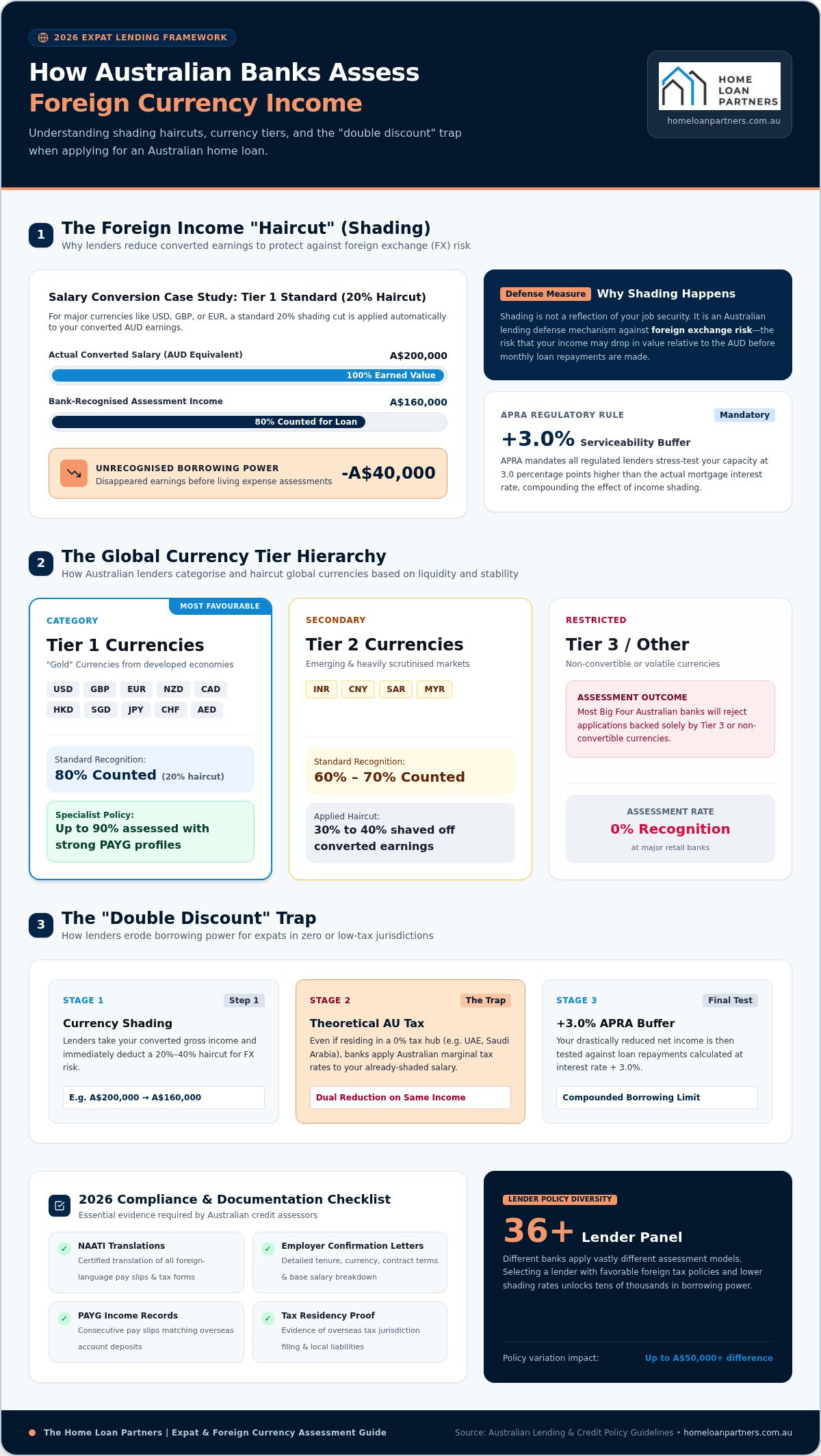
When you earn in a foreign currency, Australian banks don’t see the full value of your pay slip. They apply what’s known as a “haircut” or “shading.” Shading is the practice of only counting a portion of income to protect against currency fluctuations. This isn’t a reflection of your job security or professional standing. Instead, it’s a defensive measure against foreign exchange risk, which describes the potential for your income to drop in value relative to the Australian Dollar (AUD) before you make your monthly mortgage repayment.
Banks also look closely at your tax liabilities. Even if you reside in a low-tax or zero-tax jurisdiction like the UAE or Saudi Arabia, many major Australian lenders will calculate your borrowing power using Australian marginal tax rates. This practice, often called the “double discount,” happens when your income is shaved by 20% for currency risk and then reduced again by a theoretical tax rate. For major Tier 1 currencies like USD, GBP, or EUR, a 20% shave remains the 2026 industry standard. This means if your converted salary is A$200,000, the bank might only acknowledge A$160,000 before they even start looking at your daily expenses.
The Concept of Serviceability Buffers
The Australian Prudential Regulation Authority (APRA) mandates a 3.0% serviceability buffer for all regulated lenders. This means banks must test your ability to pay at an interest rate 3.0 percentage points higher than your actual product rate. When you combine this with a 20% income reduction, your maximum borrowing capacity shrinks significantly. It’s a double-layered safety net. While it protects the lender, it often surprises high-earning expats who expect their full global salary to be recognized. We work to find lenders whose internal calculators are more sympathetic to your specific tax residency, helping to mitigate this compounding effect.
Risk Mitigation and Global Market Stability
Banks prioritize stability and liquidity. Currencies from developed economies are preferred because they are less likely to experience sudden, massive devaluations. Geopolitical events, such as trade disputes or shifts in central bank policy, can trigger lenders to move a currency from a 10% shave to a 40% shave with very little notice. Understanding how lenders assess foreign currency income helps you prepare for these shifts. Lenders essentially use these haircuts to ensure that even if the global market experiences a downturn, your ability to service a loan in Australian Dollars remains secure. Our role is to act as your translator, ensuring the bank understands the stability of your specific employment and currency profile.
The Tier System: How Banks Categorise Different Global Currencies
Lenders don’t view all global money as equal. They use a structured tier system to manage the risks associated with global economic shifts and liquidity. This classification is heavily influenced by responsible lending conduct guidelines, which dictate that banks must verify income with a high degree of certainty before approving credit. A core part of how lenders assess foreign currency income involves grouping global economies into tiers based on their historical stability and the ease with which the currency can be converted back into Australian Dollars.
Tier 1 Currencies and Favourable Assessment
Tier 1 currencies, often called “Gold” currencies, include the USD, GBP, EUR, NZD, CAD, HKD, SGD, JPY, CHF, and AED. These are preferred because they are highly liquid and come from stable, developed economies. Most major Australian banks will recognize 80% of this income, though some specialist lenders on our panel may even assess up to 90% of Tier 1 earnings for applicants with strong PAYG profiles. This tiered approach is a fundamental component of how lenders assess foreign currency income to ensure long-term stability for both the bank and the borrower.
Navigating Tier 2 and Emerging Currencies
Tier 2 currencies, such as the INR, CNY, SAR, or MYR, face much stricter scrutiny. These are often shaded by 30% or 40%, meaning only 60% to 70% of your converted salary counts toward your loan servicing. While currencies like SGD and HKD are Tier 1, they can still present challenges if your employer is based in a complex tax jurisdiction. If you earn in a Tier 3 or non-convertible currency, most Big Four banks will reject the application entirely. In these cases, we look toward non-bank specialist lenders who have a higher appetite for emerging market risks. If you’re unsure where your specific income falls, our team can help you match your currency to the right lender policy.
| Currency Tier | Typical Shading (Haircut) | Common Examples |
|---|---|---|
| Tier 1 (Major) | 10% to 20% | USD, GBP, EUR, SGD, NZD, CAD, HKD, AED |
| Tier 2 (Secondary) | 30% to 40% | INR, CNY, SAR, MYR, IDR, VND |
| Tier 3 (Excluded) | 100% (Rejected) | Non-convertible or hyperinflationary currencies |
Assessment Criteria for Foreign Salary, Bonuses, and Allowances
Banks don’t just look at the bottom line of your pay slip. They dissect every component of your earnings to determine what’s sustainable over a 30-year loan term. A critical part of how lenders assess foreign currency income is the distinction between your guaranteed base salary and variable components. While your base pay is the anchor of your application, lenders view bonuses, commissions, and allowances through a much more conservative lens. In most cases, banks use your net (after-tax) income as the starting point for their calculations, which can lead to unexpected results for those in low-tax jurisdictions.
Base Salary vs. Variable Income
Lenders prioritize stability. Your base salary is typically accepted at the standard shading rate for your currency tier, but variable income is often shaded more aggressively. Many banks will only recognize 50% to 80% of your bonus or commission, even before the foreign currency haircut is applied. To include these figures at all, you’ll generally need a two-year verifiable track record of receiving them. If you’re earning a significant portion of your income through performance-based pay, we recommend using our home loan calculator to model how these different shading levels might impact your borrowing capacity.
The “Tax-Free” Income Trap
When evaluating how lenders assess foreign currency income, many expats are surprised by the treatment of “tax-free” salaries. If you’re working in a region like the UAE or for an international organization, you might pay zero income tax locally. However, most Australian lenders will “back-solve” your income by applying Australian marginal tax rates to your gross earnings. This is a risk mitigation strategy; the bank assumes that if you were to return to Australia, your take-home pay would drop significantly.
This practice often leads to a “double discount” where your income is reduced by a 20% currency shave and then further reduced by a theoretical 45% tax bracket. While this can be disheartening, certain specialist lenders on our panel are more sympathetic to your actual tax residency. They may use the source country’s actual tax rate or a flat assessment rate, provided you meet the requirements for declaring foreign and worldwide income. We also see high scrutiny on housing allowances and cost-of-living adjustments (COLA). Since these are tied to your overseas residency, lenders frequently exclude them from long-term servicing because they wouldn’t continue if you moved back to Australia.
Essential Documentation: Preparing Your Foreign Income for Assessment
Securing a mortgage while earning abroad requires more than just showing a high salary. It’s about providing the specific evidence banks need to tick their compliance boxes. Understanding how lenders assess foreign currency income is largely a matter of meticulous document preparation. If your documents aren’t in English, you’ll need them translated by a professional accredited by the National Accreditation Authority for Translators and Interpreters (NAATI). Banks won’t accept informal translations, as they require certified accuracy to meet their 2026 audit standards.
A professional finance broker acts as your first line of defense. We review these documents before they ever reach a bank’s desk. This pre-submission audit ensures that your income is presented in the most favorable light and that all currency conversions are accurate. We act as the translator between your global career and the bank’s rigid criteria, saving you from the stress of back-and-forth queries.
The Standard Expat Document Checklist
You’ll need to gather several key pieces of evidence to satisfy credit assessors. Most lenders require a comprehensive view of your financial history. Having these ready will speed up your application significantly:
- Last three months of foreign bank statements showing recurring salary credits.
- Letter of employment detailing your base salary, position, tenure, and currency.
- Foreign tax returns or equivalent official documents, such as a P60 in the UK or a W2 in the US.
Proving Your “Right to Work” and Residency
Your residency status significantly influences the risk profile of your application. Australian citizens living abroad generally find the process smoother, but you still need to prove your tax residency status. If you’re a non-citizen earning foreign income, lenders will closely examine your visa status to ensure you have a stable right to work in your current jurisdiction. Lenders require a clear paper trail from the employer to the bank account to avoid anti-money laundering flags. This transparency is non-negotiable. We help you map out this trail to ensure your funds are verified without delay.
Organizing these files can feel like a full-time job, but it’s the bridge to your new property. We manage the heavy lifting by coordinating with your employer and translators to ensure every box is ticked. If you’re ready to start your application, reach out to us for a personalized document review.
Navigating Complex Applications with The Home Loan Partners
Managing a global career is already a full-time commitment. When you add the layer of Australian mortgage compliance, the process can quickly become overwhelming. At The Home Loan Partners, we specialize in simplifying this journey. Because we maintain relationships with a panel of over 36 lenders, we can identify exactly which institution offers the most favorable credit policy for your specific situation. While one bank might insist on a 20% haircut, another may only apply a 10% shave for certain Tier 1 currencies. Our expertise lies in knowing exactly where those opportunities exist.
We don’t just find you a loan; we act as your translator and guide. By understanding the nuances of how lenders assess foreign currency income, we position your application to maximize your borrowing power. We take over the heavy lifting of document verification and lender negotiations, ensuring your global earnings are recognized at their true value. Our goal is to provide a steady, reassuring hand that navigates the complexities of international finance on your behalf.
Customised Loan Structures for Global Earners
A standard mortgage often fails to meet the needs of an expat. We focus on tailoring a structure that works with your global financial footprint. For many of our clients, this involves integrating offset accounts to manage high foreign savings effectively. These accounts allow you to reduce the interest paid on your Australian loan while keeping your funds liquid for future moves. If you’re looking to upgrade your portfolio or transition between properties, we can also explore bridging finance options to ensure a smooth changeover. Our supportive approach is designed to alleviate the stress of lending, especially if you plan to buy a house in Australia while still residing overseas.
Your Next Steps to Property Ownership
The most successful applications begin with a thorough pre-assessment. Before you start house hunting, it’s vital to know exactly how a bank will view your specific currency and tax residency. We provide a clear, stress-free path forward by reviewing your income and providing a tailored mortgage quote that reflects current 2026 lending appetites. This proactive step gives you the confidence to bid on property, knowing your finance is built on a solid foundation. If you’re ready to secure your future, book a consultation with The Home Loan Partners to review your foreign income strategy today. We’re here for the long-term journey, supporting you from your first overseas purchase through to your eventual return home.
Securing Your Australian Property Goals From Abroad
Navigating the Australian property market while earning overseas doesn’t have to be a source of stress. While the nuances of how lenders assess foreign currency income can seem rigid, they’re ultimately manageable with the right strategy. You now understand that while “haircuts” and currency tiers are standard, the specific policy applied to your pay slip depends heavily on which lender you choose and how clearly you present your global documentation.
At The Home Loan Partners, we act as your dedicated collaborator throughout this entire journey. With access to a panel of over 36 lenders, we match your unique income profile with the bank most likely to recognize its true value. We manage the heavy lifting of complex documentation and lender negotiations so you can focus on finding the perfect home. Our team provides the steady, supportive guidance you need to bridge the gap between your international career and your Australian property aspirations.
Simplify your foreign income home loan application with The Home Loan Partners today. It’s time to move forward with the confidence that your global success is working for you, not against you. We’re ready to help you reach this major life milestone.
Frequently Asked Questions
Do all Australian banks accept foreign income for home loans?
No, not all Australian banks accept foreign income. While select major lenders have established policies for expats, others exclude overseas residents entirely. A core part of how lenders assess foreign currency income involves identifying which credit teams are currently active in the expat space. This divergence is why we maintain a panel of over 36 lenders, ensuring you don’t waste time with banks that have restrictive residency requirements or unfavourable internal calculators.
What is the typical “shave” or “haircut” rate for USD or GBP income?
For Tier 1 currencies like USD or GBP, the industry standard “haircut” is 20%. This means lenders generally recognise 80% of your converted earnings to buffer against market volatility. However, certain specialist lenders on our panel may offer more generous terms, sometimes recognising up to 90% of your salary. Understanding how lenders assess foreign currency income across different tiers helps us match your specific pay structure to the most competitive policy available.
Can I get a home loan if I am a self-employed expat?
Yes, you can secure a loan as a self-employed expat, though the requirements are more rigorous. Most lenders cap the loan-to-value ratio (LVR) between 60% and 80% for self-employed applicants earning abroad. You’ll typically need at least two years of verifiable tax returns and financial statements from your current jurisdiction. We specialise in these complex structures, helping you present a clear, professional paper trail that satisfies strict credit delegation requirements.
How do lenders treat income from tax-free countries like the UAE?
Most Australian lenders will “back-solve” your income by applying Australian marginal tax rates, even if you pay 0% tax in the UAE. This can significantly reduce your borrowing capacity. However, a few specialist lenders use the source country’s actual tax rate, which dramatically improves your serviceability. We act as your guide to find these “expat-friendly” desks that avoid the double-discounting trap, ensuring your tax-free status actually works in your favour.
Will a lender consider my rental income from an overseas property?
Generally, Australian lenders don’t count rental income from overseas properties toward your loan servicing. They view foreign tenancies as higher risk due to different legal frameworks and currency fluctuations. Instead, they focus on your global employment income and any projected rental returns from the Australian property you’re purchasing. Most banks will include 70% to 80% of that projected Australian rent to help you meet their serviceability stress tests.
Do I need to be an Australian citizen to use foreign income for a mortgage?
You don’t need to be a citizen, but your residency status changes the lender’s appetite and your maximum loan-to-value ratio (LVR). Australian citizens living abroad can often access up to 90% LVR. Permanent residents are typically capped at 80%, while foreign nationals earning in a foreign currency are usually restricted to 60% or 70% LVR. We help you navigate these caps by identifying lenders whose policies are most inclusive for your specific visa or citizenship status.
What happens if the exchange rate drops significantly during my application?
Lenders typically use the exchange rate at the time of their formal assessment to convert your income into Australian Dollars. If the AUD strengthens significantly against your earning currency during the application, your recognised income could decrease. This is exactly why banks apply a 20% shading buffer; it’s designed to protect the loan’s serviceability from these fluctuations. We monitor these trends closely to ensure your application remains robust throughout the approval process.
Can I use a foreign income home loan to buy an investment property?
Absolutely, using foreign income to secure an investment property is a common strategy for Australians living abroad. Lenders will assess your global earnings alongside the projected rental income from the Australian investment. This structure can be particularly effective when combined with an offset account to manage your foreign savings. We specialise in tailored investment property loans that help you build your domestic portfolio while you continue your career on the global stage.