

What if the very fee you’ve been taught to avoid is actually your fastest ticket into the Australian property market? For most Australians, understanding lenders mortgage insurance (lmi) feels like a frustrating hurdle, a financial penalty for not having a massive 20% deposit ready to go. It’s completely natural to feel a sense of hesitation when you’re asked to pay for an insurance policy that protects the bank rather than your own interests. You might even worry that this extra cost will significantly drain your borrowing power or delay your dreams of homeownership.
We’re here to help you move past that stress with a clear, strategic approach. This guide will help you master the complexities of LMI so you can decide if it’s a hurdle to clear or a tool to leverage. We’ll clarify the difference between LMI and mortgage protection insurance, break down the 2026 LVR thresholds, and explore how the expanded First Home Guarantee could help you bypass these costs entirely. By the end, you’ll have a steady plan to enter the market years sooner than you thought possible. Our goal is to provide the expert expertise you need to make an informed, confident decision for your future.
Key Takeaways
- Learn why the 80% Loan-to-Value Ratio is the critical benchmark in Australian lending and how it triggers the requirement for additional insurance.
- Shift your perspective by understanding lenders mortgage insurance (lmi) as a strategic “speed to market” tool that can help you secure a property years sooner.
- Discover how to compare the one-off cost of an LMI premium against the potential risks of property price inflation and rising rental costs.
- Explore modern pathways to bypass LMI entirely, including the latest 2026 government guarantee schemes and professional waiver opportunities.
- Understand how a mortgage broker navigates a panel of 36+ lenders to find the most competitive premium structures tailored to your financial goals.
What is Lenders Mortgage Insurance (LMI) in Australia?
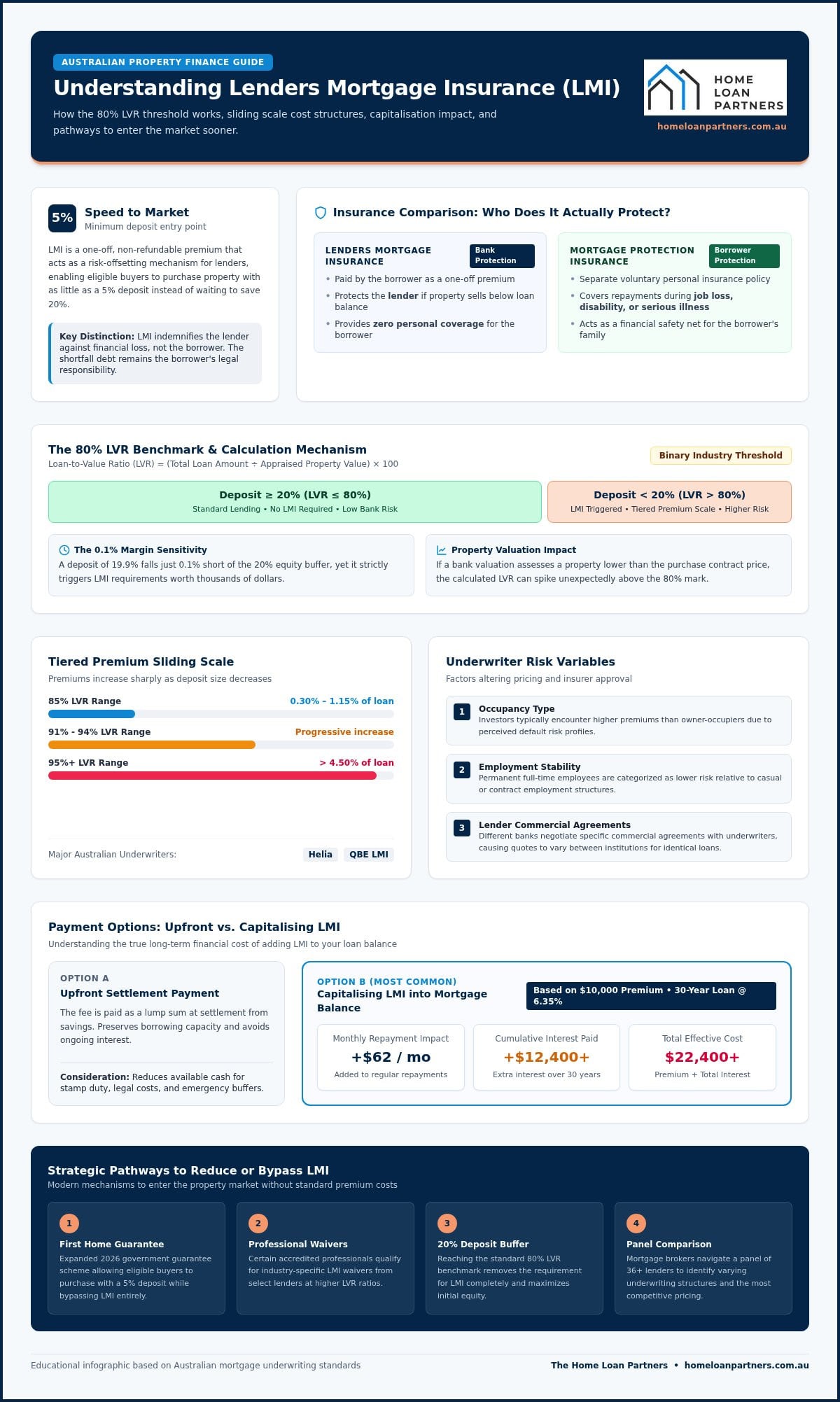
LMI is a risk-offsetting tool for lenders that allows borrowers to enter the market with as little as a 5% deposit. When you’re understanding lenders mortgage insurance (lmi), it’s vital to view it as a one-off, non-refundable premium that you pay at the start of your loan. While you’re the one paying the bill, the policy doesn’t actually offer you any personal protection. Instead, lenders mortgage insurance serves to indemnify the bank against financial loss. If you can’t meet your repayments and the property sells for less than the remaining loan balance, the insurer pays the bank the difference. However, you remain legally responsible for that shortfall debt. The insurer can still pursue you to recover the funds they paid out to the lender.
In the Australian banking sector, the 80% Loan-to-Value Ratio (LVR) is the magic number. If you provide a 20% deposit, the lender views the loan as lower risk because there’s a significant equity buffer. Anything less than that 20% equity stake usually triggers the requirement for LMI. It’s a standard practice across the industry, designed to keep the lending market stable while helping people buy homes sooner.
LMI vs. Mortgage Protection Insurance: Don’t Get Confused
Many buyers mistakenly believe LMI is there to help them during tough times. It isn’t. Mortgage Protection Insurance is a completely different product designed specifically to cover your repayments if you lose your job, become disabled, or suffer a serious illness. LMI provides zero coverage for your personal financial safety net. It’s strictly a bank-focused security measure. We always suggest discussing a personal insurance strategy alongside your home loan. This ensures your family is protected while LMI handles the bank’s risk requirements.
The Role of LVR in Triggering LMI
Lenders calculate your LVR by dividing the total loan amount by the property’s appraised value. Precision is everything in this calculation. A deposit of 19.9% might feel nearly identical to 20%, but that tiny 0.1% gap can trigger a premium worth thousands of dollars. It’s a strict binary threshold in most cases. Property valuations also play a huge role in understanding lenders mortgage insurance (lmi). If a bank valuer assesses the home at a lower price than your purchase contract, your LVR could suddenly spike above the 80% limit. This is why we work closely with you to manage the fine margins of your application and ensure there are no surprises at settlement.
How is LMI Calculated and Paid?
LMI isn’t a flat fee. It operates on a sliding scale where the cost is determined by two main factors: your total loan amount and your final LVR percentage. Lenders view a 95% LVR as significantly riskier than a 91% LVR. Because of this, the premium percentage increases sharply as your deposit shrinks. LMI premiums are tiered, meaning the riskier the loan (higher LVR), the higher the percentage charged. For instance, while a premium for an 85% LVR might range between 0.30% and 1.15% of the loan, that figure can jump to over 4.5% once you cross the 95% threshold.
Most Australian banks use specialized third-party providers like Helia or QBE LMI to underwrite these policies. Different banks have different commercial arrangements with these providers, which leads to lender-specific pricing. You might receive two vastly different quotes for the exact same loan amount simply because one bank has a more competitive agreement with their insurer. Understanding lenders mortgage insurance (lmi) involves recognizing that the insurer, not just the bank, must approve your application if the LVR is high.
Upfront Payment vs. Capitalising LMI
Most buyers choose to “capitalise” the premium. This means the bank adds the LMI cost to your total loan balance rather than asking for the cash upfront. Following Moneysmart guidance on home deposits can help you decide if this is the right move for your budget. Capitalising LMI is a helpful way to preserve your savings for other costs like stamp duty. However, you’ll pay interest on that premium for the life of the loan. Adding a $10,000 premium to a 30-year mortgage at a 6.35% interest rate can add roughly $62 to your monthly repayments and incur over $12,400 in extra interest over time.
Factors That Influence Your LMI Premium
Risk perception also shifts based on your specific situation. Investors often face higher premiums than owner-occupiers because lenders view investment loans as having a slightly higher default risk. Your employment status plays a role too. Full-time employees generally represent lower risk to insurers compared to those in casual or contract roles. Understanding lenders mortgage insurance (lmi) also means looking at the loan purpose. Refinancing an existing loan with a high LVR can sometimes trigger different premium rates compared to a new purchase. If you’re unsure how your situation impacts your costs, talking to a mortgage broker can help you compare these variables across 36+ lenders to find the most cost-effective path forward.
The Strategic Choice: Paying LMI vs. The Cost of Waiting
Choosing between paying a premium or waiting to save a full 20% deposit is one of the most significant decisions you’ll make. Understanding lenders mortgage insurance (lmi) as a “speed to market” tool rather than a penalty changes your entire perspective. While LMI represents an additional expense, the “cost of waiting” often proves far higher in a rising market. If median property prices grow by 5% annually, an $800,000 property increases by $40,000 in just one year. This growth often outstrips a typical one-time LMI premium of $10,000 to $15,000, effectively moving the goalposts further away every month you continue to save.
You should also consider the “Rent vs. LMI” trade-off. Every dollar spent on rent is capital you aren’t building in your own home. A one-off LMI premium, even when capitalised into your loan, can be significantly cheaper than two or three years of rental payments. By entering the market sooner, you start building equity through both your repayments and natural market appreciation. We recommend using a home loan calculator to model these different scenarios and see how your long-term wealth is impacted.
Scenario A: Waiting to Save 20%
Waiting to reach the 20% threshold makes sense in specific circumstances, such as when you’re anticipating a cooling market or if your income is expected to rise sharply soon. However, the biggest risk is being priced out of your preferred suburb. Saving an additional $80,000 to $120,000 requires immense financial discipline and time. During those years, you miss out on the potential for capital gains. If property prices climb faster than you can save, you might find yourself settling for a smaller home or a less desirable location despite having a larger deposit.
Scenario B: Buying Now with LMI
Buying now allows you to secure your place in market and enjoy immediate lifestyle benefits. You stop dealing with property inspections and restrictive rental agreements. Beyond the psychological peace of mind, owning the property sooner gives you the chance to manufacture equity. You can start renovations or improvements that increase the home’s value, which isn’t possible as a tenant. While you might pay a premium, programs like Housing Australia’s First Home Guarantee offer a way for eligible buyers to bypass LMI with as little as a 5% deposit. This pathway provides a steady hand for those ready to commit to their future without the delay of a decades-long savings plan.
How to Reduce or Avoid Paying LMI Entirely
While paying a premium can be a strategic move to enter the market sooner, avoiding this cost altogether remains a primary goal for many savvy buyers. There are several professional and government-backed pathways that allow you to bypass these fees without having to save a full 20% deposit. One of the most effective methods is a Family Guarantee. This involves a family member, usually a parent, using the equity in their own home to provide additional security for your loan. By bridging the gap to a 20% equity position, you can eliminate the need for LMI while still keeping your cash savings for other purchase costs.
If a guarantee isn’t an option, strategic LVR management is your next best tool. Understanding lenders mortgage insurance (lmi) involves recognizing that the premium isn’t a flat rate. A deposit of 15% results in a significantly cheaper premium than a 5% deposit because the risk to the lender is lower. Even if you can’t reach the magic 20% mark, every extra percent you save reduces the sliding scale of the insurance cost. It’s also vital to note that certain high-income professionals may qualify for LMI waivers with an LVR as high as 90%, allowing them to secure a home with a 10% deposit and zero insurance costs.
Professional LMI Waivers
Lenders actively compete for clients in professions with historically low default rates. If you work in the medical, legal, accounting, or engineering sectors, you may be eligible for a professional waiver. For instance, medical specialists can often borrow up to 90% or 95% LVR without paying a cent in LMI. These waivers usually require you to meet minimum income thresholds and maintain active membership with a recognized professional body, such as the Law Society or CPA Australia. This is a powerful advantage that can save you tens of thousands of dollars upfront.
Government Schemes and Grants
The Australian government has significantly expanded support for buyers in 2026. The First Home Guarantee (FHBG) and the Regional First Home Buyer Support Scheme allow eligible participants to purchase a home with a deposit as low as 5% while the government guarantees the remaining 15%. Following the major reforms in late 2025, many of these places are now more accessible, with several schemes removing previous income caps and annual place rationing. You can explore how these national initiatives work alongside state-specific support in our First Home Buyer guide. To find out if your specific profession or situation qualifies for a total waiver, contact our team for a personalized assessment.
How a Mortgage Broker Helps You Navigate LMI
A mortgage broker acts as your dedicated LMI navigator. With access to 36+ lenders, they can compare how different banks treat your specific deposit and employment situation. Understanding lenders mortgage insurance (lmi) becomes much simpler when you have an expert showing you the actual dollar difference between lenders. Different banks use different insurers, and their premium rates aren’t identical. A finance broker works to structure your loan so you stay within the most cost-effective LVR tier, ensuring you don’t pay a dollar more than necessary.
There’s a common myth regarding LMI refunds that often causes confusion. Many borrowers believe that if they pay their loan off early or move banks, they’ll get a portion of their premium back. In reality, LMI is almost always a non-refundable “sunk cost.” If you decide on refinancing before your equity reaches 20%, you might even be asked to pay LMI again to the new lender. We help you time your moves and structure your equity growth to avoid this “refinancing trap.”
Navigating the application also requires meeting “genuine savings” standards. Insurers are often stricter than the banks themselves. They want to see that your deposit has been saved over a period of at least three months, rather than just being a recent gift or windfall. We review your bank statements early to ensure you meet these specific insurer criteria before we hit submit, providing a steady hand through the approval process.
Comparing LMI Premiums Across Different Lenders
One bank might charge $10,000 for a specific loan, while another charges $12,000 for the exact same amount. This happens because lenders have different commercial agreements with providers like Helia or QBE. By understanding lenders mortgage insurance (lmi) costs across the market, you can avoid overpaying simply because of a bank’s internal insurer choice. A broker looks at the total cost of the loan, which includes both the interest rate and the LMI premium. A slightly higher interest rate with a significantly lower LMI fee might actually save you thousands of dollars in your first few years of homeownership.
Your Next Steps: From Inquiry to Approval
Getting started involves gathering clear documentation of your income, expenses, and savings history. In the fast-moving 2026 market, having a pre-approval is your strongest asset. It gives you the confidence to bid at auctions, knowing exactly how LMI fits into your budget. We’re here to manage the heavy lifting, from the first inquiry to the final approval. Starting the conversation is as simple as reaching out for a steady, expert review of your options. We’ll guide you through each milestone with patience and precision.
Secure Your Property Future with Confidence
Mastering the nuances of understanding lenders mortgage insurance (lmi) transforms a perceived financial hurdle into a strategic advantage for your property journey. Whether you choose to leverage LMI to enter the market years sooner or utilize specific government schemes to bypass it entirely, you now have the clarity to make a decision that aligns with your long-term security. We’ve explored how precise LVR management and professional waivers can significantly reduce your upfront costs, ensuring your borrowing power remains protected as you build equity.
As your expert collaborators, we provide the steady hand needed to navigate these complex arrangements. With access to over 36 Australian lenders and specialist knowledge of government low-deposit schemes, we manage the heavy lifting so you can focus on your future home. Our team prioritizes expert guidance on loan structuring to ensure you never pay more than necessary while helping you achieve major life milestones without the stress of unnecessary delays. Your journey doesn’t end at settlement; we’re here to support your financial health for the long term.
Ready to discover your options? Book a consultation with The Home Loan Partners to see if you qualify for an LMI waiver and start your stress-free path forward today. We look forward to helping you unlock the door to your new home with confidence.
Frequently Asked Questions
Is LMI a one-off payment or an ongoing cost?
LMI is a one-off, non-refundable premium paid at the start of your mortgage. It isn’t an ongoing monthly fee like your interest repayments or building insurance. Most borrowers choose to capitalise this cost into their total loan amount to avoid paying it upfront. This means the fee is added to your mortgage balance and paid off over the life of the loan, though interest will apply to the capitalised amount.
Can I get a refund on my LMI if I pay off my loan early?
LMI is almost always a non-refundable cost once your loan has settled. While some lenders previously offered partial refunds if the loan was paid out within the first two years, this practice has largely disappeared from the Australian market. Once the premium is paid to the insurer at settlement, it’s considered a sunk cost. This makes it vital to ensure your loan structure is correct from day one to avoid any unnecessary expenses.
Does LMI protect me if I can’t make my home loan repayments?
No, LMI does not provide any protection for you as the borrower. It’s a common misconception that this insurance covers your repayments during financial hardship or job loss. Instead, it protects the lender if you default and the sale of your home doesn’t cover the remaining debt. You remain legally liable for any shortfall. For personal protection, you should consider separate mortgage protection insurance or income protection to manage your own financial risks.
Is LMI tax-deductible for investment properties in Australia?
Yes, LMI is generally tax-deductible for investment properties in Australia. The ATO treats it as a borrowing expense, which means you can typically claim it over five years or the term of the loan, whichever is shorter. If you refinance or pay off the loan before that five-year period ends, you can often claim the remaining unamortised balance in that final tax year. Always consult a qualified tax professional for your specific investment situation.
How much is LMI usually on a $500,000 home loan?
The cost of LMI depends heavily on your Loan-to-Value Ratio (LVR) and the specific lender’s insurer. For a $500,000 loan at a 90% LVR, the premium might range between $5,000 and $10,000. However, if that same loan has a 95% LVR, the cost could jump significantly to $15,000 or more. Because understanding lenders mortgage insurance (lmi) involves navigating these sliding scales, comparing different lenders is essential to finding the most competitive premium for your deposit.
Can I avoid LMI by using a guarantor for my mortgage?
Yes, using a family guarantor is one of the most effective ways to bypass LMI entirely. A guarantor allows you to use the equity in their property as additional security for your loan. This can bring your LVR down to the magic 80% threshold, even if your actual cash deposit is only 5% or 10%. It’s a powerful strategy that helps you enter the market sooner while saving thousands of dollars in insurance premiums.
What happens to my LMI if I refinance my home loan to a new bank?
LMI is policy-bound to your specific lender and cannot be transferred to a new bank. If you refinance your home loan while your LVR is still above 80%, you’ll likely need to pay a new LMI premium to the incoming lender. This can create a “refinancing trap” for many borrowers. We work with you to monitor your equity growth so you can time your refinance for when your property value has increased sufficiently.
Are there specific lenders that don’t charge LMI for a 15% deposit?
While the 80% LVR rule is standard, some lenders offer specialized products or waivers for certain borrowers. understanding lenders mortgage insurance (lmi) includes knowing that some banks waive the fee for specific high-income professions at an 85% or 90% LVR. Additionally, certain lenders use internal risk fees instead of traditional LMI, which can sometimes be cheaper for a 15% deposit. Our role is to compare these options across our panel of 36+ lenders.