

Would you be surprised to learn that your daily coffee habit or those “interest-free” shopping installments could be the very things standing between you and your new front door? Many Australians believe that a large deposit is the only ticket to a successful mortgage, but lenders are now looking much deeper into your digital paper trail. They aren’t just checking your balance, they are auditing your lifestyle to scrutinise whether you can truly manage a long-term commitment. Knowing exactly what expenses to cut when applying for a home loan is the most effective way to protect your application from an unexpected rejection.
It’s a daunting prospect to have your personal spending under a microscope, especially when the rules around serviceability seem to change so often. We believe the process should be transparent and stress-free, so we’ve mapped out a clear path to help you clean up your bank statements and maximise your borrowing power. You’ll learn how to navigate the critical three-month lookback period, which recurring costs to pause, and how to manage “Buy Now, Pay Later” accounts to ensure you’re ready for your broker meeting with total confidence.
Key Takeaways
- Understand the three-month lookback period where lenders review every transaction to assess your financial discipline and consistency.
- Learn how banks use the Household Expenditure Measure (HEM) as a baseline and why your actual spending must align with these benchmarks.
- Discover exactly what expenses to cut when applying for a home loan, including unused credit card limits and high-impact discretionary costs.
- Identify “invisible” debts like Buy Now, Pay Later accounts that can reduce your serviceability even if you don’t have an active balance.
- Follow a structured 90-day action plan to audit your outgoings and present a clean bank statement that boosts your borrowing capacity.
Why Lenders Audit Your Expenses: The Three-Month Lookback
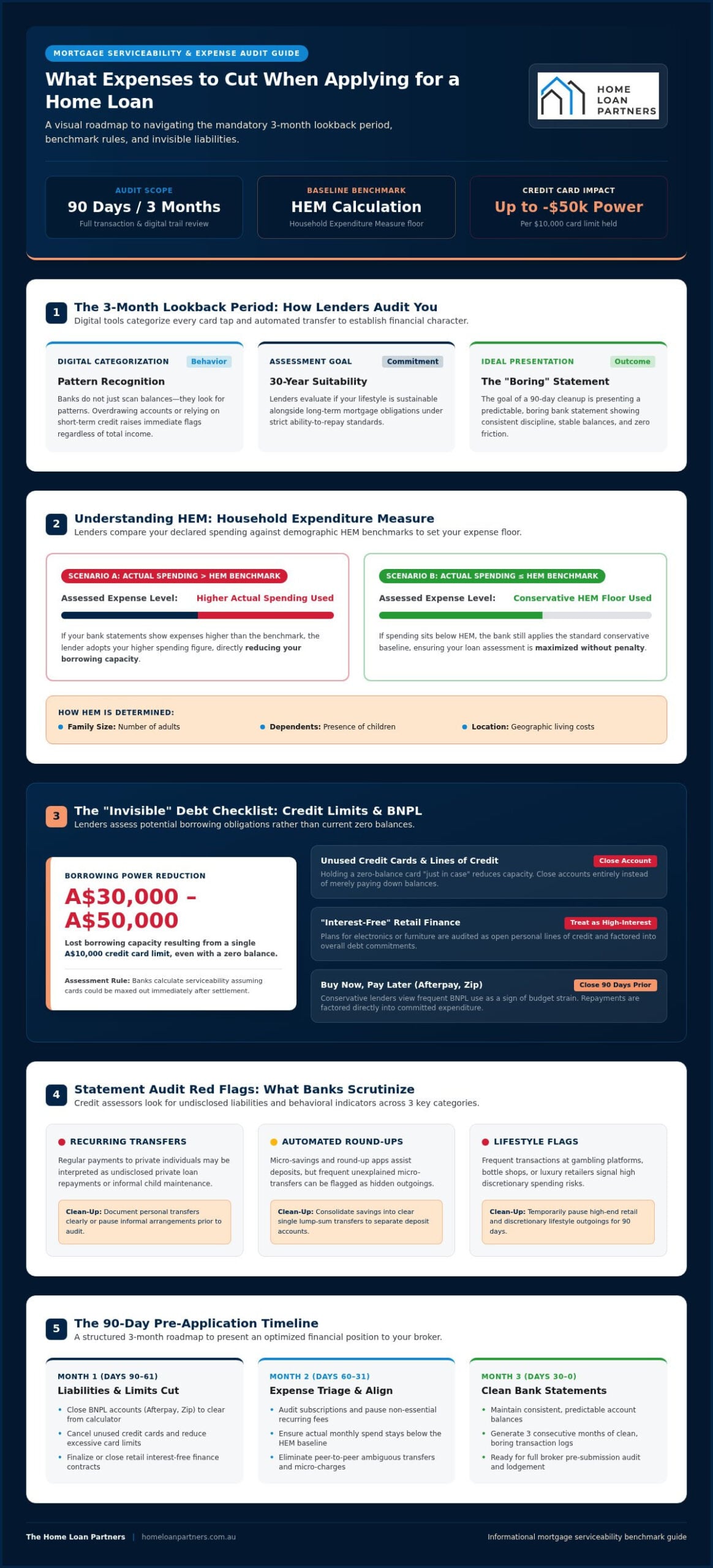
Lenders are no longer satisfied with a simple summary of your assets and liabilities. They want to see the “financial character” behind the numbers. In Australia, this process usually involves a strict three-month lookback period. Banks use digital tools to categorise every tap of your card and every automated transfer. They aren’t just looking for big purchases; they are looking for patterns of behaviour. A consistent history of overdrawing your account or relying on credit to get through the week will raise alarms, regardless of your income. It’s a detailed audit that helps them decide if you’re a safe bet for a thirty-year commitment.
Understanding the Household Expenditure Measure (HEM)
Lenders use a benchmark called the Household Expenditure Measure (HEM) to estimate your minimum living costs. This figure is calculated based on your family size, whether you have children, and your general location. It acts as a “floor” for your expenses. If your bank statements show you spend less than the HEM, the bank will likely still use the HEM figure to be conservative in their calculations. However, if your actual spending is higher, they will use that larger number instead. This is why identifying what expenses to cut when applying for a home loan is so vital. You want your actual spending to sit comfortably at or below the benchmark to ensure your application isn’t hampered by lifestyle choices that could be temporarily paused.
The Statement Audit: What Banks See
During the audit, credit assessors look for specific red flags that might suggest a higher debt-to-income ratio than what you’ve declared. They are searching for “invisible” liabilities that don’t appear on a standard credit report. We often see applications slowed down by simple patterns that could have been cleaned up in advance. Assessors are particularly focused on:
- Recurring transfers: Regular payments to individuals that could be interpreted as private loan repayments or undisclosed child maintenance.
- Round-ups: Automated savings apps are great for building a deposit, but frequent micro-transfers can look like unexplained outgoings if they aren’t clearly identified.
- Lifestyle flags: Frequent transactions at bottle shops, gambling platforms, or high-end retail outlets suggest a lifestyle that might be difficult to maintain alongside mortgage repayments.
We act as your pre-submission auditor to help you look at your statements through the eyes of a bank. By cleaning up these transactions at least 90 days before you apply, you demonstrate the financial discipline lenders crave. It’s about presenting a clear, “boring” bank statement that proves you’re ready for the responsibility of home ownership.
The “Invisible” Debt Checklist: What to Cut Immediately
Many borrowers focus on their bank balance while ignoring the “invisible” liabilities that lurk in the background. Lenders operate under a strict ability-to-repay rule, which means they must account for every potential financial obligation you have. It isn’t just about what you owe today; it’s about what you *could* owe tomorrow. This is a critical part of determining what expenses to cut when applying for a home loan to ensure your application stands up to scrutiny.
Credit Cards and Personal Lines of Credit
A common mistake is keeping credit cards “just in case” with a zero balance. Lenders don’t care that you haven’t used the card in a year. They assess your borrowing capacity based on the total limit. For example, a A$10,000 credit card limit can reduce your borrowing power by as much as A$30,000 to A$50,000. Banks assume you could max out that card the day after your home loan settles. To maximise your capacity, you should close these accounts entirely rather than just paying them off. This includes “interest-free” retail finance plans for furniture or electronics, which are often treated as high-interest personal lines of credit.
The Buy Now, Pay Later (BNPL) Trap
By 2026, Buy Now, Pay Later (BNPL) services like Afterpay and Zip have become standard fixtures on credit reports and bank statements. Conservative lenders view frequent BNPL use as a sign of budget stress or poor financial discipline. Even if you pay them on time, the individual repayments are factored into your committed expenditure. Closing these accounts at least 90 days before you apply is the safest way to remove them from the lender’s calculator. This simple step demonstrates that you can manage your lifestyle without relying on short-term credit facilities.
Small recurring costs also fly under the radar. A A$15 monthly streaming service or an unused A$60 monthly gym membership might seem minor, but banks annualise these figures. They look for “subscription bloat” where multiple small apps create a messy financial profile. Cleaning up this clutter makes your statements look “boring” and professional. If you aren’t sure which accounts are impacting your specific situation, speaking with an expert broker can help you identify which facilities to axe first. We can help you triage your spending so you only cut what is necessary to reach your goal.
Discretionary vs. Non-Discretionary: The Expense Triage
Lenders divide your life into two distinct categories: things you need and things you want. Non-discretionary costs like rent, basic utilities, and groceries are treated as fixed obligations. While you can’t stop eating or paying rent, you have total control over your discretionary spending. This is where you find the most flexibility when deciding what expenses to cut when applying for a home loan. High-impact areas like dining out, international travel, and premium entertainment are the first places a credit assessor looks to see if you can tighten your belt for a mortgage.
The “Streaming Audit” is a simple but effective tactic for this triage. Consolidating multiple subscriptions like Netflix, Stan, and Disney+ into a single service for a few months can remove several recurring lines from your statement. Similarly, one-off large purchases like a new sofa or a high-end laptop can cause confusion during the audit period. If these appear on your statements, be prepared to explain them as non-recurring. Better yet, delay these lifestyle upgrades until after your loan settles to keep your financial profile as streamlined as possible.
High-Impact Cuts for Quick Wins
Convenience spending is a major focus for modern lenders. Frequent transactions for Uber Eats or DoorDash leave a digital trail that suggests a reliance on premium services. By reducing these to occasional treats, you show a lender that you can prioritise long-term goals over immediate gratification. Another clever strategy involves switching monthly insurance or registration payments to an annual cycle. This removes recurring monthly “noise” from your bank statements, making your financial commitments look much smaller on paper. Even pausing a A$60 monthly gym membership in favour of a pay-as-you-go fitness model can marginally improve your serviceability profile.
The Grocery and Utility Myth
It is a common misconception that spending almost nothing on groceries will help your application. In reality, a A$0 grocery bill looks suspicious to a credit assessor. Lenders know you have to eat, so if they don’t see these costs, they may assume you are hiding expenses on a different card or have undisclosed debts. The goal is to show efficiency, not impossibility. You can demonstrate utility efficiency by shopping around for better rates, but don’t live in the dark just to impress a bank. Working with a licensed mortgage broker ensures you find a balance that satisfies lender policies while keeping your lifestyle realistic. For a deeper look at how these figures influence your borrowing power, our Home Loan Calculator Guide provides a practical framework for planning your 2026 property journey.
The 90-Day Pre-Application Action Plan
Success in a mortgage application isn’t just about your income; it’s about the evidence of your discipline. Lenders typically look back at ninety days of history to verify your lifestyle. This three-month window is your opportunity to present the best version of your financial self. By following a structured timeline, you can proactively address what expenses to cut when applying for a home loan and walk into your broker meeting with a high level of confidence.
Month 1: The Financial Deep Clean
Your first step is to see exactly what the bank sees. Download the last three months of CSV data from every account you own, including credit cards and savings. Categorise every transaction into “Essential” or “Axeable.” This is the time to be ruthless. If you’ve been wondering what expenses to cut when applying for a home loan, start with anything that isn’t a basic necessity. Cancel those unused streaming services, pause luxury memberships, and close every Buy Now, Pay Later (BNPL) account. It isn’t enough to just stop using them; you must close the facilities entirely to remove them from your credit profile.
Months 2 & 3: Behavioural Consolidation
Once you’ve cleared the clutter, the goal is to maintain “boring” bank statements. Lenders love predictability. Avoid large, unusual deposits or withdrawals that might trigger a request for a written explanation. If you’re receiving a gift for a deposit, ensure the documentation is ready early. Keep transfers between your own accounts to a minimum, as a complex web of internal movements can make it harder for an assessor to track your actual spending. This period of stability proves you can comfortably manage your future mortgage repayments. If you’re just starting this journey, our guide on How Do I Buy a House in Australia? provides a comprehensive step-by-step framework for the road ahead.
Before you officially submit your documents, we recommend a preliminary serviceability check. We can act as your pre-submission auditor to run the numbers against multiple lender policies. Different banks have different “sensitivities” to certain spending habits, and we can help you find the one most likely to approve your specific profile. To get started with a professional review of your borrowing capacity, contact our team for a strategy session today. We’ll help you navigate the final stretch of your application with precision and care.
How Your Mortgage Broker Navigates Expense Policies
Lenders are not a monolith. While one bank might view your childcare costs as a major serviceability hurdle, another may have a specific policy that is more lenient for young families. This is where professional guidance becomes your greatest asset. We act as your pre-submission auditor to identify potential red flags before they ever reach a credit assessor’s desk. It’s about more than just knowing what expenses to cut when applying for a home loan; it’s about understanding the nuances of how different institutions interpret your financial data.
A broker’s role is to package your application in the most favourable light. We provide the necessary context for one-off life events that might otherwise skew your three-month average. If your bank statements show a significant spike due to a wedding, a major car repair, or a family holiday, we explain these as non-recurring events. This prevents a temporary increase in spending from being treated as a permanent liability. Our goal is to ensure your “financial character” shines through the raw data, presenting you as a reliable and disciplined borrower.
Lender Niches and Expense Sensitivity
Different banks have unique “appetites” for specific types of spending. For instance, some lenders are more comfortable with private school fees or high childcare costs if the overall income profile is strong. We use our access to 36+ lenders to match your specific spending habits with a policy that suits you. This saves you the stress of multiple rejections, which can damage your credit score. If you want to understand the full scope of this partnership, read The Ultimate Guide to Hiring a Finance Broker to see how we manage the heavy lifting for you.
Ready to Polish Your Application?
The best time to start this process is well before you find your dream home. An early strategy session allows us to review your statements and provide a clear checklist of what expenses to cut when applying for a home loan based on current 2026 lender sensitivities. We’ll help you gather your documents and perform a preliminary review to ensure your “financial house” is in order. This proactive approach gives you a significant advantage in a competitive market, providing the confidence you need to make an offer when the right property appears.
When you’re ready to take the next step, we’re here to guide you with patience and precision. Book a strategy session with The Home Loan Partners today to begin your journey toward a stress-free approval. We are committed to navigating the complexities of the lending environment alongside you, ensuring a smooth path to achieving your home ownership goals.
Your Path to a Stress-Free Approval
Securing a mortgage in 2026 is about demonstrating financial discipline through a clean digital paper trail. By focusing on the 90-day pre-application window, you can ensure your bank statements reflect the stability lenders demand. Closing unused credit facilities and triaging discretionary spending are the most effective ways to boost your borrowing capacity. Understanding exactly what expenses to cut when applying for a home loan allows you to present a “boring” but highly attractive financial profile to potential lenders.
You don’t have to navigate these complex lender policies on your own. We provide expert guidance for first-home buyers and offer no-obligation serviceability reviews to catch potential issues early. With access to 36+ Australian lenders, we help you find the right loan structure that aligns with your long-term life milestones. Taking a proactive approach today ensures you’re ready to act with confidence when the right property opportunity appears.
If you’re ready to see where you stand, get a personalized borrowing power assessment from The Home Loan Partners. We look forward to acting as your steady hand and expert collaborator throughout this journey.
Frequently Asked Questions
Do I really need to stop buying coffee to get a home loan?
You don’t need to quit your coffee habit entirely, but you should be mindful of how frequent discretionary spending affects your bank’s assessment. Lenders look for a consistent surplus in your budget to ensure you can afford repayments. If daily A$5 coffees are part of a larger pattern of high convenience spending, it might push your actual costs above the benchmark. It’s about proving overall financial discipline.
How far back do banks look at my bank statements?
Most Australian lenders look back at the last 90 days of your bank statements to audit your spending patterns. This three-month period allows them to identify recurring bills, subscription services, and any undeclared liabilities. This window is the most important time to be mindful of what expenses to cut when applying for a home loan to ensure your statements look clean. It provides the proof of discipline needed for a smooth approval.
Does Afterpay affect my home loan application even if I have no debt?
Afterpay and other BNPL services can negatively affect your application even if you have no current debt. Lenders often view these accounts as a line of credit or a sign of budget reliance. Each individual repayment is factored into your committed expenditure, which can lower your borrowing capacity. We recommend closing these accounts at least 90 days before applying to show you can manage your lifestyle without short-term credit facilities.
Should I close my credit card or just pay it off before applying?
You should ideally close your credit card account instead of just paying off the balance. Banks assess your borrowing capacity based on the total credit limit rather than what you actually owe. A A$10,000 limit is treated as a potential debt obligation, which can lower your borrowing power by up to A$50,000. When you’re deciding what expenses to cut when applying for a home loan, closing unused facilities is a high-impact strategy.
Will a gym membership reduce my borrowing power?
A gym membership will be included in your living expense assessment, which can marginally reduce your borrowing power. While a single A$60 monthly fee won’t typically cause a rejection, it is annualised as a A$720 obligation in the lender’s calculator. If your serviceability is tight, pausing the membership can help. It’s the cumulative effect of multiple subscriptions that often creates the biggest hurdle for applicants during the audit.
What happens if I have a large one-off expense during the 3rd month?
Large one-off expenses can be managed by providing a clear explanation and supporting documentation to the lender. If your statements show a significant spike due to a wedding deposit or car repairs, we can package this as a non-recurring event. This prevents the bank from treating a temporary cost as a permanent liability. However, it’s best to delay major lifestyle purchases until after your loan settles to avoid unnecessary scrutiny.
Can I use a savings app while applying for a mortgage?
You can continue using savings apps, but you should ensure the transfers are clearly labelled to avoid confusion during the audit. Frequent “round-up” transfers can sometimes look like unexplained outgoings if they aren’t properly identified. Lenders want to see that the money is staying within your own accounts rather than being spent on discretionary items. Clear labelling helps the credit assessor verify your consistent ability to save.
Do banks check my savings account or just my transaction account?
Banks will scrutinise both your savings and transaction accounts to get a full picture of your financial health. They review your transaction history to audit your daily living costs and look at your savings account to verify your deposit and genuine savings history. Providing both accounts ensures the lender sees that you aren’t relying on credit to survive. It helps confirm your ability to manage a long-term mortgage commitment without stress.