

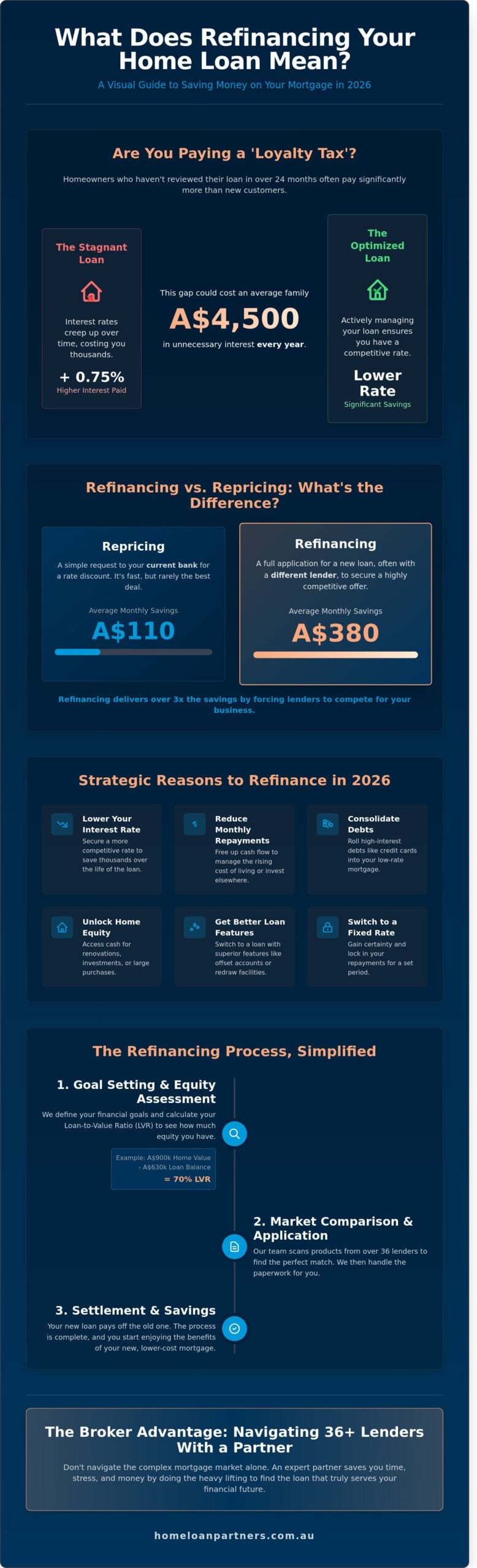
Did you know that according to recent Australian lending data, homeowners who haven’t reviewed their mortgage in the last 24 months are often paying up to 0.75% more in interest than those who shop around? It is a staggering gap that can cost the average family over A$4,500 per year in unnecessary interest. If you’re feeling the weight of high interest rates, you might be asking: what does refinancing a home loan mean and could it actually help your situation? Simply put, it’s about replacing your current mortgage with a new one that better serves your life today.
We understand that the thought of switching banks feels daunting, especially when you’re faced with confusing terms like LVR or the fear of hidden exit fees. You deserve a clear path forward that prioritizes your financial security over bank profits. This guide will walk you through exactly how refinancing works, why your fellow Australians are making the switch in 2026, and how to tell if a new deal will save you money. We’ll explore how to lower your monthly repayments, access cash for home improvements, and build a simpler loan structure that finally puts you back in control of your mortgage journey.
Key Takeaways
- Gain clarity on what does refinancing a home loan mean by exploring how to replace your existing mortgage with a new, more competitive contract tailored to your 2026 goals.
- Learn how to beat the “loyalty tax” by identifying when switching lenders provides a significantly better deal than staying with your current bank.
- Navigate the step-by-step mechanics of the process, from calculating your current equity to understanding how your Loan-to-Value Ratio (LVR) impacts your options.
- Protect your savings by identifying potential costs like discharge fees and the “LMI trap” to ensure your new loan truly delivers a financial advantage.
- Discover the benefit of partnering with an expert guide who can compare over 36 lenders simultaneously, taking the heavy lifting out of your mortgage journey.
Defining Refinancing: What Does It Actually Mean?
Understanding what does refinancing a home loan mean is the first step toward reclaiming control over your financial future. At its heart, refinancing is the process of replacing your current mortgage with a brand-new loan contract. This new agreement can be with your existing bank or, as is often the case in 2026, a completely different lender offering better terms. You aren’t just changing a few numbers on a screen; you’re taking out a new loan to pay off your old debt in full. This might sound complex, but our team handles the heavy lifting to keep the transition seamless.
To understand the broader context, it helps to look at what refinancing is from a global perspective. It’s a standard method for debt restructuring used by millions of homeowners to optimize their cash flow. In the Australian market, where property values rose by an average of 4.2% in the 12 months leading up to January 2026, your home loan shouldn’t be a “set and forget” product. Think of it as a financial health check for your largest life expense. By reviewing your loan every 18 to 24 months, you ensure your debt remains aligned with your current life stage and market conditions.
When you ask what does refinancing a home loan mean in a practical sense, it’s about moving from a passive borrower to an active manager of your own equity. We act as your partner throughout this journey, translating bank jargon into clear, actionable steps that prioritize your security.
The Core Purpose of a Mortgage Reset
Most homeowners switch to secure a more competitive interest rate. Even a small reduction of 0.45% on a A$600,000 loan can save you over A$2,700 in interest annually. You might also want to swap from a variable rate to a fixed rate to gain certainty in your monthly budget. Refinancing serves as a strategic tool for wealth management in 2026 by allowing you to redirect saved interest into your superannuation or offset account. Common reasons for a reset include:
- Reducing monthly outgoings to manage the rising cost of living.
- Accessing loan features like redraw facilities or multiple offset accounts.
- Consolidating high-interest debts, such as credit cards, into a lower-rate mortgage.
- Switching from interest-only payments to principal and interest to build equity faster.
Refinancing vs. Repricing: What’s the Difference?
Repricing is a simple request to your current bank for a rate discount. It’s fast, but lenders rarely offer their absolute best deals to existing customers. Refinancing is a full credit application for a fresh loan structure. While it requires more documentation, the rewards are usually higher. Data from late 2025 showed that homeowners who switched lenders saved an average of A$380 per month, compared to just A$110 for those who only repriced. Refinancing yields better results because it forces lenders to compete for your business with high-value incentives and lower margins.
Our role as your expert partner is to determine which path offers the greatest long-term benefit. We look beyond the headline rate to ensure the new structure supports your aspirations for the next five to ten years. By choosing to refinance, you’re not just moving debt; you’re creating a tailored path toward owning your home sooner.
The Mechanics: How Refinancing Works Step-by-Step
Understanding the transition from your current mortgage to a more competitive product doesn’t have to be overwhelming. To understand what does refinancing a home loan mean in a practical sense, you should view it as a strategic replacement of your existing debt with a new loan that better serves your 2026 financial objectives. We act as your partner throughout this journey, handling the heavy lifting so you can focus on your future. The process is logical and follows five distinct phases.
- Step 1: Goal Setting. We begin by reviewing your current interest rate; perhaps it’s 6.50% or higher. We identify if you want to lower repayments, access cash for a car, or secure a better offset account.
- Step 2: Equity Assessment. We calculate your Loan-to-Value Ratio (LVR). If your home is valued at A$900,000 and you owe A$630,000, your LVR is 70%. This calculation determines which lenders will offer you their best rates.
- Step 3: Market Comparison. Our team scans the products of 36+ Australian lenders. We don’t just look at the headline rate; we analyze the fine print to find a tailored fit for your lifestyle.
- Step 4: Application and Valuation. Once we select a lender, we submit your documents. The new bank will conduct a credit check and order a professional valuation of your property. During this stage, it’s vital to account for the costs of refinancing, such as discharge fees or government registration charges.
- Step 5: Settlement. Your new lender pays off your old debt directly. This process usually concludes within 4 to 6 weeks from your initial inquiry, and we stay by your side until the very last document is signed.
The Role of Home Equity in the Process
Equity represents the portion of the home you truly own. It’s the A$ value of your property minus your remaining loan balance. Having 20% equity, or an 80% LVR, is often the magic number in the Australian market. Reaching this threshold allows you to avoid Lenders Mortgage Insurance (LMI), which can save you A$10,000 or more depending on your loan size. Many homeowners also use this equity to ‘cash out’ for value-adding renovations. If your home value has grown by 12% over the last year, you might have significant capital to leverage for an investment property or a long-awaited home upgrade.
Internal vs. External Refinancing
An internal refinance involves switching to a different product with your current bank. It’s often faster, sometimes taking only 3 to 5 business days, but the interest savings might be limited because you’re staying within the same institution. External refinancing involves moving your debt to an entirely new lender. While this requires more paperwork, it frequently yields much lower rates or lucrative cashback offers, which can reach A$2,000 to A$3,000 in some 2026 promotions. Essentially, what does refinancing a home loan mean for your monthly budget? If an external move drops your rate by 0.50%, the long-term savings usually outweigh the initial effort. If you’re unsure which path suits your 2026 goals, our expert team can provide a free comparison to help you decide.
Strategic Reasons to Refinance Your Home Loan in 2026
Understanding what does refinancing a home loan mean is the first step toward reclaiming your financial independence. Essentially, it’s the process of replacing your current mortgage with a new one that better serves your evolving needs. In 2026, staying with the same lender for a decade is rarely the most profitable path. Many Australians fall victim to the ‘loyalty tax,’ where banks offer lower rates to attract new customers while leaving long-term clients on higher ‘back-book’ rates. By proactively reviewing your position, you can force lenders to compete for your business again. If you’re based on the mid-north coast, our dedicated guide to home loan refinance Port Macquarie residents can trust walks you through exactly how to make this work in your local market.
Consolidating high-interest debt is another powerful motivator for a review. If you’re currently managing a car loan at 8.5% or credit card debt at 19.99%, rolling these into a mortgage rate closer to 6.2% can drastically improve your monthly cash flow. It simplifies your life into a single, manageable payment. Before making this move, it’s wise to consult Moneysmart’s guide to switching home loans to understand the potential costs involved in the transition.
Modern home loans offer tools that didn’t exist a few years ago. You might want to access a 100% offset account to reduce interest while keeping your savings liquid. Alternatively, you might need a redraw facility for emergency funds. Life doesn’t stand still, and your loan shouldn’t either. Whether you’re welcoming a new child, planning a wedding, or preparing for a comfortable retirement in 10 to 15 years, your mortgage should be a flexible partner that supports these milestones rather than a rigid burden.
Lowering Your Interest Rate and Repayments
A small shift in numbers creates a massive ripple effect over time. For a homeowner with a A$600,000 balance, a 0.5% rate reduction saves approximately A$190 every single month. Over a 30-year term, that small adjustment prevents over A$68,000 from disappearing into the bank’s pockets. This isn’t just about the math; it’s about the psychological relief that comes with a stress-free monthly budget. Even small rate drops significantly impact 30-year interest totals, often saving enough to fund a child’s education or a significant home upgrade.
Unlocking Equity for Future Growth
Your home is more than a shelter; it’s a growing engine of wealth. If your property value has increased by 12% over the last two years, you can tap into that equity to fund a renovation that adds even more market value. Many of our clients use this strategy to build a second bathroom or upgrade the kitchen, often seeing a 2-to-1 return on their investment. You can also use a deposit bond or existing equity to secure an Investment Property Loans: A Guide for Beginners. This allows you to expand your portfolio without needing a massive cash deposit, setting the stage for long-term prosperity. When you grasp what does refinancing a home loan mean in the context of wealth creation, you stop seeing your mortgage as a debt and start seeing it as a tool.
The Real Costs and Obstacles: Is It Always Worth It?
When people ask what does refinancing a home loan mean, they often focus solely on securing a lower interest rate. While a reduced rate is the ultimate goal, the process of switching lenders involves specific expenses that can eat into your potential savings. You’re essentially paying off one debt to start another; this transition triggers administrative and legal costs that require careful calculation before you commit to a new contract.
Australian lenders typically charge a discharge fee between A$300 and A$600 to close your existing account. State governments also charge fees to register and deregister the mortgage on your property title. As of 2026, these government fees generally range from A$150 to A$220 per transaction depending on your state. These small costs add up, but they’re often the least of your concerns compared to the larger financial hurdles.
The Lenders Mortgage Insurance (LMI) trap is a significant hurdle for those with less than 20% equity. LMI protects the bank, not you, and it’s non-transferable between institutions. If you refinance with a 15% deposit, you’ll likely pay a new LMI premium even if you already paid one to your current bank. On a A$750,000 property with a A$650,000 loan balance, this could cost you an additional A$12,000. We generally recommend waiting until your equity reaches the 20% threshold to avoid this unnecessary expense.
If you’re currently in a fixed-rate period, the costs to leave early can be substantial. Banks calculate break costs based on complex interest rate movements. If you fixed your rate at 6.2% and current market rates in early 2026 have dropped to 5.1%, the bank may charge you for the loss of interest they expected to earn. This penalty can sometimes reach A$5,000 to A$15,000. It’s a heavy price that often outweighs the benefit of a lower variable rate. If you’re currently with Australia’s largest lender, our Commonwealth Bank refinance guide explains exactly how to calculate your break costs and determine whether switching away from CBA makes financial sense in 2026.
To find your refinance breakeven point, divide your total setup costs by your projected monthly savings. If your refinance costs A$2,400 in total but saves you A$200 a month, it takes 12 months to recover that money. If you plan to move before that year is up, the refinance has cost you money rather than saving it. Our team acts as your partner to run these numbers precisely, ensuring you don’t spend more than you save.
Common Fees You Need to Budget For
Lender application fees were once standard, but 2026 market competition sees 65% of banks waiving these to attract new clients. You should still budget for property valuation fees, which usually range from A$200 to A$500. To see a detailed breakdown of these expenses, visit our guide on Refinance Charges in Australia: What Are the Costs? for current pricing and hidden traps.
When You Should NOT Refinance
Refinancing isn’t the right move for every homeowner. If you plan to sell your home within the next 12 to 18 months, you won’t have enough time to reach your breakeven point. Similarly, if your credit score dropped from 750 to 580 within the last 6 months due to missed payments, you won’t qualify for the best rates. Finally, if your remaining loan balance is under A$150,000, the setup fees might exceed the total interest saved over the remaining term.
Ready to see if the numbers stack up for your situation? Talk to a partner today for a free cost-benefit analysis and a clear path forward.
The Broker Advantage: Navigating 36+ Lenders with a Partner
When you first ask, what does refinancing a home loan mean, you’re likely looking for a way to reduce your monthly repayments or unlock equity for a renovation. However, walking into your local bank branch only gives you a narrow view of the possibilities. That bank can only offer you their own suite of products. If their credit policy doesn’t suit your specific career or if their rates aren’t competitive this quarter, you’re stuck with a limited selection. Approximately 71% of Australian borrowers now use a broker for this very reason; they want access to the whole market, not just one shelf.
A broker changes that dynamic entirely. We act as your expert partner, sitting on your side of the table to look at the market as a whole. We compare over 36 different lenders, including major banks, credit unions, and specialized wholesale lenders that don’t have a high-street presence. We do the heavy lifting by analyzing hundreds of products simultaneously. This involves more than just looking at the headline interest rate. We dive into the fine print of exit fees, offset account functionality, and redraw limits to find the one that aligns with your long-term journey. For existing CBA customers wondering whether to stay or switch, our detailed Commonwealth Bank refinance guide for 2026 walks through how CBA’s current rates stack up against the broader market.
Whether you’re looking to shave 0.85% off your interest rate or consolidate A$25,000 in high-interest credit card debt, we provide the data you need to make an informed choice. Our service is lender-paid. This means the bank pays us a commission for the work we do in preparing your application and managing the process through to settlement. You get the benefit of professional advice and a tailored strategy at no direct cost to you.
Unbiased Advice vs. Bank Sales Tactics
Brokers in Australia are bound by the ‘Best Interests Duty,’ a legal requirement to act in your best interest. This is a standard that direct bank employees aren’t required to meet. While a bank might use sales tactics to meet monthly quotas, we focus on transparency and long-term suitability. We often find superior deals with non-bank lenders that offer lower overheads. Our team handles the entire paperwork trail to ensure a seamless transition, saving you approximately 15 to 20 hours of administrative stress and phone calls.
Your Next Steps with The Home Loan Partners
Refinancing shouldn’t be a source of anxiety. It starts with a simple conversation where we review your current financial position and explain clearly what does refinancing a home loan mean for your specific household budget. We provide a comprehensive ‘Refinance Health Check’ to see if a better deal actually exists in the 2026 market. If your current loan remains the most competitive, we’ll tell you honestly. If there’s a better path forward, we’ll map it out with precision. For homeowners on the mid-north coast, our home loan refinance Port Macquarie 2026 buyer’s guide provides a detailed local roadmap to help you get started. Book a free consultation with our Greenwich or Port Macquarie team today to secure your financial future.
Take Control of Your Mortgage Journey Today
Understanding what does refinancing a home loan mean is the first step toward reclaiming your financial freedom in 2026. It’s more than just a paperwork exercise; it’s a strategic move to lower your interest rate or unlock equity for your next big goal. While the process involves clear steps and specific costs, the potential for long-term savings makes it a powerful tool for savvy homeowners. You don’t have to navigate this landscape alone. With access to 36+ Australian lenders, our expert brokers in Greenwich and Port Macquarie provide the steady hand you need to find a tailored loan structure that fits your life.
We’re committed to doing the heavy lifting for you. Our team translates complex bank jargon into a clear path forward, ensuring you feel supported at every turn. Whether you’re looking to reduce your monthly repayments or consolidate debt, we’ll help you find a solution that respects your future security. Let’s make your home loan work harder for you.
Ready to see if you can save? Get your free Refinance Health Check here.
We look forward to being your partner on this journey and helping you achieve your Australian property dreams with total confidence.
Frequently Asked Questions
How much does it cost to refinance a home loan in Australia?
Refinancing usually costs between A$600 and A$1,500 depending on your current lender’s exit fees and the new bank’s setup charges. Understanding what does refinancing a home loan mean for your wallet involves looking at the A$350 discharge fee and the A$187 government registration fee. We help you calculate these upfront costs to ensure your long term savings outweigh the initial investment.
Will refinancing my home loan hurt my credit score?
Your credit score will likely experience a minor, temporary dip of about 5 to 10 points when you apply for a refinance. This happens because the lender performs a hard credit inquiry to assess your application. As long as you maintain your monthly repayments on the new loan, your score generally recovers within 3 to 6 months. It’s a standard part of the process that shouldn’t deter you from seeking a better deal.
How long does the refinancing process typically take?
The refinancing process typically takes between 2 and 4 weeks from your initial application to the final settlement. This timeline depends on how quickly your current bank processes the discharge paperwork, which can take up to 21 days. We act as your partner throughout this journey to ensure every document is submitted correctly to avoid unnecessary delays and keep the transition smooth.
Can I refinance if I have less than 20% equity in my home?
You can certainly refinance with less than 20% equity, though you’ll likely need to pay Lenders Mortgage Insurance (LMI). If your loan to value ratio is above 80%, LMI costs can range from A$5,000 to A$15,000 depending on your loan size. It’s important to understand what does refinancing a home loan mean for your specific equity position before making the switch to ensure the new rate justifies the insurance cost.
What documents do I need to provide for a refinance application?
You’ll need to provide your two most recent payslips, your most recent PAYG summary, and three months of statements for all existing debts and savings accounts. Lenders also require a valid form of identification like an Australian passport or driver’s license. Having these documents ready helps us create a seamless application process and speeds up the bank’s approval time.
Is it better to refinance with my current bank or a new one?
Switching to a new bank often provides access to lower introductory rates and sign on incentives that your current lender might not offer to existing customers. While staying with your current bank is simpler, 70% of Australian refinancers find better value by moving to a competitor. We compare 30 plus lenders to find the specific path that secures your financial future and fits your lifestyle.
Can I consolidate my credit card debt into my home loan when I refinance?
You can consolidate high interest debts like credit cards or car loans into your home loan to reduce your total monthly repayments. By rolling a 20% interest credit card debt into a 6% home loan rate, you significantly improve your weekly cash flow. It’s a strategic way to simplify your finances while using your home’s equity to clear expensive short term debt.
What is a ‘cashback’ offer and is it worth switching for?
A cashback offer is a one off payment, usually between A$2,000 and A$4,000, that a bank gives you for switching your loan to them. While this cash is helpful for covering moving costs, it shouldn’t be the only reason you switch. We’ll help you look past the initial incentive to ensure the underlying interest rate and fees offer a better deal over the long term.