

Securing the right Australian mortgage from abroad doesn’t start with chasing headline interest rates; it comes down to how a lender calculates the true value of your British Pounds. Successfully financing property in Australia for UK expats depends on choosing lenders whose foreign income assessment policies actually support your financial position. If you feel overwhelmed by foreign currency shading haircuts, complex FIRB rules, or managing paperwork across eight time zones, your concerns are completely justified. Between overseas tax slips and rigid domestic lending buffers, buying property back home can easily feel like an uphill battle.
You don’t have to tackle cross-border finance alone. This guide shows you how to navigate Australian lending criteria, foreign income assessments, and loan structuring smoothly while living in the UK. Ahead, you’ll gain clarity on your borrowing capacity when earning British Pounds, explore a step-by-step roadmap to secure pre-approval from overseas, and see how partnering with an Australian broker makes remote lender negotiations effortless.
Key Takeaways
- Explore how lenders differentiate between Australian citizens, permanent residents, and foreign spouses to determine your purchasing eligibility.
- Master how banks assess British Pound earnings and apply shading haircuts when financing property in australia for uk expats.
- Compare expat loan structures, deposit requirements, and Loan-to-Value Ratios across both bank and non-bank lenders.
- Follow a clear, multi-phase roadmap to secure formal pre-approval and complete property settlements entirely remotely from the UK.
- Discover how partnering with an Australian credit team removes cross-border friction, manages time-zone delays, and protects your borrowing power.
Understanding Expat Mortgages: Can You Buy Australian Property from the UK?
Yes, purchasing residential real estate down under while living and working in Britain is entirely achievable. Financing property in Australia for UK expats operates under distinct frameworks established by domestic lenders and national regulators. Rather than evaluating applications purely through local credit scorecards, Australian institutions manage cross-border exposure by applying strict macroprudential standards set by the Australian Prudential Regulation Authority (APRA). While these prudential rules keep credit parameters tight, mainstream lenders continue to offer viable pathways for overseas purchasers who understand the distinction between immigration status and borrowing criteria. If you are starting your journey, review the foundational purchasing steps in our comprehensive guide on how do i buy a house in australia.
Australian Citizens vs Foreign Nationals: Legal Eligibility
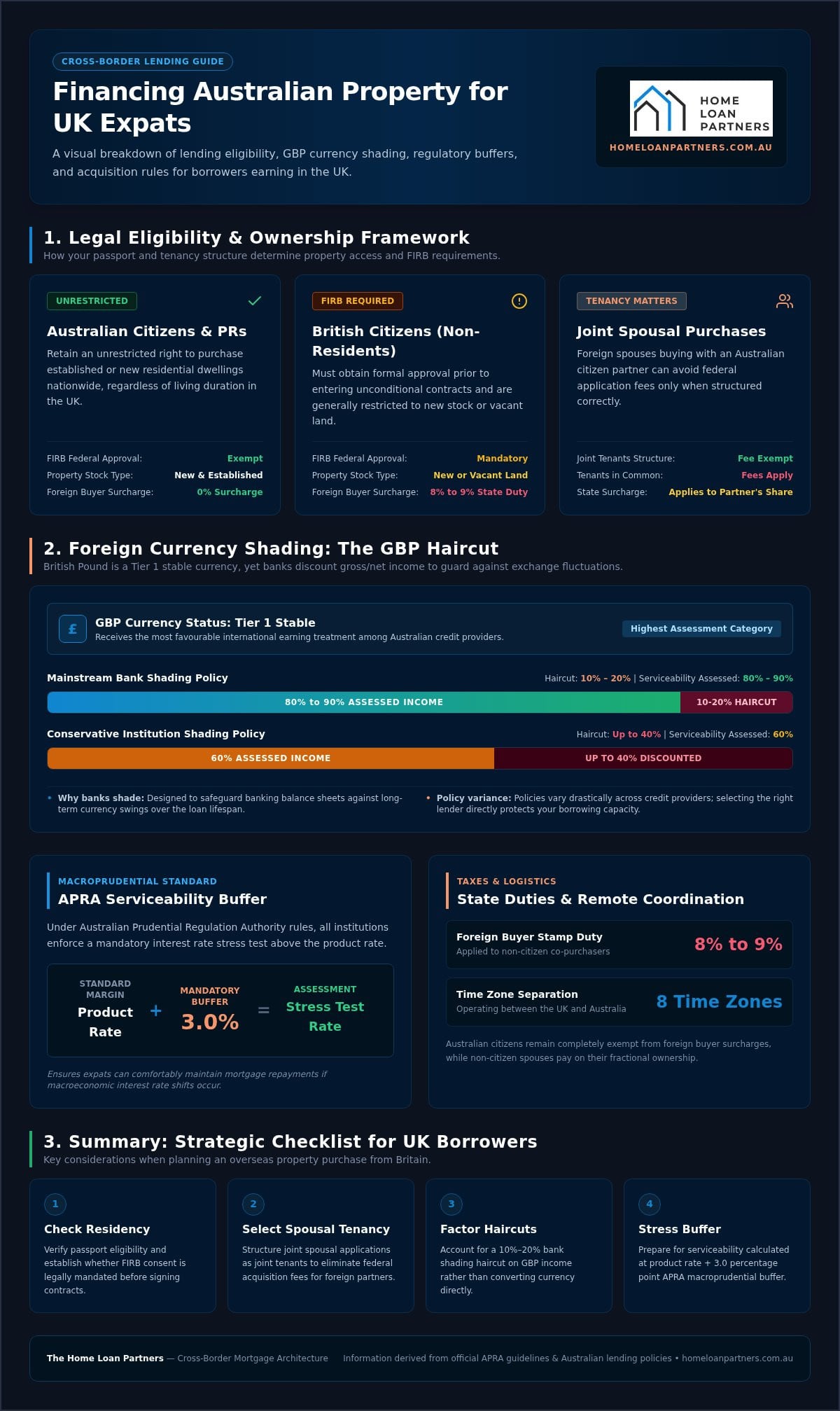
Your passport determines both your legal path to ownership and the specific credit products open to you. Australian citizens and permanent residents retain an unrestricted right to buy established or new residential property across the nation, regardless of how long they have lived in the UK. In contrast, British nationals without Australian residency face strict statutory hurdles. When couples purchase together, loan structuring becomes critical:
- Australian Citizen Borrowers: Enjoy full access to residential markets without seeking federal acquisition consent.
- British Citizens (Non-Residents): Must obtain formal approval prior to entering unconditional purchase contracts.
- Joint Spousal Purchases: A foreign spouse buying alongside an Australian citizen partner is typically exempt from federal application fees only when purchasing as joint tenants rather than tenants in common.
FIRB Regulations and Surcharges for UK Buyers
Foreign investors face defined property restrictions managed under federal Foreign Investment Review Board regulations. Under these rules, non-resident foreign nationals are generally restricted to purchasing new dwellings or vacant land intended for development, preserving established housing stock for domestic occupants. Australian citizens living abroad remain entirely exempt from these federal acquisition restrictions.
However, state-level duties introduce separate financial considerations. While Australian citizens are exempt from foreign buyer stamp duty surcharges, non-citizen co-purchasers are subject to state surcharges on their portion of the asset, which range from 8% to 9% depending on the state jurisdiction. Establishing these legal classifications early ensures you choose lenders equipped for cross-border credit assessments, keeping your path toward financing property in Australia for UK expats smooth and predictable.
How Australian Lenders Assess UK Income and Borrowing Power
Assessing offshore earnings involves far more than running British Pounds through an online currency converter. Credit assessors evaluate foreign remuneration packages through specialized risk matrices designed to safeguard domestic banking balance sheets. Under APRA’s macroprudential lending standards, institutions apply a mandatory 3.0 percentage point interest rate buffer on top of product rates, stress-testing whether you can comfortably meet loan repayments if economic conditions shift. Because policies vary drastically across different credit providers, knowing how underwriters view your cash flow is critical when financing property in Australia for UK expats. You can model preliminary borrowing scenarios across different price points using our home loan calculator.
Foreign Currency Shading: The GBP Haircut Explained
Australian lenders guard against currency swings by discounting foreign gross revenue. The British Pound is classified as a Tier 1 stable currency, ensuring it receives the most favourable treatment available for international earnings. Even so, mainstream banks routinely apply a 10% to 20% shading haircut to your gross or net GBP income, assessing only 80% to 90% for serviceability. Highly conservative institutions may discount earnings by up to 40%. Specialist lenders, however, evaluate borrowing capacity using actual PAYE tax paid in Britain rather than applying domestic Australian tax brackets, which can increase your borrowing power by up to 25%.
Documenting UK Employment, PAYE, and Self-Employed Income
Underwriters require comprehensive paperwork to substantiate overseas stability before issuing a formal credit approval. Standard PAYE applicants must provide their latest P60 summary, consecutive months of recent payslips, corresponding bank statements showing salary credits, and an official employment contract confirming permanent status. If you receive discretionary bonuses, commissions, or share options, lenders usually require a continuous two-year history before counting those funds. Self-employed directors face deeper forensic reviews, requiring two years of certified HMRC tax calculations, company accounts, and corporate bank statements to confirm sustainable operational profits.
Managing Ongoing UK Debts and Living Cost Benchmarks
Every ongoing offshore commitment directly reduces your borrowing capacity down under. Credit teams convert your UK personal loans, car finance, and revolving credit card limits into Australian Dollars before testing serviceability:
- Credit Limits vs Balances: Lenders assess maximum credit card limits rather than monthly repaid balances.
- Household Benchmarks: Assessors impose conservative overseas living cost baselines if declared expenditures fall below internal benchmarks.
- Mandatory Liabilities: Ongoing liabilities, such as HECS or HELP student debts, must be reported to avoid severe compliance delays.
If you want clear guidance on how your individual British income translates into borrowing power across various lender policies, our team at The Home Loan Partners can map out your optimal path forward.
Comparing Expat Loan Structures: Deposits, LVR, and Features
Selecting the right mortgage architecture is just as critical as securing credit approval. When financing property in Australia for UK expats, loan structuring dictates your ongoing cash flexibility, currency exposure, and future tax obligations. Most Australian lenders establish baseline Loan-to-Value Ratios (LVR) between 70% and 80% for non-resident borrowers. While specialized lenders can approve up to 90% LVR, pushing past the 80% threshold usually triggers Lenders Mortgage Insurance (LMI), which requires approval from independent mortgage insurers who enforce rigid overseas policy limits. To explore the fundamental mechanics of various credit arrangements, review the official Moneysmart home loan comparison guide. If you already hold Australian real estate and wish to restructure an existing loan, it helps to understand what does refinancing a home loan mean for your long-term portfolio.
Deposit Requirements and Acceptable Sources of Funds
Supplying a 20% cash deposit keeps your loan under the 80% LVR mark, bypassing insurance premiums entirely. Lenders demand clear proof of genuine savings, requiring at least three consecutive months of bank statements to show that funds accumulated steadily in your UK or Australian accounts. Acceptable equity sources include:
- Liquid British Savings: Cash holdings held in UK accounts, converted to Australian Dollars using conservative internal bank exchange rates.
- Equity Releases: Capital unlocked through refinancing an established Australian property or UK residential asset.
- Non-Refundable Family Gifts: Legally documented financial gifts supported by formal deed letters confirming no repayment is required.
Offset Accounts vs Redraw for Expatriates
Offset accounts provide distinct tactical benefits for overseas borrowers earning British Pounds. A 100% linked offset account reduces daily interest charges by matching your savings dollar-for-dollar against the loan balance, while keeping capital entirely liquid for currency transfers or eventual repatriation costs. Redraw facilities also lower interest expenses, but withdrawing accumulated redraw funds from an investment mortgage can forfeit tax deductibility under Australian tax rules. An offset account maintains this tax integrity while serving as a natural buffer against exchange rate swings.
Principal and Interest vs Interest-Only Loan Terms
Your choice between principal and interest (P&I) or interest-only (IO) repayments should mirror your property timeline. Interest-only terms minimize monthly cash commitments and maximize tax deductions while the asset remains an investment. However, lenders routinely cap expat interest-only periods to five years and apply higher interest margins. Choosing principal and interest repayments builds direct equity, which works well if your goal is financing property in Australia for UK expats to secure a primary family home before moving back.
The Step-by-Step Expat Mortgage Application Process
Securing a loan from 10,000 miles away requires a synchronized, step-by-step roadmap. Successfully financing property in Australia for UK expats relies on preparing paperwork early, verifying your identity properly, and anticipating administrative lead times. When you break the journey down into clear phases, the distance between London and Australia becomes completely manageable.
Securing Pre-Approval from Overseas
Obtaining formal pre-approval establishes a firm bidding ceiling before you make private treaty offers or bid at remote property auctions. Lenders evaluate your documented income, verified liabilities, and cash assets upfront to issue a conditional approval, typically valid for 90 days. Keeping your financial position completely stable during this window is vital. Avoid changing employers, taking out new personal lines of credit, or moving substantial funds between UK accounts while awaiting your purchase contract.
Overseas Identity Verification and Legal Documentation
Satisfying Australian Anti-Money Laundering (AML) standards used to require certified wet-ink signatures at the Australian High Commission in London. Today, accredited digital Verification of Identity (VOI) platforms allow expats to verify passports and proof of residency securely from a smartphone. Alongside digital identity checks, an independent Australian solicitor or licensed conveyancer should review contracts of sale, verify title searches, and confirm vendor disclosures before you sign.
Coordinating Settlement Across Time Zones
Bridging the eight-to-ten-hour time difference requires smooth coordination between your broker, conveyancer, and credit assessor:
- Digital Settlements: Property completions execute electronically through platforms like PEXA, eliminating physical paperwork exchanges on settlement day.
- Shortfall Transfers: Transfer international deposit funds into designated trust accounts several business days early to prevent international wire delays.
- Direct Liaison: Having an Australian-based representative manage local enquiries prevents time-lag bottlenecks during final underwriting checks.
Managing these moving parts across hemispheres is far simpler with an experienced team guiding every stage. To map out your borrowing capacity and secure remote pre-approval, connect with The Home Loan Partners to begin your application today.
Strategic Next Steps: Securing Your Australian Property Loan with Confidence
Making a cross-border property purchase succeed requires local market expertise and proactive coordination. Because Australian credit benchmarks, international tax rules, and exchange rate buffers constantly shift, aligning with an experienced credit team protects your borrowing power from the outset. When financing property in Australia for UK expats, having a dedicated professional managing lender negotiations on the ground removes the friction of time differences and administrative complexity. To learn how an accredited representative advocates on your behalf throughout the lending journey, explore our in-depth guide to choosing a finance broker.
Overcoming Restrictive Bank Policies Through Broker Panels
Mainstream lenders frequently modify their overseas credit policies and offshore exposure limits without advance notice. When one major bank abruptly scales back its foreign income appetite or increases shading margins, alternatives remain readily accessible across a diversified lending landscape. Working across a wide network of over 36 Australian bank and non-bank lenders ensures you aren’t reliant on a single institution’s restrictive credit matrix. Second-tier and specialist lenders frequently present viable, tailored structures for complex expat scenarios that traditional retail channels decline.
Long-Term Wealth and Repatriation Planning
Your mortgage structure should evolve alongside your career and residency milestones. Many expats initially acquire residential property as an investment asset, planning to transition it into a primary family home upon returning to Australia. Loan products must remain flexible enough to handle changes in occupancy type, potential tax considerations, and equity access down the track. If your transition involves buying a new home while selling existing property, you can explore short-term funding strategies in our guide to bridging finance.
Partnering with The Home Loan Partners
You don’t need to tackle cross-border property purchases alone. At The Home Loan Partners, we act as your steady guide throughout the entire finance journey. Our team evaluates your GBP earnings against current lender assessment models, manages end-to-end paperwork, and bridges time-zone communication gaps directly with underwriters. Whether you are expanding an investment portfolio or laying the financial groundwork to return home, we ensure financing property in Australia for UK expats remains straightforward, transparent, and completely stress-free.
Turn Your Australian Property Aspirations into Reality
Bridging the distance between the UK and the Australian property market comes down to strategic preparation and partnering with lenders who recognize the true strength of your overseas earnings. By understanding currency shading formulas, securing an optimal loan structure, and organizing your verification early, financing property in Australia for UK expats becomes an achievable milestone rather than a stressful hurdle.
You don’t need to tackle credit policies or late-night lender follow-ups by yourself. With access to a wide panel of over 36 Australian bank and non-bank lenders, we provide comprehensive guidance tailored to non-resident income policies and credit underwriting. Our team manages the heavy lifting through dedicated end-to-end mortgage management from initial assessment through to settlement, ensuring your interests remain protected at every turn. When you are ready to move forward, connect with The Home Loan Partners to explore tailored expat financing options and secure your Australian property with confidence.
Frequently Asked Questions
Can UK citizens buy residential property in Australia without being permanent residents?
Yes, UK citizens who aren’t Australian permanent residents can purchase residential property, but they must obtain Foreign Investment Review Board (FIRB) approval first. Non-resident foreign buyers are generally restricted to newly constructed dwellings or vacant land intended for residential development rather than established homes. Non-residents must also account for state-level foreign purchaser stamp duty surcharges, making early legal and tax planning vital before signing binding contracts.
How much deposit does an expat living in the UK need to purchase Australian property?
Most lenders require a minimum deposit of 20% to achieve an 80% Loan-to-Value Ratio (LVR) without paying Lenders Mortgage Insurance. While select specialist lenders approve deposits as low as 10% for eligible PAYG applicants, an 80% LVR remains the standard threshold for competitive terms. Having your deposit verified through three consecutive months of continuous bank statements ensures seamless credit underwriting when financing property in Australia for UK expats.
Do Australian banks accept British Pound earnings when assessing mortgage affordability?
Yes, Australian banks readily accept British Pound (GBP) earnings because it is recognized as a Tier 1 global currency. Assessors review official UK payslips, P60 summaries, and employment contracts to verify regular pay. Certain lenders also accept consistent overtime, discretionary bonuses, or company director dividends if supported by a continuous two-year track record, converting your overseas earnings into Australian Dollars during loan assessment.
What is foreign currency income shading and how does it reduce borrowing capacity?
Foreign currency shading is a risk-management haircut that Australian lenders apply to overseas income to cushion against exchange rate fluctuations. Banks routinely shade British Pound earnings by 10% to 20%, assessing only 80% to 90% of your actual wage for serviceability. This practice reduces your calculated borrowing capacity compared to earning the exact same income domestically, making lender policy selection critical.
Is FIRB approval required for Australian expatriates living in the United Kingdom?
No, Australian citizens and permanent residents don’t require FIRB approval to buy property in Australia, regardless of how long they have lived overseas. You can purchase new builds, vacant land, or established homes without federal permission. However, if you are purchasing jointly with a non-citizen spouse, acquiring the property as joint tenants generally maintains your exemption from federal application fees and approvals.
Can I use an equity release from my UK property to fund an Australian house purchase?
Yes, equity released from a UK property is an acceptable source of deposit funds for an Australian purchase. You must complete the equity release or remortgage through your UK lender first so the capital sits as cleared cash in your account. Australian underwriters will inspect the UK facility to assess the ongoing monthly liability when financing property in Australia for UK expats.
How do I complete verification of identity for an Australian home loan from the UK?
You can complete your verification of identity (VOI) remotely using accredited digital identification platforms approved by Australian lenders. These secure smartphone apps scan your biometric passport, cross-reference facial recognition data, and verify your UK residential address in minutes. This digital process eliminates the traditional requirement to attend in-person wet-ink identity appointments at the Australian High Commission in London.