

Your borrowing capacity isn’t a fixed number carved in stone by the banks; it’s a fluid calculation that shifts based on the lender you choose and how you present your financial story. With the national median house price at $1,274,503 and the RBA cash rate holding at 4.35%, it’s understandable if you feel the property market is becoming harder to enter. Many Australians feel restricted by the current 3% serviceability buffer or anxious about the strict debt to income caps implemented by APRA earlier this year.
We want to help you regain control and approach your next application with certainty. This guide provides a strategic roadmap on how to increase borrowing power in Australia, ensuring you can navigate 2026’s complex lending environment with a sense of calm and steady expertise. We’ve distilled the latest regulations into actionable steps that prioritize your goals and long term security.
You’ll discover which debts to clear first to maximize your impact, how to manage living expenses to satisfy bank algorithms, and how we compare over 36 different lenders to find the one that views your unique income most favorably. Let’s explore how to bridge the gap between your current capacity and the home you’ve been dreaming of.
Key Takeaways
- Understand how the 3% serviceability buffer impacts your loan capacity and how lenders assess your ability to manage repayments in the current market.
- Learn why closing unused credit card limits and identifying supplementary income sources like bonuses can significantly shift your financial profile.
- Discover how to increase borrowing power in Australia by aligning your discretionary spending with the Household Expenditure Measure (HEM) benchmark.
- Explore strategic structural changes, such as extending loan terms or leveraging joint applications, to safely enhance your total approval limit.
- See how an expert collaborator can compare 36+ lender calculators to identify niche policies that view your specific professional income more favorably.
Understanding Borrowing Power in the 2026 Australian Property Market
Borrowing power is the maximum amount a lender is willing to advance you based on your ability to meet repayments without financial hardship. It’s often referred to as serviceability. Given the current Australian economic conditions, this figure is far more than a simple calculation of your annual salary. It represents a lender’s assessment of your financial resilience over the entire life of a thirty year loan.
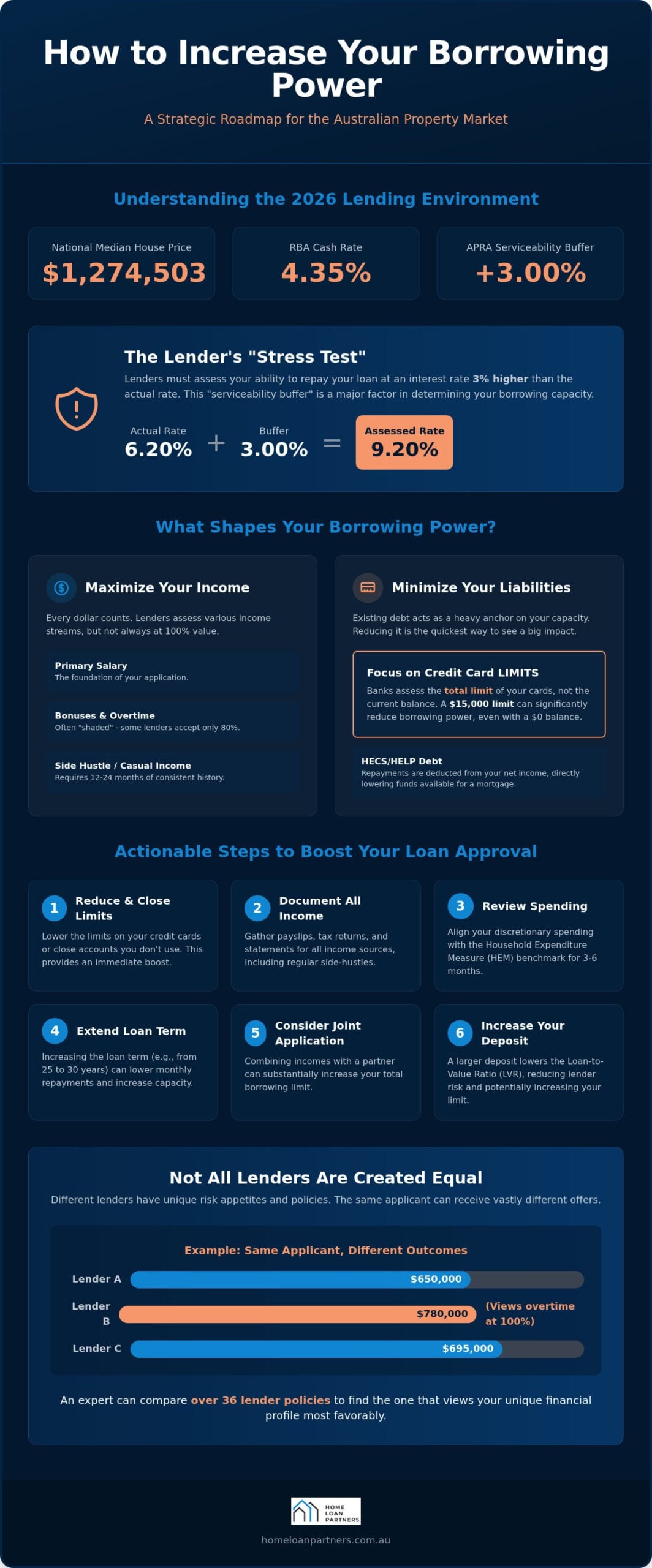
A significant factor in 2026 is the serviceability buffer. APRA requires banks to stress test your application at an interest rate 3% higher than the actual product rate. If you’re applying for a loan at 6.2%, the bank evaluates your lifestyle as if you’re paying 9.2%. This safety net is designed to protect you from future rate hikes, but it can feel like a major hurdle when you’re trying to secure a specific property. Learning how to increase borrowing power australia starts with understanding how these internal bank “stress tests” function.
Many Australians begin their journey with generic online tools. While these are useful for a quick estimate, they often fail to account for the nuanced policies of 36+ different lenders. Online calculators usually apply a “one size fits all” approach that can lead to disappointment later. To get a more reliable view of your potential, using a professional Home Loan Calculator Guide is a much safer way to begin your financial planning.
The Factors That Dictate Your Capacity
Income versus expenses sits at the heart of the serviceability equation. Lenders take your net income and subtract your regular commitments and living costs. Existing debt acts as a heavy anchor on your capacity. Credit cards are a common trap; banks assess the total limit of the card rather than the current balance. A $15,000 credit limit can reduce your borrowing power by significant margins even if you pay the balance in full every month. Your Loan-to-Value Ratio (LVR) also matters; a larger deposit signals lower risk, which can occasionally lead to more favorable treatment of your income.
Why Borrowing Power Fluctuates Between Lenders
Every bank operates with a unique internal calculator and a specific appetite for risk. Tier 1 lenders, such as the big four, often have more rigid rules regarding how they “shade” income. For instance, some lenders may only recognize 80% of your overtime or commission income, while others might accept the full 100%. APRA sets the baseline rules, but individual lenders decide how they view your specific profession or income structure. This variance is exactly why some borrowers find they can secure a higher loan amount simply by choosing a lender that views their specific financial profile more generously. This is a key strategy for anyone focused on how to increase borrowing power australia.
Maximizing Your Income and Managing Debt for Higher Capacity
Identifying every available dollar is the first step in your journey. We often find that clients overlook secondary income streams that could provide the extra leverage needed for a successful application. When looking at how to increase borrowing power australia, you should include regular bonuses, commissions, and even certain government benefits like Family Tax Benefits. While some lenders might “shade” this income by only accepting 80% of the total, others are more generous. This variability is why presenting a complete financial picture is vital for your success.
Managing your existing liabilities is just as important as proving your income. You can find more detail on this in the government guide to buying a house, which highlights how debts impact your overall position. One of the most effective moves you can make is to reduce or close unused credit card limits. Banks don’t look at what you owe on the card; they assess the total limit as a potential monthly expense. HECS/HELP debt reduces your borrowing power because lenders deduct the mandated repayments from your net monthly income, which lowers the surplus funds available to service a mortgage.
The Side Hustle and Casual Income Strategy
Secondary income can be a powerful tool, but it requires careful documentation. Most lenders want to see that you’ve held a secondary job or side hustle for at least 12 to 24 months to prove stability. If you’re an investor, ensuring your rental income is documented through official lease agreements is essential. For those who are self employed, having two years of clean tax returns is the standard way to demonstrate that your income is reliable and consistent over the long term.
Dealing with Existing Liabilities
Modern lenders now scrutinize ‘Buy Now, Pay Later’ services with the same intensity as traditional personal loans. These small, recurring commitments can signal a reliance on short term credit that lenders find risky. Similarly, car loans often have a disproportionate impact on your mortgage limit compared to the actual amount borrowed. Our team can help you review your liabilities and determine if a refinancing strategy might help you consolidate high interest debt. For a deeper look at how your total debt compares to what you earn, explore our analysis on What Is a Good Debt to Income (DTI) Ratio? to see where you stand.
The Impact of Lifestyle Expenses and the HEM Benchmark
While maximizing your income is essential, lenders place equal weight on how you spend your money. Banks use the Household Expenditure Measure (HEM) as a baseline to estimate your annual living costs. HEM is an industry standard that calculates the median spend for basic necessities based on your family size and location. It’s a common misconception that banks only look at this average. Lenders will always use the higher of your actual expenses or the HEM benchmark. If your bank statements show high discretionary spending, it will directly reduce your capacity, making it vital to understand how to increase borrowing power australia through lifestyle adjustments.
Many successful borrowers adopt a strategy often called “living like a monk” for the three months leading up to an application. This isn’t about permanent deprivation; it’s about presenting the cleanest possible financial profile. Banks categorize spending into discretionary, such as luxury items, dining out, and streaming services, and non-discretionary, which includes rent, utilities, and groceries. By temporarily reducing non-essential costs, you demonstrate a higher surplus of cash that can be used to service a mortgage. You should also be aware of your consumer rights for loans and credit to ensure you’re being treated fairly during this rigorous assessment process.
Red flags on bank statements can derail an application quickly. Excessive gambling transactions, frequent large transfers to Buy Now, Pay Later accounts, or multiple high end luxury subscriptions suggest a level of financial volatility that lenders dislike. They want to see a predictable, steady pattern of saving and responsible spending. Cleaning up these habits before you apply is a proactive way to build trust with your chosen lender. It shows you’re ready for the long term commitment of a home loan.
How to Audit Your Own Spending
Start by reviewing your bank statements from the last 90 days. Divide every transaction into “essential” and “non-essential” categories. This audit allows you to see where your money is actually going before a credit assessor does. If you have children, look into child care subsidies or other ways to lower dependents’ costs, as lenders assign a fixed cost to every dependent in your household. Being transparent with your broker about these expenses allows us to position your application more effectively and find a lender whose internal “floor” for expenses is more aligned with your reality.
The HEM vs. Actual Expenses Debate
Lenders adjust their benchmarks based on regional cost of living differences. A family in Sydney is expected to have higher baseline costs than a family in a regional town. If your actual spending is significantly higher than the HEM, the bank will use your real figures, which can sharply lower your loan limit. This is why managing your lifestyle is just as critical as managing your debt when you’re exploring how to increase borrowing power australia. Every dollar you save in your monthly budget can potentially translate into thousands of dollars in additional loan capacity.
Strategic Steps to Boost Your Loan Approval Limit
The way you structure your loan application can be just as influential as the numbers on your payslip. One of the most effective ways to lower your required monthly serviceability is to opt for a 30 year loan term. By spreading the principal repayments over a longer period, you reduce the immediate burden on your monthly cash flow. This is a common tactic for those exploring how to increase borrowing power australia, as it allows a lender’s calculator to see a higher surplus in your budget. If you’re applying with a partner, a joint application can pool your resources, provided you’ve both worked to minimize individual debts first.
Your credit score acts as a silent partner in this process. You can strengthen your profile by automating all bill payments to ensure a perfect repayment history. It’s also wise to avoid making multiple credit inquiries in the months leading up to your application, as frequent “pings” on your file can signal a high risk to potential lenders. For a broader view of how these steps fit into your property goals, our how do I buy a house in Australia guide offers a complete roadmap for the 2026 market.
The Power of a Larger Deposit
A substantial deposit fundamentally changes how a lender perceives your application. Reaching a 20% deposit allows you to avoid Lenders Mortgage Insurance (LMI), which can significantly increase your total purchasing budget. If saving that amount feels like a distant goal, using a guarantor can help you bypass deposit hurdles by leveraging the equity in a family member’s home. Throughout 2026, government support schemes like the Family Home Guarantee continue to provide a vital bridge for eligible buyers, allowing them to secure a home with a smaller deposit without sacrificing their total capacity.
Choosing the Right Loan Product
The specific loan product you select influences how the 3% serviceability buffer is applied. While most products are tested against this benchmark, lenders may view the long term stability of certain fixed rate terms differently. Interest only periods might seem attractive for initial cash flow, but lenders often calculate your capacity based on the remaining principal and interest term, which can actually reduce your maximum limit. A more effective approach is using an offset account. This keeps your serviceability high while giving you the flexibility to reduce interest costs. If you’re ready to find a structure that works for you, we can help you compare 36+ lender options to find your ideal fit.
Partnering with a Mortgage Broker to Unlock Lender Niches
While the strategies mentioned in previous sections give you a strong foundation, the final piece of the puzzle is finding the specific lender whose calculator is most sympathetic to your situation. This is where a professional collaborator becomes invaluable. At The Home Loan Partners, we compare over 36 different lenders to identify the one with the most generous assessment criteria for your unique profile. Navigating 2026’s shifting regulations requires more than just a standard application; it requires a deep understanding of how to increase borrowing power australia by matching your finances with the right institution.
Many borrowers are unaware that certain professions enjoy “niche” policies. If you work in the medical, legal, or accounting fields, some lenders offer higher Loan-to-Value Ratios (LVRs) or waived Lenders Mortgage Insurance. These specialized products can significantly boost your capacity because the bank views your profession as lower risk. Our role is to provide the unbiased advice you need to unlock these opportunities. For a deeper look at how this partnership works, you can explore The Ultimate Guide to Hiring a Finance Broker to see the full range of benefits we provide.
Why One Bank Says ‘No’ and Another Says ‘Yes’
The difference between a rejection and an approval often comes down to technical nuances in lender policy. For example, some banks apply heavy “shading” to rental income, only recognizing 80% of what you receive, while others may accept 90%. Similarly, certain lenders allow for “add-backs,” such as depreciation on investment properties, which effectively increases your paper income in their eyes. We have the ability to “pre-flight” your application with multiple credit teams before a formal submission. This protects your credit score and ensures we only proceed with the lender most likely to offer the highest limit.
Your Stress-Free Path Forward
We understand that the property journey can feel overwhelming. Our team is committed to managing the heavy lifting of the application process for you, from the initial audit of your expenses to the final settlement. We don’t just look at a single transaction; we focus on your long term goals and how your mortgage structure supports your future security. Our steady hand guides you through every hurdle with precision and care. If you’re ready to see your true potential, book a consultation with The Home Loan Partners today and let’s start this journey together.
Take the Next Step Toward Your Property Goals
Your journey to home ownership or investment success doesn’t have to be limited by a single bank’s calculator. Mastering how to increase borrowing power australia is about precision and choosing the right collaborator. By auditing your lifestyle expenses, strategically managing your existing liabilities, and selecting a loan structure that aligns with your long term aspirations, you can navigate the 2026 market with confidence. Your capacity is a variable outcome that depends heavily on which of the 36+ Australian lenders you choose to partner with.
At The Home Loan Partners, we take pride in managing the heavy lifting for you. Whether you’re a first home buyer or a seasoned investor, our professional mortgage broking services provide a stress free path through complex regulations. We act as your reliable guide, ensuring every detail of your financial profile is presented in the most favorable light possible. It’s time to move beyond guesswork and start planning with certainty.
Get a personalized borrowing power assessment from The Home Loan Partners today. We’re here to help you achieve your major life milestones with a steady hand and expert guidance. Your future security is our priority, and we look forward to supporting you throughout this rewarding journey.
Common Questions About Maximizing Your Capacity
How much does a credit card limit affect my borrowing power?
Banks assess the total credit limit of your card rather than the balance you actually owe. Even if you pay the card in full every month, a $10,000 limit is viewed as a potential debt that could be fully drawn at any time. This can reduce your loan capacity by tens of thousands of dollars. Closing unused cards or reducing these limits is a fast, effective way to boost your approval limit.
Does HECS debt significantly reduce how much I can borrow in 2026?
HECS debt impacts your capacity because lenders deduct the mandatory repayments from your net monthly income. For the 2026-27 income year, the compulsory repayment threshold is $69,528. While the marginal repayment system is now more flexible, any required payment reduces the surplus cash available to service a mortgage. Clearing a small remaining balance can be a strategic move if you’re on the cusp of approval.
Can I increase my borrowing power if I am self-employed?
Self-employed individuals can certainly increase their capacity by focusing on consistent income documentation. Most lenders require two years of tax returns, but some niche providers on our panel accept alternative documentation for shorter periods. We can help you identify lenders that view your specific business structure more favorably, which is a key part of how to increase borrowing power australia for business owners.
Will a pay rise immediately increase my borrowing capacity?
A pay rise will boost your limit once you can prove the income is stable and recurring. Most lenders require at least one to three months of payslips at the new rate before they’ll include it in their serviceability calculations. If you’ve just started a new role, some banks may also want to see that you’ve passed your probation period before they’ll fully recognize the higher salary.
How do lenders view ‘Buy Now, Pay Later’ services like Afterpay?
Lenders view Buy Now, Pay Later (BNPL) services as a form of credit similar to a personal loan or credit card. Frequent use of these services can lead a credit assessor to believe you struggle with daily cash flow management. It’s often best to close these accounts and ensure no active repayments appear on your bank statements for at least three months before you submit an application.
Does having a dependent (child) reduce my borrowing power?
Every dependent in your household increases the minimum living expense benchmark banks use. Lenders assign a fixed cost for each child, which reduces the amount of income left over to pay for a mortgage. While you can’t change your family size, ensuring you’re receiving all eligible child care subsidies can help offset how these costs are viewed during the bank’s assessment of your lifestyle.
Is it better to pay off my car loan or save a larger deposit?
Paying off a car loan is often more beneficial for your borrowing limit than saving a larger deposit. Car loans typically have high monthly repayments that significantly reduce your surplus income. Since serviceability is usually the tighter constraint in the current market, removing that monthly commitment can boost your loan capacity more than the extra cash would as a deposit.
Can a mortgage broker really find me a higher loan amount than my bank?
A mortgage broker can often secure a higher loan amount because they compare 36+ different lender calculators. Each bank has a unique way of treating income and expenses; some are far more generous with bonuses or overtime than others. Finding the right niche is a primary strategy for anyone researching how to increase borrowing power australia and seeking to maximize their total property budget.