

Did you know that 87.6% of Australian businesses report productivity gains of over 10% after upgrading their equipment? According to recent industry research, the benefits of modern gear are clear, yet the path to acquiring it often feels like a hurdle race against high upfront costs and shifting interest rates. Securing the right machinery finance shouldn’t feel like a gamble with your business’s future. It’s understandable to feel overwhelmed by the sheer volume of jargon or the fear of a “no” from a major bank, especially when the current RBA cash rate sits at 4.35%.
You want to grow your operations without draining your bank account, and you deserve a partner who translates complex terms into a clear strategy. This guide will help you master the nuances of asset finance so you can secure heavy equipment while keeping your cash flow strong. We’ll explore the tax advantages of different loan structures, clarify the difference between a chattel mortgage and an operating lease, and show you how to approach the 2026 lending market with confidence. Let’s find the steady path forward for your business growth.
Key Takeaways
- Shift your perspective from viewing equipment as a capital drain to seeing it as a revenue-generating tool that preserves your operational cash flow.
- Identify which finance structure, such as a chattel mortgage or finance lease, aligns with your business’s specific ownership and tax requirements.
- Gain access to a panel of over 36 lenders through an expert collaborator to find competitive machinery finance tailored to your unique circumstances.
- Streamline your path to approval by preparing the right financial documentation or exploring “Low Doc” options if your business history is shorter than two years.
- Secure long-term support that extends beyond the initial transaction, ensuring your asset portfolio continues to serve your growth goals throughout 2026.
What is Machinery Finance and Why Does Your Business Need It?
At its core, machinery finance is a specialized credit facility designed to help your business acquire essential equipment without the heavy burden of a lump-sum payment. It falls under the broader umbrella of asset-based lending, where the machinery itself often serves as the primary security for the loan. This structure allows you to put your equipment to work immediately, generating income while you manage the cost over time.
The most successful Australian business owners view this process as a fundamental shift in strategy. Instead of simply “buying an asset” and watching your cash reserves dwindle, you’re “financing a revenue-generator.” For example, if a new excavator earns A$500 a day but costs A$150 in finance repayments, it’s a profit center rather than a cost. By treating the finance as an operational tool, you ensure that the machine’s earnings cover its own repayments, effectively turning a capital expense into a self-sustaining investment.
Preserving your working capital is vital for day-to-day operations. Whether it’s covering payroll or managing unexpected repairs, having liquid cash provides a safety net. We often help clients match their loan terms to the useful life of the machinery. This precision ensures you aren’t still paying for equipment once it has become obsolete or requires excessive maintenance, keeping your balance sheet healthy and predictable.
The Strategic Advantage of Asset Finance in 2026
Staying competitive in today’s market requires access to the latest technology. Financing allows you to upgrade more frequently, ensuring your team has the most efficient tools available. Predictable monthly repayments simplify long-term budgeting, removing the “feast or famine” cycle that often accompanies major cash purchases. With the RBA cash rate at 4.35% as of August 2026, capital preservation isn’t just a preference; it’s a strategic necessity that protects your business against market fluctuations.
Common Types of Machinery Covered
We work with businesses across diverse sectors to secure the specific tools they need. Common examples include:
- Earthmoving and construction: Excavators, loaders, and graders for infrastructure projects.
- Agricultural machinery: Tractors, harvesters, and irrigation systems for the primary production sector.
- Manufacturing and industrial: Precision plant equipment, CNC machines, and specialized factory lines.
Comparing Machinery Finance Structures: Which Is Right for You?
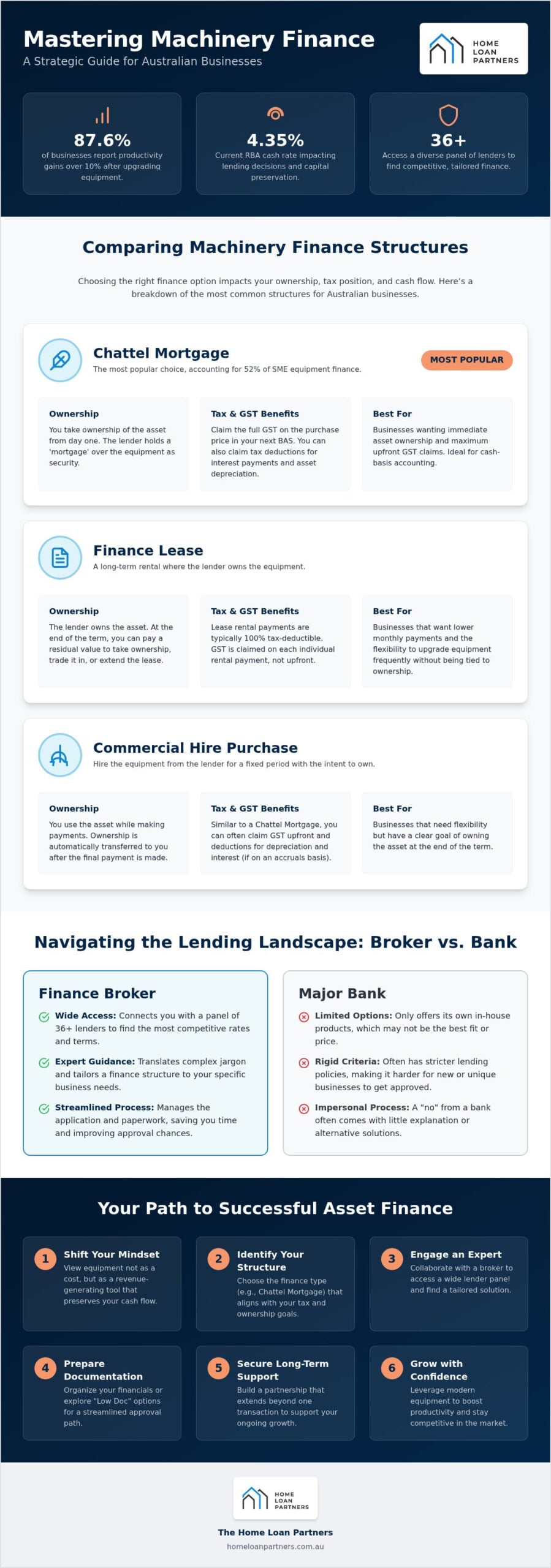
Selecting the right structure for your machinery finance is a decision that impacts your tax position and cash flow for years. It isn’t just about the interest rate. It’s about how the asset sits on your balance sheet and when you take full control of it. In Australia, the three primary paths are the Chattel Mortgage, Finance Lease, and Commercial Hire Purchase. Each offers different ownership timelines and tax treatments that can either hinder or accelerate your growth.
One essential feature across these structures is the “balloon payment” or residual value. By deferring a portion of the principal to the end of the loan term, you significantly lower your monthly repayments. This keeps more cash in your business for daily operations or emergency repairs. Most structures also allow you to claim GST input tax credits, though the timing of these claims depends on whether you’re using a lease or a purchase-style agreement. You can find a detailed breakdown of Leasing or buying vehicles and equipment through official government resources to see how these choices affect your obligations.
Chattel Mortgage: The Most Popular Choice for SMEs
The chattel mortgage remains the dominant choice for Australian small businesses, accounting for 52% of all equipment finance loans. Under this arrangement, you take ownership of the machinery from the moment of purchase. The lender secures the loan by taking a “mortgage” over the asset. Since you own the equipment immediately, you can typically claim the full GST amount on your next BAS. This is particularly beneficial for businesses using cash-basis accounting. You also benefit from tax deductions on both the interest paid and the asset’s depreciation.
Leasing vs. Hire Purchase: Understanding the Nuances
A Finance Lease is often the preferred route when you want to minimize monthly outgoings. In this scenario, the lender retains ownership, and you pay a fixed monthly rental for its use. It’s a clean way to manage costs without the immediate responsibilities of ownership. Conversely, a Commercial Hire Purchase acts as a middle ground. You hire the equipment from the lender for a fixed term, and ownership automatically transfers to you once the final payment is made. For high-turnover technology that becomes obsolete quickly, an Operating Lease functions as a simple rental-style agreement where you return the gear at the end of the term.
Deciding between these paths requires a clear understanding of your long-term goals and current tax standing. If you’re unsure which path fits your 2026 growth strategy, our team can help you compare asset and equipment finance options tailored to your specific industry.
Finance Broker vs. Bank: Navigating the 2026 Lending Landscape
Many Australian business owners assume their long-term business bank is the best place for machinery finance. It’s a common misconception. While your bank knows your history, they only have one set of products and one specific appetite for risk. If your requirements fall outside their narrow criteria, you might face a rejection or sub-optimal terms. A finance broker changes this dynamic by acting as your advocate rather than a gatekeeper for a single institution.
One significant risk of going direct is the impact on your credit profile. Every time you submit a formal application to a bank, it leaves a hard hit on your credit report. Multiple applications in a short window can signal financial distress to lenders, even if you’re just shopping for a better deal. We manage this by performing a single, comprehensive assessment and then identifying the most suitable lenders from our panel of over 36 institutions. This protective approach preserves your credit score while ensuring you see the full breadth of the market.
The Power of a Wide Lender Panel
Different lenders specialize in different asset classes. Some prefer yellow goods like excavators, while others focus on agricultural or medical equipment. Non-bank lenders have grown their market share to over 30% as of late 2025, often providing more flexible terms for businesses that don’t fit the traditional big-bank mold. Our finance broker services bridge this gap, connecting your specific machinery finance needs with lenders who actively want to support your industry.
Unbiased Advice and Long-Term Partnership
We operate as expert collaborators, not just transactional agents. Because our commissions are typically paid by the lender, you benefit from professional guidance without the burden of upfront broker fees. This alignment ensures our focus remains entirely on your best interests. We handle the heavy lifting of paperwork and negotiation, acting as a steady hand throughout the process. This partnership doesn’t end at settlement; we stay by your side to support your financial journey as your business scales and evolves.
Preparing for Your Application: Maximising Your Approval Chances
Applying for machinery finance in 2026 requires a more deliberate approach than in previous years. With the RBA cash rate currently sitting at 4.35%, lenders are paying closer attention to your business’s ability to service debt in a shifting economic climate. They don’t just look at what you owe; they look at what the machine will earn for you. Demonstrating a clear Return on Investment (ROI) is often the deciding factor. If you can show that a new excavator will increase your weekly billable hours or reduce costly maintenance downtime, you present a much lower risk to the credit team.
If your business hasn’t reached the two-year mark, don’t assume you’re ineligible for funding. While traditional banks often demand years of tax returns, specialized lenders offer “Low Doc” options. These pathways rely more on your bank statements and Business Activity Statements (BAS) than full historical financial reports. It’s a vital lifeline for growing Australian SMEs that need to scale quickly but lack the long-term paper trail that “big four” banks typically require.
Financial Readiness Checklist
Lenders scrutinize your Profit and Loss statements to identify growth trends and stability. They’re looking for the capacity to absorb repayments comfortably, especially with prime rates for borrowers currently ranging from 7.49% to 8.49%. For SMEs looking to ensure their financial records are in top shape, Proledger provides expert bookkeeping and tax compliance services that help maintain a clear picture of business health. Consider the following:
- Profit and Loss: Evidence of consistent revenue that covers all current operating costs.
- Cash flow projections: A forward-looking view that includes the new loan repayments and expected income from the asset.
- Credit Scores: Both your business and personal credit history are relevant. A single broker-led assessment helps protect these scores from multiple “hard hits.”
Evaluating the Machinery’s Value
The age and source of your equipment influence your loan terms significantly. New machinery often attracts lower interest rates because it has a longer working life and higher resale value. While used gear is currently in high demand due to supply chain delays, lenders may require an independent valuation if you’re buying through a private sale. Dealer sales are generally simpler to process and often come with more straightforward approval paths. Lenders view the machinery itself as security, which often reduces the need for other collateral. If you’re ready to start your journey, our team can help you prepare your Asset & Equipment Finance application for the best chance of success.
The Home Loan Partners: Your Expert Collaborators in Asset Finance
At The Home Loan Partners, we believe that securing machinery finance should be the beginning of a partnership, not just the end of a transaction. We understand that the heavy equipment you’re acquiring represents a significant milestone in your business’s journey. Our goal is to alleviate the inherent stress of financial planning by projecting a sense of calm, steady expertise. Whether you’re a first-time applicant or looking to expand an existing fleet, we act as a reliable guide through the entire process, from the initial consultation to final settlement and beyond.
Our team brings a wealth of knowledge that spans home, commercial, and machinery loans. This broad perspective allows us to see your whole financial picture, ensuring that your equipment debt doesn’t conflict with your other long-term goals. We’re deeply rooted in the Australian market and committed to managing the heavy lifting for you. You aren’t just a number in a database; you’re a collaborator who deserves a professional, reassuring experience that values transparency and clarity above all else.
Tailored Solutions for Your Business Goals
We don’t believe in one-size-fits-all lending. Different industries face unique challenges, such as seasonal revenue drops in agriculture or project-based cash flow cycles in construction. We structure your machinery finance to align with these specific rhythms, ensuring your repayments remain manageable during quieter periods. By accessing our panel of over 36 lenders, we find the specific “fit” that suits your industry’s requirements. This national reach combined with local expertise means we can navigate complex arrangements and distill them into punchy, benefit-driven statements that prioritize your understanding.
Getting Started is Simple
Taking the first step toward your next asset upgrade is designed to be stress-free. We begin with a no-obligation conversation to understand your equipment needs and your aspirations for 2026. From there, we manage the lender negotiations and paperwork, acting as your steady hand in a fast-moving market. We take pride in our role as an intermediary, translating specialized industry jargon into practical language that empowers you to make informed decisions. If you’re ready to secure the tools your business needs to thrive, Speak with The Home Loan Partners about your machinery finance needs today. We’re here to support you for the life of your loan and the duration of your success.
Empower Your Business Growth with Strategic Finance
Mastering the nuances of machinery finance is about more than just finding an interest rate; it’s about building a foundation for sustainable growth. By matching your loan structure to your specific cash flow cycles and preparing a robust application, you position your business to thrive in the 2026 economic landscape. We’ve explored how a strategic approach to asset acquisition turns equipment into a revenue-generator rather than a capital drain.
You don’t have to navigate these complex financial decisions alone. At The Home Loan Partners, we act as your expert collaborators, offering professional, unbiased guidance and national Australian coverage. With access to a panel of over 36 lenders, we manage the heavy lifting so you can focus on running your business. We’re committed to your long-term journey and are ready to help you reach your next milestone with a steady hand.
Get a Tailored Machinery Finance Quote from Our Experts
Frequently Asked Questions
How much can I borrow for machinery finance in Australia?
You can typically borrow anywhere from A$10,000 to several million dollars depending on your business’s financial strength and the asset’s value. Lenders generally look at your serviceability and the equipment’s revenue-generating potential. Through our panel of over 36 lenders, we help you find a facility that matches your specific borrowing requirements. Most established businesses can secure up to 100% of the machinery’s purchase price, including GST and delivery costs.
What is the difference between a chattel mortgage and a lease?
The primary difference lies in ownership and tax treatment. With a chattel mortgage, you own the equipment from day one, and the lender takes a mortgage over the asset. In a lease, the lender owns the machinery, and you pay for its use. While a mortgage allows for immediate GST claims and depreciation, a lease often provides lower monthly payments. Choosing the right structure for your machinery finance depends on your specific cash flow and tax goals.
Can I get machinery finance for used equipment?
Yes, you can certainly finance used equipment, though lenders often have guidelines regarding the asset’s age. Most institutions prefer the machinery to be no older than 10 to 15 years at the end of the loan term. While interest rates for used gear can be slightly higher than for new models, it remains a popular choice due to immediate availability. We assist with the necessary valuations and inspections required for used assets, especially in private sales.
Do I need a deposit for a machinery loan?
You don’t always need a deposit to secure an equipment loan. Many lenders offer 100% financing for established businesses with a strong credit history and clear financial statements. However, if you’re a new business or purchasing specialized gear from a private seller, a deposit of 10% to 20% might be required. Providing a deposit can reduce your monthly repayments and lower the total interest paid over the life of the loan.
What are the tax benefits of machinery finance in 2026?
In 2026, eligible businesses with an annual turnover of less than A$10 million can access the permanent A$20,000 instant asset write-off threshold. This allows you to claim an immediate deduction for the full cost of eligible assets used or installed by 30 June 2026. Additionally, you can generally claim tax deductions for the interest paid on the loan and the annual depreciation of the machinery. These benefits significantly improve your net cash position.
Can I get finance if I have a new business (less than 2 years)?
You can still secure funding even if your business has been trading for less than two years. While traditional banks often require extensive history, our access to non-bank lenders allows us to explore “Low Doc” options. These paths focus on your recent Business Activity Statements (BAS) and bank statements rather than years of tax returns. It’s a practical way for newer enterprises to acquire the heavy equipment they need to scale their operations quickly.
What happens if I want to pay off my machinery loan early?
You can pay off your loan early, but it’s important to check your specific contract for early termination fees or break costs. Some lenders charge a fee to compensate for the interest they lose when a fixed-rate loan ends prematurely. Others might offer more flexible terms with minimal penalties. We help you understand these conditions before you sign, ensuring your finance structure provides the flexibility your business might need in the future.
How long does it take to get approval for machinery finance?
Approval times vary, but many simple machinery loans are approved within 24 to 48 hours. If your application is straightforward and you have all your documentation ready, the process is quite fast. More complex scenarios or specialized equipment might take three to five business days for a final decision. We manage the communication with the lender to ensure your application moves through the system as efficiently as possible, helping you get on-site sooner.