

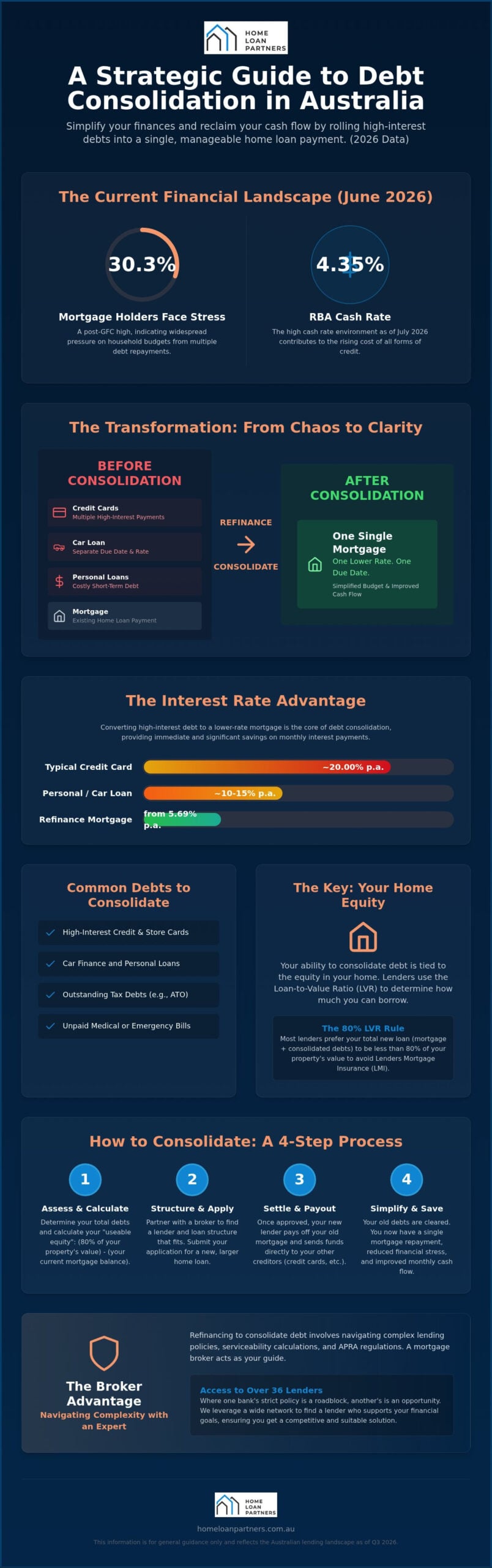
With 30.3% of Australian mortgage holders currently facing mortgage stress as of June 2026, you aren’t alone if your monthly budget feels tighter than ever. Juggling high-interest credit cards, car loan due dates, and a mortgage is exhausting, and it often feels like you’re just treading water despite your best efforts. If you’re looking for a more manageable path forward, you might decide to refinance to consolidate debt in Australia to regain control of your household cash flow and simplify your life.
We understand that while the idea of a single, lower monthly repayment is appealing, you’re likely worried about whether you’ll end up paying more in the long run. This guide will show you how to restructure your finances effectively while avoiding common interest traps that can extend the life of your debt. We’ll explore the latest 2026 lending landscape, including APRA’s debt-to-income regulations, to help you build a clear, stress-free strategy for becoming debt-free sooner.
Key Takeaways
- Learn how to roll high-interest liabilities into a single mortgage payment to simplify your budget and immediately improve monthly cash flow.
- Discover the strategic steps to refinance to consolidate debt in Australia while navigating the latest 2026 APRA serviceability buffers and debt-to-income limits.
- Understand the importance of the 80% LVR rule and how maintaining sufficient equity helps you access more competitive interest rates.
- Identify the specific pitfalls of long-term interest and how to structure your new loan to ensure you’re actually paying off debt faster.
- Explore how partnering with an expert who has access to over 36 lenders provides the flexibility needed to find a supportive financial solution tailored to your goals.
What Does It Mean to Refinance to Consolidate Debt?
Refinancing to consolidate debt isn’t just a paperwork change; it’s a strategic financial reset. At its core, What is Debt Consolidation? through your mortgage means replacing your current home loan with a new, larger facility. This new loan pays off your existing mortgage plus the balances of other high-interest debts you’ve accumulated. We act as your guide through this process, ensuring the transition is smooth and the new structure aligns with your future goals.
The process is seamless. Your new lender pays out your credit cards or personal loans directly, and the total amount is then rolled into your home loan balance. By doing this, you’re essentially converting expensive, short-term debt into more affordable, long-term debt. It’s a proactive way to manage the heavy lifting of multiple repayments by bringing them under one roof.
As of July 2026, Australians are facing a challenging environment with the RBA cash rate at 4.35%. With mortgage stress reaching a post-GFC high of 30.3%, many families are using this method to protect their household budget from the rising cost of living. It provides a way to reclaim your monthly cash flow when non-mortgage debts start to feel overwhelming.
You might consider asking your current bank for a “top-up,” which simply increases your existing loan limit. However, this often keeps you locked into a product that may no longer be the most competitive option on the market. When you refinance to consolidate debt in Australia by moving to a new lender, you open the door to tailored loan structures. We often find that one bank’s strict policy is another’s opportunity, and having access to over 36 lenders allows us to find the right fit for your specific needs.
Common Debts Australians Consolidate
Homeowners frequently bundle various liabilities to simplify their lives. High-interest credit cards and store cards are the most common targets, followed closely by car finance and personal loans. We also help clients include tax debts or outstanding medical bills to ensure every financial obligation is captured under one manageable, predictable payment plan.
The Immediate Impact on Monthly Cash Flow
The Role of Home Equity and LVR in Consolidation
Your ability to refinance to consolidate debt in Australia relies heavily on two pillars: the value of your home and the amount you currently owe. Equity is the difference between these two figures. For example, if your home is worth $900,000 and your mortgage is $600,000, you have $300,000 in total equity. However, lenders don’t allow you to borrow against every cent of that value. They use the Loan-to-Value Ratio (LVR) to determine how much risk they’re willing to take on.
Most lenders prefer your total debt to stay below 80% of your property’s value. This is known as the “80% Rule.” If your new loan amount, which includes your mortgage plus consolidated debts, exceeds this threshold, you’ll likely need to pay Lenders Mortgage Insurance (LMI). While this adds an upfront cost, it’s sometimes a viable trade-off if the interest savings from your high-rate debts outweigh the insurance premium. We can help you weigh these costs against your potential savings to ensure the move makes financial sense. For a deeper look at the risks and benefits, you can consult this Australian government guide to debt consolidation.
Calculating Your Useable Equity
It’s vital to distinguish between “total equity” and “useable equity.” Useable equity is the amount you can actually access without exceeding the 80% LVR limit. You can calculate this by taking 80% of your property’s current value and subtracting your existing mortgage balance. If you’re unsure of your current numbers, our Home Loan Calculator Guide is an excellent resource for planning your next steps. With property valuations shifting in early 2026, getting an up-to-date appraisal is the first step in seeing what’s possible.
Serviceability and Debt-to-Income (DTI) Ratios
Having equity is only half the battle. Lenders also look at your “serviceability,” which is your ability to afford the new repayments. As of February 2026, APRA requires banks to limit new lending to borrowers with a total debt-to-income ratio of six times or more. This means your total debt, including the consolidated amount, should ideally stay within this range. Lenders also factor in your existing credit card limits as if they were fully drawn, even if you owe nothing on them. This is where tailored loan structures become essential. We work with you to present your financial position accurately, ensuring lenders see the full picture of your improved cash flow post-consolidation.
The Pros and Cons: Is It Always a Good Move?
Choosing to refinance to consolidate debt in Australia is a powerful maneuver, but it requires a clear-eyed look at both the immediate wins and the long-term costs. The most obvious benefit is the immediate surge in household cash flow. By merging multiple high-interest payments into your mortgage, you can often halve your monthly outgoings. This creates breathing room to build an emergency fund or simply manage daily expenses without the stress of constant due dates.
There’s also a significant advantage for your credit profile. When you close high-limit credit cards and store accounts, you reduce your total credit exposure. Lenders look favorably on borrowers who’ve streamlined their liabilities, which can improve your standing for future financial milestones. If you’re in severe financial distress where refinancing isn’t an option, you might need to explore formal debt agreement options through AFSA. For most homeowners, though, refinancing remains the primary tool for proactive debt management.
The Long-Term Interest Trap Explained
The primary risk of consolidation is turning short-term debt into a decades-long burden. Consider a $30,000 car loan with four years remaining. If you roll that balance into a mortgage with a 30-year term, you’ll be paying interest on that car long after it’s been sent to the scrap yard. While your monthly payment drops, the total interest paid over 30 years can be significantly higher than the original high-interest 5-year loan. Interest rate is only half the story; loan term is the other. Without a specific strategy, you might trade a short-term cash flow problem for a long-term wealth erosion problem.
How to Beat the Trap: Strategic Loan Splitting
We help our clients avoid this trap by using tailored loan structures, specifically split loans. Instead of dumping everything into one big bucket, we isolate the consolidated debt into its own separate sub-account. You can then set a much higher repayment schedule for this specific portion, aiming to pay it off in the original 3 to 5 year timeframe. This allows you to enjoy the lower mortgage interest rate without the penalty of a 30-year term. Understanding what does refinancing a home loan mean in a strategic sense is the key to ensuring your restructure actually builds wealth. We handle the heavy lifting of setting up these partitions so your path to being debt-free remains clear and predictable.
How to Refinance to Consolidate Debt: Step-by-Step
Moving from the “why” to the “how” requires a methodical approach to ensure your new loan structure delivers the relief you need. When you decide to refinance to consolidate debt in Australia, following a structured path helps you avoid administrative delays and ensures the final product aligns with your long-term wealth goals. We act as your expert collaborator during this transition, managing the heavy lifting so you can focus on your household budget.
Step 1: Audit your current debts. Gather recent statements for every credit card, personal loan, and car finance agreement. You need a precise total of your outstanding balances and their current interest rates to calculate your potential savings. Step 2: Determine your equity. We coordinate a professional valuation of your property to see how much “useable equity” is available. This step is vital for staying within the 80% LVR threshold we discussed earlier.
Step 3: Consult your broker. This is where our access to over 36 lenders becomes your greatest asset. We compare different credit policies to find a lender that is “debt-friendly” and offers the most competitive 2026 rates. Step 4: Create an Exit Strategy. We help you document a clear plan for the consolidated portion of the loan. This might involve a split loan structure that ensures the short-term debt is paid off in five years rather than thirty. Step 5: Settlement. Once approved, your new lender pays off your old debts directly. You’re left with one single, manageable mortgage payment.
Documents You Will Need
Lenders in 2026 are thorough with their assessments. To keep the process moving, you should have your most recent two payslips and your last two years of tax returns ready. You’ll also need the last three to six months of statements for every debt you intend to consolidate, along with your current mortgage statements and your latest council rates notice. Having these ready allows us to move quickly when we find the right lender for your situation.
Common Pitfalls to Avoid During the Application
One of the biggest mistakes is applying for new credit, like a store card or “buy now, pay later” service, just before or during your refinance. This can trigger a credit file alert and potentially disqualify your application. Additionally, be realistic about your living expenses. Lenders use the Household Expenditure Measure (HEM) but will also look at your actual spending patterns. Finally, you must close your old credit card accounts once they are paid out. Keeping them open, even with a zero balance, counts against your future borrowing power under current APRA debt-to-income limits. If you’re ready to start your audit, you can speak with our team about your refinancing options today.
Why a Mortgage Broker Is Essential for Debt Consolidation
When you approach a single bank, you’re limited by their specific appetite for risk. If your debt-to-income ratio is nudging that six times threshold set by APRA in early 2026, a “no” from one of the big four can feel like a dead end. However, our access to over 36 lenders changes the dynamic entirely when you refinance to consolidate debt in Australia. We know which lenders are currently more “debt-friendly” and which ones have adjusted their serviceability buffers to accommodate different financial backgrounds. This variety ensures that we aren’t just searching for any loan, but the right loan that supports your specific recovery.
The Home Loan Partners approach is built on alleviating the inherent stress of these complex financial shifts. We don’t just facilitate a transaction; we act as a steady hand navigating you through a competitive market. By distilling technical jargon into practical language, we help you understand exactly how your new structure will function. It’s about more than just a lower rate. It’s about a tailored loan structure that protects your long-term security and prevents you from falling back into the same interest traps we’ve discussed.
Navigating Lender Policies
Lender policies are often dense and nuanced, especially regarding how they view existing liabilities. For instance, some banks assess your serviceability based on your total credit card limits, even if you owe nothing, while others may be more flexible if you agree to close the accounts as part of the refinance to consolidate debt in Australia. We also identify lenders who allow for “cash out” to pay debts personally versus those who require direct payout to the creditors. Understanding these small differences can be the deciding factor in a successful application. For more on how to choose the right expert for this journey, see The Ultimate Guide to Hiring a Finance Broker.
Your Long-Term Financial Partner
Our commitment to your financial health doesn’t end when the loan settles. We view our involvement as a long-term journey, continuing through the duration of your relationship with your lender. We perform ongoing reviews to ensure your loan structure remains appropriate as your equity grows or as market conditions shift. This focus on longevity helps you achieve major life milestones without the weight of unmanaged debt. If you’re ready to move toward a simpler, more predictable financial future, Book a strategy session with The Home Loan Partners and let us handle the heavy lifting for you.
Your Path to a Simpler Financial Future
Restructuring your finances doesn’t have to be a source of anxiety. By understanding the balance between your home’s equity and your current liabilities, you’ve already taken the first step toward reclaiming your monthly cash flow. We’ve seen how a strategic approach, particularly using split loan structures, ensures that you don’t trade short-term relief for long-term interest costs. When you choose to refinance to consolidate debt in Australia, you aren’t just moving numbers around; you’re creating a sustainable environment for your family to thrive.
Our team is here to manage the heavy lifting, providing access to over 36 Australian lenders and expert guidance on loan structuring to ensure your new arrangement fits your life perfectly. We pride ourselves on delivering a professional, stress-free process that prioritizes your clarity and future security. You don’t have to navigate the complexities of 2026 lending regulations alone. Simplify your repayments with a free debt consolidation strategy session and let’s build a clear, predictable roadmap together. You’ve got this, and we’re ready to help you every step of the way.
Frequently Asked Questions
Will refinancing to consolidate debt affect my credit score?
Consolidating debt can have a positive long-term impact on your credit score by reducing your total credit utilization and simplifying your repayment history. While the initial application involves a credit inquiry that might cause a minor, temporary dip, the act of closing multiple high-interest accounts often outweighs this. It signals to future lenders that you’re proactively managing your liabilities and maintaining a structured approach to your finances.
How much equity do I need to consolidate my debts?
You typically need enough equity to ensure your total loan amount remains at or below 80% of your property’s value to avoid Lenders Mortgage Insurance. While some lenders on our panel of 36+ may allow you to consolidate with as little as 5% or 10% equity, this often incurs additional insurance costs. Staying within the 80% threshold usually provides access to the most competitive interest rates available in the 2026 market.
Can I consolidate my credit cards if I am behind on my mortgage payments?
It’s significantly more challenging to refinance to consolidate debt in Australia if you are currently in arrears on your mortgage. Lenders generally require a clean repayment history for at least the last six months to demonstrate your reliability as a borrower. If you’re struggling, it’s best to speak with us early so we can explore your options before your credit file is impacted by missed payments.
Is it better to use a personal loan or a home loan for debt consolidation?
A home loan typically offers a much lower interest rate than a personal loan, but you must consider the total interest over the life of the loan. While a personal loan has higher monthly costs, its shorter term means you pay less interest overall. We often recommend a split home loan structure to combine the lower rate of a mortgage with the shorter repayment timeframe of a personal loan.
What are the costs involved in refinancing for debt consolidation?
Refinancing involves several standard costs, including lender application fees, property valuation fees, and government registration charges. You’ll also need to account for a discharge fee from your current lender to close your existing mortgage. We provide a clear, professional breakdown of these expenses upfront so you can ensure the interest savings from your consolidation outweigh the initial setup costs of the new loan.
How long does the refinancing process take in Australia?
The refinancing process in Australia generally takes between four and six weeks from your initial application to the final settlement. This timeframe allows for the property valuation, the lender’s credit assessment, and the legal transfer of the mortgage between institutions. We handle the administrative heavy lifting and follow-ups with lenders to keep your application moving as quickly and smoothly as possible.
Can I consolidate tax debt into my home loan?
You can often consolidate ATO tax debt into your mortgage, provided you meet specific lender criteria regarding your income and equity. Some lenders are more supportive of this than others, often requiring evidence of a current payment plan or a clear explanation for the debt. We work with specialized lenders who understand these scenarios and can help structure a loan that clears your tax obligations.
Do I have to close my credit cards after they are consolidated?
Most lenders will require you to close your credit card accounts as a condition of the loan approval to manage your debt-to-income ratio. Even a card with a zero balance is viewed as a potential liability because you could draw on that credit limit at any time. Closing these accounts ensures your new, simplified budget remains on track and prevents you from accumulating new high-interest debt.