

What if the answer to “how much can i borrow for an investment property” had less to do with your annual salary and more to do with which bank’s calculator you used? It’s a common frustration for Australian investors in 2026. You might feel the weight of the 3% serviceability buffer or worry that “rental shading” policies, where banks only count a portion of your rental income, are unfairly limiting your reach. With the RBA holding the cash rate at 4.35% and new APRA caps on debt to income ratios, the lending environment can feel restrictive and complex.
We understand that these hurdles can feel like roadblocks to your long term goals. However, your borrowing capacity is actually a variable outcome rather than a fixed figure. This guide will walk you through the precise formulas lenders use and show you how to strategically position your finances to unlock higher loan amounts. We’ll explore how to use your existing home equity effectively and why comparing 36+ different lender policies is the most powerful tool in your kit. By the end of this article, you’ll have a clear, stress-free path to securing the finance you need for your next move.
Key Takeaways
- Understand exactly how much can i borrow for an investment property by exploring how different Australian lenders apply risk weighted assessments to your unique financial profile.
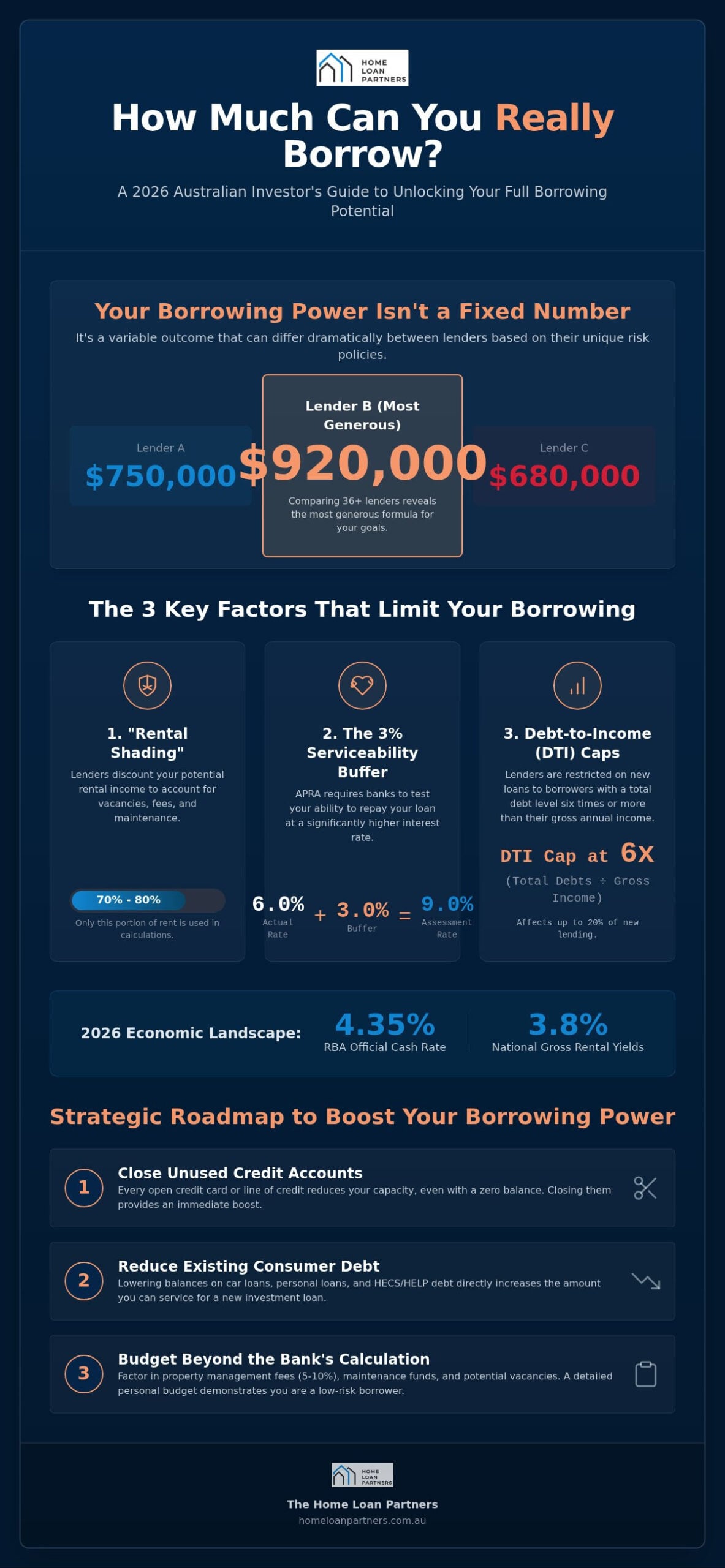
- Learn why “rental shading” often limits your capacity and how banks vary in their treatment of projected rental income, typically counting only 70% to 80%.
- Identify strategic ways to increase your borrowing power, including a 3 to 6 month financial roadmap and the immediate impact of closing unused credit accounts.
- Explore the impact of the 3% serviceability buffer and learn why lender variance means one bank’s rejection could be another bank’s approval.
- Gain the confidence to move forward by discovering how comparing 36+ lenders can reveal the most generous borrowing formula for your investment goals.
Understanding Investment Borrowing Power in the 2026 Australian Market
Determining how much can i borrow for an investment property starts with a clear grasp of borrowing power. In the eyes of a lender, this isn’t just a simple multiple of your salary. It’s a risk weighted assessment of your loan to income ratio. This calculation determines the maximum amount of debt a bank feels you can safely carry without jeopardizing your financial security or their capital. While you might have a specific figure in mind, the bank’s perspective is shaped by complex regulatory requirements and internal risk appetites.
Investment borrowing capacity usually differs from owner occupier limits for several reasons. When you buy a home to live in, your personal income is the sole source of repayment. With an investment, you have the benefit of rental income, but you also face higher interest rates and additional holding costs. Lenders view investment debt as slightly higher risk, which is why they often apply more stringent “shading” to your income and stricter assessments of your existing liabilities. A foundational step in understanding mortgage loans is recognizing that these variables can significantly shift your total capacity from one lender to the next.
The 2026 economic landscape has introduced new layers of complexity. With the Reserve Bank of Australia (RBA) holding the official cash rate at 4.35%, and APRA enforcing caps that limit high debt to income lending, the “ceiling” for many borrowers has lowered. Specifically, lenders are now restricted to having no more than 20% of their new loans go to borrowers with a debt to income ratio of six or higher. Investment serviceability is the calculation of your ability to cover loan repayments using personal income plus a portion of projected rental returns.
The Role of APRA and 2026 Serviceability Buffers
The Australian Prudential Regulation Authority (APRA) currently requires all banks to apply a 3% serviceability buffer. This means if your actual interest rate is 6%, the bank tests your ability to make repayments at 9%. This “stress testing” is a protective measure. It ensures you can still manage your portfolio even if interest rates rise in the future. While these national regulations create a consistent “floor” for major lenders, they also mean that your actual borrowing limit might be lower than what your monthly surplus suggests.
Borrowing Capacity vs. Your Personal Budget
There’s often a significant difference between what a bank says you can borrow and what you should borrow. When you’re asking how much can i borrow for an investment property, it’s vital to look at your personal comfort levels. A bank’s calculator doesn’t always account for your specific lifestyle goals or the granular costs of property ownership. You should always factor in:
- Property management fees, which typically range from 5% to 10% of the rent; for expert assistance with these costs, you can visit RealHelp Real Estate.
- Ongoing maintenance costs and emergency repair funds.
- Buffer periods for potential vacancies where no rent is coming in.
Our role is to act as a steady hand, helping you balance ambitious portfolio growth with your daily financial requirements. We want to ensure your investment journey is a source of security, not a source of stress.
The Serviceability Equation: How Lenders Assess Your Investment Profile
Lenders don’t just ask how much you earn. They look at the quality and consistency of your financial life to determine how much can i borrow for an investment property. Every bank uses a serviceability calculator, which is a math problem with moving parts. The core components include your gross income, ongoing living expenses, existing debts, and the projected rental yield of the property you intend to buy. While you might see a high rental return on a listing, banks view this through a lens of caution. The RBA’s recent reports on Australian financial stability emphasize why these assessments have become more granular in 2026.
One of the biggest surprises for many investors is “rental shading.” Even though national gross rental yields have risen to 3.8%, most banks will only count 70% to 80% of that income in their calculations. They do this to account for potential vacancies, management fees, and maintenance costs. Simultaneously, they use the Household Expenditure Measure (HEM) to set a baseline for your living costs. If your actual spending is lower than the HEM benchmark for your family size, the bank will often still use the higher HEM figure. This conservative approach ensures you have a safety net, but it can also limit your perceived capacity if you don’t present your application correctly.
Income Assessment: Beyond the Pay Slip
In 2026, lenders are looking closely at how your income is structured. If you receive bonuses, commissions, or dividends, some banks may only recognize 80% of those amounts, while others might accept the full 100% if you have a two year history. Negative gearing remains a helpful factor for properties purchased before the 2027 tax changes. Many lenders allow you to “add back” the expected tax savings from negative gearing, which can provide a modest boost to your serviceability. Self-employed investors face different documentation requirements than PAYG earners. Having a broker analyze your investment profile across various lenders can help you find one that treats your specific income type most favorably.
The ‘Debt Drag’ and Credit Limits
Existing liabilities often act as a “debt drag” on your application. A credit card with a $20,000 limit can reduce your borrowing power by significant margins, even if the balance is zero. Banks assess the limit, not the balance, assuming you could spend that money at any time. Similarly, HECS or HELP debts are scrutinized because they reduce your monthly take home pay. Modern credit teams also look at “Buy Now Pay Later” (BNPL) accounts. These are now treated as lines of credit, and multiple active accounts can signal a reliance on short term debt. Clearing these small limits before you apply is a simple way to instantly improve your standing.
Why Bank Calculators Often Underestimate Your Real Potential
Most investors begin their journey by visiting a major bank’s website to use a basic online tool. While these are convenient, they rely on rigid “computer says no” logic. A single bank’s calculator only uses one set of internal rules, which may not account for the nuances of your financial situation. This often leads to a conservative result that doesn’t reflect your actual capacity. When you’re asking how much can i borrow for an investment property, it’s vital to remember that each of the 36+ lenders in the Australian market has a different appetite for risk.
The “Lender Variance” gap is a powerful tool for savvy investors. While one bank might be strict about the new APRA debt to income caps, another might have a more flexible policy for borrowers with high rental yields. For example, consider a hypothetical investor with a stable salary and a potential property yielding 4%. Lender A might limit their borrowing to A$650,000 due to aggressive shading of the rental income. Lender B, using a different serviceability model, might offer A$750,000 for the exact same profile. That A$100,000 difference can be the deciding factor between a standard apartment and a high growth house in a prime location. A professional finance broker can run your numbers through dozens of these models to find the one that fits you best.
Lender Policies for Specific Professional Niches
Some Australian lenders actively seek out specific types of borrowers by offering “niche” policies. Medical professionals, such as doctors and dentists, or legal experts often have access to higher Loan to Value Ratios (LVRs) or may have Lenders Mortgage Insurance (LMI) waived entirely. Other banks prefer high net worth investors who use complex tax structures like family trusts or companies. By matching your “financial DNA” to the right lender’s specific preferences, you can often unlock significantly more capital than a generic calculator would suggest.
The Strategy Behind Using a Home Loan Calculator
This concept of finding a specific fit extends to private lending as well, where specialized resources like level4funding.com offer financing solutions that can help investors navigate scenarios where traditional banks might be too rigid.
An online home loan calculator is an excellent starting point for your research. It helps you visualize your potential budget and narrow down which suburbs fit your price range. However, it’s a guide, not a final answer. Use these estimates to begin your property search without over extending your personal comfort levels. Before you make a formal offer in today’s softening market, professional verification is essential. We provide that steady hand, ensuring your pre approval is based on verified data rather than a web estimate.
Strategic Ways to Boost Your Investment Borrowing Power
If you’re asking how much can i borrow for an investment property, it’s helpful to view your financial profile as a work in progress. You can often improve your standing with a focused 3 to 6 month roadmap designed to polish your application before it reaches a credit team. One of the most effective moves is the ‘Credit Card Trim’. As we mentioned earlier, banks assess your total credit limits rather than your actual balance. By closing unused accounts or reducing a A$15,000 limit down to A$3,000, you instantly free up significant serviceability. This proactive approach gives you a clearer picture of how much can i borrow for an investment property while ensuring you present the lowest possible risk to a lender.
Similarly, high interest personal or car loans can severely impact your Debt to Income (DTI) ratio. Consolidating these debts into a lower interest environment or paying them off entirely reduces your monthly financial obligations. This shift allows more of your income to be allocated toward your new investment loan. We also suggest a short period of spending discipline to ensure your discretionary outgoings align closely with the Household Expenditure Measure (HEM) benchmarks lenders use as a baseline. Reducing non essential subscriptions and dining out for a few months can make a tangible difference in your final assessment.
Leveraging Existing Equity
Many Australians don’t realize they are sitting on a powerful resource: their current home. Usable equity is generally calculated as 80% of your property’s current value minus your existing mortgage. This equity can act as a deposit for your next purchase, removing the need to save a massive cash sum. Remember that while equity solves the deposit hurdle, you still need to prove you can service the total debt across both properties. Our team can help you calculate your usable equity and structure your loans to maximize this advantage without overextending your lifestyle.
Managing Your Credit Reputation
In 2026, Comprehensive Credit Reporting (CCR) means lenders have a clear view of your repayment history over the last 24 months. Every on time payment for a utility bill or credit card builds your credit reputation. Conversely, multiple hard inquiries from window shopping for different loans can flag you as a higher risk. Before applying, check your credit report for any simple clerical errors that might be suppressing your borrowing limit. Correcting a wrongly recorded late payment can sometimes be the final piece of the puzzle that secures your approval and unlocks a better interest rate.
Securing Your Investment Future with The Home Loan Partners
Moving from the question of “how much can i borrow for an investment property” to actually holding a pre-approval letter is a significant milestone. While online tools provide a baseline, they cannot replicate the nuance of a professional assessment. At The Home Loan Partners, we bridge the gap between abstract numbers and real world results. We take on the heavy lifting by comparing 36+ lenders, ensuring you don’t settle for a “computer says no” response from a single bank. Our focus is on your long term journey, meaning we stay by your side long after the initial transaction is complete.
Our role as your expert collaborator is to simplify the complex. By analyzing the 2026 market conditions and your unique financial DNA, we find the path that leads to your goals. We understand that every investment is a step toward a major life milestone, and we treat your application with the precision it deserves. This proactive approach allows you to focus on finding the right property while we manage the intricacies of the lending landscape.
What Happens in a Strategy Session?
A strategy session is where your investment goals take shape. We review your current assets, existing equity, and future cash flow requirements. This collaborative process allows us to identify lenders whose internal policies favor your specific professional niche or income structure. We don’t just look for the highest loan amount. We design a tailored structure that balances maximum capacity with competitive 2026 interest rates. For those just starting out, our step-by-step guide provides a comprehensive overview of the entire purchase process.
Moving Toward Settlement with Confidence
Securing a conditional pre-approval is the key to moving with speed in a softening market. It signals to agents that you are a serious buyer with verified backing. However, it’s vital to distinguish this from a formal loan offer, which requires a valuation of the specific property you choose. We manage every detail of this transition, from the initial paperwork to the final settlement. This end to end service is designed to provide a calm, predictable experience even as national lending standards evolve.
Our commitment to your success means we are always looking ahead to your next acquisition. By building a solid foundation today, you set the stage for a growing portfolio. Book a strategy session with The Home Loan Partners to discover your true investment potential.
Chart a Clear Path for Your Investment Journey
Understanding the variables behind the question “how much can i borrow for an investment property” is the first step toward building a successful portfolio in 2026. Your capacity isn’t a single number etched in stone. Instead, it’s a result of how well your financial profile aligns with a specific lender’s internal rules. Small changes, like managing your credit limits or leveraging usable equity, can significantly shift the outcome in your favor.
The Home Loan Partners act as your steady hand in this complex market. We provide access to a panel of 36+ Australian lenders and offer deep expertise in complex investment and equity structures. Our national team is committed to a long term partnership, ensuring you feel supported from your first pre-approval to your final settlement. Don’t let a generic bank calculator limit your aspirations. Discover your true investment borrowing power-book a free strategy session with The Home Loan Partners today. We’re here to help you navigate the hurdles and reach your major life milestones with confidence.
Frequently Asked Questions
Does having a credit card affect how much I can borrow for an investment property?
Yes, having a credit card significantly impacts your borrowing power. Lenders assess the total credit limit, not your current balance. For instance, a A$15,000 limit is treated as a monthly repayment obligation even if you never use the card. This calculation reduces your surplus cash flow. Closing unused accounts or lowering limits is a fast way to improve your standing when asking how much can i borrow for an investment property.
How much rental income do banks actually count toward my borrowing power?
Banks typically count between 70% and 80% of your projected rental income toward your borrowing power. This policy accounts for property management fees, maintenance, and potential vacancy periods. With national gross rental yields currently at 3.8%, this “shaded” income provides a helpful boost to your serviceability. However, because each lender treats this income differently, comparing 36+ options is the best way to maximize your total loan amount.
Can I use the equity in my home to buy an investment property in 2026?
You can absolutely use your existing home equity to fund an investment property in 2026. Usable equity is usually 80% of your home’s current value minus your remaining mortgage. This allows you to secure a 20% deposit and costs without using cash. While this solves the deposit hurdle, you must still meet the bank’s serviceability requirements at the current interest rates plus the mandatory 3% APRA buffer.
What is a good debt-to-income (DTI) ratio for an investment loan?
A debt to income (DTI) ratio below six is considered favorable by most Australian lenders. As of late 2026, APRA regulations restrict banks from having more than 20% of their new lending go to borrowers with a DTI of six or higher. If your total debt is more than six times your gross annual income, you may find it harder to secure approval. We help you calculate this ratio across 36+ lenders to find flexibility.
Does HECS or HELP debt reduce my investment borrowing capacity?
Yes, HECS or HELP debt reduces your investment borrowing capacity because it lowers your net take home pay. When a bank calculates how much can i borrow for an investment property, they look at your after tax income. Since HECS repayments are deducted before you receive your salary, they represent a fixed expense. Even though it’s not a traditional loan, this debt can reduce your maximum borrowing limit by tens of thousands of dollars.
How do 2026 interest rates impact the amount I can borrow?
The 2026 interest rate environment has a direct impact on your borrowing limit. With the RBA cash rate at 4.35%, variable investment rates sit around 5.94%. Because APRA requires a 3% serviceability buffer, banks test your ability to repay the loan at roughly 9%. These higher “stress test” rates mean your surplus income doesn’t stretch as far as it did when rates were at historic lows.
What is ‘rental shading’ and how does it work?
Rental shading is a risk management tool where banks only recognize a portion of your rental income, usually 80%. This discount covers the “hidden” costs of being a landlord, such as agent commissions, rates, and repairs. If a property earns A$600 per week, the bank might only use A$480 in their serviceability calculator. Some lenders are more generous than others, which is why comparing different bank policies is so important for investors.
How long does an investment loan pre-approval last in Australia?
In the 2026 Australian market, most investment loan pre approvals last for 90 days. This period gives you three months to find a property and make a formal offer. If you don’t find a property within that window, you can usually apply for a 90 day extension. However, if your financial circumstances or national interest rates change significantly during that time, the lender may need to reassess your application from scratch.