

What if you could sign the contract on your new dream home today, even if your current property is weeks away from being ready for sale? It’s a common dilemma for many Australian homeowners who fear missing out on the perfect property while feeling the weight of managing two mortgages. Understanding what is a bridging loan can be the key to moving forward with confidence rather than hesitation. It’s a strategic tool designed to help you transition smoothly, ensuring you don’t have to wait for a “sold” sign before you start your next chapter.
We believe the process of upgrading your home should be an exciting journey, not a source of constant stress. In this 2026 guide, we’ll walk you through exactly how bridging finance works in the current market, where the national median dwelling value has reached $922,838. You’ll discover the reality of interest structures, including how capitalised interest can help your cash flow, and the specific costs you need to plan for. By the end, you’ll have a clear, predictable path to securing your next home while managing your existing commitments with total precision and calm expertise.
Key Takeaways
- Understand what is a bridging loan and how it acts as a short-term solution to help you secure a new home before your current one sells.
- Learn how your existing equity and “Peak Debt” calculations determine your borrowing power during the transition between properties.
- Discover the strategic advantages of bridging finance, such as bypassing the need for a “subject to sale” clause and avoiding the stress of moving twice.
- Identify the 2026 eligibility requirements, focusing on the importance of substantial equity and your ability to service the final loan.
- Explore how a collaborative partnership with an expert broker provides access to over 36 lenders to find a finance structure that fits your long-term goals.
What is a Bridging Loan? The Basics for Australian Homeowners
Imagine finding your perfect home before you’ve even listed your current property. In a fast-moving market where supply is tight, waiting for a settlement can mean losing your dream home to a faster buyer. Essentially, a bridging loan is a specialized, short-term financial tool designed to cover the gap between your new purchase and the sale of your existing property. It serves as a financial bridge that connects your current life to your future one, providing the agility you need to act when the right opportunity appears.
Commonly referred to as interim financing, this facility isn’t a traditional second mortgage that simply sits on top of your current debt. Instead, it’s a temporary restructure of your entire financial position. Most Australian lenders provide a bridging period of up to 12 months. This window gives you enough time to prepare, list, and sell your home without the crushing pressure of a “subject to sale” clause or the fear of being left without a roof over your head.
Open vs. Closed Bridging Loans
The structure of your bridge depends on where you are in your selling journey. A “Closed” bridging loan is used when you’ve already exchanged contracts on your current home and have a confirmed settlement date. Because the exit strategy is guaranteed, these are generally simpler to approve.
An “Open” bridging loan is designed for those who haven’t sold yet. It’s slightly more complex because the lender must account for the uncertainty of when your funds will arrive. In the 2026 market, where national median dwelling values have risen to over $922,000, open bridging has become a vital tool for families who want to secure their next home before prices climb even higher.
The Core Terminology You Need to Know
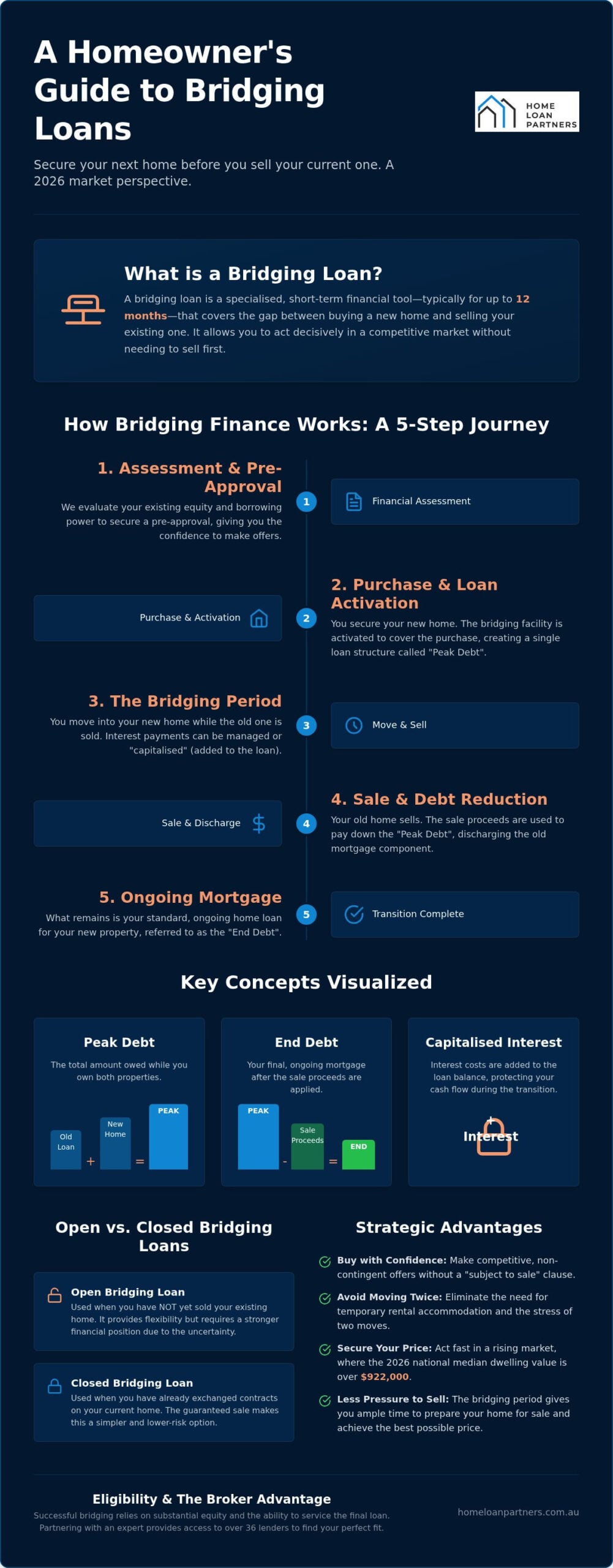
Understanding what is a bridging loan requires getting familiar with how debt is calculated. “Peak Debt” refers to the total amount you owe while you own both properties. This is the figure lenders use to assess your borrowing capacity. Once your old home sells and the proceeds are paid into the loan, you’re left with the “End Debt” or your ongoing mortgage balance.
A standout feature for many homeowners is “Capitalised Interest.” Rather than forcing you to manage two sets of repayments simultaneously, many lenders allow you to add the interest costs to your Peak Debt. This protects your daily cash flow and ensures you can focus on your move with a sense of calm, knowing the heavy lifting is being managed strategically behind the scenes.
How Bridging Finance Works: A Step-by-Step Mechanics Guide
Understanding the mechanics of what is a bridging loan starts with the equity you’ve built in your current home. Lenders calculate your borrowing power by looking at the value of your existing property minus your current mortgage balance. This equity serves as the foundation for the entire arrangement. Instead of requiring you to manage two separate loans with different banks, your lender typically combines your existing debt and the new purchase into one facility known as “Peak Debt.” During this transition, the lender holds the titles to both properties as security, providing a stable structure that allows you to move forward without waiting for a settlement check.
Once your existing property sells, the proceeds are applied directly to the Peak Debt. This triggers the “discharge” of your old mortgage, effectively closing that chapter of your financial journey. What remains is your “End Debt,” which is the standard mortgage for your new home. It’s a logical, rhythmic transition that we manage alongside you to ensure the process remains predictable and stress-free. If you’re wondering how these figures might look for your specific situation, chatting with a dedicated guide can help clarify your borrowing capacity.
The 5 Steps of a Bridging Loan Journey
- Step 1: Financial Assessment. We work together to evaluate your equity and secure pre-approval, giving you the confidence to bid at auction in a competitive 2026 market.
- Step 2: Purchase and Initiation. You secure your new property, and the Peak Debt facility is activated to cover the purchase price and associated costs.
- Step 3: The Bridging Period. You move into your new home while your old one is listed. During this time, you’ll manage the debt through interest-only payments or by capitalising the interest.
- Step 4: Sale and Discharge. Your old home settles. The sale proceeds are paid into the loan, and the mortgage on the sold property is officially discharged.
- Step 5: Long-Term Conversion. The remaining balance is converted into a standard long-term home loan, tailored to your ongoing financial milestones.
Managing Your Cashflow During the Transition
The thought of managing two mortgages can feel overwhelming, but the right structure protects your daily budget. Capitalised interest is a popular choice because it adds the interest costs to the loan balance rather than requiring monthly cash payments. While this keeps your cash flow steady, it’s important to consider the pros and cons of a bridge loan setup. Adding interest to the loan means your final End Debt will be slightly higher, so it’s a trade-off between current comfort and future balance.
To get a precise sense of your potential repayments and final debt levels, using a home loan calculator is a vital step in your planning. It allows you to model different sale prices for your current home, ensuring you have a clear view of the road ahead. This transparency is key to maintaining a sense of calm as you transition into your next dream home.
Pros and Cons: Is a Bridging Loan Your Best Strategic Move?
Deciding to purchase your next property before selling your current one is a bold step toward achieving a major life milestone. When you evaluate what is a bridging loan, you’re looking at a trade-off: the cost of interest versus the value of timing. For many families, the ability to secure a home in a rising market, where the national median dwelling value has reached $922,838, far outweighs the temporary expense of the loan itself. It’s about seizing the right opportunity without the constraints of a traditional timeline.
The Strategic Advantages
- Negotiating Power: You enter negotiations as a “cash-ready” buyer. Without a “subject to sale” clause, your offer is significantly more attractive to vendors who prioritize a certain, swift transaction.
- Avoiding the “Double Move”: Renting between homes is expensive and exhausting. A bridge allows you to stay in your current home until your new one is ready, saving you thousands in short-term rent, bond, and storage fees.
- Market Agility: In high-performing markets like Perth, which is forecasted for 12.8% growth in 2026, waiting six months to sell could mean paying tens of thousands more for your next property. Bridging lets you buy at today’s prices.
The Risks and How to Mitigate Them
While the benefits are clear, we must address the financial realities with professional transparency. Bridging products often carry higher interest rates than standard mortgages. Current 2026 data shows rates can range from approximately 6.39% p.a. to 9.92% p.a. depending on the lender and your equity position. Understanding how bridge finance works in terms of cumulative cost is essential for your peace of mind. The primary risk involves your exit strategy; if your home sells for less than expected, your “End Debt” will be higher than originally planned.
A common concern is what happens if the 12-month bridging period expires before you sell. This is where a collaborative partnership with your broker becomes vital. We help you establish a robust “Plan B” from the start. This might include exploring refinancing options to restructure the debt or adjusting your marketing strategy to ensure a sale. By preparing for these scenarios early, you can navigate the “Open” bridging timeframe with a steady hand and a clear path forward. We act as your expert collaborator, managing the technical details so you can focus on the excitement of your new home.
Eligibility and Requirements: How to Qualify in 2026
Qualifying for a bridging loan in 2026 requires more than just a stable income; it demands a solid equity foundation. If you’re wondering what is a bridging loan eligibility like in the current market, think of it as a two-part assessment. Lenders first examine the strength of your current property’s value, then they rigorously test your ability to manage the “End Debt.” This ensures that once your transition is complete, your long-term financial health remains secure. Because the lender takes on more risk with an “Open” bridging loan, the criteria for these are significantly stricter than for “Closed” loans where a sale contract is already signed.
The “Serviceability Test” is a critical hurdle. Lenders don’t just check if you can handle your current mortgage; they assess whether you can manage the final loan amount once your old home sells. They use a buffered interest rate to ensure you stay protected even if the RBA cash rate, currently at 4.35%, were to move. We manage this heavy lifting for you, preparing the necessary income proof, valuations, and contracts to present a clear, professional case to the right lender. To get started, you can assess your eligibility today with our expert team.
Equity: The Engine of Your Bridging Loan
Equity is the engine. Most Australian lenders require a Loan to Value Ratio (LVR) of 80% or less across your total Peak Debt. With the national median dwelling value sitting at $922,838 as of March 2026, having substantial equity (typically between 20% and 50%) in your current home is the primary driver for approval. This buffer protects both you and the lender if property prices fluctuate during your bridging period. Professional valuations are a non-negotiable part of this process. They provide the precision needed to calculate exactly how much you can borrow for your next major life milestone.
Lender Policies and Variances
Lender appetite for bridging finance varies wildly. Some institutions are happy to support a bridge for a standard suburban house but will refuse applications for rural properties or high-density apartments. There are also significant differences in how banks treat capitalised interest. While Bank A might insist on you making interest-only payments, Bank B might allow the interest to be added to the loan, preserving your monthly cash flow. Many general guides on how to buy a house in australia often overlook these technical nuances. We act as your expert collaborator, navigating the specific policies of over 36 lenders to find the one that aligns with your property type and financial goals.
The Broker Advantage: Navigating 36+ Lenders for Your Bridge
Navigating the transition between homes is a significant milestone, and having a steady hand to guide you makes all the difference. When you’re investigating what is a bridging loan, it’s easy to assume that every bank offers the same terms. However, the reality of the Australian market in 2026 is far more nuanced. We provide access to over 36 lenders, each with their own specific appetite for risk and unique policy requirements. Our role is to act as your expert collaborator, filtering through these options to find the “Policy Match” that aligns with your specific financial landscape. Understanding what is a bridging loan in the context of your personal goals is our priority, ensuring the structure we choose supports your long-term security.
The heavy lifting of a property transition often involves complex paperwork, multiple valuations, and tight deadlines. We take this burden off your shoulders, managing the communication between lenders and ensuring every document is precise. This proactive approach allows you to focus on the emotional side of moving while we handle the technical density. By positioning ourselves as your dedicated partner, we transform a potentially high-pressure transaction into a smooth, predictable journey. We focus on achieving your major life milestones with a sense of calm, steady expertise that only a specialized broker can provide; to gain more transparency on how these professionals operate, you can learn more about Mortgage Brokerage Commissions through industry experts.
Why One Size Does Not Fit All
Lender policies on bridging aren’t just about the interest rate. Some banks are leaders in capitalisation features, allowing you to defer interest for up to 12 months, while others may require immediate repayments that strain your cash flow. We also help you avoid “valuation shocks” by strategically selecting lenders who are known for their fair assessment of property values in your specific suburb. This level of precision ensures your Peak Debt is calculated accurately from the start, preventing unexpected hurdles during the bridging period.
Your Path Forward
The secret to a stress-free transition is early planning. We recommend starting the conversation before you attend your first open home or list your current property. This allows us to structure your bridging finance in a way that protects your long-term wealth and provides a clear exit strategy. Our commitment to your journey doesn’t end when the sale settles; we remain your steady guide throughout the life of your loan. If you’re ready to secure your next home with confidence, book a consultation with us today to map out your stress-free path forward.
Secure Your Next Chapter with Confidence
Transitioning between properties doesn’t have to be a period of uncertainty. By leveraging your existing equity and a tailored peak debt structure, you can bypass the stress of a double move and focus on the excitement of your new home. Whether you’re navigating capitalised interest or managing an open bridging period, the key is having a clear, predictable exit strategy. Understanding what is a bridging loan provides the essential foundation, but the right partnership ensures your long-term wealth is protected throughout the entire journey.
We’re here to manage the heavy lifting for you. With access to a panel of over 36 lenders and specialized expertise in complex Australian lending structures, we ensure your transition is handled with precision and calm expertise. Our focus remains on your major life milestones, providing the personalized guidance you need to move forward with total peace of mind. Your future security is our priority, and we act as your steady guide from the first inspection to the final settlement.
Ready to take the next step toward your dream home? Book a stress-free consultation with The Home Loan Partners today to map out your property journey. Your next chapter is waiting, and we’re honored to help you reach it with confidence and ease.
Frequently Asked Questions
Can I get a bridging loan if I haven’t sold my house yet?
Yes, you can secure an “Open” bridging loan specifically for this situation. It’s designed to let you purchase a new property even if your current home isn’t on the market yet. Lenders will focus heavily on the equity you’ve built up and your plan for selling within the standard 12-month timeframe. This flexibility is a core part of what is a bridging loan, as it gives you the power to act quickly when your dream home appears.
How much more expensive is a bridging loan than a standard mortgage?
Bridging loans carry higher interest rates than standard residential mortgages to reflect the short-term nature of the debt. As of July 2026, you can expect rates to range between 6.39% p.a. and 9.92% p.a. depending on the lender and your equity position. While the rate is higher, the loan is only intended to be held for a few months, so the total interest cost is often manageable when compared to the expense of renting and moving twice.
What happens if my house doesn’t sell within the bridging period?
If your property remains unsold after the agreed period, usually 12 months, your lender will typically review the facility. They might increase the interest rate to a default level or require you to begin making principal and interest repayments on the full Peak Debt. We work closely with you to monitor market trends and ensure you have a strategic backup plan well before this deadline approaches.
Do I need to make double repayments during a bridging loan?
No, most lenders structure these loans so you don’t have to manage two full sets of repayments simultaneously. By using capitalised interest, the interest costs are added to your loan balance and settled once your current home sells. This keeps your monthly cash flow steady, as you’ll only need to service the repayments on your expected final loan amount while the transition is underway.
Can I use a bridging loan for a construction project or renovation?
Yes, bridging finance is a versatile tool that can be used for construction or major renovation projects. It’s particularly useful if you’re building a new home and want to remain in your existing property until the new one is ready for move-in. This avoids the disruption of moving into a rental and ensures your family has a stable environment during the build process.
Is there a maximum amount I can borrow for a bridging loan?
The maximum amount you can borrow is generally capped at 80% of the total value of both your current and new properties. This is known as the Loan to Value Ratio (LVR) on your Peak Debt. If your combined debt exceeds this 80% threshold, lenders see the deal as higher risk. Having a larger equity buffer in your current home will significantly increase your borrowing capacity and approval chances.
How long does it take to get a bridging loan approved in Australia?
You should allow approximately two to four weeks for a full bridging loan approval. The process takes slightly longer than a standard mortgage because the lender must perform professional valuations on two separate properties. To speed things up, we recommend having your income evidence and property details ready before you start negotiating on a new purchase. Understanding what is a bridging loan approval timeline helps you set realistic settlement dates with vendors.
Can I use a bridging loan to buy an investment property?
Yes, you can use bridging finance to secure an investment property before selling an existing asset. While most homeowners use this for their primary residence, the strategy works just as well for investors looking to pivot their portfolio quickly. The lender will still apply the same equity and serviceability tests to ensure the transition is financially sound for your long-term wealth goals.