

What if your next commercial property loan wasn’t just a debt on a ledger, but the strategic foundation for your business’s entire ten-year growth plan? It’s a shift in perspective that separates successful investors from those who feel stalled by the current market. You probably already know that commercial finance demands more from you, with deposits often starting at 30% and lenders keeping a closer eye on your annual performance than they would with a standard home loan.
We understand that the three RBA rate hikes in the first half of 2026 have added a layer of caution to your decision-making. It’s natural to feel the weight of these shifting conditions, but you don’t have to carry that burden alone. This guide will help you master the complexities of commercial finance so you can secure your premises or investment portfolio with confidence. We’ll show you how to lock in a competitive LVR, identify the total cost of borrowing beyond the headline rate, and connect with lenders who value your specific industry expertise as much as we do.
Key Takeaways
- Understand the fundamental differences in security types, ranging from standard retail and office spaces to specialized assets like childcare centers or industrial hubs.
- Discover how to navigate the 2026 economic landscape by choosing between fixed and variable rates or exploring flexible low-doc options for self-employed investors.
- Learn why a commercial property loan typically requires a higher deposit and how critical metrics like the Interest Cover Ratio (ICR) influence your eligibility.
- Gain a competitive edge by accessing the “shadow market” of lenders through a broker who compares over 36 different lending institutions on your behalf.
- Master a clear, step-by-step application process that prioritizes your long-term business strategy while managing the heavy lifting of complex financial documentation.
What is a Commercial Property Loan and How Does it Differ from Residential?
A commercial property loan is a financial tool specifically designed for the acquisition or refinancing of real estate used for business purposes or to generate rental income. While a home loan is secured against a place where people live, this type of finance is secured against assets that drive economic activity. Lenders assess these applications with a different lens, focusing heavily on the property’s ability to pay for itself through lease income or business profits. This shift in focus means the lender is partnering with your business’s success as much as they are with the bricks and mortar.
The security types involved in these transactions are incredibly diverse. You might be looking at a retail shop in a busy precinct, a high-tech industrial warehouse, or a CBD office suite. Lenders also consider “specialised” properties like childcare centres, medical clinics, or petrol stations. These assets are often viewed as higher risk because their value is intimately tied to a specific business use. If that industry faces a downturn, the property may be harder to sell or re-lease than a standard home. For a foundational overview of these structures, you can explore What is a Commercial Mortgage to see how global standards compare to the Australian market.
Commercial vs. Residential: The Key Differences
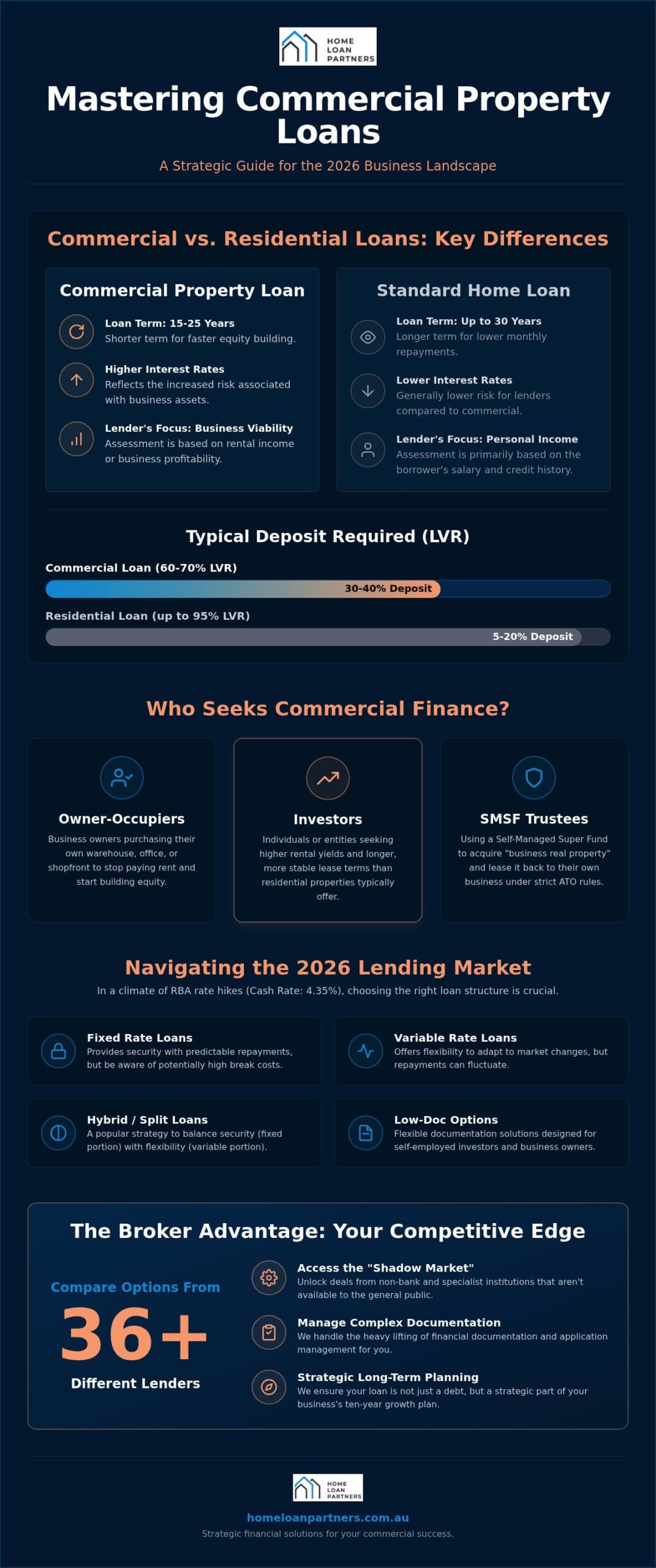
The most immediate difference you’ll encounter is the Loan-to-Value Ratio (LVR). While you might secure a home with a small deposit, commercial lenders typically require 30% to 40% equity. This higher entry point acts as a buffer against market volatility. Additionally, the loan term is significantly shorter. Most commercial agreements run for 15 to 25 years. This shorter timeframe means your monthly principal repayments will be higher than a standard 30-year residential mortgage, but it also means you’ll own the asset outright much sooner.
Interest rates also behave differently. They are generally higher than residential rates to compensate for the increased risk of vacancy or business failure. Lenders use a “purpose test” to categorise the debt. If the property is used to run a business or house a commercial tenant, it falls under commercial rules, regardless of whether you are an individual or a company.
Who is a Commercial Loan For?
We typically see three main groups of clients seeking this finance:
- Owner-occupiers: These are business owners who want to stop paying rent and start building equity in their own warehouse, office, or shopfront.
- Investors: Individuals or entities looking for higher rental yields and longer lease terms than residential properties usually offer.
- SMSF Trustees: Many Australians use their Self-Managed Super Fund to acquire “business real property,” allowing them to lease the premises back to their own business under strict ATO guidelines.
Understanding which category you fall into is the first step in tailoring a commercial property loan that supports your long-term financial security.
Types of Commercial Property Loans Available in 2026
The 2026 lending market offers far more variety than the standard products found at a local bank branch. Choosing the right commercial property loan requires a careful balance between your immediate cash flow needs and your long-term tax strategy. While the “Big Four” banks provide a sense of traditional stability, the non-bank sector has expanded significantly. These alternative lenders often provide the flexibility that established institutions might overlook, especially for unique assets or complex business structures.
Fixed vs. Variable Commercial Rates
In the current economic climate, with the RBA cash rate at 4.35%, the choice between fixed and variable rates is a strategic one. A fixed rate provides the security of predictable repayments, which is essential for businesses operating on tight margins. However, you should be aware that commercial break costs are typically much higher than those in the residential sector. These costs are often calculated using complex market formulas, making it expensive to exit a fixed contract early. Many of our clients now prefer hybrid structures. This allows you to fix a portion of your debt for security while keeping the remainder variable, ensuring you don’t lose all your flexibility if you need to refinance or sell.
Documentation and Income Verification
For self-employed Australians, “Full Doc” loans requiring two years of comprehensive tax returns aren’t always the most efficient path. “Low Doc” options have become a reliable alternative, allowing you to use accountant letters or recent bank statements to demonstrate your ability to service the debt. We’ve also seen a significant rise in “Lease Doc” loans in 2026. These are particularly attractive for investors because the lender assesses the loan based solely on the property’s rental income. If you have a high-quality tenant with a strong lease in place, this can be a streamlined way to grow your portfolio without the need for personal income assessments.
Specialised Lending: SMSF and Construction
Using a Self-Managed Super Fund (SMSF) to acquire commercial property remains a powerful strategy under 2026 ATO guidelines. These loans are structured as limited recourse borrowing arrangements, which means your other retirement assets are protected if something goes wrong. If your goal is to build a custom facility, construction loans for commercial projects are managed through progressive draw-downs. Unlike residential construction, these often feature interest-only periods during the entire build phase to help you preserve working capital until the building is ready for occupancy.
The 2026 landscape also rewards sustainability. “Green Commercial Loans” now offer lower interest rates for energy-efficient buildings or those undergoing significant environmental retrofits. If you’re feeling overwhelmed by these options, chatting with a specialist who understands your industry can help simplify the comparison across our panel of 36+ lenders.
Eligibility and the “Hidden” Costs of Commercial Finance
Many investors experience a moment of “sticker shock” when they first discover that a commercial property loan usually requires a deposit of 30% to 35%. While residential buyers can often secure a home with a 10% or even 5% deposit, commercial lenders generally cap their Loan-to-Value Ratio (LVR) at 65% to 70%. This higher entry point isn’t just a hurdle; it’s a protective buffer that ensures your equity remains secure even if the local business market experiences a period of volatility.
Beyond the deposit, lenders focus on two critical metrics: the Interest Cover Ratio (ICR) and the Weighted Average Lease Expiry (WALE). The ICR measures your ability to service the debt by comparing your net income to your interest expenses. Lenders typically look for a ratio of at least 1.5x to 2x. If you’re an investor, the WALE is equally vital. A property with a long WALE indicates that your tenants are locked in for several years, providing the steady cash flow that lenders love to see. It’s also important to remember that most commercial sales are GST-inclusive. You may need to fund an additional 10% for the GST at settlement before claiming it back from the ATO in your next BAS. To secure the debt, lenders will often register a General Security Agreement (GSA), which gives them a legal charge over your business’s assets as additional protection.
One detail often missed in standard bank brochures is the “Annual Review” requirement. Unlike a residential mortgage that you can “set and forget,” many commercial contracts include covenants that require you to submit updated financials every 12 months. This allows the lender to verify that your business remains healthy and that you’re still meeting the agreed financial benchmarks.
The Financial Checklist for Borrowers
Lenders will want to see a clear picture of your financial health. This typically includes two years of business financials, tax returns, and current lease agreements. A professional Business Plan is also a powerful tool in your application, as it demonstrates to the lender that you’ve considered market risks and have a clear strategy for growth. Even when you’re borrowing for a business, your personal debt to income ratio remains a factor. Lenders want to ensure that your personal financial commitments won’t put undue pressure on your ability to manage your commercial obligations.
Valuations and Legal Fees
Budgeting for entry costs is essential. A commercial valuation is far more technical than a residential appraisal and can cost several thousand dollars. It involves a deep dive into market yields, replacement costs, and comparable business sales. If you’re looking at an industrial site, you might also be required to pay for an Environmental Audit to check for soil contamination. Finally, keep in mind that you’ll be responsible for two sets of legal fees: your own solicitor’s costs and the lender’s legal expenses. Commercial contracts are bespoke documents that require specialised legal expertise to ensure your interests are protected throughout the life of the loan.
Step-by-Step: The Commercial Loan Application Process
While some major banks might promote “instant application” buttons, the reality of securing a commercial property loan in 2026 is a methodical journey that requires patience and precision. It’s best to view this process as a strategic partnership rather than a simple digital transaction. We begin with an initial consultation to assess your borrowing power and align it with your broader business strategy. This isn’t just a numbers game; it’s about ensuring the debt structure supports your long-term goals without straining your working capital.
Once we’ve established your baseline, we perform a detailed scenario analysis across our panel of 36+ lenders. We compare traditional institutions against flexible non-bank lenders to find the most competitive fit for your specific industry. From here, you’ll receive an Indicative Offer, often called a Letter of Intent. This non-binding document outlines the proposed interest rates and terms. If these align with your expectations, we move into the most critical phase: full approval and the formal valuation. This stage is where the lender’s credit department performs deep due diligence on both you and the property itself.
Preparing Your Application for Success
Presenting your cash flow accurately is vital to satisfying 2026 lending criteria. Lenders want to see that your business can comfortably manage repayments even if market conditions shift. Negotiating the specific “Covenants” in your contract is another area where expert guidance is essential. These rules might require you to maintain a certain debt-service ratio throughout the year. Having a finance broker act as your intermediary with credit departments ensures your application is presented in a language the bank understands, which significantly increases your chances of a smooth approval.
Timeline Expectations in 2026
You should generally expect the commercial settlement process to take between 45 and 60 days. This timeline is longer than residential settlements because commercial valuations are more technical and the legal documentation is far more bespoke. Common bottlenecks often involve complex entity structures, such as Family Trusts or Pty Ltd companies, which require extra time for legal vetting. After settlement, your lender will conduct an Annual Review every 12 months to verify that your business remains healthy and continues to meet its financial benchmarks. If you’re ready to see how your business strategy translates into borrowing power, you can start your 36+ lender comparison with us today.
Why a Broker is Essential for Commercial Property Loans
Securing a commercial property loan isn’t a one-size-fits-all process. While your local bank branch can only offer their own products, a specialist broker acts as your advocate across a vast financial landscape. This includes access to the “Shadow Market,” a network of private and non-bank lenders who don’t deal directly with the public. These institutions often provide the flexibility needed for complex business structures or unique properties that traditional banks might decline. By leveraging our relationship with these lenders, we can structure your finance to balance immediate tax benefits with your long-term borrowing capacity.
Our role is to manage the competitive pressure on your behalf. With access to a panel of over 36 lenders, we play the banks against each other to secure the most favourable rates and terms. This negotiation power is vital in the 2026 market, where lending criteria can shift overnight. We don’t just facilitate a transaction; we build a partnership that lasts for the life of your loan. This includes helping you navigate regular reviews and exploring options for refinancing as your business grows and your financial needs evolve.
The Multi-Lender Advantage
Your current business bank might have been great for your transactional needs, but they may not have the “appetite” for your specific property type. Lenders often rotate their focus. One month they might favour medical suites, while the next they prefer industrial warehouses. We identify which lenders are currently hungry for your specific industry, ensuring you don’t waste time on applications destined for rejection. This unbiased advice is the cornerstone of a stress-free experience in a complex financial market.
Saving Time and Reducing Stress
The administrative burden of a commercial application is significant. We take care of the heavy lifting, from managing the mountains of paperwork to chasing up lender follow-ups. Crucially, this approach protects your credit score. By only applying to the right lender first, we avoid multiple “Credit Enquiries” that can damage your rating. Our goal is to provide a steady hand, navigating you through every hurdle with precision. If you’re ready to take the next step, speak to the experts at The Home Loan Partners about your commercial goals today.
Secure Your Commercial Future with Strategic Finance
The 2026 property market offers significant opportunities for those who understand how to leverage debt correctly. By mastering the differences between security types and navigating specific LVR requirements, you’re no longer just buying a building; you’re building a legacy. Success depends on finding a commercial property loan that balances competitive rates with a structure that protects your cash flow as your business grows.
You don’t have to manage this complex transition alone. Our team provides the steady expertise you need, offering access to over 36 Australian lenders and deep knowledge of the NSW and national markets. Whether you’re exploring tailored SMSF structures or securing a site for business expansion, we’re here to manage the heavy lifting and ensure your investment remains secure for the long term.
Book a strategic commercial finance consultation with The Home Loan Partners to start your journey today. We’re ready to help you reach your next major milestone with confidence and precision.
Frequently Asked Questions
How much deposit do I need for a commercial property loan in 2026?
You generally need a deposit of 30% to 35% for a standard commercial property loan in 2026. While some specialized non-bank lenders might offer a Loan-to-Value Ratio (LVR) of up to 75%, most traditional banks cap their lending at 65% to 70%. This higher equity requirement serves as a buffer for the lender against the specific risks associated with commercial assets and market fluctuations.
Can I use residential property equity to fund a commercial purchase?
Yes, you can leverage the equity in your residential home to fund the deposit for a commercial asset. This is often achieved by refinancing your home loan to “cash out” the required funds or by using the residential property as additional security. This strategy can help you enter the commercial market sooner without needing to save a large cash deposit from scratch.
What is the difference between an owner-occupied and an investment commercial loan?
The primary difference lies in how the property is used and how the income is generated. An owner-occupied loan is for businesses buying premises to run their own operations, whereas an investment loan is for entities seeking rental yield from a third-party tenant. Lenders often view owner-occupied properties more favourably because the business owner has a direct stake in maintaining the premises.
Are commercial property loan interest rates tax-deductible?
Interest payments on a commercial property loan are typically tax-deductible if the property is used for income-generating purposes. This applies whether you are an investor collecting rent or an owner-occupier using the space for your business. Because tax laws are complex, it’s essential to consult with a qualified accountant to understand how these deductions apply to your specific entity structure.
How long does it take to get a commercial loan approved in Australia?
You should allow between 45 and 60 days for the entire process from application to settlement. While an initial indicative offer can sometimes be issued within a week, the formal approval requires a detailed valuation and legal due diligence. These steps are more technical than residential processes and involve a thorough assessment of lease agreements and business financials.
What is a “Low Doc” commercial loan and who is it for?
A “Low Doc” commercial property loan is designed for self-employed Australians who may not have two years of up-to-date tax returns available. Instead of full financial statements, these lenders accept alternative verification such as recent bank statements or an accountant’s declaration. This provides a flexible path for profitable businesses to secure finance without the traditional paperwork burden.
Do I need a business plan to buy a commercial property?
While not always mandatory, a professional business plan significantly strengthens your application with major Australian lenders. It demonstrates that you have a clear strategy for growth and have considered potential market risks. For owner-occupiers, a plan shows the lender that the property acquisition is a logical step that supports the long-term viability of your business operations.
What happens during a commercial loan annual review?
During an annual review, your lender will examine your current financial statements to ensure you are still meeting your loan covenants. They check metrics like your interest cover ratio and may request an updated valuation to confirm the LVR remains within acceptable limits. This process is a standard part of commercial finance and helps maintain a transparent, ongoing relationship between you and the lender.