
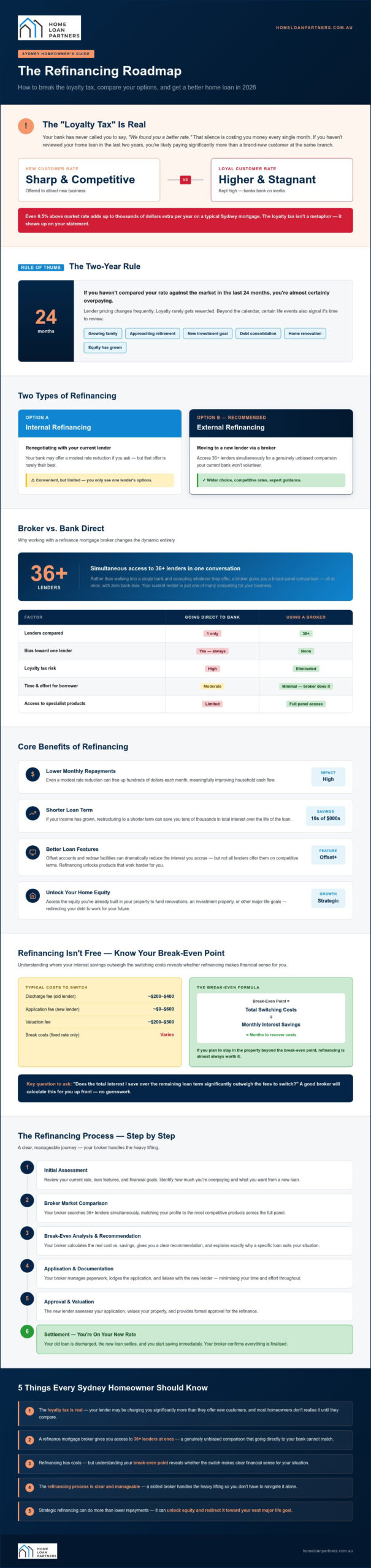
Your bank has never called you to say, “We found you a better rate.” That silence has a name: the loyalty tax. If you haven’t reviewed your home loan in the last two years, there’s a real chance you’re paying significantly more than a new customer sitting right beside you at the same branch. Working with a refinance mortgage broker in Sydney is often the fastest way to find out exactly how much that silence is costing you.
You’re not alone in feeling the weight of high monthly repayments, or in finding the world of comparison rates, offset accounts, and discharge fees genuinely confusing. Most Sydney homeowners simply don’t have the hours it takes to meaningfully compare dozens of lenders on their own, and that’s completely understandable.
This guide is here to change that. You’ll discover how a strategic refinance can lower your repayments, unlock the equity you’ve already built, and put your debt to work for your future goals rather than your lender’s bottom line. We’ll walk you through how the refinancing process works, what to watch out for, and how an independent broker with access to 36+ lenders can give you a genuinely unbiased path forward.
Key Takeaways
- The “loyalty tax” is real — your current lender may be charging you significantly more than they offer new customers, and most homeowners don’t realise it until they compare.
- Working with a refinance mortgage broker in Sydney gives you access to 36+ lenders at once, delivering a genuinely unbiased comparison that going directly to your bank simply cannot match.
- Refinancing isn’t free, but understanding your break-even point — where interest savings outweigh switching costs like discharge and application fees — reveals whether the move makes financial sense for you.
- The refinancing process follows a clear, manageable journey from initial assessment to final settlement, and a skilled broker handles the heavy lifting so you don’t have to navigate it alone.
- Strategic refinancing in 2026 can do more than lower your repayments — it can unlock the equity you’ve already built and redirect it toward your next major life goal.
What Does Refinancing a Home Loan Mean in 2026?
At its core, refinancing means replacing your existing home loan with a new one, ideally on better terms. That might mean a lower interest rate, a different loan structure, or features that actually match how you live and spend. What’s changed in 2026 is the market context around that decision, and it matters more than most homeowners realise.
The Reserve Bank of Australia has moved through a significant rate cycle over the past few years, and the current environment has created a genuine window of opportunity for borrowers who haven’t reviewed their loan recently. Lenders are actively competing for refinancers, which means the gap between what loyal existing customers pay and what new customers are offered has widened considerably in many cases.
There’s also an important distinction worth understanding before you take any action: internal refinancing means renegotiating your loan with your current lender, while external refinancing means moving to an entirely different lender. Your bank may offer you a modest rate reduction if you ask, but that offer is rarely their best. External refinancing, especially when guided by a refinance mortgage broker in Sydney with access to a broad panel of lenders, consistently opens up options your current bank simply won’t volunteer.
The triggers that prompt most Sydney homeowners to refinance tend to fall into three categories: a meaningful drop in available interest rates, significant growth in their property’s equity, or a shift in personal financial goals such as consolidating debt, funding a renovation, or preparing for retirement.
The Core Benefits of Moving Your Mortgage
Switching to a more competitive loan can deliver several practical advantages, depending on your circumstances:
- Lower monthly repayments: Even a modest rate reduction can meaningfully improve household cash flow, freeing up hundreds of dollars each month.
- A shorter loan term: If your income has grown, restructuring to a shorter term reduces the total interest you pay over the life of the loan, sometimes by tens of thousands of dollars.
- Better loan features: Offset accounts and redraw facilities can dramatically reduce the interest you accrue, but not all lenders offer them on competitive terms. Refinancing gives you access to products that actually work harder for you.
When Is the Right Time to Review Your Loan?
A practical rule of thumb used widely in the industry is the Two-Year Rule: if you haven’t compared your rate against the market in the last 24 months, you’re likely paying more than you need to. Lender pricing changes frequently, and loyalty rarely gets rewarded.
Beyond the calendar, certain life milestones often signal that your current loan structure no longer fits. A growing family might need access to equity for more space. Approaching retirement might call for a strategy focused on reducing debt faster. A new investment goal might require restructuring entirely.
For a deeper look at what the refinancing process involves from start to finish, the complete 2026 guide to what refinancing a home loan means walks through every stage in plain language. Understanding the fundamentals puts you in a far stronger position before any conversation with a lender or broker begins.
Mortgage Broker vs. Bank Direct: Breaking the Loyalty Tax
Here’s a dynamic that rarely gets discussed openly: the same bank offering a sharp introductory rate to attract new customers is simultaneously charging its existing borrowers considerably more. This isn’t accidental. It’s a deliberate pricing strategy built on the assumption that switching feels too complicated to bother with. That assumption, left unchallenged, costs loyal customers real money every single month.
The arithmetic is straightforward. A borrower sitting on a rate even half a percentage point above what’s currently available on the market is paying significantly more over the life of their loan than someone who took the time to compare. The loyalty tax isn’t a metaphor. It shows up on your statement.
Working with a refinance mortgage broker in Sydney changes that dynamic entirely. Rather than walking into a single bank and accepting whatever they’re prepared to offer, you gain simultaneous access to a panel of 36-plus lenders, including both major banks and specialist non-bank lenders who don’t advertise on television. That breadth of choice is something no single institution can replicate, no matter how long you’ve banked with them.
The cost question is also worth addressing directly. A broker’s service is typically lender-paid, meaning the lender whose product you ultimately choose covers the broker’s commission. For most borrowers, there’s no upfront fee involved. You’re getting expert guidance, a market-wide comparison, and hands-on support through the application process, without adding another line item to your expenses.
The practical relief this provides shouldn’t be underestimated. Gathering payslips, tax returns, and statements; completing lender-specific application forms; managing valuations and discharge paperwork; negotiating terms: a skilled broker handles all of it. For time-poor Sydney homeowners, that alone is often reason enough to make the call.
Why Your Bank Might Not Tell You Everything
A bank’s relationship manager is fundamentally constrained by their employer’s product suite. They can’t recommend a competitor’s lower rate, even if it would clearly serve you better. Brokers operate differently. Using specialist comparison software, a good broker can assess hundreds of loan products in minutes, filtering by rate, features, fees, and lender appetite for your specific financial profile. Critically, a broker’s legal Best Interests Duty (BID) requires them to act in your interest, not the lender’s.
The Long-Term Partnership Value
A broker’s ongoing trail commission, paid by the lender over the life of your loan, creates a direct incentive to keep supporting you well beyond settlement. That means regular loan reviews, proactive conversations when the market shifts, and a relationship that evolves as your circumstances do. Whether you’re refinancing today, planning an investment purchase next year, or restructuring ahead of retirement, that continuity has genuine value.
For a detailed look at what to expect from that ongoing relationship, the guide on hiring a finance broker covers the full picture, from initial engagement through to long-term loan management.
If you’re ready to find out what the market is actually offering right now, speaking with an experienced mortgage broker is the most direct way to get a clear, unbiased answer.
Calculating the Real Cost and Savings of Refinancing
Refinancing isn’t free, and treating it as though it were is one of the most common mistakes Sydney homeowners make. Before you move forward with any switch, you need a clear picture of what it actually costs to leave your current lender, and how long it takes for your savings to cover those costs.
The fees you’re most likely to encounter include:
- Discharge fee: Charged by your current lender to close out your existing loan. This varies by lender but is a standard exit cost.
- Application or establishment fee: Charged by your new lender to set up the loan.
- Valuation fee: Your new lender will typically require a formal property valuation before approving the refinance.
- Legal or settlement fees: Administrative costs associated with transferring the mortgage.
Adding these up gives you your total switching cost. From there, the calculation is straightforward: divide that figure by your projected monthly saving to find your break-even point. If the total costs come to a few thousand dollars and your new rate saves you a meaningful amount each month, you’ll recover that outlay within a reasonable timeframe. If you’re planning to sell or move in the near future, a longer break-even period may make the switch less compelling.
Your Loan-to-Value Ratio (LVR) plays a significant role in what rate you can actually access. Borrowers with an LVR below 80% typically unlock the most competitive pricing, because lenders view them as lower risk. If your property has grown in value since you originally purchased, your LVR may have improved considerably, even without you making extra repayments. That improved position can be worth real money in rate negotiations.
One trap worth naming directly is rate chasing: switching purely for the lowest advertised rate without examining the full loan structure. A rate that looks sharp today may carry high ongoing fees, no offset facility, or limited redraw access. The total cost of a loan over its life, not just the headline rate, is what actually determines your financial outcome.
Unlocking Equity for Future Growth
There’s a meaningful difference between refinancing simply to lower your rate and refinancing to access the equity you’ve built. The latter, often called “cash-out” refinancing, allows you to borrow against the increased value of your property and direct those funds toward a renovation, an investment property deposit, or another financial goal. It’s a fundamentally different strategy with different risk considerations, and it deserves its own analysis rather than being lumped in with a straightforward rate switch. The home loan calculator guide is a useful starting point for running your own equity and repayment estimates before any broker conversation.
Are Refinance Cashback Offers Still Worth It?
Cashback offers from lenders remain active in 2026, but they require careful scrutiny. A lump-sum payment at settlement can look attractive, particularly when it appears to offset your switching costs. The problem is that many cashback products are paired with rates that revert to a higher variable after an initial period, a classic “honeymoon rate” structure. Over a 25-year loan, a rate even slightly above the market average will cost far more than any upfront cashback recovers.
A good refinance mortgage broker in Sydney applies what’s known as a net benefit test to any proposed switch: a structured assessment that weighs the total cost of the new loan over time against all switching costs and incentives, ensuring the move genuinely serves your long-term interests rather than just delivering a short-term cash injection. That kind of analysis is where working with an experienced broker, rather than responding to a lender’s marketing, makes a tangible difference to your financial outcome.
The Step-by-Step Process to Successfully Switch Your Loan
Knowing refinancing makes financial sense is one thing. Understanding exactly what happens next is another. For many Sydney homeowners, the process feels like a black box, and that uncertainty is often what keeps people on an uncompetitive rate far longer than they should be. The reality is considerably more straightforward, particularly when a skilled refinance mortgage broker in Sydney is managing the moving parts alongside you.
From Assessment to Application
The process begins with a genuine health check on your current position. Your broker will analyse your existing loan structure, remaining balance, current rate, and the features you’re actually using versus the ones you’re paying for. Equally important is the conversation about where you’re heading: are you prioritising lower monthly repayments, faster debt reduction, or accessing equity for a future goal? That clarity shapes every recommendation that follows.
Document preparation happens early, and getting it right saves time later. You’ll typically need:
- Recent payslips covering the last two to three pay cycles
- Your two most recent tax returns, particularly if you’re self-employed
- Three to six months of bank statements across all accounts
- Your current loan statement showing the outstanding balance and rate
- Identification documents as required by the new lender
With your financial picture complete, your broker compares the full panel of 36-plus lenders and narrows the field to the top options that genuinely match your profile. Not just by rate, but by lender appetite for your specific circumstances, loan features, and total cost over time. Once you’ve confirmed the preferred lender, your broker manages the entire submission, handling communication, answering lender queries, and keeping the application moving without you needing to chase anyone.
Approval, Settlement, and Beyond
The approval phase introduces one step that catches some borrowers off guard: the property valuation. Your new lender will commission an independent valuation to confirm your property’s current market value before finalising the loan structure. This matters most when you’re refinancing to access equity, because the approved loan amount depends directly on the outcome. If the valuation comes in lower than expected, your broker can advise on adjusting the loan structure or approaching an alternative lender with a more favourable assessment methodology.
Settlement is the cleanest part of the journey. The new lender pays out your existing loan directly, the mortgage is transferred, and your new loan begins. You don’t need to coordinate between institutions. Your broker handles the discharge paperwork with your outgoing lender and confirms the transition is complete.
If you’re simultaneously buying and selling, a bridging loan can be integrated into this structure to cover the gap between settlement dates, keeping both transactions on track without requiring you to manage two separate financing conversations.
The process doesn’t end at settlement. A good broker schedules regular reviews as market conditions shift, ensuring your loan continues to serve your goals rather than drifting back toward the loyalty tax you worked to escape.
Ready to understand exactly where you stand? Talk to a Home Loan Partners broker and get a clear picture of your options from the first conversation.
The Home Loan Partners: Your Expert Guide to a Better Rate
There’s a meaningful difference between a broker who processes your application and one who genuinely understands where you’re trying to get to. At Home Loan Partners, the relationship doesn’t begin and end at settlement. It’s built around your financial journey, your milestones, and the goals that matter most to you, whether that’s retiring with less debt, building a property portfolio, or simply stopping the loyalty tax from quietly eroding your household budget each month.
That commitment shapes everything about how the team works. With access to a panel of over 36 bank and non-bank lenders, the comparison you receive isn’t filtered through a single institution’s product suite. It’s a genuine, market-wide assessment of what’s available to you right now, structured around your specific financial profile rather than a lender’s sales targets. And because the service is lender-paid, there’s no upfront cost to you for that expertise.
The Australian lending market carries real complexity: lender credit policies shift, serviceability calculations vary between institutions, and the gap between what’s advertised and what you’ll actually qualify for can be significant. A skilled refinance mortgage broker in Sydney knows how to read those variables and position your application accordingly, handling the communication, documentation, and negotiation so you don’t have to.
Tailored Solutions for Every Property Journey
Not every borrower fits a standard template, and the Home Loan Partners team is built for that reality. Whether you’re refinancing a straightforward owner-occupied loan, restructuring an investment portfolio, navigating a construction project, or exploring the requirements of an SMSF loan, the team brings specialist knowledge to each scenario. Complex structures are explained in plain terms, not buried in industry jargon, because your confidence in the decision matters as much as the outcome itself. Your long-term milestones drive every recommendation made.
Start Your Stress-Free Refinance Today
The first conversation doesn’t need to be a commitment. A no-obligation loan health check gives you a clear picture of where your current mortgage sits relative to the market, what switching would realistically cost, and whether the numbers genuinely stack up in your favour. It’s a calm, expert-led discussion about your financial future, with no pressure and no jargon.
The 2026 property market has real opportunities for borrowers who take the time to look. You don’t have to navigate it alone. Reach out to the Home Loan Partners team today and take the first step toward a loan that actually works for you, with a trusted refinance mortgage broker in Sydney by your side every step of the way.
Your Next Step Toward a Smarter Home Loan
The loyalty tax is real, it’s measurable, and it doesn’t have to be your reality. This guide has walked you through why so many Sydney homeowners are paying more than they need to, how the break-even calculation works, and what the refinancing journey actually looks like from first conversation to final settlement.
Three things are worth carrying forward. First, your current lender’s best offer and the market’s best offer are rarely the same number. Second, understanding your true switching costs is what separates a smart refinance from a reactive one. Third, having a broker working under a legal Best Interests Duty, with access to 36-plus lenders and a lender-paid service model, changes the quality of guidance you receive entirely.
You don’t need to figure this out alone. Book your stress-free strategic refinance review with The Home Loan Partners and find out, in plain terms, exactly what your loan could look like with the right refinance mortgage broker Sydney team behind you. The right move starts with a single honest conversation.
Frequently Asked Questions
How much does it actually cost to refinance a home loan in Australia?
The total cost of refinancing typically includes a discharge fee from your outgoing lender, an application or establishment fee with your new lender, a property valuation fee, and legal or settlement costs. These figures vary between lenders and loan types, so getting an itemised breakdown before committing is essential. Avoid treating any single fee in isolation; what matters is the combined switching cost measured against your projected savings.
The most useful exercise is calculating your break-even point: divide your total switching costs by your monthly saving to see how many months it takes to come out ahead. A broker can run this calculation for your specific situation, including any cashback offers, to give you a genuinely clear picture before you decide anything.
Will refinancing my mortgage affect my credit score?
Yes, refinancing does involve a credit enquiry, which can cause a temporary, modest dip in your credit score. Each formal loan application registers as a hard enquiry on your credit file. The impact is generally short-lived, and a stronger loan structure with lower repayments can support your broader financial health over time.
The key is to avoid submitting multiple applications to different lenders simultaneously, as each one registers separately and the cumulative effect is more significant. A broker submits a single, well-matched application to the most suitable lender for your profile, which minimises unnecessary credit enquiries and protects your score during the process.
Can I refinance if I have less than 20% equity in my home?
Refinancing with less than 20% equity is possible, but it comes with important trade-offs. Lenders typically require Lenders Mortgage Insurance (LMI) when the loan-to-value ratio exceeds 80%, which adds a cost that can offset your interest savings. Some lenders have more flexible policies than others, so the options available to you depend heavily on which lenders your broker has access to.
If your property has grown in value since purchase, your effective equity position may be stronger than your original deposit suggests. A current valuation can reveal genuine options you didn’t know existed, and a broker can identify which lenders are most likely to approve your application at a competitive rate given your current LVR.
How long does the refinancing process typically take from start to finish?
From initial assessment to settlement, refinancing generally takes between four and eight weeks, though this varies depending on lender workloads, the complexity of your application, and how quickly documentation is gathered. Straightforward applications with complete paperwork tend to move faster. Construction or investment loan refinances involving more complex structures may take longer.
Working with an experienced refinance mortgage broker in Sydney meaningfully reduces delays, because your application is submitted to the right lender from the outset, complete and well-prepared. Your broker manages lender communication throughout, so you’re not waiting on hold or chasing updates yourself.
Is it possible to consolidate credit card or car loan debt into my mortgage?
Debt consolidation through refinancing is a legitimate strategy that rolls higher-interest debts into your home loan, replacing multiple repayments with a single, lower-rate obligation. The immediate cash flow relief can be substantial. The risk that’s often underestimated is that short-term consumer debt becomes long-term mortgage debt, meaning you could pay more interest overall if the loan term extends significantly.
This strategy works best when paired with a disciplined repayment plan that maintains higher payments to offset the extended term. A broker can model both scenarios side by side, showing you the true cost over time so you can make an informed decision rather than one driven purely by the appeal of lower monthly outgoings.
What is the difference between a redraw facility and an offset account?
Both features help reduce the interest you pay, but they work differently. A redraw facility lets you access extra repayments you’ve already made on your loan, so the funds sit within the mortgage itself and reduce your outstanding balance until you withdraw them. An offset account is a separate transaction account linked to your loan, and the balance in that account offsets the principal you’re charged interest on each day.
Offset accounts typically offer more flexibility for day-to-day spending while still delivering interest savings, but they’re not always available on the most competitively priced loans. Redraw is more common across a broader range of products. Understanding which feature actually suits how you manage money is part of what a broker assesses when comparing loan structures for you.
Should I choose a fixed or variable interest rate when I refinance in 2026?
The right choice depends on your priorities and financial circumstances, not on trying to predict rate movements with certainty. A fixed rate gives you repayment certainty and protection if rates rise, but it limits flexibility: extra repayments are often capped, and breaking a fixed term early can trigger significant costs. A variable rate moves with the market, offers more features, and typically allows unlimited extra repayments.
A split loan, part fixed and part variable, is a practical middle ground that many borrowers find genuinely useful. It provides some certainty on a portion of the debt while retaining flexibility on the rest. Your broker can model each structure against your specific goals and income pattern to help you choose with confidence rather than guesswork.
Why should I use a mortgage broker instead of going directly to my current bank?
Your bank can only offer you its own products, and it has no obligation to tell you when a competitor offers a better deal. A broker with access to a panel of 36-plus lenders compares the full market on your behalf, including non-bank lenders that don’t advertise publicly. Critically, brokers operate under a legal Best Interests Duty, which requires them to recommend what genuinely serves you, not what earns the highest margin for a single institution.
Beyond the comparison itself, the practical support a broker provides throughout the application, valuation, and settlement process saves considerable time and reduces the risk of avoidable errors. The service is lender-paid for most borrowers, meaning you receive expert, market-wide guidance without adding another cost to the refinance itself.