

What if the key to your next investment wasn’t sitting in your savings account, but was already hidden within the walls of your current home? It’s natural to feel a sense of hesitation when considering using equity to buy investment property in Australia, especially with 2026 interest rates and the latest APRA debt-to-income limits. You want to grow your wealth, but the fear of overextending or risking your family home is a heavy weight to carry. We understand that the jargon around LVR and serviceability can often feel like a barrier rather than a bridge to your goals.
We’re here to show you that building a portfolio doesn’t have to be a high-stakes gamble. You’ll learn exactly how to calculate your usable equity and, more importantly, how to structure your loan to prioritise safety and long-term stability. This guide provides a clear path to assessing your borrowing capacity and selecting a lender that looks at your whole financial picture. Together, we’ll ensure your next move is a confident, steady step toward your future milestones.
Key Takeaways
- Unlock the wealth within your home by understanding how leveraging acts as a secure alternative to a traditional cash deposit.
- Master the “80% Rule” calculation to accurately define your borrowing power before you begin your next property search.
- Explore the differences between standalone and cross-collateralised structures to protect your family home while using equity to buy investment property in Australia.
- Navigate the 2026 serviceability landscape with a clear understanding of interest rate buffers and new debt-to-income requirements.
- Partner with a dedicated guide who’ll compare over 36 lenders to find the most supportive path for your long-term financial journey.
What is Home Equity and How Does Leveraging Work?
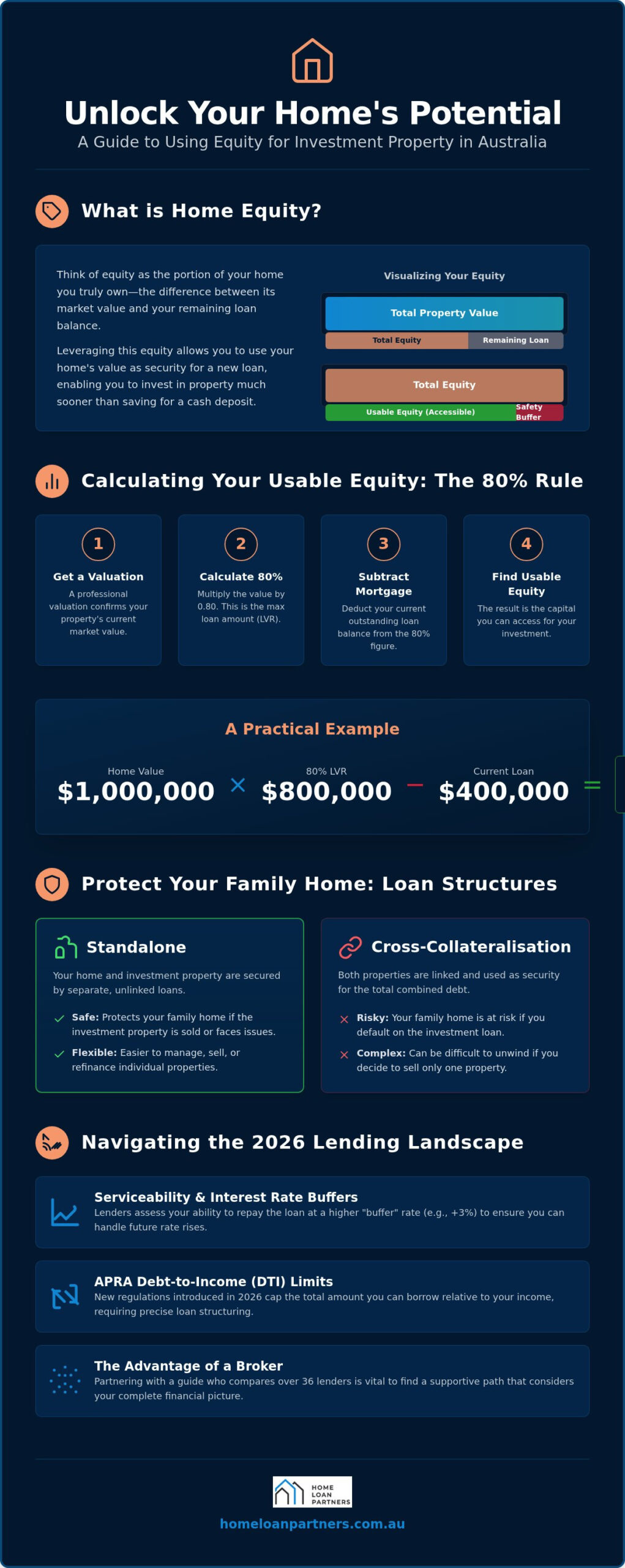
Think of equity as the portion of your home you truly own. It represents the wealth you’ve accumulated through consistent mortgage repayments and property value growth over time. To understand What is Home Equity in a practical sense, it’s the difference between the current market value of your property and the balance remaining on your loan. However, this isn’t cash sitting in your bank account. It’s potential capital that remains inaccessible until you choose to unlock it through a new loan facility or a property sale.
Leveraging is the strategic engine that drives successful property portfolios. Instead of waiting years to save a massive cash deposit, you use the existing value of your home as security for a new loan. This approach allows for significantly faster growth. By using equity to buy investment property australia investors can often enter the market much sooner than those relying solely on personal savings. It’s a proactive way to make your existing assets work harder for your future financial security.
The Difference Between Total Equity and Usable Equity
Banks are naturally conservative and don’t lend against every dollar of your equity. They maintain a safety buffer to protect both your interests and theirs. This leads to the concept of usable equity, which typically sits at the 80% Loan-to-Value Ratio (LVR) threshold. If your home is worth $1 million and you owe $500,000, your total equity is $500,000. But your usable equity is only the amount up to 80% of the value minus your debt. Understanding this distinction helps prevent disappointment when a lender provides a lower borrowing figure than you initially expected. Going beyond this 80% mark usually triggers Lenders Mortgage Insurance (LMI), an extra cost that most investors prefer to avoid.
Why 2026 is a Strategic Time for Australian Investors
The 2026 property market presents unique opportunities despite a shifting interest rate environment. With national median dwelling values around $922,838, many long-term homeowners have seen significant equity growth over the last few years. While new APRA debt-to-income caps introduced in February 2026 require more precision in loan structuring, the tight rental market continues to support the investment logic. Professional guidance is vital now to navigate these regulatory changes and find the right lender. If you’re just starting your journey, our guide on how to buy a house in Australia offers a foundational step-by-step approach. Using your equity wisely today can set the stage for a resilient portfolio that thrives through future market cycles.
Calculating Your Usable Equity: The 80% Rule
Moving from the concept of wealth to concrete numbers is where your investment journey truly begins. While your total equity might look impressive on paper, lenders prioritize a safety margin known as the 80% rule. This threshold ensures you maintain a healthy buffer in your home’s value, protecting you against market fluctuations. When using equity to buy investment property australia, calculating this figure accurately is the first step toward a secure portfolio.
To find your usable equity, follow this simple, four-step formula:
- Step 1: Get a professional valuation. Online estimates are a helpful starting point, but lenders require a formal valuation from a qualified professional to confirm the current market value.
- Step 2: Calculate 80% of that value. Multiply the valuation by 0.80. This represents the total amount a bank is typically willing to lend against the property without extra costs.
- Step 3: Subtract your mortgage. Deduct your current outstanding loan balance from the 80% figure.
- Step 4: Identify your usable equity. The remaining amount is the capital you can access to fund a deposit and purchase costs for your next property.
A Practical Example for Australian Homeowners
Let’s look at how this works in a real-world scenario. Imagine your current home is valued at $1,000,000 and your mortgage balance is $400,000. Under the 80% rule, a lender considers $800,000 as the maximum total debt they’ll secure against that property. By subtracting your existing $400,000 loan, you’re left with $400,000 in usable equity. This sum is incredibly powerful; it can cover a 20% deposit on a new property plus essential costs like stamp duty, legal fees, and building inspections. If you’re feeling uncertain about these figures, chatting with an expert can help clarify your specific position.
The Role of Property Valuations
It’s vital to distinguish between a real estate agent’s appraisal and a bank valuation. An appraisal is often an optimistic estimate based on potential sales, while a bank valuation is a conservative assessment used to manage lending risk. To maximize your result, ensure your home is presented in its best light. Simple actions like completing minor repairs, tidying the garden, and providing a list of recent comparable sales in your area can influence the final figure. A skilled finance broker can often order valuations from several different lenders simultaneously. This strategy allows you to identify the lender that recognizes the highest value in your asset, potentially unlocking more capital for your next move.
Choosing Your Loan Structure: Standalone vs. Cross-Collateralisation
Once you’ve crunched the numbers and confirmed your usable equity, the next step is deciding how to link your assets. This is a critical fork in the road when using equity to buy investment property australia. Most lenders will default to a structure called cross-collateralisation, where they use both your current home and your new investment as security for a single loan facility. While this simplifies the process for the bank, a standalone structure is often the safer, more flexible choice for your long-term journey. In a standalone setup, we keep the equity release on your home entirely separate from the loan for the new property.
Lenders prefer “crossing” your properties because it gives them maximum control over your portfolio. If you decide to sell one property, the bank can legally require you to use the proceeds to pay down the debt on the other property, rather than letting you keep the cash. This is often triggered by an “all-monies” clause. For investors, this lack of control can be frustrating and restrictive. Standalone structures, by contrast, offer risk isolation and the freedom to manage each asset independently.
The Risks of Cross-Collateralisation
The primary danger of crossing your properties is the loss of financial flexibility. Because your assets are tied together, any major change requires the bank’s approval for the entire portfolio. If the market dips and one property loses value, it could prevent you from accessing equity in the other, even if that second property has grown significantly. Furthermore, cross-collateralisation can limit your future borrowing capacity. It’s much harder to move to a different lender to find a better deal if you have to refinance your entire portfolio at once. This structure essentially tethers you to one bank, making it difficult to shop around for more competitive terms as your wealth grows.
The Standalone Equity Release Strategy
A more protective approach involves setting up a separate equity loan, often called a “split” or “top-up,” against your primary residence. This separate loan provides the specific amount needed for the 20% deposit and purchase costs. You then take out a completely separate loan for the remaining 80% of the investment property’s value, ideally with a different lender if it serves your goals better. This partitioning keeps your family home and your investment portfolio in separate buckets. It simplifies your tax reporting, as the interest on the equity loan used for investment purposes remains clearly deductible. Most importantly, it gives you the power to sell, refinance, or restructure one property without the bank dictating what happens to the other.
Serviceability and Costs: Can You Afford the Leap?
Having the capital to start is exciting, but equity is only half of the financial equation. While your home’s value provides the security for the loan, your income and expenses determine your serviceability. This is the bank’s way of ensuring you can comfortably manage repayments without financial strain. When using equity to buy investment property australia, you’ll encounter a strict “Interest Rate Buffer.” Lenders typically test your ability to pay at a rate 3% higher than the current market offer. This stress test protects you from future rate hikes, ensuring your portfolio remains a source of wealth rather than a source of anxiety.
Beyond the loan repayments, you must account for several entry and ongoing costs that can impact your cash flow:
- Entry Costs: Stamp duty is usually your largest upfront expense, followed by legal fees and professional building and pest inspections.
- Ongoing Costs: You’ll need to budget for land tax, property management fees (often 5% to 10% of rent), council rates, and a dedicated maintenance fund.
Understanding Your Borrowing Power in 2026
Lenders don’t just look at your salary; they also consider the potential rental income from your new investment. Typically, banks “shade” this income, counting only about 80% of the total rent to account for vacancies or repairs. Your existing financial commitments also play a significant role. Even if you don’t use them, high credit card limits, car loans, or HECS balances can reduce your borrowing capacity more than you might expect. To get a clearer picture of your specific numbers, use our home loan calculator to model various investment scenarios and see how different variables affect your bottom line.
Refinancing to Unlock Better Rates
Before you move forward, it’s wise to review your current mortgage. If your existing home loan isn’t on the most competitive rate, you’re essentially leaving borrowing power on the table. A lower interest rate on your primary residence reduces your monthly outgoings, which immediately improves your serviceability for an investment loan. You can learn more about this process in our guide on what refinancing a home loan means. Taking the time to optimize your current debt is a smart strategic move that makes the transition into investment property ownership much smoother. If you’re ready to see how your income stacks up against your goals, contact our team for a personalized serviceability assessment.
The Strategic Advantage of Working with a Mortgage Broker
When you walk into a local bank branch, you’re only seeing a tiny slice of the Australian lending market. Banks are designed to sell their own products, and they won’t tell you if a competitor offers a policy that’s more favorable to your situation. When you’re using equity to buy investment property australia, this limited perspective can become a significant roadblock. We act as your expert collaborator, comparing options from over 36 lenders to find the one that says “yes” to your specific financial profile. Our role is to translate complex industry jargon into a clear, actionable plan that puts your goals first.
We take the heavy lifting off your shoulders by managing the entire application process. From initial bank negotiations to the final exchange of paperwork, our team provides a steady hand to ensure a stress-free experience. Instead of forcing you to fit into a bank’s rigid criteria, we tailor your loan structure for long-term success. This means setting up your finances to protect your family home while maintaining the flexibility to grow your portfolio as new opportunities arise. We’re committed to a partnership that lasts well beyond a single transaction.
Navigating the 2026 Lending Landscape
In the current market, serviceability rules vary significantly between different institutions. Some lenders have more generous calculators for rental income or different ways of assessing the 2026 debt-to-income caps. We know exactly which lenders are currently more supportive of investors. We also manage the critical timeline from the initial property valuation through to settlement, keeping you informed at every milestone. Our involvement is a continuous journey; we regularly review your loans to ensure they still serve your needs as your equity grows and market conditions shift.
Your Next Steps to Property Investment
The most effective way to begin your search is by securing a formal pre-approval. This provides a definitive budget and gives you the confidence to negotiate with real estate agents. To make this process as smooth as possible, start gathering your essential documents now. You’ll generally need your most recent payslips, tax returns, and bank statements ready for review. Having these organized allows us to move quickly when you find the perfect investment opportunity. Your future security is built on precise planning and dependable expertise. If you’re ready to see what’s possible for your portfolio, Book a discovery call with The Home Loan Partners today.
Building Your Future with Strategic Confidence
We’ve explored how using equity to buy investment property australia requires more than just a high valuation; it demands a strategic approach to loan structures and a clear understanding of your serviceability in 2026. By prioritising standalone loans and keeping your assets separate, you protect your family home while allowing your portfolio to grow with genuine flexibility. This careful partitioning ensures that your wealth-building journey remains secure, even as market cycles evolve and interest rate buffers shift.
Navigating the nuances of 36+ Australian lenders alone can be overwhelming, especially when every bank has different rules for investment lending. Our team specialises in complex investment property loan structures, providing the professional, stress-free guidance you need from your first valuation to final settlement. We’re here to manage the heavy lifting so you can focus on your long-term milestones. Let our experts calculate your usable equity and find the right loan structure for you. Your path toward financial security is a significant life journey, and we’re honored to act as your dependable guide every step of the way.
Frequently Asked Questions
How much equity do I need to buy an investment property in Australia?
You typically need enough usable equity to cover a 20% deposit plus purchase costs, which often total around 5% of the new property’s value. Usable equity is defined as 80% of your current home’s market value minus your outstanding mortgage balance. If your home is worth $1 million and you owe $400,000, your usable equity is $400,000. This amount provides a solid foundation for your next purchase without needing a cash deposit.
Can I use equity to buy an investment property without a cash deposit?
Yes, you can certainly enter the market without a cash deposit by using your existing home’s value as security. This process involves an equity release, where you set up a new loan facility against your current property. By using equity to buy investment property australia wide, you’re leveraging your current assets to grow your wealth faster. It’s a common strategy that allows you to keep your personal savings intact for other lifestyle goals.
Is it better to use equity or cash for an investment property deposit?
Using equity is often preferred by investors because it preserves cash liquidity and may offer tax advantages. If you keep your cash in an offset account, you reduce the interest on your non-deductible home loan while the interest on your investment equity loan remains deductible. However, using cash reduces your total debt and monthly repayments. We recommend reviewing your specific financial goals with a professional to see which path offers you more security.
What are the risks of using equity to buy another property?
The main risks involve increased debt levels and potential exposure to market fluctuations. If property values fall, you could find yourself with a high debt-to-equity ratio across multiple assets. There is also the risk of interest rate rises affecting your ability to service the larger debt. Choosing a standalone loan structure rather than cross-collateralisation helps mitigate some of these risks by keeping your family home and investment assets separate and protected from each other.
How does a bank value my home for an equity release?
Banks use independent, professional valuers who follow strict industry standards to determine a conservative market value. They look at recent comparable sales in your area, the land size, and the overall condition of your home. This valuation is usually lower than a real estate agent’s appraisal because the bank needs to manage its lending risk. Having a broker order valuations from multiple lenders can sometimes help you find a more favorable result for your application.
Can I use equity for an investment property if I am still paying off my mortgage?
You can definitely access equity while still paying off your mortgage, provided your property has increased in value or you’ve paid down a significant portion of the principal. Lenders look at the gap between what you owe and what the home is worth. As long as your total debt stays below 80% of the property value, that surplus is considered usable. This is how most Australian homeowners begin their journey into property investment portfolios.
What is the maximum LVR for an investment property loan using equity?
The standard maximum LVR for an investment property loan is 80% of the property’s value. While some lenders allow you to borrow up to 90% or even 95%, doing so usually requires paying Lenders Mortgage Insurance. In the 2026 lending environment, your maximum borrowing is also heavily influenced by your serviceability and the new debt-to-income caps. A broker can help you compare different lender calculators to see which one offers the borrowing capacity you need.
Do I need to pay Lenders Mortgage Insurance (LMI) when using equity?
Lenders Mortgage Insurance (LMI) is generally only required if you borrow more than 80% of a property’s value. By keeping your total loan amount within the 80% LVR limit, you avoid this one-off cost, which can save you thousands of dollars. Most strategic investors aim to stay under this threshold to maintain a healthy equity buffer. This approach ensures your investment journey starts on a more cost-effective and secure foundation from the very beginning.