

Waiting years to save a full 20% deposit might actually cost you more in rising property prices than paying an insurance premium today. Most Australians feel that LMI is simply “wasted” money, especially when the average first home buyer loan has climbed to $614,048 in 2026. It’s natural to feel anxious about a fee that protects the bank rather than your own interests. Using a lenders mortgage insurance calculator is the first step to turning that confusion into a clear, manageable strategy for your future.
Our goal is to act as your steady guide through these complex financial decisions. We’ll show you how to get a precise dollar estimate of your potential premium and explain how to use this insurance strategically to enter the market years ahead of schedule. This guide covers the latest 2026 government guarantee updates, professional waivers for high-stability industries, and tips to minimize your costs. You’ll learn whether paying LMI is a smart move for your specific timeline or if a different path will better serve your long-term security. We’re here to help you navigate these options with precision and care.
Key Takeaways
- Understand how the “80% Rule” triggers insurance costs and use a lenders mortgage insurance calculator to estimate your premium before starting your property search.
- Identify the primary factors that influence your premium, including how loan-to-value ratio tiers and total loan sizes can change the cost across different insurers.
- Evaluate the opportunity cost of paying LMI now versus waiting to save a larger deposit as property prices continue to shift in the 2026 market.
- Discover strategic ways to reduce or avoid premiums entirely through professional waivers, government guarantee schemes, or the support of a family guarantor.
- Learn why comparing 36+ lenders through a broker can help you secure a more cost-effective loan structure than relying on a single bank’s internal policy.
What is Lenders Mortgage Insurance and How Do Calculators Estimate It?
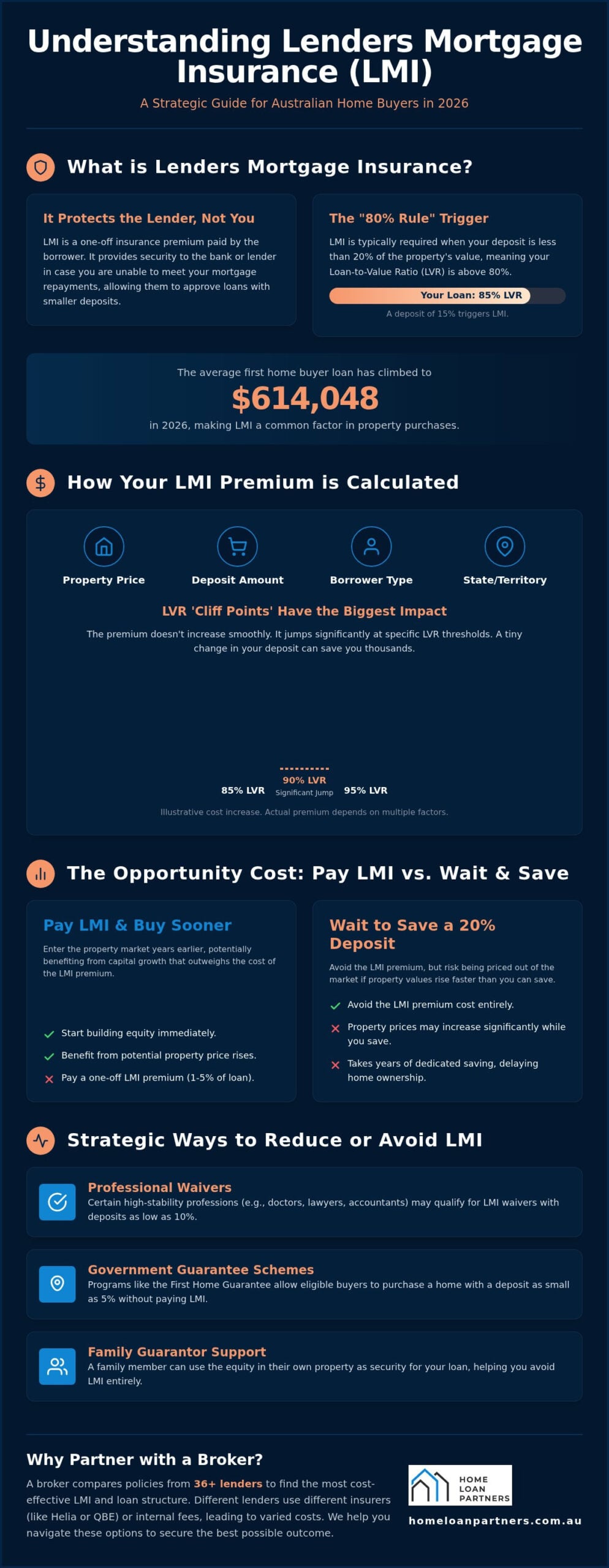
Understanding What is Lenders Mortgage Insurance is a vital step for any Australian home buyer in 2026. Unlike standard insurance policies that protect your assets, LMI is a one-off premium that protects the lender if you can’t meet your mortgage repayments. Banks generally apply the “80% Rule,” which triggers this insurance requirement whenever your deposit is less than 20% of the property’s value. From the bank’s perspective, LMI is a risk-offsetting tool that allows lenders to accept smaller deposits and approve loans that would otherwise be considered too high-risk for their portfolio.
How an LMI Calculator Works
A reliable lenders mortgage insurance calculator helps you plan by processing several critical variables. Most tools require you to input specific data points to generate an estimate, including:
- The total property purchase price
- Your available deposit amount
- Borrower category, such as first home buyer or investor
- The state or territory where you’re purchasing
The most critical factor is your Loan-to-Value Ratio (LVR). As your LVR climbs, the cost doesn’t just grow steadily; it often jumps significantly at specific thresholds, such as 85%, 90%, and 95%. LMI typically costs between 1% and 5% of the loan amount, and these calculators also include regional adjustments to account for state-based stamp duty on the premium. This ensures your estimate reflects the actual costs in your specific territory, as taxes on insurance vary across Australia.
Upfront Payment vs. Capitalising LMI into Your Loan
Most buyers choose to “capitalise” their LMI, which means the fee is added to the total loan balance rather than paid as a lump sum at settlement. This is a practical way to keep your upfront costs low, but it requires careful calculation. Adding the premium to your loan increases your total debt and can occasionally shift your LVR into a more expensive risk tier. Additionally, because you’re borrowing the premium, you’ll pay interest on that amount for the life of the loan. Over a 30-year mortgage, a premium that was originally a few thousand dollars could end up costing you significantly more when total interest is factored in. Using a lenders mortgage insurance calculator allows you to compare these two paths and decide which fits your budget and your long-term security.
Key Factors That Influence Your LMI Premium Calculation
Your Loan-to-Value Ratio (LVR) is the primary factor determining your premium. While it seems like a simple percentage, the role of LMI in financial stability means that insurers look at risk through very specific lenses. If you borrow more than $1 million, for instance, you’ll often encounter tiered pricing structures where the insurance rate itself increases. Lenders also vary their choice of insurer; some use Helia or QBE, while others use internal risk fees. These internal ‘Lender Protection Fees’ can sometimes be cheaper but aren’t always portable if you decide on refinancing later.
The Difference Between Owner-Occupied and Investment LMI
Investment loans generally carry higher premiums than owner-occupied ones. This is because insurers perceive higher risk in rental properties, especially if you choose interest-only repayments. A lenders mortgage insurance calculator will often show a noticeable price jump when switching from principal and interest to interest-only terms. This risk weighting reflects the insurer’s need for security during market fluctuations. If you’re a first home buyer, you might find more competitive rates or government-backed waivers that investors can’t access in the 2026 market.
LMI Tiers and ‘Cliff’ Points
Understanding ‘cliff points’ can save you thousands. For example, moving from a 90.01% LVR down to exactly 90% can result in a significant premium drop. It’s often worth finding a few extra dollars for your deposit to cross that threshold. An accurate property valuation is essential here, as the final LVR is based on the bank’s valuation rather than your purchase price. Using a lenders mortgage insurance calculator during the early stages of your search helps you identify these ‘sweet spots’ for your deposit size.
A common mistake is ignoring how “capitalisation” impacts your risk tier. Adding the insurance fee back into the loan is convenient, but it increases your total debt. If your initial loan is at 89% and the premium is 1.5%, capitalising it pushes your final LVR to 90.5%. This shift might trigger a higher insurance rate for the entire amount. We can help you model these scenarios to ensure your loan structure remains cost-effective for the long term. Our team works to compare options across 36+ lenders to find the most protective and affordable path for your journey.
LMI Cost vs. Property Market Growth: The Opportunity Cost Analysis
It’s common to hear that LMI is a waste of money. After all, you’re paying for a policy that offers you no direct protection. However, when you look at the official definition of Lenders Mortgage Insurance, it’s clear this is a tool designed to bridge the gap between your current savings and your property goals. In a rising market, LMI acts as a time-buying mechanism. If you use a lenders mortgage insurance calculator and see a premium of $15,000, it might feel steep. But if property prices in your target area rise by $40,000 while you spend the next year saving, you’ve actually “lost” $25,000 by waiting. Buying now allows you to start building equity immediately. You’re no longer chasing a moving target. For many Australians, the decision isn’t about whether LMI is “good” or “bad,” but whether the cost of the insurance is lower than the cost of missing out on market growth.
Calculating the ‘Time to Save’ vs. ‘Buying Now’
To make an informed choice, you need to calculate your personal “cost of waiting.” This involves more than just looking at property price trends. You must factor in the rent you’ll pay during the extra time it takes to save a full 20% deposit. If it takes you 24 months to save an additional $60,000, and you’re paying $3,000 a month in rent, that’s $72,000 in non-recoverable costs. When you compare that $72,000 plus potential price growth against a one-off LMI premium, the insurance often becomes the more logical financial path. A lenders mortgage insurance calculator gives you the data needed to run these comparisons with confidence and clarity.
Using LMI for Investment Property Leverage
Investors often view LMI as a strategic expense rather than a penalty. By opting for a higher LVR and paying the insurance premium, an investor can spread their capital across multiple properties. Instead of putting a 20% deposit into one unit, you might put 10% into two different assets. This increases your exposure to capital growth across different markets and diversifies your risk. Additionally, LMI is generally tax-deductible for investment purposes in Australia, usually spread over five years. This makes it a highly efficient way to scale a portfolio while preserving your cash flow. If you’re just starting out, our beginner’s guide to investment property loans provides deeper insights into how to structure these deals. We’re here to help you weigh these leverage strategies against your long-term wealth milestones with a steady, expert hand.
How to Reduce or Avoid LMI Premiums Altogether
While a lenders mortgage insurance calculator provides a reliable baseline for your budget, it isn’t the final word on what you’ll actually pay. Many buyers assume LMI is an unavoidable tax on small deposits, but several strategic paths exist to bypass this cost entirely. The most traditional method is reaching the magic 80% Loan-to-Value Ratio (LVR). By increasing your deposit to 20% of the property’s value, you eliminate the lender’s perceived risk and the insurance requirement. If saving that extra capital feels out of reach, a guarantor home loan allows a family member to use the equity in their own home as additional security. This can reduce your LVR to 80% on paper, even if you only have a 5% cash deposit, effectively removing LMI from the equation.
Leveraging Government Support Schemes in 2026
The Australian government has significantly expanded its support for buyers, making it easier to avoid insurance costs without a 20% deposit. In 2026, the First Home Guarantee (FHG) remains a powerful tool, allowing eligible participants to purchase with as little as a 5% deposit while the government effectively acts as the insurer. This removes the need for you to pay any LMI premium. As of October 2025, income caps for the FHG were removed and the number of places became unlimited, making this path more accessible than ever. Property price caps still apply across different states and territories, with specific limits designed to reflect local market values. Applying early through a participating lender is essential to ensure your specific property fits within these 2026 national thresholds.
Professional Waivers for High-Income Earners
Lenders actively compete for borrowers in stable, high-income industries by offering professional LMI waivers. If you work in a qualified field, you may be able to borrow up to 90% or even 95% of the property value without paying any insurance. These waivers are typically available to:
- Medical Professionals: Doctors, dentists, veterinarians, and pharmacists.
- Legal Professionals: Solicitors, barristers, and judges.
- Accounting and Finance: Accountants, auditors, and actuaries.
- Other Specialists: Some lenders extend these offers to engineers and IT professionals.
Each lender has specific minimum income requirements and membership criteria for professional bodies to grant these exemptions. Because these policies aren’t always public, a lenders mortgage insurance calculator won’t automatically apply them to your results. If you’re unsure which category you fall into, we can help you identify a First Home Buyer Loan that utilizes these waivers. Our role is to act as your expert collaborator, comparing 36+ lenders to find the specific policy that acknowledges your professional status and saves you thousands in upfront costs.
Why Partner with a Broker to Calculate and Manage LMI?
A lenders mortgage insurance calculator is an excellent tool for initial budgeting, but it operates on industry averages. In reality, LMI premiums aren’t fixed. Different lenders partner with different insurers, and these partnerships create price variations that can amount to thousands of dollars for the same loan amount. We act as your expert collaborator to navigate these differences. Instead of accepting the first quote, we compare options across our panel of 36+ lenders to find the most cost-effective structure for your specific needs. This process moves you from a rough estimate to getting a formal mortgage quote that reflects your true financial position.
Navigating Mortgage Insurer Guidelines
It’s vital to remember that the bank isn’t the only gatekeeper for your loan. When you borrow more than 80% of a property’s value, the mortgage insurer must also approve your application. Companies like Helia and QBE have their own specific rules regarding property types, postcodes, and employment stability that aren’t always public. We understand these “hidden” guidelines and can “shop” your scenario to the insurer most likely to provide an approval. This professional oversight significantly reduces the risk of a declined application, protecting your credit score and your peace of mind during a stressful time.
A Tailored Plan for Your Property Journey
Our commitment to your success extends throughout the duration of your homeownership journey. We help you move beyond simple estimations toward a comprehensive home loan plan that accounts for your long-term milestones. Whether you’re a first home buyer or an experienced investor, we provide unbiased advice that prioritizes your future security. By looking at the full 2026 market landscape, we ensure your loan structure is flexible enough to grow with you. If you’re ready to take the next step with a steady hand by your side, book a consultation with The Home Loan Partners today. We’ll manage the heavy lifting so you can focus on finding the perfect home.
Secure Your Path to Homeownership in 2026
Navigating the costs of entering the property market doesn’t have to feel like an uphill battle. While a lenders mortgage insurance calculator provides a helpful starting point for your initial budget, the real power lies in how you use that information to build a strategic entry plan. Whether you’re leveraging the latest 2026 government guarantee schemes or qualifying for a professional waiver, the right loan structure can save you thousands in upfront fees and years of extra saving time. It’s about finding the perfect balance between the one-off cost of insurance and the long-term value of starting your equity journey today.
Our team is here to manage the heavy lifting and provide the steady expertise you need to move forward with confidence. We offer access to 36+ Australian lenders and specialize in First Home Buyer schemes, providing a personalized assessment of LMI waivers that many banks don’t promote directly. We’re committed to your long-term success and look forward to acting as your expert collaborator throughout this journey. Speak with our expert brokers to find the lowest LMI premium for your loan and take a stress-free step toward your property goals. Your future home is closer than you think, and we’re ready to help you reach it.
Frequently Asked Questions
Is Lenders Mortgage Insurance refundable if I pay off my loan early?
Most LMI premiums are non-refundable once the loan has settled. While a small number of lenders previously offered partial refunds if the loan was repaid within the first two years, this practice has largely disappeared in the 2026 market. Once the insurer has accepted the risk and the policy is active, the premium is considered fully earned. It’s best to view this as a one-off cost of entering the market sooner.
Can I add the LMI premium to my total loan amount?
You can typically capitalise the LMI premium by adding it to your total loan balance. This is a common strategy for buyers who want to preserve their cash for other upfront costs like stamp duty or moving expenses. However, adding this fee to your loan increases your total debt and interest charges over time. You should use a lenders mortgage insurance calculator to see how this affects your monthly repayments.
How much deposit do I need to avoid LMI in Australia?
You generally need a 20% deposit to avoid LMI in Australia. This ensures your Loan-to-Value Ratio (LVR) is 80% or less, which lenders consider a safe threshold that doesn’t require extra insurance. However, in 2026, many buyers bypass this requirement by using government guarantee schemes or professional waivers. These paths allow you to purchase with as little as a 5% deposit without the added expense of an insurance premium.
Does LMI protect me if I can’t make my mortgage repayments?
LMI does not provide any protection for the borrower. It is an insurance policy that protects the lender if you default on your loan and the property is sold for less than the outstanding debt. If a claim is made, the insurer may still pursue you for the shortfall. You should consider separate mortgage protection or income protection insurance if you want coverage for your own financial security and peace of mind.
Is LMI tax deductible for investment properties?
LMI is generally tax-deductible for investment property loans in Australia. Instead of claiming the full amount in one year, you typically spread the deduction over five years or the life of the loan, whichever is shorter. This makes LMI a more palatable cost for investors, as it effectively reduces your taxable income. We recommend consulting with a qualified accountant to ensure you’re maximizing your specific tax benefits under current 2026 regulations.
What happens to LMI if I refinance my home loan later?
LMI is usually not portable between different lenders. If you decide on refinancing your mortgage to a new bank and your LVR is still above 80%, you’ll likely need to pay a new LMI premium. This is why it’s crucial to get the structure right the first time. Some lenders offer internal waivers for existing customers, but switching institutions almost always triggers a fresh assessment from their specific mortgage insurer.
Are there any lenders that don’t charge LMI for a 10% deposit?
Some lenders offer specific products or waivers that allow for a 10% deposit without LMI. These are often targeted at high-income professionals like doctors, lawyers, or accountants who are seen as lower risk. Additionally, some smaller lenders may offer competitive 90% no LMI promotions to attract new business. Using a lenders mortgage insurance calculator can help you compare these specialized offers against standard loans to see which provides the best overall value.
How is stamp duty on LMI calculated in different states?
Stamp duty on LMI is a state-based tax applied to the insurance premium itself, not the property value. Each Australian state and territory has its own rate, which is why the total cost of LMI varies depending on where you buy. For example, the tax rate in New South Wales differs from the rate in Victoria. Most modern calculators automatically factor in these regional differences to give you a more accurate total cost estimate.