

What if your recent career move was actually the key to unlocking a better mortgage, rather than the barrier you’ve been told it is? Many Australians believe they must wait at least six months before getting a home loan after changing jobs, fearing that being on probation or switching industries will lead to an automatic rejection. It’s completely natural to feel anxious that a new, higher salary might not be viewed as stable income by traditional banks in the current 2026 lending environment.
We understand that these hurdles can feel overwhelming, but your professional growth should be celebrated, not penalized. This guide will show you how to secure approval even while you’re still settling into a new role. We’ll explore how different lenders view employment continuity and why your industry experience often matters more than your start date. You’ll learn the exact timelines required for a successful application and which lenders are currently the most supportive of career-driven movers. This roadmap provides the clarity you need to move forward with your property goals and secure your future with confidence.
Key Takeaways
- Learn why lenders prioritize income continuity and how to position your career move as a sign of professional growth rather than a risk factor.
- Discover that probation periods are not an automatic barrier, with many lenders in 2026 offering flexible options for those with strong industry experience.
- Understand the specific documentation and history requirements for getting a home loan after changing jobs based on your current employment contract and industry background.
- Identify proactive steps, such as maximizing genuine savings and maintaining a clear credit history, to strengthen your application during a job transition.
- Find out how a dedicated broker acts as a steady hand, navigating policies across 36+ lenders to find a tailored loan structure that fits your new career path.
Why Lenders View Changing Jobs as a Risk Factor
Lenders aren’t trying to be difficult; they’re trying to predict the future. When you’re pursuing the Great Australian Dream, a bank’s primary tool for assessment is your serviceability. This is their way of measuring if you can comfortably meet your repayments alongside your other living expenses. A recent job change introduces a variable into their calculations. If your income history looks like a series of peaks and valleys, a lender’s automated credit algorithm might flag your application as higher risk, even if your new salary is significantly higher.
Getting a home loan after changing jobs becomes a matter of narrative. Lenders distinguish between a voluntary move, such as a promotion or a strategic step up, and an involuntary career shift caused by redundancy. A voluntary move suggests you’re in demand; an involuntary one might suggest instability in your sector. Employment stability in 2026 is the proven ability to generate consistent, sufficient income through reliable professional engagement, regardless of whether that income flows from one employer or several within the same field.
The Role of the Probation Period
Banks traditionally view probation as a period of uncertainty. From their perspective, a borrower on probation is subject to a ‘last in, first out’ risk during economic shifts. If a company needs to downsize, the newest team members are often the first to go. Lenders price this risk by either requiring a higher deposit or, in some cases, declining the application until the probation period is officially over. However, not all lenders follow this rigid path. Some specialized lenders on our panel recognize that certain high-demand professions carry very little actual risk of termination, and they’re willing to consider your application from day one.
Industry Continuity vs. Career Pivots
Staying within the same industry for at least two years provides a safety net for your application. Even if you’ve recently switched employers, having a track record in the same field demonstrates that your skills are transferable and your earning potential is established. This continuity helps mitigate the perceived risk of getting a home loan after changing jobs. Conversely, a ‘Career Pivot’ into a completely new field often triggers more scrutiny. A lender may worry that you won’t enjoy the new line of work or that you lack the experience to maintain your new income level. You can prove your industry experience by providing a detailed resume or previous tax returns that show a steady progression within your specialized field.
The Truth About Getting a Home Loan While on Probation
The idea that you must wait six months to apply for a mortgage is one of the most persistent myths in the Australian property market. While some major banks still prefer this timeframe, the reality in 2026 is far more flexible. Getting a home loan after changing jobs doesn’t require a long waiting period if you can demonstrate a clean transition between roles. Lenders are increasingly focused on your overall career trajectory rather than just the date on your current contract. If you’ve moved for a higher salary, that pay rise actually works in your favor by improving your serviceability and allowing you to manage a larger loan comfortably.
A clean transition is vital. Lenders look for “income continuity,” meaning they prefer to see no more than a month’s gap between your previous role and your new one. If your career move was a step up in responsibility or pay, it signals professional growth. In high-demand sectors like healthcare, education, or technology, some specialized lenders will even accept an application on “Day 1” of your new employment. They recognize that your skills are in short supply, which reduces the perceived risk of your probation period.
Lenders Who Accept Probation
The “Big Four” banks typically have stricter policies and often require you to have completed your probation period or have at least three to six months of tenure. However, the non-bank sector in 2026 has become a vital resource for job-switchers. These lenders often apply the “industry continuity” rule. If you’ve spent two or more years in the same field, they may waive the probation requirement entirely. Your Loan-to-Value Ratio (LVR) also plays a significant role here. If you have a 20% deposit, you’ll find far more lenders willing to overlook a current probation status compared to someone with only a 5% deposit.
Documentation Needed for New Employees
To satisfy a credit assessor, you’ll need a specific set of documents that prove your new income is stable. The most important is a formal Letter of Employment. This document must be on company letterhead and clearly state your start date, base salary, and employment status. While a contract is a good start, your first payslip is the real “golden ticket” for your application. It proves the role has commenced and the income is being paid as agreed. If you’re still in your first month, providing professional, unbiased advice through a broker can help you package your previous two years of tax returns to bolster your case for reliability.
How Different Employment Types Affect Your Application
Your contract type is just as influential as your tenure for a lender’s decision. While a full-time PAYG role remains the most straightforward path for those getting a home loan after changing jobs, the Australian workforce in 2026 is far more diverse. Lenders have adapted their credit models to account for various employment structures, but each comes with its own set of rules. Understanding these nuances helps you present your application in the best possible light, ensuring your new career move doesn’t stall your property goals.
Full-time and part-time PAYG employees typically enjoy the most flexibility. If your new role is permanent, many lenders will look at your base salary immediately. Fixed-term contractors and self-employed individuals face more scrutiny. For the self-employed, a change in business structure, such as moving from a sole trader to a company, is often viewed as a fresh start rather than a job change. This usually requires two years of new tax returns, regardless of your previous success. We act as your steady hand here, identifying which lenders prioritize your total professional experience over the legal structure of your income.
Casual Workers and Job Changes
Casual employment traditionally requires a longer history to prove income stability. Most lenders look for 6 to 12 months in the same role to account for fluctuations in hours. However, if you’ve recently moved between casual roles in the same industry, you may benefit from the ‘continuity of hours’ rule. If your weekly hours remain consistent with your previous employment, some lenders will average your income across both roles to satisfy serviceability. This is a vital strategy when you are first buying a house in Australia, as it prevents a career move from resetting your eligibility clock.
Contractors and Agency Workers
Fixed-term contractors often need to show at least 12 months of history in similar roles to be considered stable. Lenders also look closely at the ‘remaining term’ of your current contract. If you have less than three months left without a confirmed renewal, it can trigger a red flag. PAYG contractors, who have tax withheld by an agency, are generally viewed more favorably than ABN contractors. Professionals in IT and healthcare who move frequently between high-paying contracts can often bypass standard tenure rules by providing a solid two-year history of back-to-back assignments. This demonstrates that your skills are in high demand, making getting a home loan after changing jobs a much smoother process.
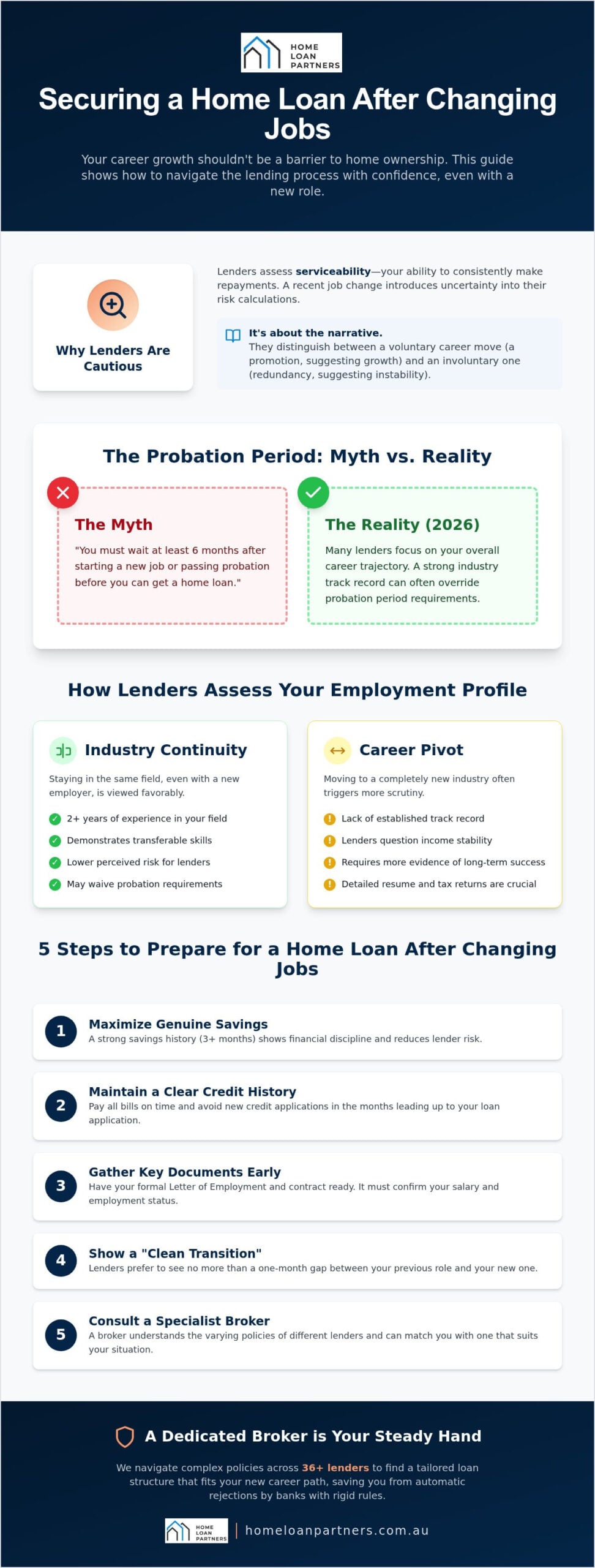
5 Steps to Prepare for a Home Loan After Changing Jobs
Preparation is the bridge that connects your new career move to your property goals. While getting a home loan after changing jobs is entirely possible in 2026, lenders look for specific signals of financial discipline to offset the perceived risk of a fresh contract. By following a structured approach, you can present a high-quality application that highlights your strengths and minimizes the focus on your short tenure. These five steps provide a clear roadmap to secure your approval.
- Step 1: Build a robust deposit. Aiming for a 20% deposit significantly increases your choice of lenders and often removes the need for Lenders Mortgage Insurance (LMI).
- Step 2: Guard your credit score. Avoid any new debt applications and ensure every existing bill is paid on time during your transition.
- Step 3: Gather your paperwork. Have your signed employment contract and your first payslip ready as soon as they’re available.
- Step 4: Minimize lifestyle debt. Close unused credit cards and avoid taking out new personal loans while you’re in your probation period.
- Step 5: Engage a specialist broker. Partner with a professional who understands the specific 2026 policies of both major and non-bank lenders.
The Importance of Genuine Savings
A substantial deposit is one of the most powerful tools for getting a home loan after changing jobs. If you can provide a 20% deposit, many lenders view the lower Loan-to-Value Ratio (LVR) as a safety net that cancels out the uncertainty of a new role. It’s vital to distinguish between ‘gifted’ funds and ‘genuine’ savings. Lenders generally want to see that you’ve personally accumulated at least 5% of the property value over a three-month period. To see how your current savings align with your goals, you can use our home loan calculator guide to estimate your required deposit and potential repayments.
Credit Health During Career Moves
Lenders in 2026 are highly sensitive to ‘Buy Now, Pay Later’ (BNPL) accounts, especially for borrowers with short job tenure. Even if you have a perfect repayment history, these accounts can reduce your serviceability in the bank’s eyes. Frequent job changes, while often great for your salary, can sometimes impact the ‘stability’ component of your credit score. Before you apply, check your credit report for any inaccuracies that might suggest financial stress. If you’re ready to see which of our 36+ lenders best fits your new career path, contact our team today for a tailored assessment of your situation.
How The Home Loan Partners Navigate 36+ Lenders for You
The Home Loan Partners act as your steady hand in a market where credit policies shift constantly. Getting a home loan after changing jobs requires more than just a good salary; it needs a strategic match between your career trajectory and a lender’s appetite for risk. With access to a panel of over 36 lenders, we don’t just look for a loan; we look for the specific policy that rewards your professional growth. We manage the heavy lifting of lender negotiations, translating your career move into a language that credit assessors understand and trust.
Our “Stress-Free” approach means we handle the complex back-and-forth with banks so you can focus on your new role. We build tailored loan structures that account for your higher income and future earning potential, rather than just looking at your last two payslips. This precision ensures that your mortgage remains a supportive tool for your lifestyle, not a source of financial strain. Our involvement doesn’t end at settlement; we’re here for the long haul as your expert collaborator.
Policy Matching vs. Bank Hopping
Applying to multiple banks on your own can inadvertently damage your credit score. Each “hard inquiry” from a lender can lower your rating, making you look desperate for credit during a career transition. We avoid this by performing deep policy research before any application is submitted. By identifying ‘common sense’ lenders who value industry experience over simple tenure, we protect your financial reputation while securing the funds you need. Getting a home loan after changing jobs is much safer when you have a professional filtering the options first.
This process is about more than just finding a low rate; it’s about finding a lender whose internal algorithms align with your employment type. Whether you’re a PAYG professional or a specialized contractor, we filter through dozens of criteria to find your perfect match. You can see how this fit translates into a smoother application by reading our guide to hiring a finance broker in Australia.
Your Long-Term Financial Journey
Our partnership doesn’t end when you get the keys. We view the life of your loan as a collaborative journey that evolves alongside your career. Once you move from your probation period to a permanent position, your risk profile in the eyes of the bank changes significantly. We proactively review your loan structure at these milestones to ensure your interest rate remains competitive. This is a commitment to your future security, not just a one-time transaction.
Because we’re committed to your long-term success, we maintain a regular rhythm of communication to check that your mortgage still serves your needs. Our team is incentivized to keep your rate low and your structure efficient throughout the duration of the relationship. This is the practical benefit of trail commissions; they keep us focused on your ongoing financial health. If you’re ready to explore your options, Contact The Home Loan Partners for a personalized assessment of your borrowing power and a clear path toward your next home.
Secure Your Property Future with Confidence
Your career advancement shouldn’t be a roadblock to your home ownership goals. The 2026 Australian lending landscape offers significant flexibility for those who have recently switched roles. By focusing on industry continuity and maintaining a strong deposit, you can position yourself as a reliable borrower despite being on probation. Getting a home loan after changing jobs is a manageable process when you have a clear strategy and the right documentation in hand.
Income stability is about more than just time spent with one employer; it’s about your professional journey and your future earning potential. We’re here to act as your steady hand, navigating the complex credit policies of over 36 Australian lenders to find your ideal fit. Our national team specializes in tailored structures for complex employment situations, ensuring a smooth path forward. Book a stress-free consultation with The Home Loan Partners today to explore your borrowing power. Your next milestone is closer than you think.
Frequently Asked Questions
Can I get a home loan while on probation in 2026?
Yes, securing mortgage approval while on probation is absolutely possible in 2026. While traditional banks often prefer you to complete your six-month trial, many of the 36+ lenders we work with prioritize your industry experience instead. If you’ve spent two or more years in the same field, we can often find a tailored loan structure that accepts your application from day one. Having a 20% deposit also significantly improves your chances of success.
How long should I wait after starting a new job to apply for a mortgage?
You don’t always have to wait six months to start your property journey. The ideal waiting period depends on your employment type and industry history. For many permanent PAYG employees, receiving your first payslip is enough to begin the process. However, if you’ve moved into a completely new industry, some lenders may require a three-month history to prove income stability. We help you navigate these differing policies to find the right timing for your situation.
Does a higher salary in a new job help my home loan application?
A higher salary is a significant advantage as it directly boosts your serviceability. Lenders use your income to calculate if you can comfortably manage repayments alongside the current 3% APRA serviceability buffer. When getting a home loan after changing jobs, a pay rise demonstrates career progression and financial growth. This increased borrowing power can often offset the perceived risk of a new contract, provided you can document the income with a formal letter of employment.
What if I change jobs after my home loan is pre-approved?
Changing jobs typically invalidates an existing pre-approval because the lender’s initial assessment was based on your previous employment. You must notify your lender or broker immediately to have your application reassessed. While this might feel stressful, it doesn’t mean you’ll be rejected. We’ll work with you to update your documentation and ensure your new role still meets the lender’s criteria, maintaining your path toward a successful settlement without unnecessary delays.
Can I get a home loan if I’m moving from a full-time to a casual role?
Moving from full-time to casual employment is viewed as a higher risk by most lenders due to fluctuating hours. Generally, you’ll need to demonstrate 6 to 12 months of consistent income in the casual role before an application is considered. However, if you’re staying with the same employer or in a high-demand industry like healthcare, some specialist lenders may be more flexible. We can help you identify which policies account for your specific professional circumstances.
Do I need to tell my lender if I plan on changing jobs during the application?
Yes, you have a legal and contractual obligation to disclose any significant changes to your financial situation during the application process. Attempting to hide a job change can lead to a formal decline or even issues with your loan contract later. Transparency allows us to manage the transition professionally. We can often re-package your application to highlight your career growth, ensuring the lender remains confident in your ability to service the debt.
Will a gap between jobs affect my chances of getting a home loan?
A small gap of less than one month between roles usually won’t impact your application, provided you have a strong overall work history. Lenders look for income continuity to ensure you can meet ongoing repayments. If you’ve had a longer break, you may need to provide a valid reason or wait until you’ve been in your new role for three to six months. We act as your steady hand, explaining these transitions to credit assessors.
Can I refinance my home loan immediately after starting a new job?
You can certainly explore refinancing options after starting a new role, but your choice of lenders may be more restricted if you’re still on probation. Refinancing requires a fresh credit assessment, so getting a home loan after changing jobs involves the same serviceability checks as a new purchase. We’ll compare products across our panel of 36+ lenders to find a structure that recognizes your new income while offering a more competitive interest rate for your future.