

Did you know that in 2026, many Australian lenders are testing your ability to manage a mortgage at interest rates as high as 9.5%? With the APRA serviceability buffer at 3.0% and new caps on debt to income ratios, it’s natural to feel frustrated by restrictive lending criteria. You might be wondering how to increase my borrowing capacity so you don’t get priced out of the property market. We understand the anxiety of watching prices move while feeling like banks are auditing every coffee you buy.
The good news is that your borrowing power isn’t a fixed figure. It’s a variable outcome based on which of the 36 plus lender calculators we use to assess your profile. We’ve helped many families navigate these complex requirements to find a steady, stress free path forward. In this guide, you’ll discover the professional strategies mortgage brokers use to unlock higher loan amounts. We’ll provide a clear roadmap to maximize your eligibility, from identifying which debts to clear first to finding the lenders that view your income more favourably.
Key Takeaways
- Understand how the 3% serviceability buffer impacts your loan eligibility and why banks assess your repayments at much higher rates than you’ll actually pay.
- Learn how to audit your income to include bonuses, commissions, and government payments that lenders often “shade” or overlook.
- Discover how to increase my borrowing capacity by strategically reducing credit card limits, as lenders assess your total limit rather than your monthly balance.
- Compare the unique lending calculators of over 36 different lenders to find the specific policy that views your profession or income type most favourably.
- Move beyond basic applications by using a collaborative structure that aligns your current debts and lifestyle expenses with your long-term property goals.
Understanding Borrowing Capacity: Why Lenders Say No (or Not Enough)
Borrowing capacity is essentially a measure of your financial serviceability. It’s the maximum loan amount a lender believes you can comfortably manage without falling into financial hardship. While it might feel like a fixed number, it’s actually a variable outcome based on how a bank views your income and liabilities. Many Australians searching for how to increase my borrowing capacity are surprised to find that their eligibility can vary by tens of thousands of dollars between different institutions.
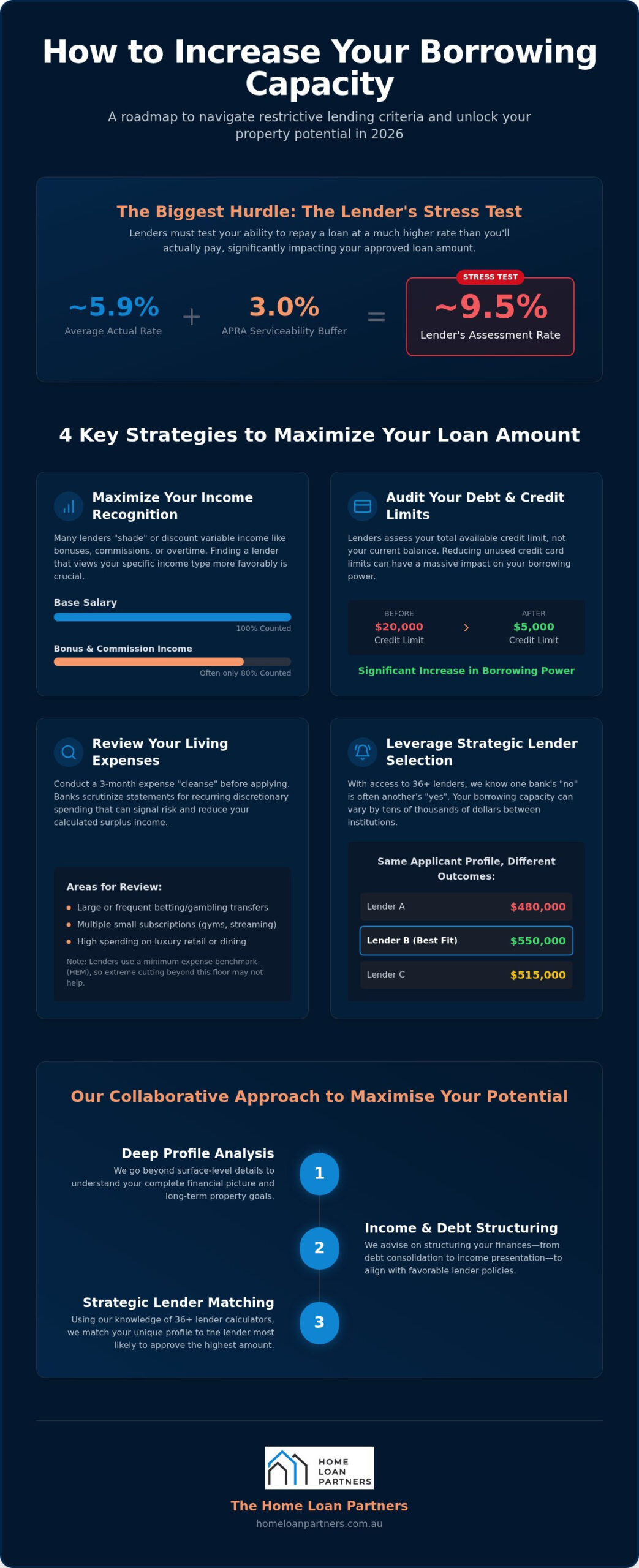
A major factor in this calculation is the serviceability buffer. As of September 2026, APRA requires lenders to assess your ability to repay a loan at an interest rate at least 3.0 percentage points higher than the actual rate. With average variable rates around 5.90%, banks are testing your budget against a hypothetical 9% interest rate. This safety net is designed to protect you from future rate hikes, but it can significantly limit your initial loan amount in the current economic climate.
The 2026 market is defined by a cautious lending appetite. With the RBA cash rate at 4.35%, banks have become more meticulous in their audits. However, because we have access to over 36 lenders, we know that one bank’s “no” is often another bank’s “yes.” Each lender uses a unique calculator, and finding the right fit is the first step toward securing your property goals.
The Net Monthly Income vs. Living Expenses Formula
Lenders determine your borrowing power by calculating your Uncommitted Monthly Income (UMI). This is the surplus cash remaining after your tax, essential living expenses, and existing debt repayments are subtracted from your gross earnings. Even minor lifestyle choices can have a massive impact. For example, a $100 monthly subscription or gym membership might seem small, but it can reduce your borrowing power by thousands of dollars because that $100 is no longer available for loan repayments. Lenders also pay close attention to your debt-to-income ratio to ensure your total liabilities don’t outweigh your earning potential.
The Role of APRA and Responsible Lending
The Australian Prudential Regulation Authority (APRA) sets the “floor” for lending rules to maintain national financial stability. In 2026, banks must adhere to strict portfolio limits, such as restricting high debt-to-income loans to just 20% of their new lending. This is why standard online calculators are often so conservative; they are programmed to meet these strict regulatory baselines rather than looking for ways to support your specific needs. APRA’s primary role in 2026 is to ensure the banking system remains resilient by enforcing these conservative lending standards across the board.
Optimising Your Income and Expenses for Maximum Impact
To understand how to increase my borrowing capacity, you must first look at how you present your cash flow. Lenders don’t just look at your base salary. They want to see the full picture, including bonuses, commissions, and government payments. However, you should be aware of “income shading.” Many banks only count 80% of irregular income types to protect themselves against fluctuations. If you’re a contractor or rely heavily on overtime, this can significantly impact your loan size. We help you identify which lenders view these income streams most favourably.
We recommend a three month expense “cleanse” before you apply. Banks will scrutinise your bank statements for recurring discretionary spending. While a single subscription won’t break your application, large, regular transfers to betting accounts or luxury retail can signal risk. By separating these from fixed essential costs like utilities and insurance, you demonstrate financial discipline. It’s helpful to calculate your DTI ratio early to see how your current earnings support your debt obligations.
Navigating the Household Expenditure Measure (HEM)
Banks use a benchmark called the Household Expenditure Measure (HEM) to estimate your living costs based on your family size and location. If your actual reported spending is lower than this floor, the bank will use the higher HEM figure anyway. This means that cutting your expenses to an extreme level won’t actually help your capacity beyond a certain point. Our role as your guide is to find the balance between realistic reporting and these benchmark minimums to ensure your application remains credible and strong.
Making Rental Income Work Harder
If you’re looking at investment properties, potential rental income is a powerful tool. Lenders typically add about 70% to 80% of the expected rent back into your serviceability calculation. When combined with the tax benefits of negative gearing, your borrowing power can increase substantially. You can learn more about these structures in our Investment Property Loans Guide. If you aren’t sure how your specific income type is viewed or how to increase my borrowing capacity through better structuring, speaking with our team can help clarify your options.
The Debt Audit: Surgical Strikes to Increase Capacity
Lenders don’t just look at what you owe today; they look at what you could potentially owe tomorrow. This is the biggest misconception many Australians have about credit cards. If you have a $10,000 credit card limit but a zero balance, the bank still assesses you as if you’re making monthly repayments on that full $10,000. In 2026, most lenders use a 3% assessment rate for these limits. This means your $10,000 limit is viewed as a $300 monthly expense, which can slash your loan eligibility by $40,000 or more. Closing unused cards or reducing limits is one of the fastest answers to how to increase my borrowing capacity.
Personal loans and car leases also carry heavy weight in a bank’s calculator. Because these debts often have shorter repayment terms, the monthly commitments are high relative to the total debt. We often help clients look at consolidating these high-commitment debts or paying them down to free up surplus cash flow. Even a small personal loan can have a disproportionate impact on your serviceability. By clearing these “surgical” targets, you present a much cleaner profile to a potential lender.
HECS and HELP debt require a different strategy. Lenders assess these based on your gross income rather than the total balance. If you’re close to a repayment threshold, your borrowing power might drop suddenly as your take-home pay decreases. If you have a small remaining balance, paying it off entirely before your application can sometimes result in a significant jump in your borrowing power.
Calculating Your Debt-to-Income (DTI) Ratio
As of February 2026, APRA has tightened the rules around high-leverage lending. Banks are now restricted to issuing no more than 20% of their new loans to borrowers with a debt-to-income ratio of six or more. To calculate your DTI, divide your total debt, including your proposed new mortgage, by your gross annual income. If your ratio sits above 6.0, you’ll find that many major banks will become quite restrictive. However, our team navigates the policies of over 36 lenders. We can often find non-bank alternatives that offer more flexibility for DTI-heavy borrowers while still maintaining a secure financial structure.
The Credit Score Factor
Your credit score acts as a digital handshake with your lender. While a high Equifax score, typically 700 or above for major banks, doesn’t directly increase the dollar amount you can borrow, it unlocks the most competitive interest rates. Since lower interest rates result in lower assessed repayments, a strong credit score indirectly supports your goal to maximize capacity. A high score alone doesn’t increase capacity, but it unlocks better rates that make higher loan amounts more affordable. We recommend checking your report for errors at least three months before applying to ensure your profile is ready for scrutiny.
Strategic Lender Selection: The Advantage of Choice
One of the most effective secrets to how to increase my borrowing capacity is knowing that no two lenders are the same. While the “Big Four” banks are a popular starting point, they often have the most rigid assessment criteria due to their high volume and strict regulatory oversight. In contrast, Tier 2 lenders or non-bank organisations frequently use different formulas for assessing your financial health. They might be more generous with how they treat overtime, or they may have more flexible views on self-employed income projections.
If you’re self-employed, the traditional requirement for two years of tax returns can be a significant hurdle. Some niche lenders in our panel only require the most recent year’s figures, or they might allow us to “add back” one-off expenses that don’t reflect your true earning potential. This is where the value of a broker becomes clear. We run your unique scenario through 36 plus different calculators to identify the specific institution that views your income most favourably. This tailored approach ensures you don’t settle for a “no” when a better option is available elsewhere.
Professional Packages and LMI Waivers
Certain professions like doctors, lawyers, and accountants are often eligible for “professional packages.” These policies recognise the low-risk nature of these careers and may allow you to borrow up to 90% or 95% of a property’s value without paying Lenders Mortgage Insurance (LMI). By removing the need for LMI, you can redirect those thousands of dollars toward your purchase price instead. Understanding these niche rules is a core part of Why Use a Finance Broker when navigating the 2026 market.
Choosing Longer Loan Terms and Interest-Only Options
Opting for a 30 year loan term instead of 25 years is a simple way to lower your monthly commitment. This reduction in your “paper” expenses immediately improves your serviceability in the eyes of the bank. Interest-only periods can also provide temporary cash flow relief, though you must be careful; some lenders assess your ability to pay back the full loan over a shorter remaining term once the interest-only period ends. This can sometimes have a counterproductive effect on your total capacity. We help you weigh the risk of a longer term against the reward of securing your dream home today. If you’re ready to see what’s possible for your situation, you can compare your options across our panel of 36+ lenders with our expert guidance.
How The Home Loan Partners Maximise Your Potential
At The Home Loan Partners, we believe a mortgage isn’t just a transaction; it’s a critical milestone in your long-term financial journey. While we’ve discussed technical ways to boost your eligibility, the most effective strategy is having an expert guide to manage the heavy lifting. We don’t just find a loan. We work as your collaborators to structure your finances in a way that appeals to specific bank policies. By understanding the nuances of how to increase my borrowing capacity, our team ensures your application is presented with precision and clarity.
With access to a panel of over 36 lenders, we navigate the sea of calculators on your behalf. We know which institutions are currently offering more favourable terms for your specific employment type or debt profile. From the initial audit of your bank statements to the final settlement, we act as a steady hand to alleviate the stress of the process. Our involvement doesn’t end when you get the keys, either. We provide ongoing support to ensure your loan remains competitive as the 2026 market continues to shift.
Your Personalized Borrowing Roadmap
If you’re currently short of the amount you need, we provide a comprehensive gap analysis. This personalized roadmap shows you exactly what changes will have the biggest impact on your serviceability. Whether it’s reducing a specific credit limit or waiting for a bonus to clear, we give you a steady, logical path to home ownership. This structured approach is a core part of our How to Buy a House in Australia guide, designed to remove the guesswork from your property journey.
Ready to See Your Real Borrowing Power?
The 2026 property market can feel overwhelming, but you don’t have to navigate it alone. Our professional review looks beyond the surface to find hidden opportunities in your financial profile. We take pride in our supportive and protective approach, ensuring you feel secure at every step. If you’re ready to discover how to increase my borrowing capacity and secure your dream property, our team is here to help. You can book a consultation with The Home Loan Partners today to begin your stress-free path forward.
Secure Your Property Future in 2026
The 2026 property market presents unique hurdles, but your borrowing power is more flexible than it first appears. By strategically auditing your income and taking surgical strikes against high-commitment debts, you can transform your financial profile in the eyes of a lender. Remember that every bank uses a different formula. A “no” from one major lender doesn’t mean you can’t secure your dream home elsewhere.
Understanding how to increase my borrowing capacity is about more than just numbers. It’s about finding a steady, expert guide who can navigate the complex serviceability buffers and debt-to-income caps for you. We specialise in tailored loan structures for first home buyers and investors, providing the clarity you need to move forward with confidence. Whether you’re looking at refinancing or complex SMSF loans, our team is here to manage the heavy lifting.
We offer access to a panel of over 36 Australian lenders to ensure you find the specific calculator that fits your unique journey. Take the first step toward your property goals today with our calm, steady expertise.
Check your 2026 borrowing capacity with The Home Loan Partners
Frequently Asked Questions
Does a credit card limit affect my borrowing capacity even if I don’t use it?
Yes, lenders assess your borrowing power based on your total credit limit rather than your current balance. Most banks assume a monthly repayment of 3% of that limit. For instance, an unused $10,000 card is treated as a $300 monthly commitment. This can reduce your total loan eligibility by roughly $40,000 depending on the current interest rates and serviceability buffers.
How much does $1,000 of monthly debt reduce my borrowing power?
A $1,000 monthly debt commitment can reduce your borrowing capacity by approximately $100,000 to $140,000. Lenders calculate your surplus income after all existing obligations are met. Because that $1,000 is no longer available to service a new mortgage, the bank must lower the maximum loan amount they offer. This is why clearing high-interest personal loans is a key step in how to increase my borrowing capacity.
Can I increase my borrowing capacity by adding a co-borrower?
Adding a co-borrower typically increases your capacity because it combines two sets of income into a single application. However, lenders also factor in the co-borrower’s existing debts and living expenses. This strategy works best when the second person has a stable income and minimal liabilities. It’s a collaborative way to reach a higher purchase price while sharing the long-term responsibility of the mortgage.
Will a pay rise immediately increase how much I can borrow?
A pay rise will increase your capacity, but most lenders require evidence before they’ll include it in their calculations. You’ll typically need to provide at least two recent payslips showing the new amount or a signed employment contract. If you’re still in a probation period with a new salary, some lenders may wait until that period ends, though our panel includes lenders with more flexible policies.
Does HECS/HELP debt significantly impact my home loan application?
Yes, HECS/HELP debt impacts your application by reducing your net take-home pay. Lenders don’t look at the total balance of the debt, but rather the mandatory repayment amount based on your income bracket. If your salary is above the repayment threshold, your disposable income drops, which directly lowers your serviceability. In some cases, paying off a small remaining HECS balance can provide a significant boost to your loan eligibility.
How do lenders view “Buy Now, Pay Later” services like Afterpay?
Lenders generally view Buy Now, Pay Later (BNPL) services as ongoing financial commitments or lines of credit. While the individual amounts might be small, frequent use can signal a reliance on short-term credit. Some banks will include these as a fixed monthly expense in their serviceability calculators. We recommend closing these accounts and ensuring your bank statements are clear of BNPL transactions for at least three months before applying.
Is it better to have a larger deposit or less debt when applying?
Reducing debt usually has a more significant impact on your borrowing capacity than increasing your deposit. While a larger deposit improves your Loan-to-Value Ratio (LVR) and may help you avoid Lenders Mortgage Insurance, debt reduction directly improves your serviceability. If your goal is to secure a higher loan amount, clearing personal loans or credit cards often provides a better outcome than adding that same cash to your deposit.
Can a mortgage broker find lenders with more generous calculators?
Yes, a mortgage broker is an expert guide who can compare your financial profile against 36 plus different lender calculators. Every bank has a different appetite for risk and unique ways of treating overtime, bonuses, or self-employed income. We do the heavy lifting by identifying which institution’s formula will say yes to your specific situation. This ensures you find a tailored loan structure that maximises your borrowing potential.