

What if the exit fee you’ve been dreading is actually the key to unlocking a much better financial future? Many homeowners feel trapped in their fixed terms, fearing that refinance break costs will wipe out any potential savings. It’s a valid concern; bank jargon and complex interest rate calculations can make anyone feel like they’re walking into a trap. You want to know that if you make a move, you’re doing it for the right reasons and not just handing over your hard-earned equity to a lender.
We’re here to act as your steady guide through the 2026 refinancing landscape. In this guide, you’ll learn exactly how these costs are calculated and how to identify the precise moment it makes financial sense to pay them. We’ll demystify the bank’s math, look at current market trends, and provide you with a clear path to a loan structure that fits your life today. By the end, you’ll have the confidence to decide whether staying put or making a change is the best way to reach your next milestone.
Key Takeaways
- Understand the mechanics of Interest Rate Differential (IRD) and how 2026 wholesale rate movements influence the fees your bank charges.
- Learn how to calculate your precise break-even point so you can move forward with confidence that your interest savings will exceed your expenses.
- Discover effective methods to minimize refinance break costs, such as timing your exit strategically or utilizing annual repayment thresholds.
- See how a collaborative partnership takes the stress out of the process by managing the technical heavy lifting and lender negotiations for you.
What Are Refinance Break Costs in the 2026 Australian Market?
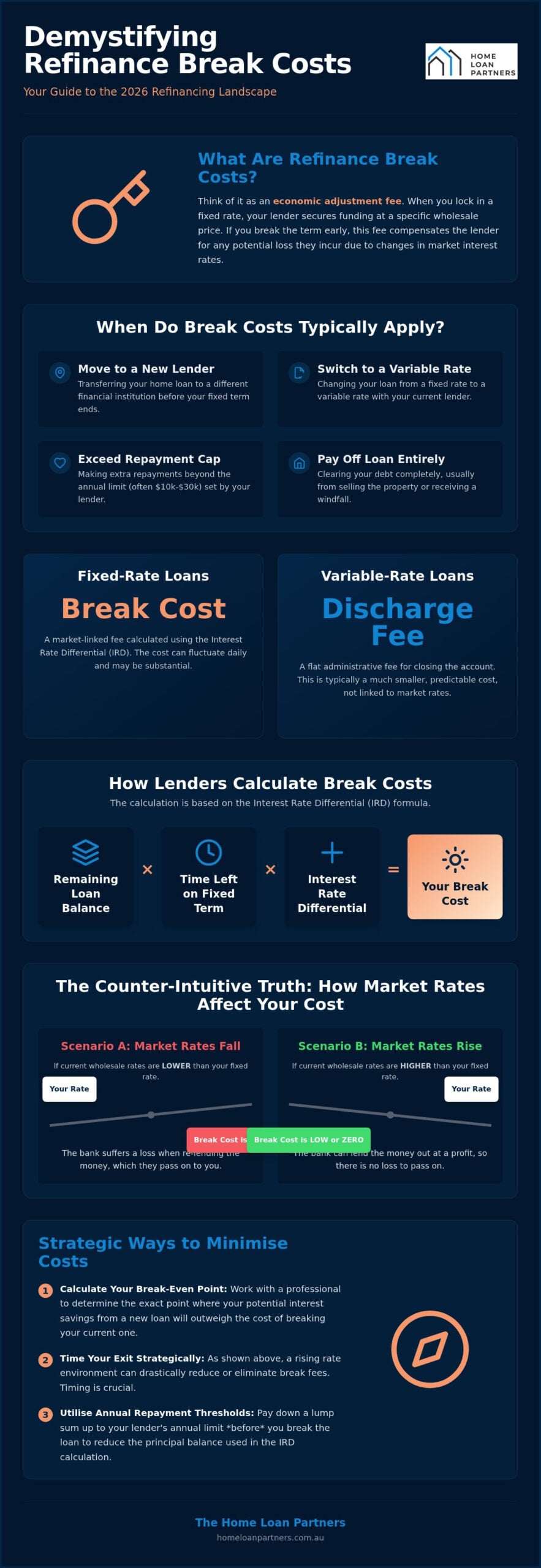
Refinance break costs are essentially an economic adjustment fee. When you sign a fixed-rate contract, you and the lender agree on a set interest rate for a specific period. If you decide to end that agreement early, the lender charges a fee to recover the financial loss they incur from the change in market rates. In 2026, many Australians are looking at their options as the last waves of the fixed-rate cliff settle. Understanding What is refinancing? involves weighing these costs against the potential for a lower variable or a new fixed rate that better suits your current goals.
Lenders don’t charge these fees to be difficult; they do it because they’ve already “bought” the money for your loan at a specific wholesale rate. If you leave, they’re left with that commitment. In the current 2026 market, where the RBA cash rate sits at 4.10%, the calculation for refinance break costs depends heavily on how wholesale rates have shifted since you first locked in your loan. If wholesale rates have risen significantly since you fixed, your cost might be much lower than you expect. Lenders today are often willing to negotiate to keep your business, but they remain protective of their margins as they navigate the tail end of the fixed-rate era.
When Do Break Costs Actually Apply?
You won’t trigger these fees just by thinking about a change. They typically apply in four specific scenarios where the original contract terms are altered. It’s important to identify these early so you aren’t surprised by a final statement. These scenarios include:
- Moving your home loan to a new lender before your fixed term expires.
- Switching your current fixed-rate loan to a variable rate with the same bank.
- Making extra repayments that exceed your lender’s annual cap, which is often between $10,000 and $30,000 depending on the institution.
- Paying your loan off entirely, which often happens when you sell your property or receive a windfall.
The Difference Between Fixed and Variable Exit Fees
It’s easy to confuse general exit fees with break costs. If you have a variable rate loan, you generally won’t pay a break fee. Instead, you’ll likely see a discharge fee or settlement fee, which covers the bank’s administrative costs for closing the account. This is because the government introduced legal restrictions on exit fees for most residential loans established after mid-2011 to encourage competition. However, fixed-rate loans are different because they involve a specific contractual hedge. Unlike a flat discharge fee, refinance break costs can fluctuate daily based on market movements. Break costs are a market-linked calculation based on current wholesale interest rates.
How Lenders Calculate Break Costs: The IRD Explained
Calculating the potential cost of leaving a fixed term can feel like trying to solve a puzzle with moving pieces. Lenders use a specific formula known as the Interest Rate Differential (IRD) to determine refinance break costs. This isn’t a random penalty; it’s a calculation based on the difference between the interest rate you locked in and the current wholesale interest rate, often referred to as the Bank Bill Swap Rate (BBSW). Because the BBSW fluctuates constantly, your break cost quote is usually only valid for 24 to 48 hours.
Think of the BBSW as the price the bank pays to “buy” the money they lent you. If you return that money early by refinancing, the bank has to find a new way to invest it. If current market rates are lower than your fixed rate, the bank loses out on the profit they expected. They pass this loss on to you as a break fee. Consulting a government guide to switching loans can help you understand the broader regulatory landscape, but the specific math remains tied to your individual contract.
The IRD Formula Breakdown
Lenders look at three primary components to arrive at your final figure. First is your remaining loan balance; a larger debt naturally leads to a higher potential fee. Second is the time remaining on your fixed term. The longer you have left on the clock, the more interest the bank stands to lose. Finally, they calculate the “rate gap.” This is the difference between the wholesale rate when you started the loan and the wholesale rate today. By multiplying these factors together, the bank arrives at the economic cost of your early exit.
Why a “Higher Rate” Environment Might Lower Your Break Costs
It sounds counter-intuitive, but a rising interest rate environment can actually be good news for your exit strategy. If the current wholesale rates are higher than the rate you locked in back in 2021 or 2022, the bank can actually lend your money back out to someone else at a higher profit. In this scenario, the bank hasn’t suffered a loss, and your refinance break costs could drop to zero. This was a common trend throughout 2025 and continues to be a factor in mid-2026.
Before you call your lender, it’s helpful to check your “rate gap” by comparing your current fixed rate against the latest market offers. If you find the math overwhelming, our team can help you explore your refinancing options and provide a clear breakdown of what a move might look like for your specific situation. We focus on the precision of these calculations so you don’t have to guess about your financial future.
Refinance Math: Calculating Your Break-Even Point
Deciding to move forward with a new loan isn’t just about the interest rate; it’s about the recovery time. The “break-even point” is the most critical metric in your decision-making process. It represents the exact number of months your new, lower interest payments will take to fully offset the upfront refinance break costs and other associated fees. If you plan to keep your new loan longer than this period, the switch becomes a net gain for your household budget.
You must look beyond the headline break fee to find your true cost. Lenders often charge a discharge fee to close your current account, and you’ll encounter government registration fees to switch the mortgage title. New lenders might also charge application or valuation fees. The ASIC Regulatory Guide on early termination fees ensures these charges remain transparent, but they still add up. We help our clients tally these “hidden” expenses to ensure the math remains honest and grounded in reality.
Consider a 2026 scenario where a homeowner moves from a 6.5% fixed rate to a 5.8% variable rate. On a $600,000 loan, this 0.7% difference saves roughly $350 in interest every month. If the total cost to exit the current loan and start the new one is $3,500, the break-even point is exactly 10 months. If that homeowner has 18 months left on their fixed term, they’ll enjoy eight months of pure savings before the original term would have ended.
The 4-Step Decision Framework
We use a logical progression to help you decide if a change is right for you. First, obtain a formal payout quote from your current lender; don’t rely on estimates. Second, calculate the monthly interest difference between your current rate and the new offer. Third, divide your total exit and entry costs by those monthly savings. Finally, compare that month count to your remaining fixed term. If the break-even occurs well before your fixed term expires, the financial case for moving is strong.
When It Makes Sense to Pay the Fee
Math isn’t the only factor; strategy matters too. Paying the fee is often a wise move if your break-even point is less than 12 months away. It’s also beneficial when you need to access equity for an urgent renovation or a time-sensitive investment. Sometimes, an existing loan structure simply doesn’t support your long-term investment property loans goals. In these cases, paying the refinance break costs is an investment in a more flexible financial future that allows you to grow your portfolio without being held back by an outdated contract.
Strategic Ways to Minimise or Avoid Break Costs
If you’re feeling stuck in a fixed term, you don’t necessarily have to accept a high exit fee as a foregone conclusion. There are several proactive strategies you can use to reduce the impact of these charges. One effective method is the “Partial Break.” Most major Australian lenders allow you to pay off a certain amount extra during the fixed period without penalty, often ranging between $10,000 and $30,000. By understanding how refinance break costs are influenced by these caps, you can plan a more cost-effective exit. Maximising this threshold before you officially refinance lowers the loan balance that the final fee is calculated on, which leads to a smaller bill.
Timing is another critical factor. As we explored in the IRD section, these costs fluctuate daily based on wholesale market movements. If interest rates are trending upward, your cost to exit might actually decrease because the bank can lend that money back out at a higher profit. Monitoring these shifts requires patience, but the savings can be substantial. Banks also have dedicated retention teams. Sometimes, if you express a desire to move to a variable rate, they might waive the fee to keep your business, provided you stay with them on a different product.
The Power of Refinance Rebates
Many lenders in the 2026 market offer cash-back incentives to attract high-quality borrowers. These rebates typically range from $2,000 to $4,000 and can be used to effectively wipe out your exit expenses. However, you should look at refinance charges holistically. A cash-back offer is only a true win if the new loan also provides a competitive interest rate and lower ongoing fees over the long term. We help you weigh these upfront bonuses against the total cost of the loan to ensure you’re making a move that builds real wealth.
Switching vs. Refinancing
There is a distinct difference between switching products internally and refinancing with a new lender. An internal switch might allow your bank to waive certain fees, but it often comes with a “loyalty tax.” This is when a bank offers you a rate that is slightly higher than what they give to new customers. Over several years, that higher rate often costs you far more than the initial refinance break costs would have. A professional finance broker can run these complex comparisons across more than 36 lenders to ensure you aren’t just trading one cost for another. If you’re ready to see how the numbers stack up for your home, you can request a personalized comparison from our team today.
How The Home Loan Partners Manage the Heavy Lifting
Managing the transition from a fixed-rate loan to a more flexible structure shouldn’t be a solo burden. At The Home Loan Partners, we act as your expert collaborator, taking on the technical complexities so you can focus on your long-term goals. While refinance break costs can often feel like a barrier, we view them as just one variable in a much larger equation. Our team specialises in calculating your “Real Return on Refinance” (RRR). This isn’t just a simple interest rate comparison; it’s a comprehensive analysis of your net gain over time, accounting for every fee, rebate, and potential interest saving.
We take a proactive approach to lender communication. Obtaining an accurate Early Repayment Adjustment (ERA) quote from your current bank can be a frustrating process, often involving long hold times and confusing paperwork. We manage these interactions on your behalf, ensuring the data we use for your strategy is precise and up-to-date. By handling the heavy lifting of the application and negotiation process, we provide a stress-free path toward your next property milestone, whether that’s building equity or preparing for a new investment.
Why Partnership Beats a Transaction
Choosing a broker over a single bank gives you a significant advantage in the 2026 market. We provide access to more than 36 lenders, allowing us to compare complex loan structures that a single institution simply can’t offer. Our commitment is to your long-term journey, not just the immediate settlement. We help you understand what refinancing a home loan means for your specific equity position and how it aligns with your life milestones. This collaborative partnership ensures that the structure we find today remains effective for years to come.
Your Next Steps to Financial Freedom
The first step toward clarity is our no-obligation home loan health check. During this initial conversation, we’ll review your current fixed term and help you determine if the current refinance break costs are a hurdle or a strategic opportunity. To prepare for a 2026 refinance, it’s helpful to have your recent loan statements and proof of income ready, as this allows us to move with the precision and speed the current market demands. We’re here to provide the steady hand and expert guidance you need to navigate these choices with confidence. If you’re ready to see what’s possible for your portfolio, you can book a strategy session with The Home Loan Partners today.
Take Control of Your Refinancing Strategy Today
Refinancing doesn’t have to be a source of anxiety. By understanding the mechanics of Interest Rate Differential and calculating your specific break-even point, you can turn a complex bank fee into a strategic financial decision. Whether you want to access equity or simply lower your monthly outgoings, the key is looking at the long-term journey rather than just the immediate hurdle of refinance break costs. When the math aligns with your goals, paying an exit fee can actually be the first step toward significant future savings.
We are here to manage the heavy lifting for you. With access to 36+ lenders and national Australian expertise, we provide the steady hand needed to navigate complex IRD calculations with precision. Our collaborative approach ensures you don’t just find a new rate, but a loan structure that supports your specific property milestones. You deserve a partner who values your financial security as much as you do.
Ready to see if a change is right for your home? Talk to an expert about your refinance options and let’s build a clear path toward your financial freedom together. We’re ready to help you move forward with confidence.
Frequently Asked Questions
Can I negotiate break costs with my current bank?
You can often negotiate the outcome, though the mathematical formula itself is usually fixed. While banks won’t change the interest rate differential calculation, they may waive the fee if you agree to switch to a different product within their own institution. This is a common retention strategy used in the 2026 market. However, you should always compare the internal offer against the broader market to ensure you aren’t paying a loyalty tax that exceeds the original fee.
How long does it take to get a break cost quote?
You can typically receive an Early Repayment Adjustment (ERA) quote within 24 to 48 hours. Because wholesale market rates shift constantly, these quotes are usually only valid for one or two business days. If you don’t act within that window, you’ll need to request a fresh calculation. We manage this communication for you to ensure we have the most accurate refinance break costs data before finalizing your new loan structure and break-even analysis.
Is the break cost tax-deductible for investment properties?
Break costs are generally tax-deductible if the loan is for an investment property. The Australian Taxation Office typically views these fees as a cost of managing your tax affairs or as a deductible borrowing expense. This can significantly soften the financial blow of exiting a fixed term early. We always recommend consulting with a qualified tax professional to confirm how these deductions apply to your specific portfolio and your 2026 tax return strategy.
What happens to my break costs if interest rates rise?
Your refinance break costs will likely decrease as market interest rates rise. If current wholesale rates move higher than the rate you locked in, the lender doesn’t suffer a financial loss when you leave early. In fact, they can often lend that money back out at a higher profit. In many cases during 2025 and 2026, borrowers have found their break fees dropped to zero as the wholesale market moved above their original fixed rates.
Do variable-rate loans have break costs in Australia?
Variable-rate loans in Australia do not have break costs. Following government reforms in 2011, lenders were banned from charging exit fees on variable residential mortgages. If you’re on a variable rate, you’ll only need to pay a standard discharge or settlement fee, which covers the administrative work of closing the file. This makes transitioning from a variable loan much simpler and less expensive than ending a fixed-rate contract before its scheduled expiry date.
Can I roll my break costs into the new home loan balance?
Many lenders allow you to roll your break costs into the new loan balance, a process known as capitalization. This means you don’t need to pay the fee from your savings upfront. However, this is subject to your Loan-to-Value Ratio (LVR) limits. If your total debt exceeds 80% of the property’s value after adding the fees, you might trigger Lenders Mortgage Insurance. We help you calculate if this structure serves your long-term financial goals.
Will my credit score be affected if I pay a break fee to refinance?
Paying a break fee does not negatively impact your credit score. It’s a standard contractual payment between you and your lender. However, the act of refinancing involves a new credit application, which results in a “hard inquiry” on your credit report. While a single inquiry usually has a minor, temporary effect, it’s important to avoid multiple applications in a short period. We focus on finding the right lender first to protect your credit standing throughout the process.
Is there a limit to how much a bank can charge for break costs?
There is no specific dollar limit on break costs, but they must be a “reasonable estimate” of the lender’s actual loss. Under ASIC guidelines, banks cannot charge fees that act as a penalty or are considered unconscionable. The cost must strictly reflect the financial impact caused by your early exit from the fixed term. If you feel a quote is inaccurately high, we can help you review the calculation against current market benchmarks to ensure you aren’t being overcharged.