

What if the interest rate you’ve been obsessing over is actually the least important part of your commercial finance strategy? While the RBA cash rate sits at 4.35 percent, the real challenge for business owners in 2026 isn’t just the cost of money, it’s the structure behind it. You’ve likely noticed that securing a commercial property loan in NSW now involves more than just a handshake and a deposit. With most major lenders capping LVRs at 65 percent and new AML/CTF regulations adding layers of documentation, the process can feel heavy and unpredictable.
We understand that your property goals are about more than just square footage; they’re about your long-term security and business growth. This strategic guide simplifies the current landscape by offering a clear look at market realities, from finding lenders who still offer 80 percent LVR to managing the latest NSW stamp duty thresholds. We’ll explore the essential steps to protect your personal assets and ensure your path to settlement is as smooth and stress-free as possible. Together, we can turn these financial hurdles into a steady foundation for your future.
Key Takeaways
- Learn how to distinguish between owner-occupier and investment structures to protect your personal assets and maximize your borrowing power.
- Navigate the 2026 lending landscape by understanding current LVR limits and interest rate trends for a commercial property loan nsw.
- Prepare a comprehensive “Full Doc” pack to ensure a smooth, predictable path from application to settlement.
- Gain a competitive edge by leveraging a panel of 36+ lenders rather than relying on traditional bank loyalty.
- Identify the key factors that lenders prioritize when assessing tenant quality and lease income for commercial investments.
Understanding Commercial Property Loans in the NSW Market
A commercial property loan nsw is a strategic financial facility designed for the purchase or refinancing of properties used for business operations or investment. Unlike residential mortgages, where personal salary is the primary driver of borrowing capacity, commercial lenders focus on the income-generating potential of the security itself. They evaluate the stability of your business cash flow—which can be optimized through accounts receivable solutions like smartAR—and the quality of existing lease agreements. In the 2026 landscape, lenders are prioritizing “repayment rent” and the overall viability of the industry you serve. This shift means that your business’s financial health and the property’s utility become the cornerstone of the credit assessment process.
Commercial vs. Residential Lending: The Critical Shifts
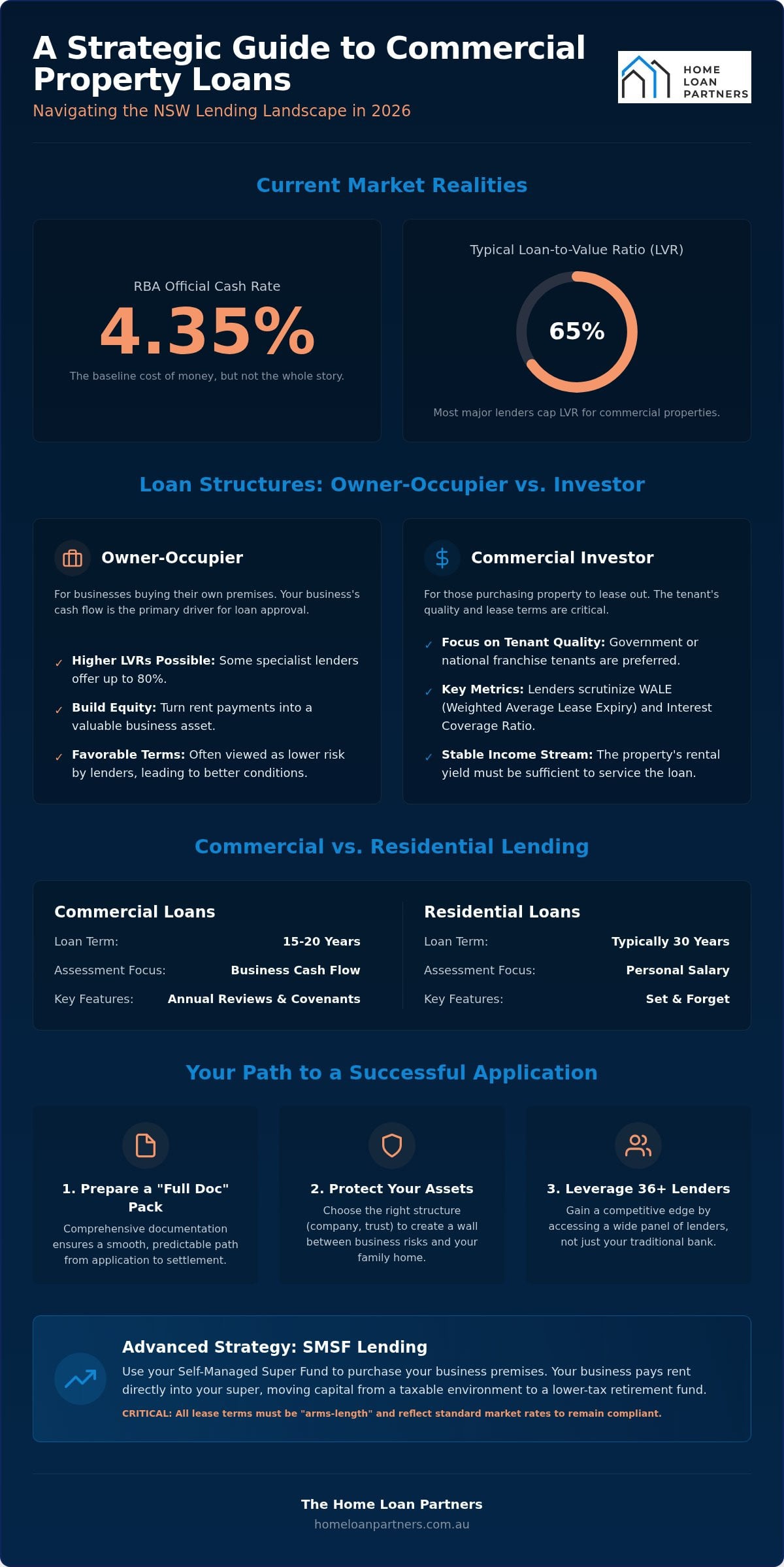
The differences between these two lending worlds are significant and impact your long-term planning. Commercial loans typically feature shorter terms, often capped at 15 to 20 years, and include “covenants” that require you to maintain certain financial ratios. It’s also common for lenders to conduct annual reviews to ensure the asset continues to meet their risk parameters. For those new to this space, Understanding Mortgage Law provides a helpful foundation for how these business-secured debts operate legally. One of the most important factors lenders analyze is the Weighted Average Lease Expiry (WALE). A longer WALE suggests a more secure income stream, which can often lead to more favorable loan terms and a smoother approval path.
Why NSW Business Owners are Moving from Lease to Purchase
Increasingly, business owners are deciding that owning their premises is a smarter long-term play than paying rent. Securing a commercial property loan nsw allows you to build equity in your own business asset, effectively turning a monthly overhead into a wealth-building tool. This strategy provides a fixed cost of occupancy, protecting your profit margins from the unpredictable spikes in commercial rental rates. There are also distinct tax advantages and depreciation benefits available to owners that tenants simply cannot access. As the regional population expands and demand for prime commercial space increases, owning your building provides the permanence and stability required to scale your operations with confidence and peace of mind.
Evaluating Loan Structures: Owner-Occupier vs. Commercial Investment
Selecting the right structure for your commercial property loan nsw is a strategic decision that impacts your tax position and asset security. If you’re an owner-occupier, lenders often view your application more favorably because your own business cash flow services the debt. This can lead to higher LVRs. Some specialist lenders may even reach 80 percent for established businesses in certain sectors. Investors, conversely, must demonstrate that the property’s rental yield can cover repayments independently. Choosing between a company, a family trust, or a personal name isn’t just about paperwork; it’s about building a wall between your business risks and your personal family home. You need a structure that allows for growth while keeping your core assets protected from unforeseen operational hurdles.
SMSF Lending: Buying Your Premises with Your Super
NSW directors are increasingly using Self-Managed Super Funds (SMSFs) to purchase their own business premises. This strategy allows your business to pay rent directly into your super fund, effectively moving capital from a taxable business environment into a lower-tax retirement environment. To remain compliant, you must strictly follow the “arms-length” rule, ensuring the lease terms mirror a standard market agreement. It’s a sophisticated way to build long-term wealth while giving your business a permanent home. If this sounds like the right path for you, our team can help you explore SMSF loan options tailored to your long-term goals.
Lease Income Loans for Savvy Investors
For those focused on pure investment, the quality of your tenant is your greatest asset. Lenders prioritize high-quality tenants, such as government bodies or national franchises, because they represent a lower default risk. When assessing these applications for a commercial property loan nsw, banks look closely at the interest coverage ratio. According to the RBA on Commercial Real Estate Risks, lending standards remain disciplined to ensure investors can withstand market fluctuations. You might consider interest-only periods during the initial years of the loan. This strategy preserves cash flow. It also helps you manage potential vacancy risks if a lease ends unexpectedly. By focusing on the property’s yield rather than your personal salary, you can often scale your portfolio faster than you would through traditional residential lending.
Navigating LVRs, Interest Rates, and Lending Criteria
Securing a commercial property loan nsw often starts with a conversation about the Loan-to-Value Ratio (LVR). While residential buyers might expect 80 or 90 percent, commercial lenders typically settle between 65 and 70 percent for standard assets. Your borrowing power is heavily influenced by the property type. Industrial warehouses and modern office spaces are currently viewed as lower risk, sometimes allowing for 75 percent LVR. In contrast, specialized properties like childcare centers or car washes might be capped at 50 to 60 percent. If you’re facing a deposit gap, we can explore bridging finance or the use of additional security to help you reach your goals without draining your business’s working capital.
Interest rates in 2026 have become more nuanced. For a commercial property loan nsw, you’ll likely choose between a variable rate, which starts around 6.17 percent for larger borrowings, or a fixed rate ranging between 6.85 and 8.89 percent. Many sophisticated borrowers are also utilizing bill-swap rates (BBSY), which offer a transparent way to price larger debt facilities. It’s also vital to account for tax obligations early in the process. Consulting the ATO: GST and Commercial Property guide can help you understand how GST impacts your purchase price and your ultimate loan requirement.
Factors That Influence Your Commercial Interest Rate
Lenders don’t just look at the property; they assign a “risk grade” to your entire application. This grade is a composite of your business’s credit history, the length of your lease, and your financial transparency. A “Full Doc” application, supported by two years of tax returns and a clear profit and loss statement, will almost always secure a lower margin than a “Low Doc” alternative. Your LVR also plays a direct role. The more equity you contribute, the less risk the lender carries, which typically translates into a more competitive interest rate for your business.
The Role of Security: Beyond the Property Itself
Commercial lending often requires security that extends beyond the physical building. You’ll likely encounter General Security Agreements (GSA) over business assets or personal Director Guarantees. These instruments provide lenders with the confidence to approve complex facilities. If you’re looking to achieve 100 percent finance for a new premises, you can often use the existing equity in your home to bridge the gap. You can use our home loan calculator to perform an initial equity assessment and see how your residential assets might unlock your next commercial milestone.
The Step-by-Step Commercial Loan Application Process
Applying for a commercial property loan nsw is a journey that demands precision. It’s a multi-stage process where your broker acts as your steady guide, ensuring every detail aligns with your long-term business goals. We begin with a strategy session to map out your requirements. This initial phase isn’t just about numbers; it’s about finding a lender from our panel of 36+ options whose appetite for risk matches your specific industry. Once we have a clear direction, we move into gathering your “Full Doc” pack. This comprehensive file presents your business in the best possible light, helping you secure the most competitive terms available in the 2026 market.
The valuation is often the most critical phase of the entire process. Unlike a residential appraisal, a commercial valuation is a deep dive into market yields, tenant stability, and comparable sales data. These reports require specialized expertise, so they typically take longer and cost more than residential versions. During this stage, the appraiser assesses the “let-ability” of the space and the strength of the current lease. Finally, we reach formal approval and settlement. Since June 1, 2026, the new Edition of the Contract for Sale has been mandatory in NSW. This digital-first approach helps streamline the final weeks, but having an expert hand to manage the moving parts is still essential for a stress-free experience.
Documentation Checklist for NSW Applicants
To ensure your application moves quickly, you’ll need to have your financial records in order. Lenders are looking for transparency and proof of operational stability. You should prepare the following items early:
- Two years of full financial statements and tax returns for the borrowing entity.
- Certified copies of all current lease agreements and a detailed rent roll.
- A personal statement of assets and liabilities for every company director.
NSW Purchase Costs: Budgeting for More Than Just the Deposit
Budgeting for a commercial property loan nsw requires looking beyond the initial deposit. NSW-specific costs can add up quickly, and missing these can stall your settlement. You’ll need to account for valuation fees, which can range from a few thousand dollars upward, along with legal conveyancing and lender application fees. Stamp duty is often the largest additional expense you’ll face. You can get an accurate estimate of these costs by using our stamp duty calculator nsw.
GST is another vital factor that often catches buyers off guard. In many cases, if a property is sold with an active lease in place, it can be treated as a “Going Concern,” making the purchase GST-free. However, if GST does apply, you’ll need to fund that 10 percent upfront before claiming it back from the ATO later. This creates a significant short-term cash flow gap that must be managed. If you’re ready to map out your specific requirements and navigate these costs with confidence, contact our team to begin your strategy session today.
Securing Your Commercial Future with a Specialist Finance Broker
Choosing the right partner for your commercial property loan nsw is just as important as choosing the property itself. Many business owners fall into the trap of “bank loyalty,” assuming their long-term transactional history will yield the best terms. In the commercial world, this is rarely the case. Lenders have specific “appetites” for different industries and property types that change frequently. One major bank might be overexposed in retail and tighten its criteria; meanwhile, a non-bank lender might be actively seeking to grow its industrial portfolio. By working with a specialist, you gain access to a panel of 36+ bank and non-bank lenders. This ensures you aren’t limited by one institution’s internal policy shifts.
The commercial landscape is complex, with credit policies that vary wildly. Some lenders prioritize the “bricks and mortar” security, while others focus almost exclusively on your business’s debt-service coverage ratio. Navigating these differences alone is exhausting. A specialist broker understands these hidden benchmarks. We know which lenders are offering “set and forget” loans for smaller amounts and which ones will require rigorous annual reviews for facilities over $1.5 million. This steady expertise helps alleviate the stress of the unknown, providing you with a clear, logical path toward your next acquisition.
Why a Finance Broker is Your Best Commercial Ally
We handle the heavy lifting of your application. This involves more than just submitting paperwork; it’s about translating your business’s success into a language that credit teams understand. We often negotiate better-than-advertised rates because of the volume and quality of the loans we bring to the table. Our role is to act as your expert collaborator, navigating the nuances of covenant requirements so you can focus on running your business. For a deeper look at how this partnership works, you can read our finance broker guide. We’re here to ensure your loan structure remains a tool for growth, not a source of restriction.
Start Your Journey with The Home Loan Partners
Our involvement doesn’t end when your loan settles. We view our relationship as a long-term journey, standing by you through every milestone and future refinancing opportunity. Whether you’re purchasing your first warehouse or restructuring a multi-million dollar portfolio, our team provides the steady hand you need. We’re committed to making your experience professional, predictable, and entirely focused on your personal goals. It’s time to stop second-guessing your finance strategy. Reach out to us today to book your commercial strategy session and secure a tailored path forward for your business.
Your Next Chapter in the NSW Commercial Market
Securing a commercial property loan nsw is more than a financial transaction; it’s a foundational step toward your business’s independence and long-term security. We’ve explored how the right loan structure can protect your personal assets while turning monthly rent into growing equity. You don’t have to navigate these shifting regulations or strict LVR requirements alone. Our team provides a steady hand, drawing on deep expertise in the local market to manage the heavy lifting of your application from start to finish.
With access to a panel of 36+ bank and non-bank lenders, we ensure you aren’t limited by one bank’s policy. We’re here to be your expert collaborators, guiding you through every valuation and annual review with precision and care. Your future milestones deserve a partner who values your journey as much as you do. We’re committed to providing the dedicated support you need to settle your loan with confidence.
Ready to take the next step? Book Your Commercial Strategy Session with The Home Loan Partners today. Let’s build a secure foundation for your business together.
Frequently Asked Questions
How much deposit do I need for a commercial property loan in NSW?
You typically need a deposit of 30 to 35 percent for a standard commercial property loan nsw. While residential loans often allow smaller deposits, most major banks cap their Loan-to-Value Ratio (LVR) at 65 percent. Some specialized lenders or non-bank options might consider an 80 percent LVR depending on the property type and lease strength. This higher requirement ensures your business has enough equity to withstand market fluctuations while protecting your long-term financial security.
Can I use my residential home as security for a commercial loan?
Yes, you can use the equity in your residential home to secure a commercial loan. This strategy often allows you to borrow up to 100 percent of the commercial purchase price plus costs like stamp duty. By cross-collateralizing your assets, you avoid depleting your business’s cash reserves. We’ll help you structure this arrangement carefully to ensure your personal assets remain protected while you build your commercial portfolio through our panel of 36+ lenders.
What are the current commercial property loan interest rates in 2026?
Indicative variable interest rates for commercial property in August 2026 range from 6.17 percent to 10.74 percent. If you prefer a fixed rate for budget certainty, these currently sit between 6.85 percent and 8.89 percent. Your specific rate depends on your risk grade, which includes your credit history and the property’s income potential. Larger loans over $5 million often attract more competitive pricing starting from 6.17 percent per annum for well-secured assets with strong lease profiles.
Is GST payable on the purchase of a commercial property in NSW?
GST of 10 percent is generally payable on commercial property purchases unless the transaction qualifies as a Going Concern. To meet this exception, the property must be sold with an active lease in place and both parties must be GST-registered. If GST applies, you’ll need to fund this amount at settlement before claiming it back from the ATO. It’s a significant cash flow consideration that we’ll help you factor into your initial loan strategy.
How long does the commercial loan approval process typically take?
A commercial loan approval typically takes between four and eight weeks from the initial application to settlement. This timeline is longer than residential lending because the valuation process is more complex and detailed. Lenders need time to assess the lease strength, tenant quality, and market yields. Having your Full Doc pack ready early can help us streamline the process and avoid unnecessary delays during the bank’s credit review and final documentation stages.
What is a ‘Low Doc’ commercial loan and do I qualify?
A Low Doc commercial loan is designed for business owners who can’t provide full tax returns or financial statements. Instead, lenders might accept an accountant’s letter or several months of bank statements to verify your income. You might qualify if you have a clean credit history and a larger deposit, usually at least 30 percent. These loans offer flexibility but often come with a slightly higher interest margin to reflect the lender’s increased risk profile compared to standard products.
Can I buy a commercial property through my SMSF?
Yes, you can purchase business real property through your Self-Managed Super Fund (SMSF). This is a popular strategy for business owners because it allows you to pay rent into your own retirement fund. The transaction must occur at an arms-length market rate to remain compliant with superannuation laws. We specialize in complex SMSF loans and can guide you through the specific documentation required by the various bank and non-bank lenders on our panel to ensure compliance.
What is the difference between a commercial loan and a business loan?
A commercial loan is specifically secured by real estate, while a business loan is often used for working capital or equipment. Because a commercial property loan nsw is backed by physical property, it typically offers lower interest rates and longer terms than unsecured business finance. Business loans are usually shorter term and focus on your cash flow rather than the value of a specific building or land asset you’ve acquired for your operations or investment portfolio.