

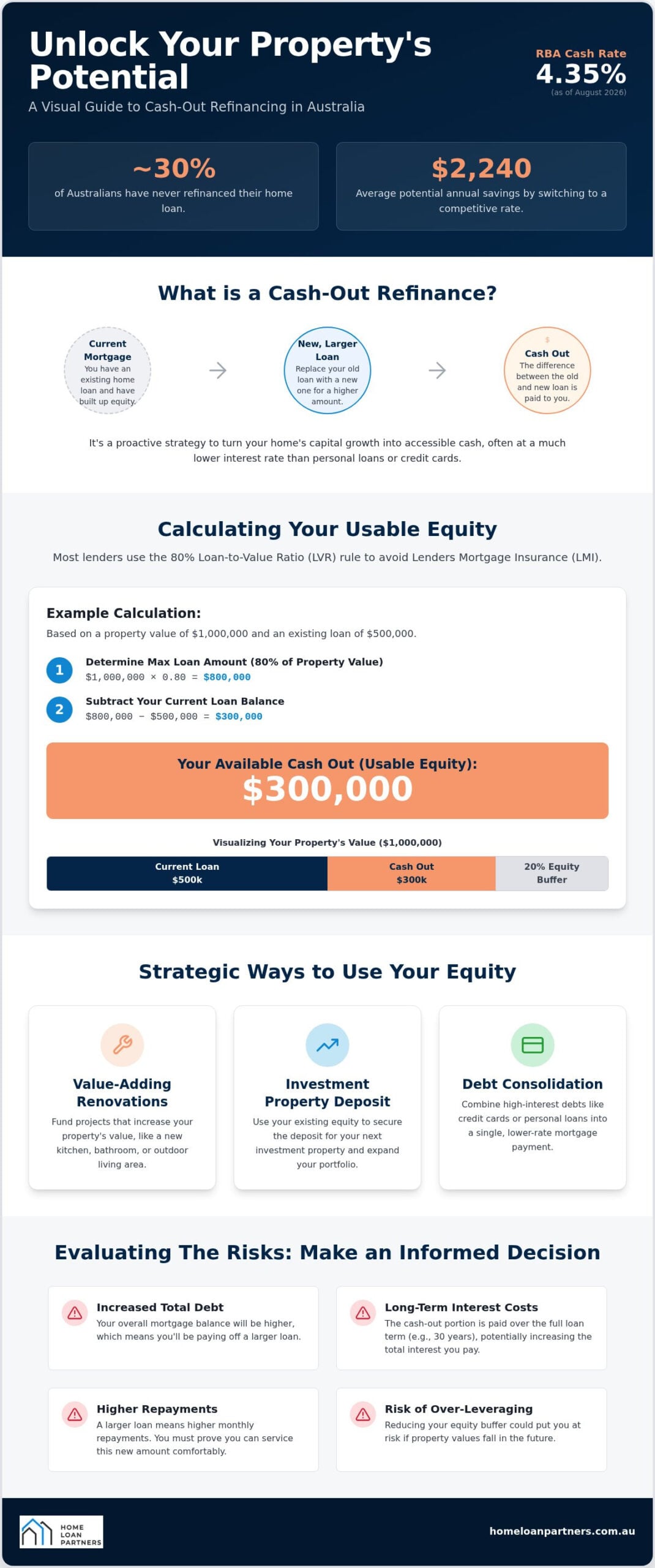
Nearly 30% of Australians have never refinanced their home loan, even though the average homeowner could save approximately $2,240 a year by switching to a more competitive rate. If you feel house rich but cash poor, a strategic cash out refinance australia plan could be the key to unlocking your property’s hidden potential. With the RBA cash rate sitting at 4.35% as of August 2026, many homeowners are discovering that their equity is a powerful, yet untapped, financial resource.
We understand that the thought of increasing your debt can feel daunting, especially with concerns about over-leveraging or navigating complex lender LVR policies. It’s completely natural to want to protect the security you’ve worked so hard to build. Our goal is to show you how to access liquidity strategically; we want to ensure your property wealth serves your immediate needs without compromising your long-term financial health.
This guide walks you through the practical steps of a cash out refinance in the current market. You’ll learn how to maintain a healthy 20% equity buffer, understand the impact of the 2026-27 Federal Budget tax changes, and find a clear path to lowering your overall interest costs while funding your next big milestone.
Key Takeaways
- Understand the mechanics of replacing your existing mortgage with a larger loan to transform property growth into immediate, accessible liquidity.
- Calculate your borrowing power using the 80% LVR rule to ensure you unlock wealth without compromising your long-term financial stability.
- Explore strategic ways a cash out refinance australia can fund value-adding renovations or provide the deposit for your next investment property.
- Evaluate the potential risks, from interest rate traps to credit profile impacts, to make an informed and secure decision for your future.
- Learn the step-by-step process of securing a refinance, including how to leverage a panel of 36+ lenders to find the most competitive structure.
What is a Cash Out Refinance and How Does it Work in 2026?
At its core, a cash out refinance australia involves replacing your current mortgage with a new, larger loan. The lender pays off your existing debt and gives you the difference in cash at settlement. While you might be familiar with the general concept of what is refinancing?, a dedicated cash-out application is a more surgical tool. It’s not just about chasing a lower interest rate; it’s a proactive strategy to turn your home’s capital growth into accessible liquidity.
In the 2026 market, where the RBA cash rate sits at 4.35%, many homeowners find themselves with significant equity but limited cash flow. As property values have shifted, the gap between what you owe and what your home is worth has likely widened. This “paper wealth” becomes useful only when you unlock it. Unlike a standard refinance, which simply moves your debt from one lender to another to save on interest, a cash-out refinance increases your total debt to provide a lump sum for specific goals, such as renovations or debt consolidation.
Accessing equity this way has become a popular alternative to traditional personal loans or credit cards. Because the debt is secured against your property, the interest rates are typically much lower than unsecured borrowing options. It’s a way to use your most significant asset to fund your next life milestone while keeping your repayments structured within a single, manageable mortgage.
Cash Out vs. Home Equity Loans
While some people use these terms interchangeably, they function differently in the Australian lending landscape. A home equity loan often acts as a second, separate loan alongside your mortgage. In contrast, a cash-out refinance merges everything into one new debt obligation. This creates a cleaner financial structure with one monthly repayment and one interest rate. The primary benefit is simplicity, though it’s vital to remember that you’re spreading that “cash” over a 25 or 30-year term. Without a clear plan, you could end up paying more interest over the long run, which is why we focus on finding tailored structures across our panel of 36+ lenders.
The Role of Property Valuation
Your maximum borrowing ceiling is dictated by a current market appraisal. Equity in 2026 is the financial bridge between your home’s current market valuation and the remaining balance on your mortgage. Lenders use this valuation to determine how much they’re willing to lend you. You might encounter two main types of assessments:
- Desktop Valuations: A quick, automated process based on recent sales data in your area, often used for lower-risk applications.
- Full Physical Valuations: A comprehensive inspection where a valuer visits your property to assess its condition, size, and unique features.
A higher valuation directly increases your “usable equity,” giving you more room to move. By working with an expert collaborator who understands which lenders are currently more generous with their valuations, you can maximize the cash available to you without over-leveraging your position.
Calculating Your Usable Equity: The 80% Rule and Beyond
Determining how much you can actually borrow starts with the Loan-to-Value Ratio (LVR). Most Australian lenders prefer you keep your total debt under 80% of your property’s value. This threshold is the standard benchmark for a cash out refinance australia because it allows you to access funds without the extra cost of Lenders Mortgage Insurance (LMI). To find your usable equity, use this simple formula: (Current Property Value x 0.80) minus your Current Loan Balance. If your home is worth $1,000,000 and you owe $500,000, your usable equity isn’t the full $500,000 gap; it’s $300,000.
It’s also important to consider how your redraw balances and offset accounts factor into this calculation. While these funds are technically yours, lenders look at the total “limit” of your loan during the assessment. If you have a significant amount sitting in offset, it might be more efficient to use those funds first before increasing your total debt. Reviewing these tips for refinancing from ASIC can help you weigh up the costs of restructuring versus using existing cash reserves.
However, your property’s value is only half the equation. You also need to prove you can comfortably afford the new, higher repayments. Banks don’t just look at what you earn today; they apply serviceability buffers to see if you could still manage if interest rates rose even further. If you’re unsure where you stand, our team can help you assess your borrowing capacity across dozens of different lender policies to find a structure that fits your life.
Going Above 80% LVR: Is LMI Worth It?
Sometimes, staying under 80% isn’t the best move for your specific goals. If you’re planning high-value renovations that will significantly increase your home’s worth, paying a one-off LMI premium might be a logical investment. Just be aware that many Australian lenders have stricter rules for cash-out purposes when the LVR exceeds 80%. They often require more detailed evidence of how you plan to use the funds, such as builder quotes or proof of investment, and may limit the total amount you can take as “untied” cash.
Serviceability Buffers in 2026
In 2026, lenders are particularly cautious about your existing liabilities. Debts like HECS/HELP balances or car loans are heavily weighted in serviceability calculators. A $30,000 car loan can reduce your borrowing power by much more than the loan amount itself because of the monthly repayment commitment. To improve your profile, consider closing unused credit cards or consolidating smaller, high-interest debts before you apply. This proactive approach shows lenders you’re a dependable borrower, making the path to your cash-out approval much smoother.
Strategic Use Cases: Turning Equity into Wealth
Many homeowners view a cash out refinance australia as a simple way to access extra funds, but the most successful clients treat it as a deliberate wealth expansion tool. It’s about moving value from an idle asset into one that works harder for your future. Whether you’re looking to manufacture capital growth through property improvements or diversify your portfolio, your home equity is often the most cost-effective capital source available.
Strategic use cases for equity release typically fall into four main categories:
- Renovations and Value Addition: Funding a kitchen upgrade or a structural extension can increase your property’s market value by more than the cost of the work itself.
- Investment Property Deposits: You can use your existing equity to cover the deposit and costs of a new purchase, allowing you to build a portfolio without depleting your cash savings.
- Strategic Debt Consolidation: Rolling high-interest credit cards or personal loans into your lower mortgage rate can significantly improve your monthly cash flow.
- Funding Life Milestones: Equity can provide the steady capital needed for business startups, specialized education, or helping family members enter the property market.
Consolidating debt is a popular choice for a reason. By moving high-interest liabilities into your mortgage, you can reclaim hundreds of dollars in monthly cash flow. However, this strategy requires a steady hand. We work with you to ensure these savings aren’t just spent elsewhere; instead, they should be used to pay down your home loan faster to avoid paying interest on small debts for 30 years.
Debt Recycling for Australian Investors
Renovation Finance Strategies
Lenders distinguish between cosmetic updates and structural changes when releasing funds. For cosmetic work, banks often release the cash directly to your account. For structural projects, they may require council-approved plans and fixed-price contracts. Presenting a clear, professional plan helps justify a larger cash release and ensures the bank sees the same value-add potential that you do. If you find your dream home before your current one sells, exploring Bridging Finance can provide the flexibility needed to manage both properties during the transition.
Evaluating the Risks: Is a Cash Out Refinance Right for You?
Unlocking equity is a powerful strategy, but it’s essential to remember that you’re essentially taking on more debt. While the interest rates on a mortgage are typically lower than those of a credit card, the term of the loan is much longer. When considering a cash out refinance australia, it’s essential to weigh the immediate benefits against the long-term commitment. We believe in acting as a steady hand, helping you look past the initial cash injection to see the full financial picture.
Market fluctuations are another factor to keep in mind. If property values in your area soften after you’ve increased your loan, you run the risk of having limited equity for future needs. Additionally, every time you apply for a new loan, it’s recorded on your credit report. Multiple applications in a short window can signal financial stress to lenders, which might hinder your profile later. It’s better to get the structure right the first time with a precision-oriented plan.
You should also prepare for the upfront costs of switching. While many lenders offer cashback incentives to help cover these, the typical cost to refinance in Australia ranges between $500 and $2,000. These expenses often include:
- Discharge Fees: Paid to your current lender to close the old loan.
- Application and Settlement Fees: Charged by the new lender to set up the facility.
- Government Registration Fees: To update the title of your property.
- Valuation Costs: To confirm the current market value of your home.
If you’re feeling unsure about the potential costs or risks involved, you can speak with an expert collaborator to run a detailed comparison tailored to your specific situation.
The Long-Term Cost of Cheap Debt
The biggest trap for homeowners is the “term” of the debt. A personal loan might have a higher interest rate, but it’s usually paid off in five years. If you add $50,000 to a 25-year mortgage at a 6% interest rate, the total interest cost for that cash-out portion alone can reach approximately $46,000 over the life of the loan. To mitigate this, we often suggest split loan structures. This allows you to make higher, more aggressive repayments on the cash-out portion, ensuring your cash out refinance australia remains a benefit rather than a long-term burden.
Tax and Legal Considerations
The purpose of your cash determines its tax treatment. If you use the funds for personal reasons, like a holiday or a car, the interest isn’t tax-deductible. However, if you use it for income-producing purposes, like buying shares or an investment property, you may be able to claim the interest. It’s vital to avoid “mixed-purpose loans” where personal and investment funds are lumped together; this creates significant accounting difficulties later. We always recommend seeking independent financial advice to ensure your new structure aligns with your tax strategy.
How to Secure a Cash-Out Refinance in Australia
Securing a cash out refinance australia involves more than just showing a lender your property’s value. It requires a documented plan and a clear demonstration of your ability to manage a larger loan. While the process might seem complex, it typically follows a logical path that we manage on your behalf to ensure a smooth transition from paper wealth to liquid capital.
The journey starts with documenting your goals. Lenders are often hesitant to approve “unrestricted” cash-outs for large amounts without a clear purpose. Whether you’re planning a specific renovation, consolidating debt, or preparing for an investment, having your quotes or investment plans ready is essential. Once your goals are clear, the process follows these key stages:
- Engage an Expert: We compare your needs against our panel of 36+ lenders to find the policy that best fits your specific cash-out requirements.
- Prepare the Paperwork: You’ll need to provide recent payslips, tax returns, and bank statements that show a clean “paper trail” of your financial habits.
- Property Valuation: The lender will order an appraisal to confirm your usable equity. This is the moment where your property’s growth is officially recognized.
- Approval and Documents: Once the lender is satisfied with your serviceability and the valuation, they’ll issue a new loan offer for you to sign.
- Settlement: Your old loan is paid off, and the surplus funds are deposited into your nominated account, ready for you to use.
Why Lender Choice Matters
Each bank has a different appetite for risk. Some major banks may reject a cash-out request if the purpose isn’t for home improvements, while others are more flexible with funds used for business startups or share portfolios. This is where The Home Loan Partners adds significant value. If your current bank says no, it doesn’t mean your goal is impossible. Our access to 36+ lenders allows us to find the specific policy nuances that align with your unique situation, acting as a steady hand when the big banks aren’t the right fit.
Preparing a Successful Application
Lenders in 2026 look closely at your spending habits in the three months leading up to your application. We recommend maintaining “clean” bank statements during this period. This means avoiding late fees, staying within credit limits, and minimizing “Buy Now, Pay Later” transactions that can complicate your serviceability profile. If you’re still early in the research phase, understanding what does refinancing a home loan mean? will give you a solid foundation before you dive into the specifics of a cash-out request. By presenting a professional, well-documented application, you significantly increase your chances of a fast and stress-free approval.
Take Control of Your Property Wealth Today
Your home is far more than a shelter; it’s a powerful financial foundation for your future aspirations. Throughout this guide, we’ve explored how a cash out refinance australia can transform paper wealth into a strategic engine for growth, whether you’re manufacturing value through renovations or diversifying into new investments. By respecting the 80% LVR rule and understanding the 2026 serviceability landscape, you can access the liquidity you need while protecting your long-term security.
Success in this market isn’t about taking the first offer from your current bank; it’s about precision and partnership. We provide access to 36+ Australian lenders and offer personalised loan structuring to ensure your debt serves your goals, not the other way around. Our unbiased national expert guidance is designed to alleviate the stress of complex applications, giving you a clear, predictable path forward.
If you’re ready to turn your property’s equity into a tangible plan for wealth creation, we’re here to help. Book a Strategy Session with The Home Loan Partners today to discuss your vision. Your next financial milestone is within reach, and we look forward to navigating that journey with you.
Frequently Asked Questions
Can I get a cash-out refinance with bad credit in Australia?
You can still secure a cash-out refinance with bad credit, although your options will likely be limited to specialist or non-conforming lenders. These lenders often charge higher interest rates to offset the risk. We help you navigate this by looking at the reasons behind the credit issues and finding a lender that prioritizes your current ability to service the loan over past financial hurdles.
How much can I refinance with cash out?
The amount you can access depends on your property’s current valuation and your income serviceability. Most lenders allow a cash out refinance australia up to 80% of the property’s value without charging Lenders Mortgage Insurance. For example, if your home is worth $1,000,000 and you owe $500,000, your maximum usable equity at 80% LVR is $300,000; this assumes your income supports the new, larger repayments.
Is a cash-out refinance the same as a home equity loan?
No, they aren’t exactly the same. A cash-out refinance replaces your entire existing mortgage with a new, larger one. A home equity loan is often a separate, second loan that sits alongside your primary mortgage. In Australia, most homeowners prefer the refinance structure because it consolidates everything into a single monthly repayment and typically offers a lower interest rate than a secondary loan facility.
What LVR do I need for a cash-out refinance?
An 80% Loan-to-Value Ratio (LVR) is the standard requirement for most competitive cash-out applications. While some lenders allow you to go up to 90% LVR, you’ll generally need to pay Lenders Mortgage Insurance and provide more detailed evidence of how you intend to use the funds. Staying at or below 80% LVR ensures you maintain a healthy equity buffer and access the most favorable interest rates available.
Will a cash-out refinance affect my credit file?
Yes, applying for a refinance will result in a hard enquiry on your credit file. This is a standard part of the lender’s assessment process. While a single enquiry is unlikely to cause significant harm, making multiple applications in a short period can lower your credit score. We prevent this by carefully selecting the right lender from our panel of 36+ before submitting your formal application.
How long does the cash-out refinance process take?
The process typically takes between two and six weeks from application to settlement. This timeline depends on how quickly your property valuation is completed and how fast your current lender processes the discharge of your old loan. We act as your expert collaborator throughout this period, managing the heavy lifting and keeping you updated so the transition feels smooth and predictable.
Can I use cash-out funds for a business startup?
What happens if my property value has decreased?
If your property value has decreased, your usable equity will be reduced. Lenders base their calculations on the current market appraisal, not what you originally paid for the home. If the value has dropped significantly, you might find that your LVR is too high to allow for a cash release. In these cases, we look for lenders with more flexible valuation policies or wait for market conditions to improve.