

Did you know that a rejection from a major bank often says more about their current lending appetite than it does about your financial health? With the RBA cash rate sitting at 4.35% and new APRA debt-to-income caps in place, understanding the specific investment property loan requirements Australia demands in 2026 has become a vital step for every serious investor. It’s no longer just about having a deposit. It is about how you present your financial story to the right lender.
We understand that the shift toward tighter lending conditions and 3% serviceability buffers can feel overwhelming. It’s natural to feel anxious about how higher interest rates might impact your borrowing power or whether your existing equity is being calculated correctly. You deserve a partner who translates this complex jargon into a clear plan for your future security and growth.
This guide is designed to replace that uncertainty with a steady, reliable path forward. You will master the exact benchmarks and documentation needed to secure your next property with confidence. We will walk through a comprehensive eligibility checklist, explain how to unlock usable equity instead of cash, and show you how to find a lender that aligns with your unique financial profile.
Key Takeaways
- Understand the specific investment property loan requirements australia demands in 2026, including the latest APRA debt-to-income caps and serviceability buffers.
- Learn how to leverage existing home equity to fund your next purchase, potentially covering 100% of the investment without a cash deposit.
- Discover the property-specific criteria, such as minimum square footage and postcode restrictions, that can influence a bank’s decision to fund your asset.
- Gain a clear checklist of the financial documentation and income “shading” rules lenders use to assess your borrowing capacity.
- Explore how to navigate the lending market beyond the major banks by matching your specific profile to the credit policies of over 36 different lenders.
The 2026 Investment Loan Landscape: Why Requirements Have Changed
The lending environment in 2026 is a different beast compared to previous years. While the Australian property market has shown resilience with an 8.4% growth in median prices recently, the path to financing has narrowed. Lenders have tightened their belts, making investment property loan requirements australia more stringent than ever. This isn’t meant to discourage you. Instead, it’s a call to be more prepared and precise with your application. Banks view investment debt differently than the mortgage on your family home. If you face a financial squeeze, you’re likely to prioritize the roof over your head. This perceived risk is why you’ll see higher bars for entry.
To understand how a lender views your application, we look at the ‘Four Cs’ of credit. Character covers your credit history and reliability. Capacity assesses your ability to meet repayments at higher stress-test rates. Capital is the size of your deposit or equity. Finally, Collateral is the quality and location of the property you’re buying. Mastering these four pillars is the key to a stress-free approval.
Investment vs. Owner-Occupier: The Risk Premium
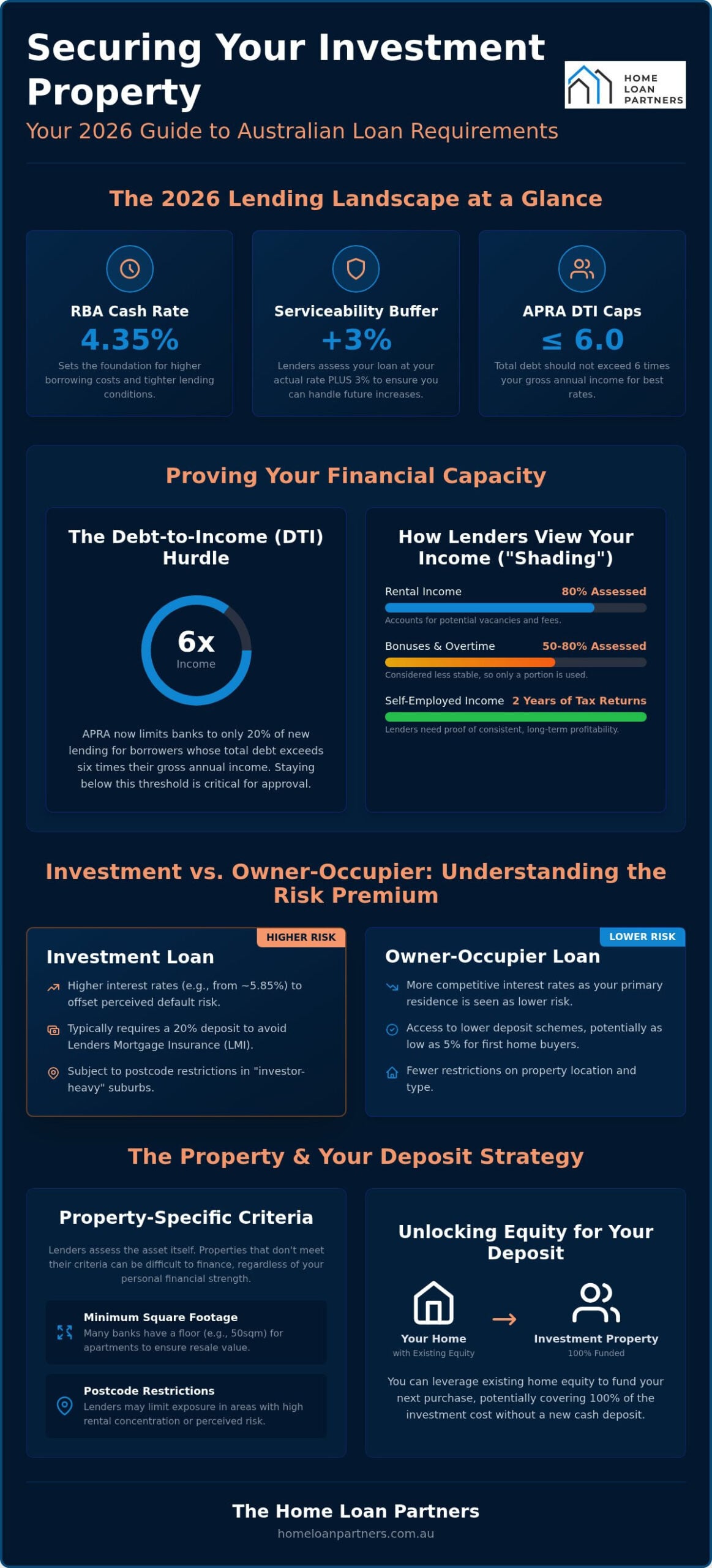
Lenders apply a risk premium to investment loans because they’re statistically more likely to default during economic downturns. This translates to higher interest rates, often starting around 5.85% for variable options in 2026. You’ll also find that deposit requirements are less flexible. While a first home buyer might scrape in with a 5% deposit, investors are typically nudged toward a 20% stake to avoid costly Lenders Mortgage Insurance. Lender appetite also fluctuates based on “investor-heavy” postcodes. If a specific suburb is dominated by rentals, a bank might limit their exposure, requiring a larger deposit from you to offset their risk.
The Role of APRA and Responsible Lending in 2026
Regulatory bodies like APRA play a massive role in your borrowing power. In 2026, the 3% serviceability buffer remains a critical hurdle. This means if your actual rate is 6%, the bank assesses your ability to pay at 9%. This buffer significantly reduces the total amount you can borrow. Additionally, the way lenders track your spending has evolved. The Household Expenditure Measure (HEM) is no longer a simple benchmark. Lenders now use sophisticated tools to scrutinize your real-world bank statements. Your monthly subscription habits and dining out frequency are often more important to a credit assessor than your gross annual income. They want to see a consistent surplus that proves you can handle the commitment of a new debt.
Core Financial Requirements: Proving Your Capacity to Pay
Meeting the investment property loan requirements australia demands in 2026 starts with a deep dive into your numbers. Lenders have become significantly more focused on your Debt-to-Income (DTI) ratio. As of February 2026, APRA has tightened the screws, limiting banks to only 20% of new lending for borrowers whose total debt exceeds six times their gross annual income. This makes your “magic number” a DTI of 6.0 or lower if you want to access the most competitive rates. This regulatory shift is aligned with recent RBA analysis of housing investors which highlights the shifting debt profiles of Australian landlords and the need for greater financial buffers.
Income Shading: Not All Dollars are Equal
Lenders don’t view every dollar you earn through the same lens. This process, known as “shading,” can catch many investors off guard. For example, most banks will only count 80% of your projected rental income when calculating your ability to service the loan. They do this to account for potential vacancies and management fees. Similarly, if your income relies heavily on bonuses, commissions, or overtime, lenders might only recognize 50% to 80% of those amounts. For self-employed investors, the standard requirement is two years of full tax returns, though some specialists offer Alt-Doc options for those with tailored investment structures who may not have traditional paperwork ready.
The Credit Health Check
Your credit score is the silent gatekeeper of your investment goals. In 2026, even small, recurring “Buy Now Pay Later” debts can drastically reduce your borrowing capacity. Lenders view these as ongoing liabilities that eat into your monthly surplus. We recommend cleaning up your bank statements at least three months before you apply. This means closing unused credit cards and ensuring no late payment markers appear on your file. Comprehensive Credit Reporting is a system where lenders share both your negative and positive credit behaviors, giving them a transparent view of your entire financial history. This transparency means that consistent, on-time bills can actually work in your favor to secure a lower interest rate.
To make the process as smooth as possible, keep this 2026 documentation checklist ready:
- Two most recent payslips and your latest PAYG summary or Group Certificate.
- Three months of personal bank statements showing regular savings and living expenses.
- A formal rental appraisal from a real estate agent for the property you intend to buy.
- Two years of personal and business tax returns if you are self-employed.
- A clear breakdown of all existing debts, including limits and current balances.
Presentation is everything. By organizing these documents early, you present yourself as a low-risk, high-quality borrower, which is exactly what banks are looking for in the current climate.
The Deposit Hurdle: Cash vs. Equity Requirements
One of the most common hurdles in meeting investment property loan requirements australia is the upfront capital. While owner-occupiers often rely on years of disciplined saving, seasoned investors know that cash is only one way to enter the market. The 20% deposit remains the gold standard in 2026. Maintaining a Loan-to-Value Ratio (LVR) of 80% or less allows you to bypass Lenders Mortgage Insurance (LMI) and typically unlocks the most competitive interest rates. However, if you already own property, you might not need to touch your savings account at all.
Using the equity in your current home is a sophisticated way to fund your next acquisition. Banks generally allow you to borrow up to 80% of your current property’s value, minus any existing mortgage. This “usable equity” can act as the deposit and cover purchase costs like stamp duty for your new investment. It’s a strategy that turns your existing home into a powerful engine for portfolio growth. We often see clients utilize this approach to secure a 100% investment loan, keeping their cash reserves liquid for renovations or unexpected expenses.
Using Equity as Your Deposit
Calculating your usable equity is the first step in your investment journey. Start by obtaining a professional valuation of your current home. If your property is worth $1,000,000, the bank’s comfort zone is typically $800,000 (80%). If your current mortgage is $500,000, you have $300,000 in usable equity. You can “top up” your current loan by this amount to create a deposit for your next purchase. This process requires a steady hand to ensure your debt is structured correctly. Many investors also explore Bridging Finance if they plan to sell an existing asset to fund their long-term investment goals.
We generally recommend a stand-alone loan structure rather than cross-collateralisation. While cross-collateralisation ties your properties together in one neat package, it gives the bank significant control over your assets. If you sell one property, the bank may require you to pay down the debt on others. A stand-alone structure offers the flexibility to sell or refinance individual properties without disturbing the rest of your portfolio.
Understanding Lenders Mortgage Insurance (LMI) for Investors
If you choose to borrow more than 80% of the property value, LMI becomes a factor. It’s a one-off cost that protects the lender, not you. It’s important to remember that LMI is usually treated as a borrowing expense for tax purposes; this means it’s generally deductible over five years rather than being immediately deductible like interest. In 2026, certain professionals like doctors, lawyers, and accountants may still qualify for an LMI waiver up to 90% LVR, providing a significant shortcut to entry. You should also be aware that high LVR loans often restrict your ability to choose “Interest Only” repayments, as lenders prefer the security of principal reductions when the equity cushion is thin.
Property-Specific Requirements: What the Bank Will (and Won’t) Fund
While your financial health is paramount, the property itself acts as the bank’s ultimate security. Understanding the investment property loan requirements australia lenders enforce on specific assets is vital before you sign a contract; for instance, working with a specialist like Regal Gateway Property can help you identify properties that meet both your investment criteria and a bank’s strict security standards. If a bank believes a property will be difficult to resell in a downturn, they may refuse the loan or demand a much higher deposit. This collateral assessment is the final gatekeeper in the approval process.
Size matters for apartments. Most major lenders in 2026 require a minimum internal living space of 40 to 50 square meters, excluding balconies and car spaces. Anything smaller is often classified as a “studio” and might require a 30% deposit. Similarly, postcode restrictions are common in high-density CBD areas or remote towns. Banks often maintain caution lists where they cap the amount you can borrow to mitigate their exposure to volatile markets. Zoning also plays a role. While residential properties are straightforward, NDIS or SDA-approved homes often require specialized lenders who understand the specific cash flow and regulatory structures involved.
The Valuation Process: The Bank’s Safety Net
A valuation shortfall occurs when the bank’s valuer thinks the property is worth less than what you paid. If you bought for $900,000 but the valuation hits $850,000, you must cover that $50,000 gap yourself. Desktop valuations use data algorithms for low-risk areas, while full valuations involve a physical inspection for complex or high-value assets. Rental yield is calculated by taking the projected annual rent, dividing it by the purchase price, and multiplying by 100 to determine the property’s gross return.
High-Risk Property Types in 2026
Off-the-plan purchases carry unique risks in 2026. Because the valuation happens at completion, not at the time of the contract, a market dip during construction can leave you with a massive funding gap. Serviced apartments and student accommodation also face strict lending caps because their resale market is limited to other investors rather than owner-occupiers. This lack of broad appeal makes them higher-risk assets in the eyes of a credit assessor.
Environmental factors have also become a top priority. Properties in designated bushfire or flood zones now face intense scrutiny. If you can’t secure affordable building insurance, most lenders will decline the mortgage entirely. It’s a protective measure for both you and the bank to ensure the asset remains viable long-term. If you’re unsure if a specific asset meets these criteria, our team can help you check property eligibility across our panel of 36+ lenders before you commit.
Strategic Approval: How a Mortgage Broker Navigates Requirements
Securing a loan in the current climate requires more than just meeting a checklist. It’s about finding the specific lender whose current appetite for risk matches your unique financial profile. While a major bank might decline an application due to high debt-to-income ratios, another lender on our panel of 36+ providers might welcome the same scenario with open arms. Navigating investment property loan requirements australia wide involves understanding these subtle shifts in credit policy that happen behind the scenes. This is where a professional advocate makes the difference between a frustrating rejection and a successful settlement.
Our approach centers on proactive loan structuring. We don’t just look at your next purchase; we look at the three after that. By correctly setting up your offsets and choosing between interest-only or principal and interest repayments now, we protect your future borrowing capacity. This strategic foresight ensures your portfolio remains scalable and tax-effective as you build wealth. Understanding the broker’s role in this process is vital, and our Finance Broker Guide provides a deeper look at how we manage the heavy lifting on your behalf.
Accessing the Non-Bank and Boutique Lender Market
A “no” from a “Big Four” bank is often just the beginning of the conversation. Non-bank and boutique lenders frequently offer more flexible serviceability calculators, especially for investors with complex income streams or multiple existing debts. These institutions aren’t always subject to the same rigid constraints as the major players, allowing for a more common-sense approach to your application. We use our insider knowledge of current lender turnaround times and credit appetites to place your application where it has the highest chance of a swift, stress-free approval.
In the global lending landscape, specialized institutions like Equitable Lending showcase the flexibility available through non-bank providers, offering products such as DSCR and bank-statement mortgages that cater to unique investor requirements.
For investors looking into more specialized ventures, Mortgage Suite Ltd provides dedicated support for property development funding, illustrating how niche providers can bridge the gap left by traditional banks for complex projects.
Your Long-Term Investment Partner
The relationship doesn’t end when you get the keys. A well-structured investment journey requires ongoing care and attention. We conduct annual reviews to ensure your interest rates remain competitive and your loan features still serve your evolving goals. This commitment to longevity is what turns a simple transaction into a powerful partnership. We’re here to act as your steady hand, guiding you through every milestone with precision and calm expertise.
Ready to move forward with clarity? Book a strategy session with The Home Loan Partners to map out your 2026 investment journey and ensure you meet every investment property loan requirements australia demands with confidence.
Securing Your Financial Future in 2026
Navigating the investment property loan requirements australia demands in 2026 is about more than just paperwork. It’s a strategic process of aligning your financial story with the right lender’s appetite. You’ve learned how to navigate APRA serviceability buffers, leverage your home’s equity, and identify properties that banks are eager to fund. These elements form the foundation of a resilient and scalable portfolio that can withstand market shifts.
Your aspirations deserve a partner who values your future as much as you do. Start your 2026 property investment journey with a free strategy session today. We look forward to helping you achieve your major life milestones with precision and confidence.
Frequently Asked Questions
Can I get an investment property loan with a 5% deposit in 2026?
Yes, it is possible to secure a loan with a 5% deposit, but these products are less common in the current market. Most lenders prefer a minimum of 10% to 20% to mitigate risk. If you choose a 5% deposit, you will likely face higher interest rates and significant Lenders Mortgage Insurance costs, which can impact your overall return on investment.
How much equity do I need in my home to buy an investment property?
You typically need enough usable equity to cover a 20% deposit plus purchase costs, like stamp duty, while keeping your total debt below 80% of your home’s value. For example, if your home is worth $1,000,000 and your mortgage is $500,000, you have $300,000 in usable equity. This amount is often sufficient to fund a new investment purchase without needing to provide a cash deposit.
What is the minimum credit score for an investment loan in Australia?
Most lenders look for a credit score of at least 600, though a score above 700 often unlocks more competitive interest rates. Under the Comprehensive Credit Reporting system, banks look beyond just the number. They scrutinize your last 24 months of repayment history. Consistent, on-time payments are just as vital as the score itself when meeting investment property loan requirements australia wide.
Is rental income included in my borrowing power calculation?
Yes, lenders include rental income in your serviceability assessment, but they don’t use the full amount. Banks typically “shade” the expected rent to 80% to account for management fees, maintenance, and potential vacancies. This conservative approach ensures you can still manage the loan even if the property is empty for a few weeks each year.
Can I use a guarantor for an investment property loan?
Guarantor options are primarily designed for first home buyers purchasing an owner-occupied property. While some niche lenders may allow a family guarantee for an investment purchase, it is rare in 2026. Most investors find that leveraging the equity in their existing property is a more effective and widely accepted alternative to using a guarantor.
What are the requirements for an Interest-Only investment loan?
To qualify for interest-only repayments, you generally need a maximum LVR of 80% and a strong serviceability surplus. Lenders assess your ability to repay the debt based on the remaining principal and interest term. This means they stress-test your finances to ensure you can handle the higher repayments once the interest-only period, typically five years, concludes.
Do I need to be an Australian citizen to get an investment loan?
No, you don’t need to be a citizen, but your residency status significantly impacts your options. Permanent residents often have access to the same products as citizens. However, temporary visa holders or non-residents may face lower LVR limits, often capped at 60% or 70%, and might require approval from the Foreign Investment Review Board (FIRB) before purchasing.
How long does it take to get an investment loan approved in 2026?
Approval times currently range from two to ten business days, depending on the complexity of your application and the lender’s current volume. While major banks can sometimes take longer due to strict internal processing, many non-bank lenders offer faster turnarounds. Having your full documentation checklist ready before you apply is the best way to ensure a smooth and steady approval process.