
What if the biggest risk to your dream home isn’t the builder’s timeline, but a finance structure that hits peak debt before the roof is even on? Securing construction loans across Australia in 2026 requires more than just a signature. It demands a strategy that accounts for evolving building regulations and the reality of current construction costs. We understand that juggling builder demands with strict bank requirements feels overwhelming. You’re likely worried about interest costs spiraling while waiting for approvals or managing the updated regulatory regime.
It’s completely normal to feel the weight of these financial moving parts. This guide provides the steady hand you need to move forward with confidence. You’ll learn how to structure progress payments to protect your cash flow, meet lender requirements under the 2026 regulations, and secure your long-term equity. We’ll walk through the specific steps to minimize interest costs during your 12 to 14 month build, ensuring your journey from the first sod to the final completion approval is predictable and stress-free.
Key Takeaways
- Understand how progressive drawdowns work so you only pay interest on funds as they are used throughout the build stages.
- Learn the essential documentation required for construction loans nsw, including fixed-price contracts and council-approved plans under the 2026 regulations.
- Discover how to manage “peak debt” by strategically combining bridging finance with your build to maintain financial stability during the transition.
- Master the coordination between your builder and lender to avoid payment delays and keep your project moving toward its completion milestones.
- See how a professional guide manages the heavy lifting by accessing a panel of 36+ lenders to protect your long-term equity.
What is a Construction Loan and How Does it Work in 2026?
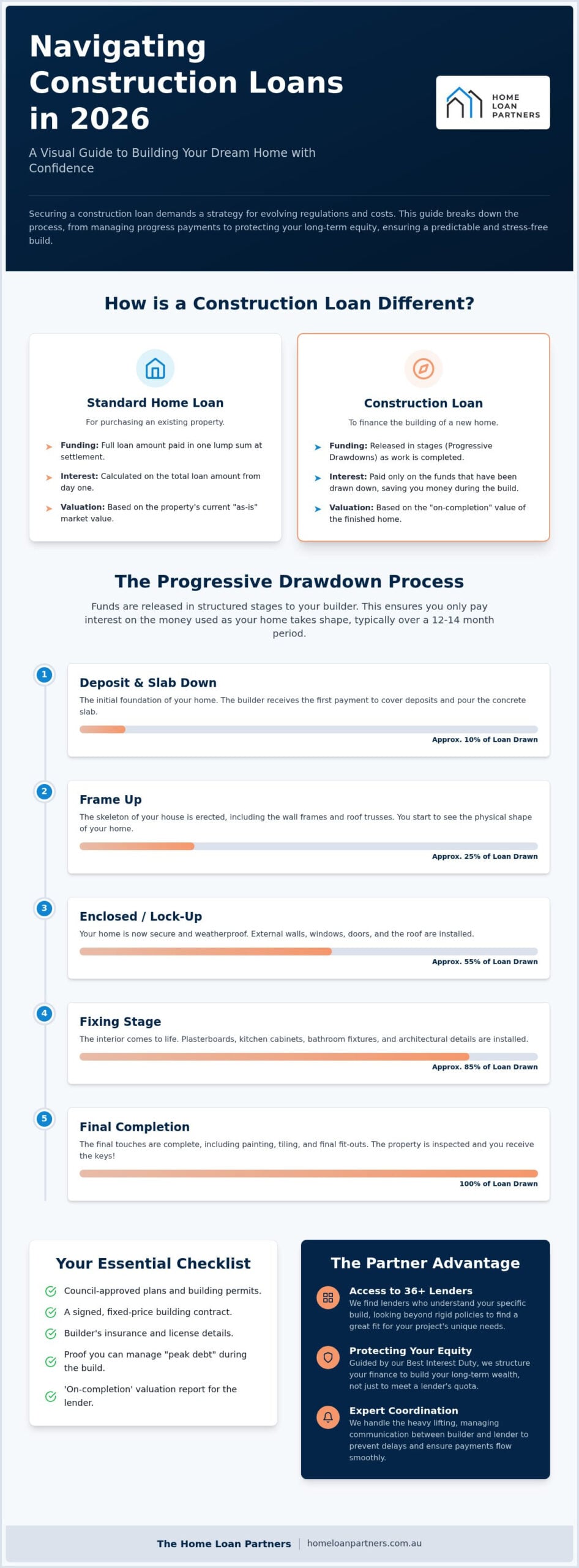
A construction loan is a specialised finance product designed to fund the building of a new dwelling or a major renovation. It functions differently than a standard mortgage because funds are released in stages rather than as a single lump sum. This structure ensures your builder receives payment only after completing specific milestones, which protects your investment from the start. A construction loan is a credit facility that uses ‘progressive drawdowns’ to pay builders as milestones are met. Securing construction loans nsw in 2026 requires a steady hand and a clear strategy to manage these moving parts.
The 2026 market brings a heightened awareness of lender serviceability buffers and APRA regulations. Lenders now look deeper into your financial stability to ensure you can handle the “peak debt” period of the build. This scrutiny isn’t a hurdle; it’s a safeguard for your future security. By understanding how property loans work in this specific regulatory environment, we can position your application to highlight your strengths and secure the necessary funding for your construction loans nsw.
The Core Difference: Construction vs. Established Property Loans
When you’re buying a house in Australia that already exists, the bank values the property in its current state. Building requires a more complex ‘on-completion’ valuation. This estimate predicts the market value of the finished home before the first sod is even turned. Comparing this to the ‘as-is’ land value is critical for determining your total borrowing power. Our role as your expert collaborator is to ensure the valuation aligns with your goals. We operate under a strict Best Interest Duty, which means we prioritize a finance structure that builds your equity rather than just meeting a lender’s internal quota.
Why 36+ Lenders Offer More Than Just a Rate
The Progressive Drawdown Process: Managing Cash Flow
Progressive drawdown is the heartbeat of your build finance. Unlike a standard mortgage where the full loan amount is handed over at settlement, construction loans nsw release funds in increments. This means your interest costs stay as low as possible during the early months because you only pay for what has been built. This structure keeps your builder accountable and your cash flow manageable. It ensures that the bank’s money is working directly for your project milestones rather than sitting idle in a builder’s account.
The stages are predictable and structured. Most lenders follow a six-stage payment schedule: deposit, slab, frame, enclosed (lock-up), fixing, and final completion. Using a home loan calculator allows you to model these stages before you sign a contract. You can see exactly how your monthly commitment grows as the house takes shape, which helps you plan your household budget with precision. This proactive approach takes the guesswork out of your monthly expenses during the 12 to 14 month build period.
Navigating the 5 Common Build Stages
Stages one and two cover the initial deposit and the pouring of the concrete slab. These are foundational but often move quickly. Stages three and four, the frame and lock-up phases, are where your expenses typically peak. This is often the most stressful time for homeowners as the debt increases significantly. To help manage wider market pressures and support housing supply, the NSW Pre-sale Finance Guarantee provides a framework for developers to start projects sooner. As an individual builder, your focus remains on ensuring each milestone is verified by the bank before funds are released. Finally, stage five involves the fixing of internal items and the path toward your Certificate of Occupancy.
Managing Interest-Only vs. Principal and Interest
Most construction loans nsw start as interest-only facilities. This protects your liquidity while you might still be paying rent or another mortgage. You aren’t forced to pay down the principal until the house is actually liveable. Once the final inspection is complete and the bank is satisfied, the loan typically reverts to standard principal and interest repayments. An expert tip for the savvy builder: if you have extra savings, look for a lender that offers a redraw facility. This allows you to park cash against the loan to reduce interest costs without losing access to those funds if an unexpected build cost arises. If you’re unsure how these stages align with your specific builder’s contract, our team is here to act as your collaborative guide through the paperwork.
The Essential Construction Loan Checklist for NSW Borrowers
Building a home is a major life milestone, and the paperwork involved reflects the significance of that investment. In the context of the National Housing Accord, which aims to deliver 1.2 million new homes across Australia, the regulatory environment for construction loans nsw has become more precise. Lenders require a specific set of documents to ensure your project is viable and compliant with current standards. You’ll need a signed, fixed-price building contract from a licensed builder, council-approved plans (either a DA/CC or a CDC), and comprehensive insurance certificates. These aren’t just hurdles; they are the foundation of a secure financial partnership.
A detailed ‘Schedule of Progress Payments’ is equally vital. This document must be agreed upon by you, your builder, and the lender before any funds are released. It aligns with the stages we discussed earlier, ensuring everyone is on the same page regarding when payments are due. Having these documents ready from the start allows us to move quickly through the approval process, reducing the stress of waiting for lender feedback while your builder is ready to break ground.
The Importance of a Fixed-Price Contract
In the 2026 building environment, material costs can fluctuate. A fixed-price contract protects you from these sudden spikes, giving both you and your lender peace of mind. Lenders pay close attention to ‘prime cost’ (PC) and ‘provisional sum’ (PS) items. These are allowances for items not yet selected, like tiles or tapware. If these sums are too high, the bank might see the project as too variable, which could lead to a lower loan offer. Variations during the build can also shift your loan-to-value ratio (LVR). If you change the design mid-build, it might require more upfront capital to cover the difference. We help you review these contracts to ensure they meet lender standards without compromising your vision.
Valuations and Equity Requirements
Your borrowing power for construction loans nsw depends heavily on the ‘As-If-Complete’ valuation. The bank sends a valuer to assess your plans and the land to predict the future market value of the finished asset. This is a critical step because it determines how much the bank is willing to lend. If you already own the land, the equity you’ve built can often serve as your deposit for the construction phase. However, if your deposit is less than 20% of the total value, you’ll likely need to account for Lenders Mortgage Insurance (LMI). This is a one-off cost that protects the lender, but we can help you calculate if it’s the right strategic move for your long-term equity goals. Our aim is to ensure your loan is structured to maximize your future security while keeping your current costs manageable.
Strategic Finance: Bridging and Investment Build Scenarios
Building a dream home is rarely a standalone event. Often, it involves a complex dance between your current residence and your future one. In 2026, many homeowners are opting for construction loans nsw that integrate bridging finance. This strategic combination allows you to commence your build without the immediate pressure of selling your existing property. It provides a vital buffer, giving you a place to live while the slab is poured and the frame goes up, ensuring your family’s routine remains undisturbed during the construction process.
Managing the financial weight of two properties requires a steady hand and a clear plan. We focus on protecting your cash flow during the months when your debt is at its highest. By structuring your finance correctly from the start, we ensure the transition from your old front door to your new one is a milestone to celebrate rather than a source of stress. An expert coordinator manages the overlap between two properties to ensure your transition is seamless and financially secure.
Building Your Next Home While Living in Your Current One
The transition period is where “peak debt” occurs. This is the moment near the end of the build when you carry the full weight of both your existing mortgage and the nearly finished construction loan. To manage this without financial strain, most bridging facilities allow for interest capitalisation. This means the interest on the new build is added to the loan balance rather than paid out of pocket each month. This preserves your liquidity during the high-cost fixing stage when you might be purchasing furniture or landscaping. This oversight prevents you from being forced into a hurried sale of your old home, allowing you to wait for the right market price.
Construction for Investors
For investors, construction loans nsw offer a pathway to high-yield assets like dual-occupancy dwellings or granny flats. These projects are particularly attractive in 2026 due to the significant depreciation benefits available for new builds. Every component of a new build, from the appliances to the structure itself, can be depreciated to improve your after-tax cash flow. Navigating the credit policies for these non-standard projects requires a partner who understands how lenders view potential rental income from unbuilt dwellings. We help you structure these loans to maximise tax effectiveness and prepare for future equity release once the project is valued at its finished price. If you’re ready to explore how these strategies fit your goals, you can book a strategy session with our team to map out your investment timeline.
The Home Loan Partners: Your Reassuring Guide Through the Build
Building a home is one of the most significant life milestones you’ll ever achieve. It’s a journey that should be defined by excitement, not overshadowed by the stress of managing complex financial paperwork. We act as your expert collaborator, providing a steady hand through the intricacies of construction loans nsw. Our team focuses on the long-term journey, ensuring that your finance structure supports your aspirations well into the future. With access to a national panel of 36+ lenders, we don’t just find a rate. We find the specific lender whose policies align with your builder’s schedule and your personal financial security.
This strategic approach is vital in the 2026 market, where lender appetites and serviceability buffers can shift quickly. By leveraging our deep relationships across a broad panel, we can navigate the nuances that a single bank might overlook. We’re here to alleviate the inherent stress of these complex processes by projecting a sense of calm, steady expertise at every turn. You aren’t just another transaction to us; you’re a partner, and we’re committed to your success from the first application to the day you move in.
Managing the ‘Heavy Lifting’ of Progress Payments
Managing the relationship between a bank and a builder is a delicate task that requires constant oversight. We take over the heavy lifting of coordinating your progress payments, ensuring that funds are released exactly when your builder reaches a verified milestone. If a lender delay occurs or a valuation dispute arises, we step in with professional precision to resolve the issue before it impacts your build timeline. This proactive management keeps your project moving and maintains a positive relationship with your builder. Whether you’re a first-time builder or a seasoned developer, our guidance is personalized to your level of experience. We’ve seen the hurdles the 2026 market presents, and we’re here to navigate them so you don’t have to.
Ready to Start Your Construction Journey?
The first step in any successful build is a comprehensive 2026 rate review. This allows us to assess your borrowing power against the latest regulatory changes and ensures your project is viable before you sign a contract. We then provide a tailored quote for construction loans nsw that reflects your specific project needs and long-term goals. Our commitment to you doesn’t end when the keys are handed over. We remain your partners for life, helping you transition your construction finance into a permanent mortgage that continues to protect your equity as your life evolves. If you’re ready to move forward with a team that values your peace of mind as much as your property goals, book a strategy session with The Home Loan Partners today.
Building Your Future with Confidence
Your journey toward a custom-built home is an investment in your family’s future security. By mastering the progressive drawdown process and ensuring your documentation meets the 2026 standards, you’ve already taken the first step toward a successful project. We’ve seen how the right strategy for construction loans nsw can shield you from peak debt and align your finance with your builder’s timeline. This level of preparation ensures that your focus remains on the excitement of the build rather than the stress of the spreadsheets.
Secure your build’s future with a strategy session from The Home Loan Partners. We’re here to ensure your project is built on a foundation of financial precision and personal care. Your dream home is within reach, and we’re ready to help you cross the threshold.
Frequently Asked Questions
What is the difference between a construction loan and a standard home loan?
A standard home loan provides a lump sum at settlement for an existing property, whereas a construction loan releases funds in stages as building milestones are met. This structure means you only pay interest on the amount drawn down, which protects your cash flow during the build. It’s a specialized facility designed to manage the unique risks associated with building from scratch rather than buying an established asset.
How do progress payments work on a construction loan?
Progress payments occur at specific stages like the slab, frame, and lock-up phases. Once your builder completes a stage, they issue an invoice that we then coordinate with your lender for payment. The bank often sends a valuer to verify the work before releasing the funds, ensuring the project remains on track and within the agreed budget without you having to manage the bank’s internal release process.
Can I use an owner-builder structure for my construction loan?
Finding a lender for an owner-builder project is significantly more challenging in 2026 due to increased risk assessments across the industry. Most Australian lenders require a fixed-price contract with a licensed builder to ensure professional oversight and insurance coverage. While some niche products exist, they often come with stricter equity requirements and a much higher level of scrutiny regarding your specific project management experience and qualifications.
What documents do I need to provide for a construction loan in NSW?
To secure construction loans nsw, you must provide council-approved plans, a signed fixed-price building contract, and the builder’s insurance certificates. Lenders also require a detailed specifications list and a schedule of progress payments. These documents prove to the bank that the project is legally compliant and financially structured to succeed under current state building regulations, providing a steady foundation for your finance approval.
Can I get a construction loan if I haven’t sold my current house yet?
Yes, you can manage this transition by using a bridging loan alongside your construction finance. This allows you to start your new build while still living in your current home, with the interest on the new debt often capitalised until you sell. It provides a steady, stress-free path forward without the need for a rushed property sale or the expense of paying rent and a mortgage simultaneously.
How much deposit do I need for a construction loan in 2026?
Lenders generally prefer a 20% deposit to avoid Lenders Mortgage Insurance (LMI), though some may accept as little as 5% or 10% depending on your serviceability. If you already own the land, the equity in that land often serves as your deposit for the construction phase. We help you calculate your position to ensure you meet the 2026 buffer requirements while maximizing your long-term equity and future security.
What happens if my builder increases the price during construction?
A fixed-price contract generally protects you from price hikes, but if you agree to design variations, you’ll need to seek bank approval for additional funding. If the bank’s valuation doesn’t cover the increase, you might need to fund the difference from your own savings. This is why we emphasize the importance of thorough planning and maintaining a contingency fund before the first sod is turned on your site.
Does a construction loan have a higher interest rate than a normal mortgage?
Interest rates for construction loans nsw are typically comparable to standard variable rates, though they usually operate as interest-only during the building period. Once the project reaches practical completion and the final payment is made, the loan usually reverts to a standard principal and interest mortgage. We review our panel of 36+ lenders to find a competitive rate that aligns with your specific build timeline and goals.