

What if your next company car could actually improve your bottom line instead of just draining your bank account? For many owners, business vehicle finance australia feels like a maze of complex ATO rules and strict depreciation limits. It is common to feel a bit of pressure when you are trying to choose a structure that won’t restrict your future borrowing power or leave you confused about the 2026 instant asset write-off status. We understand that you want to move forward with confidence, knowing your capital is working just as hard as you are.
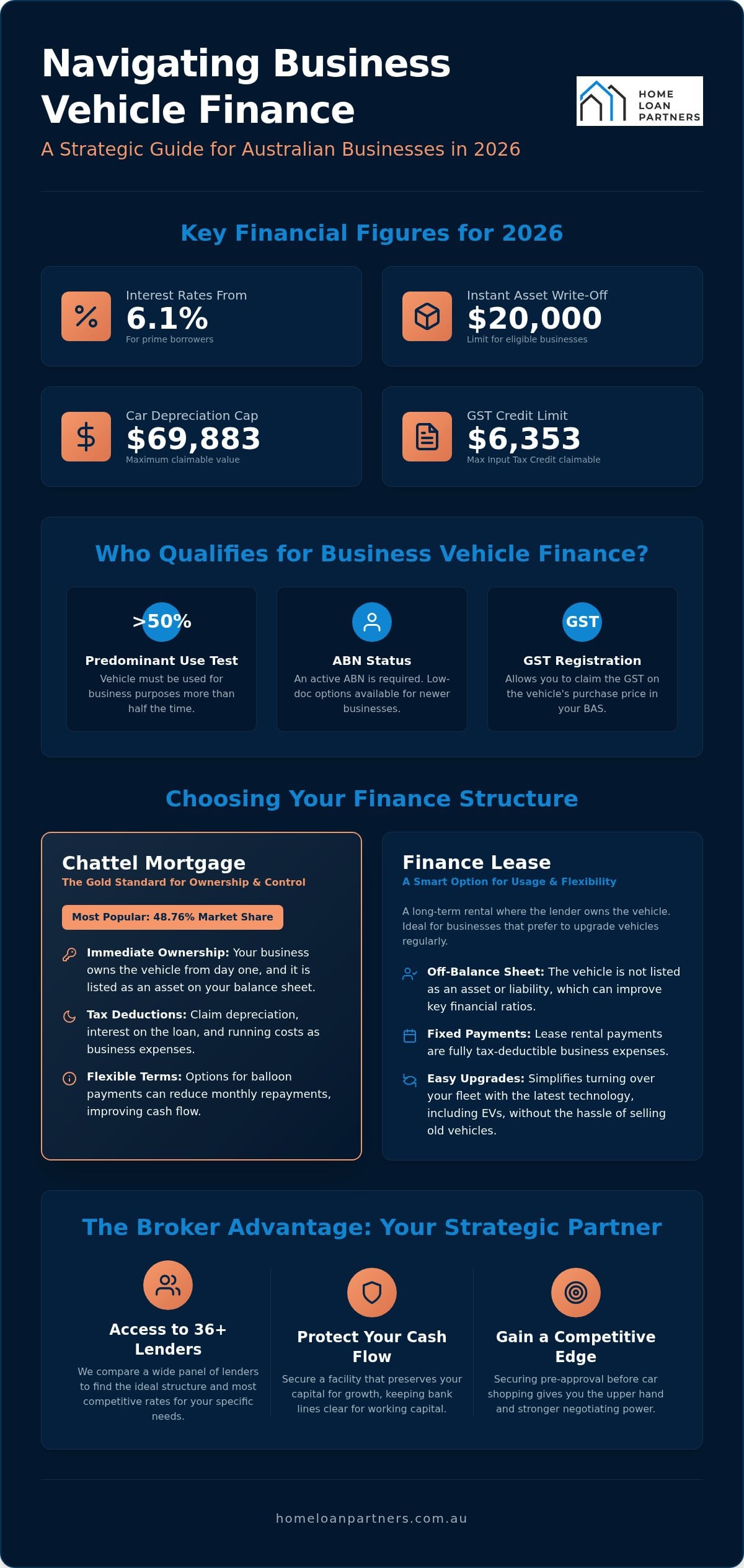
We believe that financing your fleet should be a steady, predictable process that supports your long-term goals. This guide will show you how to master these financial complexities to optimize your tax position and preserve your company’s vital cash flow. We will walk through the latest 2026 interest rates starting from 6.1% for prime borrowers, explain the $69,883 depreciation cap, and clarify the status of the $20,000 instant asset write-off. Our partnership aims to provide a clear path to securing competitive rates while maximizing every possible deduction for your business.
Key Takeaways
- Understand why choosing between a chattel mortgage and a finance lease is essential for your 2026 tax strategy.
- Discover how to master business vehicle finance australia to protect your cash flow while accessing the latest EV infrastructure incentives.
- Learn how to turn interest costs into a core business expense that works for your bottom line rather than against it.
- See why securing a finance facility before you go car shopping gives you the upper hand in a competitive market.
- Explore how a partnership with a specialized broker simplifies the process by comparing over 36 lenders to find your ideal structure.
Understanding Business Vehicle Finance in Australia (2026)
Business vehicle finance is a specialized credit structure designed for vehicles used more than 50% for commercial purposes. Unlike a standard personal car loan, this type of finance treats your vehicle as a working asset rather than a personal expense. In 2026, this distinction is more important than ever. With a 161% increase in EV loan volumes recorded earlier this year, Australian businesses are rapidly shifting toward sustainable fleets. Choosing the right business vehicle finance australia strategy allows you to modernize your operations while keeping your liquid capital available for daily expenses and growth opportunities.
Commercial finance offers a level of flexibility that personal loans simply cannot match. It recognizes that your cash flow might fluctuate. By using asset-specific debt, you keep your primary bank lines clear for working capital. This separation of debt is a protective measure. It ensures that your ability to fund inventory or pay staff isn’t hampered by your vehicle repayments. It’s a proactive way to manage your balance sheet with precision and care.
The Strategic Importance of Asset Finance
Asset finance serves as a powerful tool for managing your company’s cash flow cycles. When you finance a vehicle, you aren’t just buying a car; you’re securing a facility that preserves your cash reserves. Many of our clients prefer the certainty of fixed interest rates. In an economy that sometimes feels unpredictable, knowing your exact monthly commitment provides a welcome sense of security. This stability allows you to plan for the long term without worrying about sudden rate hikes affecting your fleet costs.
One common approach is the Chattel Mortgage. This structure allows your business to take ownership of the vehicle immediately while the lender uses the asset as security. It’s a clear, direct arrangement that prioritizes your ownership rights while providing the lender with the necessary safety. This balance of interests is why it remains the most popular choice for Australian businesses in 2026, making up nearly half of the automotive financing market.
Who Qualifies for Business Vehicle Finance?
Qualification isn’t reserved only for large corporations. Sole traders, partnerships, and proprietary limited companies are all eligible for commercial finance. To qualify, you must meet a few key criteria:
- The Predominant Use Test: You must intend to use the vehicle for business purposes at least 51% of the time.
- ABN Status: Lenders typically look for an active ABN. While some require a two-year history, low-doc options are available for businesses with shorter histories, sometimes covering vehicles up to $300,000.
- GST Registration: While not always mandatory, being GST-registered allows you to claim the GST on the vehicle purchase price (up to the $6,353 limit for 2026) as an Input Tax Credit in your next BAS.
Lenders in 2026 are increasingly looking for businesses that show a clear path forward. Whether you are upgrading to a high-performance ute like a Ford Ranger or a fleet of electric delivery vans, the focus is on how that vehicle supports your revenue. We act as your steady guide through this process, helping you present the strongest possible case to our panel of over 36 lenders.
Chattel Mortgage vs. Finance Lease: Which Structure Wins?
Choosing between a chattel mortgage and a finance lease is one of the most critical decisions you’ll make when setting up business vehicle finance australia. In 2026, we’re seeing a distinct shift in how companies approach their fleets. Businesses are moving toward structures that support faster vehicle replacement cycles, especially as electric vehicle technology and charging infrastructure evolve rapidly. Your choice ultimately determines how the asset sits on your balance sheet and how it impacts your tax return at the end of the financial year.
The fundamental difference lies in ownership versus usage. A chattel mortgage is a loan where you own the vehicle from day one, while a finance lease is an agreement where the lender owns the asset and you pay for its use. Both have merits, but the “winner” depends entirely on your company’s specific cash flow needs and long-term borrowing goals. We aim to act as a steady hand, helping you weigh these options with precision.
The Chattel Mortgage: Ownership and Control
For most Australian small businesses, the chattel mortgage remains the gold standard. It currently holds a 48.76% share of the automotive financing market. With this structure, you take ownership immediately, and the lender takes a “mortgage” over the vehicle as security. This is a clear, direct arrangement that many business owners find reassuring. Because you own the asset, you can typically claim the full GST component on your next Business Activity Statement. For the 2026-2027 period, the maximum GST credit you can claim is $6,353.
Beyond the upfront GST benefit, you can deduct both the interest on the loan and the vehicle’s depreciation as business expenses. It is vital to follow the Australian Taxation Office (ATO) guidelines to ensure your claims are accurate and compliant. For 2026, the car depreciation limit is $69,883. This structure provides a predictable path for businesses that want to build equity in their fleet while managing their tax position effectively.
Finance Leases and Hire Purchase Options
Some businesses prefer to pay for the use of a vehicle rather than owning it outright. A finance lease allows you to do exactly that. The lender retains ownership, and you pay a monthly rental fee. This can be an attractive option if you prefer off-balance-sheet financing. It keeps your debt-to-equity ratios looking healthy, which is often important if you plan on applying for other commercial loans in the near future. It’s a strategic way to preserve your borrowing power.
Balloon payments play a major role in these structures. By setting a larger payment for the end of the term, you can significantly reduce your monthly commitment. This keeps your working capital free for other growth areas, such as hiring new staff or investing in equipment. If you’re unsure which path aligns with your long-term strategy, our team can help you compare Asset & Equipment Finance options from our panel of over 36 lenders to find the right fit for your journey.
Commercial hire purchase is another alternative that acts as a middle ground. You technically hire the vehicle until the final payment is made, at which point ownership transfers to you. While it’s less common than it used to be, it still serves businesses using specific accounting methods like cash-basis reporting. Every business is unique, and we take the time to understand your specific cycles before recommending a path forward.
Maximising Tax Benefits and Cash Flow Efficiency
Many business owners ask if the interest cost of a loan is truly worth the tax saving. It’s a fair question. When you use business vehicle finance australia, you aren’t just taking on debt; you’re creating a structural advantage for your balance sheet. Interest on a commercial vehicle loan is typically a fully deductible business expense. By financing the asset, you keep your cash reserves intact while the vehicle helps generate revenue. This strategy allows you to offset the cost of borrowing against your taxable income, effectively reducing the net cost of the vehicle over time.
The Instant Asset Write-off remains a vital topic for our clients in 2026. For the financial year ending 30 June 2026, the threshold is $20,000 per asset for businesses with an aggregated turnover of less than $10 million. While there is a proposal to make this $20,000 limit permanent from 1 July 2026, it’s important to know that this is not yet law. If the legislation doesn’t pass, the threshold will revert to $1,000. We keep a close eye on these changes to ensure you’re making decisions based on the most current facts.
Green Finance is also becoming a powerful tool for reducing the effective cost of capital. With a 161% increase in EV loan volumes recorded earlier this year, lenders are offering “green loans” with discounted interest rates for fuel-efficient vehicles. These incentives, combined with FBT exemptions for eligible electric vehicles up to the luxury car tax threshold, make transitioning to a sustainable fleet a savvy financial move rather than just an environmental one.
GST Implications and Input Tax Credits
The timing of your GST claims can significantly boost your short-term cash flow. If you choose a chattel mortgage, you can generally claim the full GST component on the vehicle’s purchase price in your next Business Activity Statement. Conversely, with a finance lease, you claim the GST on each monthly rental payment as it occurs. Timing your acquisition at the end of a BAS period can result in a faster refund from the ATO, putting cash back into your business sooner. For the 2026-2027 year, the maximum GST credit you can claim for a business vehicle purchase is $6,353.
Depreciation and the Luxury Car Limit
Depreciation is a non-cash expense that reduces your taxable profit, and understanding the ATO’s limits is essential for accurate planning. For the 2026-2027 income year, the maximum value for calculating depreciation on a business vehicle is $69,883. If you’re considering a high-value vehicle, you must also account for the Luxury Car Tax (LCT). The LCT threshold for fuel-efficient vehicles is $91,661, while it sits at $80,809 for all other vehicles. Choosing a fuel-efficient model doesn’t just lower your running costs; it also provides a higher threshold before the additional tax applies, further protecting your profit margins.
The Roadmap to Securing Business Vehicle Finance
Securing the right vehicle for your business starts long before you walk onto a dealership floor. In a competitive market, moving from ‘shopping for a car’ to ‘securing the facility’ is a strategic shift that puts you in the driver’s seat. Obtaining a pre-approval for business vehicle finance australia gives you the confidence to negotiate as a cash buyer. It signals to dealers that you’re ready to move, which is essential when stock levels for popular models like utes and EVs are often tight.
Your credit profile plays a major role in the rate you’ll ultimately receive. For prime borrowers with an established ABN and a clean credit history, rates in 2026 can start from 6.1% p.a. If your business is newer or your credit is less than perfect, rates might range from 9% to 15%. We act as your expert collaborator, analyzing your personal and business credit to match you with the most competitive offer from our panel of over 36 lenders. Avoiding the pitfall of multiple “hard” credit inquiries is vital, as too many applications in a short window can negatively impact your score.
Essential Documentation for Australian Businesses
The path you choose depends on your timeline and the state of your financials. A ‘Full Doc’ application usually yields the lowest rates but requires complete tax returns and profit and loss statements. For many sole traders, a ‘Low Doc’ path is more practical. These loans are increasingly popular in 2026, with some lenders offering finance up to $300,000 without requiring full financial statements. We also see ‘No Doc’ options for established ABN holders who have a strong asset-backing, providing a streamlined experience that values your time.
- Full Doc: Requires two years of tax returns and current BAS statements.
- Low Doc: Often only requires an ABN, GST registration, and basic bank statements.
- No Doc: Designed for property-backed business owners with a long-standing ABN.
Step-by-Step Application Process
Our collaborative approach begins with an initial assessment to understand your goals. Once we find a lender match, we handle the heavy lifting of the credit submission. You can typically expect an approval within 24 to 48 hours for standard applications. After approval, we manage the settlement phase, ensuring the lender and the dealer are perfectly aligned for a smooth delivery. If you’re ready to begin your journey, our Asset & Equipment Finance team is here to guide you through every step with precision and care.
Why Partnering with a Finance Broker is Your Best Strategy
A direct bank manager can only offer you the products on their specific menu. This limitation often leads to a “one size fits all” approach that might not align with your specific cash flow cycles or tax requirements. When you seek business vehicle finance australia, the path you choose impacts your company’s flexibility for years to come. A professional finance broker acts as your expert collaborator, scanning the entire market to find a structure that fits your unique profile. At The Home Loan Partners, we manage the heavy lifting of lender negotiations, allowing you to focus on running your business while we secure the facility.
Our role is to serve as a steady hand through the complexity. We provide access to specialized non-bank lenders that often outperform the big four banks on both interest rates and flexible terms. These institutions frequently have a higher appetite for specific industries or newer businesses that traditional banks might overlook. By looking beyond a single institution, we ensure your debt structure remains balanced and sustainable for the long term.
Access to a Panel of 36+ Lenders
Choice is your greatest asset. With access to over 36 lenders, we can find tailored loan structures that accommodate niche industries or unique vehicle types, such as heavy machinery or specialized delivery fleets. In 2026, we’re particularly focused on identifying lenders offering the most aggressive “Green” discounts. As EV adoption continues to surge, these specialized lenders provide significant incentives that can lower your effective cost of capital. We do the research to find these opportunities, ensuring you don’t miss out on rebates or discounted rates simply because your local bank doesn’t offer them.
A Collaborative Approach to Your Business Growth
We believe your vehicle finance shouldn’t exist in a vacuum. It’s one piece of a much larger financial puzzle. Our team takes a holistic view, ensuring your fleet debt doesn’t restrict your ability to secure bridging finance or other property-related loans in the future. This integrated strategy protects your borrowing power and supports your broader aspirations, whether that involves expanding your office space or investing in new equipment.
The experience we provide is designed to be stress-free and predictable. From the initial assessment to the final settlement, we handle the documentation and lender follow-ups. Our relationship doesn’t end when the keys are handed over; we remain your reliable guide throughout the life of the loan. We’re here to help you navigate future upgrades, refinancing opportunities, and the ever-changing business vehicle finance australia landscape with precision and care.
Driving Your Business Toward a Stronger Future
Success in 2026 requires more than just a reliable fleet; it demands a finance strategy that protects your capital and evolves with your goals. By mastering the nuances of business vehicle finance australia, you turn a necessary expense into a powerful tool for tax optimization and cash flow management. Whether you are transitioning to electric vehicles or expanding your service reach with high-performance utes, the structure you choose today will define your borrowing power for years to come.
You don’t have to navigate these complex ATO rules or lender negotiations alone. Our team provides access to a panel of 36+ Australian lenders, ensuring you receive a tailored solution that a single bank simply cannot match. We pride ourselves on offering personalized service that prioritizes your long-term stability over a quick transaction. Our expert guidance is designed to handle the heavy lifting, giving you the freedom to focus on growth. We invite you to secure your business’s future with a tailored finance quote from The Home Loan Partners. Let’s work together to find the steady, predictable path forward that your business deserves.
Frequently Asked Questions
What is the difference between a chattel mortgage and a car lease?
A chattel mortgage allows your business to take ownership of the vehicle immediately while the lender secures the loan against the asset. In contrast, a car lease involves the lender maintaining ownership while you pay for its use over a set term. Many Australian business owners prefer the chattel mortgage structure because it often allows for an upfront GST claim and provides a clear path to full ownership.
Can I get business vehicle finance if I am a new sole trader?
You can definitely secure business vehicle finance australia as a new sole trader by utilizing specialized low-doc loan products. Lenders often provide finance for newer ABNs if you can provide basic bank statements or a declaration of income. While interest rates for newer businesses typically range between 9% and 12%, these options allow you to acquire essential assets without needing years of tax returns.
Is a novated lease considered business vehicle finance?
A novated lease is a three-way agreement between an employer, an employee, and a financier. While it is technically an employee benefit, it functions as a form of vehicle finance that uses pre-tax salary to cover repayments. It has become a dominant strategy in 2026 for electric vehicles, as the FBT exemption for eligible EVs can provide significant tax savings for both the business and the driver.
What are the tax benefits of financing an electric vehicle for my business in 2026?
Financing an electric vehicle in 2026 offers substantial advantages, including a complete exemption from Fringe Benefits Tax for eligible models up to the luxury car tax threshold. You also benefit from a higher Luxury Car Tax threshold of $91,661 compared to $80,809 for standard vehicles. Many lenders on our panel also offer “green” interest rate discounts, which can lower your total cost of capital significantly.
Do I need a deposit for a business vehicle loan in Australia?
You don’t necessarily need a deposit to secure a business vehicle loan. Many lenders offer 100% finance to established businesses with a strong credit profile and an active ABN. Opting for a zero-deposit loan preserves your liquid capital for other operational needs, though some owners choose to pay an upfront amount to reduce their monthly commitments and the total interest paid over the life of the loan.
What is a balloon payment and how does it affect my business cash flow?
A balloon payment is a pre-determined lump sum that you pay at the end of your loan term. By deferring a portion of the principal to the final payment, you significantly reduce your monthly repayments, which helps keep your daily cash flow steady. It is a strategic choice for businesses that prefer to trade in or refinance their vehicles every three to five years to maintain a modern fleet.
How does the ‘Instant Asset Write-off’ work for cars in 2026?
For the financial year ending June 2026, the instant asset write-off threshold is $20,000 for businesses with a turnover under $10 million. While there is a proposal to make this $20,000 limit permanent from July 2026, it hasn’t become law yet. If the legislation doesn’t pass, the threshold will revert to $1,000, so we recommend consulting with your accountant to time your business vehicle finance australia application perfectly.
Can I finance a used vehicle for my business?
You can certainly finance used vehicles for your business, and roughly 55% of business applications currently focus on the used market. Lenders typically have age restrictions, often preferring vehicles to be less than 12 years old at the end of the loan term. Rates for used vehicles are slightly higher than new ones, usually starting around 7% for established businesses with a strong credit history.