

If you’re searching for how to appeal a home loan rejection, start by asking the lender to explain its decision. You can request a review, but the right next step depends on why the application was declined and whether you can provide information that addresses the issue.
A rejection can feel discouraging, especially when the lender’s explanation is brief. It’s understandable to want to act quickly, but applying elsewhere before understanding the decision may not solve the problem. Review the lender’s reasons and check whether your application contains an error, missing information or an issue you can address.
This guide explains how to request a review, when to use the lender’s complaints process and what practical changes may strengthen a future application. You’ll also learn how to weigh your options before applying again. A mortgage broker can help interpret the decision and compare potential alternatives across a panel of more than 36 lenders, without promising that another lender will approve your loan.
Key Takeaways
- Ask the lender for its specific reasons for declining your application, then check the details against your income, expenses, debts and property information.
- Learn how to appeal a home loan rejection by deciding whether to request an informal reassessment or make a complaint through the lender’s internal process.
- Keep a clear record of dates, lender contacts, requested documents and agreed follow-ups so you can track the review.
- Before applying again, identify whether the issue can be corrected or needs time to improve. A broker can help compare potential lender criteria against your circumstances.
How to Appeal a Home Loan Rejection: What the Decision Means
A declined home loan application can be upsetting, particularly if you’re working towards a purchase deadline. But one lender’s decision doesn’t automatically end your home-buying plans. Before deciding how to appeal a home loan rejection, find out what the lender assessed and why it declined the application. Your next step depends on the stated reason and whether the application is still being assessed or has received a final decision.
An appeal is a request for the lender to review its decision, not a promise that the outcome will change. If information was missing or recorded incorrectly, you may be able to provide corrected details. If you believe the lender misunderstood or incorrectly assessed information you already supplied, explain the issue and ask it to reconsider. Review processes vary, so ask how the lender handles requests and what supporting documents it needs.
What does appealing a home loan rejection involve?
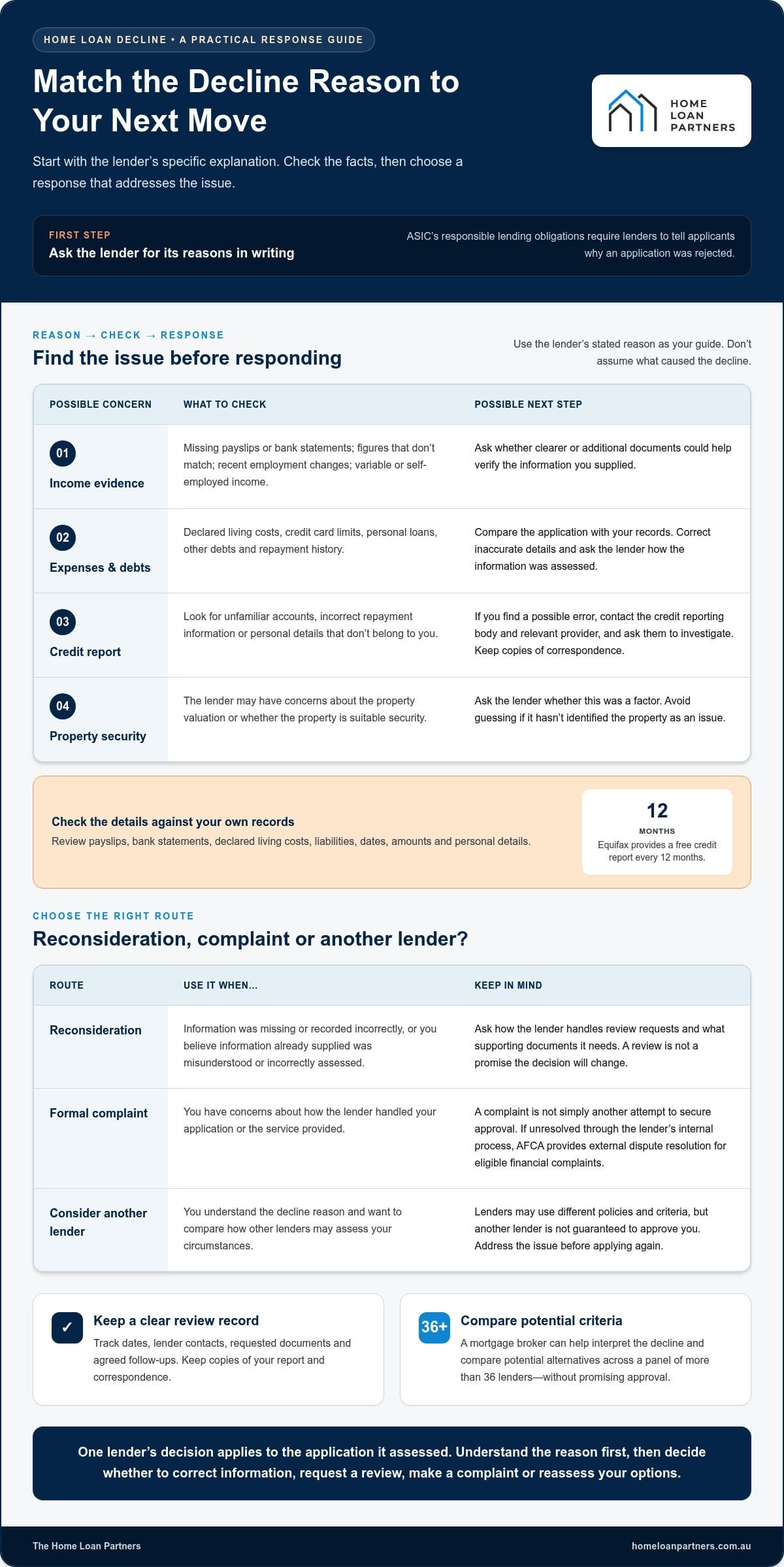
Start by asking the lender to clarify its reasons. ASIC’s responsible lending obligations require lenders to tell applicants why a home loan application was rejected. Request the explanation in writing so you have a clear record. Then compare it with your application: is a payslip missing, has a debt or expense been recorded incorrectly, or do you disagree with how the information was assessed?
Reconsideration asks the lender to review its decision or consider corrected information. A formal complaint raises concerns about the lender’s handling of your application or service. A complaint isn’t simply another attempt to secure approval. If the issue remains unresolved after the lender’s internal process, the Australian Financial Complaints Authority provides external dispute resolution for eligible financial complaints.
Does a home loan rejection mean you cannot borrow?
No. A lender’s decision applies to the application it assessed. Other lenders may use different policies and criteria, so they may assess the same circumstances differently. That doesn’t mean another lender will approve the application or that applying elsewhere immediately is the best move.
For example, if the decline relates to how your income was documented, clearer evidence may address the issue. If it relates to affordability or existing debts, the application may need a more substantial review before you try again. The application stage also matters: if the lender is waiting for information, supplying it may be more appropriate than making a complaint about a final decision.
A mortgage broker can help interpret the decline and compare potential alternatives across a panel of more than 36 lenders. The aim is to understand which next step may fit your circumstances, not to assume a different lender will approve the application. Reviewing the decision carefully can help you move forward with a clearer plan.
Why Was Your Home Loan Rejected? Find the Reason Before You Respond
A useful response starts with a clear reason. Ask the lender to explain the specific factors behind its decision and what information it can provide. If the explanation is broad, ask whether the concern relates to your income, expenses, debts, credit history, deposit or the property being used as security. ASIC’s guidance on why a loan may be rejected can also help you understand common issues and what to do next.
Let the lender’s stated reason guide your next action: correct an error, provide missing evidence, address an underlying concern or ask how your application was assessed. Serviceability isn’t determined by one universal income or expense threshold. Each lender assesses whether repayments appear manageable given your circumstances and its own criteria.
Which application issues commonly contribute to a decline?
Start by looking for gaps or inconsistencies. Missing payslips, bank statements that don’t match declared figures, a recent employment change or complex income, such as variable or self-employed earnings, can make it harder for a lender to verify your position. Ask whether additional or clearer documents could help explain the information you supplied.
Expenses and existing commitments matter too. Credit card limits, personal loans and other debts may affect how a lender views your capacity to manage repayments. Repayment history can also be relevant. A lender may have concerns about the property valuation or whether the property provides suitable security, but don’t assume that’s the issue unless the lender says so. Each factor calls for a different response, so avoid guessing.
How to check your credit report and application details
Compare your application with your records, including payslips, bank statements, declared living costs and a current list of liabilities. Check dates, amounts and personal details. A small discrepancy may not explain the decline, but identifying it gives you a specific question to raise with the lender.
You can request your credit report from Australian credit reporting bodies. Equifax provides a free copy every 12 months. Review the report for unfamiliar accounts, incorrect repayment information or details that don’t belong to you. If you find a possible error, contact the credit reporting body and the relevant provider, such as the lender or credit provider, and ask them to investigate. Keep copies of your report and any correspondence.
Once you understand the concern, you can make a more informed decision about how to appeal a home loan rejection instead of applying again without addressing the issue. If you’d like support understanding the decision and comparing possible lender criteria, explore personalised home loan guidance.
Reconsideration, Complaint, or Another Lender: Compare Your Options
The best response depends on what went wrong. A missing document or factual error may call for a reassessment request. A concern about how the lender handled your application may fit its complaints process. If the decision appears sound but the lender’s criteria don’t suit your circumstances, exploring another lender may be more relevant than disputing the outcome.
An appeal asks the lender to review its decision; it doesn’t give you a right to loan approval. Use the comparison below to choose a practical starting point.
| Option | Purpose | May suit you if | First action | Important limitation |
|---|---|---|---|---|
| Reassessment request | Ask the lender to reconsider its decision | Evidence was missing, misunderstood or has changed | Write to the lender with the specific reason and relevant documents | The lender may uphold its decision |
| Internal complaint | Raise concerns about the lender’s process or handling | You believe there was an error or service issue, not simply an unfavourable outcome | Use the lender’s internal dispute resolution process | A complaint doesn’t guarantee a different lending decision |
| Another lender | Explore whether different lending criteria may fit | You understand the decline reason and can address it or identify a better fit | Review your circumstances before making another application | Different criteria don’t guarantee approval |
When should you request reconsideration from the lender?
Consider a review if the lender overlooked a document, relied on incorrect information or assessed circumstances that have since changed. Keep your request factual: refer to the lender’s stated reason, explain what needs correcting and attach evidence that addresses it. For example, if the lender says it couldn’t verify your income, provide the relevant records and ask whether they can be reconsidered. A review may clarify the decision, but it may not change it.
When might a formal complaint or AFCA be relevant?
Use a formal complaint to raise a concern about the lender’s process or handling, such as an alleged factual or procedural error. In Australia, first try to resolve the issue through the lender’s internal dispute resolution process. Lenders generally have 21 to 30 days to respond. If you’re dissatisfied with the response, or don’t receive one within the applicable timeframe, you may be able to lodge a free complaint with the Australian Financial Complaints Authority (AFCA). Eligibility and time limits depend on the complaint, so check AFCA’s current guidance before lodging.
When deciding how to appeal a home loan rejection, distinguish between a dispute about the process and disappointment with the lending outcome. For complex disputes, consider independent legal or financial advice. If the issue is the lender’s criteria rather than its handling, a mortgage broker can help interpret the decision and compare potential alternatives without promising approval.
How to Appeal a Home Loan Rejection: A Practical Step-by-Step Plan
A clear sequence can make the process easier to manage. Work through these steps before deciding whether to request a review or apply elsewhere.
- Read the decline notice. Note the decision date, the lender’s stated reasons and whether it asks you to provide further information.
- Ask for clarification. If the reason is vague, contact the lender and ask which part of your application raised concern and whether it can be reviewed.
- Check your application. Compare the details you submitted with your payslips, bank statements, liabilities and other supporting records. Note errors, missing documents or changes since you applied.
- Review affordability assumptions. Check that your income, expenses and existing commitments are accurately represented. The home loan calculator guide can help you explore repayment estimates and plan your budget. A calculator is a planning tool, not a lender’s assessment.
- Choose your next step. If you can provide evidence that addresses the stated reason, request reconsideration. If your concern is about the lender’s process, consider its complaints process. If you’re thinking about another application, first assess whether the underlying issue is likely to remain.
- Keep a written record. Log contact dates, names or teams, stated reasons, requested documents, what you submitted and any agreed follow-up date. Save copies of the notice and your correspondence.
What to include in a request for reconsideration
Keep your request professional, concise and focused on the lender’s stated reason. Include your application reference and decision date, identify the specific information you want reviewed, and explain why. Attach only relevant evidence, such as updated income documents or a corrected application detail. Ask the lender to confirm receipt and explain what happens next. Avoid adding unrelated material that could obscure the issue you want reconsidered.
What to do while waiting for a response
Use the time to check your application and credit report for errors or inconsistencies. Avoid lodging several unplanned applications before you understand the original decline. Each new application should follow a considered assessment of your circumstances. Set a reminder for the follow-up date, and keep copies of supporting documents and any response you receive.
If you’d like help interpreting the decision and considering your next steps, explore how a finance broker can help.
What to Do If the Lender Upholds Its Decision
An unchanged decision doesn’t mean you need to abandon your plans, but it is a reason to pause before applying again. Match the lender’s explanation to your circumstances. If the concern was missing or unclear income evidence, gather complete, consistent records. If existing commitments or affordability were an issue, review your budget and whether those commitments can be reduced. If the lender raised a property or security concern, understand that issue before proceeding with another application.
There’s no single waiting period that suits every borrower. The timing of another application depends on the reason for the decline, what has changed and whether you can provide stronger information. Applying again before addressing the underlying issue may simply lead to another decline.
How can a broker help after a home loan rejection?
A mortgage broker can review the lender’s stated reason alongside your application details, helping you distinguish between an information gap and a broader lending concern. They can then compare your circumstances with potential lender criteria before you decide whether another application makes sense. The Home Loan Partners has a panel of over 36 lenders, giving you potential alternatives to consider. Access to a panel doesn’t mean every lender will suit your circumstances or approve an application.
For a clearer picture of how a broker can support your next steps, explore how an Australian finance broker can help.
How to prepare for a stronger future application
Use the lender’s feedback to focus your preparation. Depending on the reason, useful steps may include:
- Organising clearer, up-to-date evidence of income and employment.
- Checking that your declared expenses, debts and application details match your records.
- Reviewing existing credit commitments and considering whether they can be reduced.
- Resolving errors in relevant records before submitting another application.
Give yourself time to make changes and collect supporting documents. A stronger application responds directly to the previous concern, rather than simply repeating the same application with a different lender. If your declined application was for refinancing, the home loan refinancing guide can help you revisit what refinancing involves.
Understanding how to appeal a home loan rejection can help you choose a deliberate next step, even if the lender doesn’t change its decision. Review the reason, strengthen what you can and seek guidance if you’re unsure how your circumstances may fit potential lender criteria.
Take a Clear Next Step Towards Your Home Loan
A home loan rejection can be disappointing, but it doesn’t automatically close the door on your plans. Start by understanding the lender’s reasons and checking your application for errors or missing evidence. Then decide whether a review, complaint or carefully considered new application fits your situation.
Knowing how to appeal a home loan rejection means treating a review as a request, not a guarantee of approval. If the lender upholds its decision, addressing the underlying concern before applying again can help you move forward with greater clarity.
The Home Loan Partners offers personalised guidance for Australian borrowers, helping you understand your options and plan practical next steps. Its panel includes over 36 lenders, giving you potential alternatives to compare, not a promise that any lender will approve your application.
Talk through your home loan options with The Home Loan Partners and take your next step with a clearer plan.
Frequently Asked Questions
Can you appeal a home loan rejection in Australia?
Yes, you can ask the lender to review its decision, but an appeal doesn’t guarantee approval. First, request the specific reason for the decline. If information was missing, misunderstood or incorrect, provide relevant evidence and ask whether the lender can reassess it. If your concern is about how the application was handled, the lender’s internal complaints process may be more appropriate than a straightforward review request.
How do I ask a lender to reconsider a rejected home loan?
To understand how to appeal a home loan rejection, start with a concise written request. Include your application reference and decision date, explain the specific issue you want reviewed, and attach evidence that addresses the lender’s stated reason. For example, if income details were unclear, provide relevant updated documents. Ask the lender to confirm receipt and explain what happens next. Keep copies of your request and supporting material.
Does a home loan rejection affect your credit score?
A rejection itself isn’t the same as a credit enquiry. However, applying for a home loan can result in a hard enquiry being recorded on your credit file, and several enquiries in a short period may lower your credit score. These enquiries can remain on your file for five years. Before applying elsewhere, check your credit report and understand the original decline so you can make a considered decision.
What should you do if a lender will not explain why it rejected your home loan?
Ask the lender in writing for the specific reasons behind its decision and keep a copy of your request. Australian responsible lending guidance says lenders should provide a reason for a rejection. If you still don’t receive a clear response, use the lender’s internal dispute resolution process to raise your concern about how the application was handled. Record contact dates and responses so you have a clear timeline.
Can a mortgage broker help after a home loan rejection?
Yes. A broker can help you interpret the lender’s stated reason, review the information in your application and consider what may need to change before you apply again. They can also compare potential lender criteria against your circumstances. The Home Loan Partners has access to a panel of over 36 lenders, which can help you explore potential alternatives, but it doesn’t mean every lender will suit your situation or approve an application.
Should you apply with another lender after a home loan rejection?
Possibly, but first work out why the original lender declined your application. If the issue was missing evidence, correct it. If affordability or existing debts were concerns, consider whether your circumstances or application can be improved. Different lenders assess applications under different criteria, but another lender may reach the same decision. Avoid rushed applications and consider whether you can address the original concern before applying again.
Can you complain to AFCA about a home loan rejection?
You may be able to complain to the Australian Financial Complaints Authority (AFCA) if you have an eligible complaint about the lender’s handling of your application. First, raise the issue through the lender’s internal dispute resolution process. Lenders generally have 21 to 30 days to respond. If you’re dissatisfied with the response or don’t receive one within the applicable timeframe, check AFCA’s current eligibility and time-limit guidance before lodging a complaint.