

What if a low credit score doesn’t automatically end your chances of getting a home loan? The phrase “lenders that don’t credit score in australia” can sound like lenders won’t check your credit at all, but that’s not usually what it means. A lender may consider your score alongside your income, expenses, debts and recent repayment conduct, rather than treating one number as the whole application.
Past repayment problems or a limited credit history can make applying feel daunting. However, a home loan assessment considers your broader financial position, and a “no credit check” claim isn’t the same as a flexible home loan option. It may refer to another type of borrowing, such as a short-term personal loan.
This guide explains what Australian lenders may assess beyond a credit score, how to distinguish home loan pathways from short-term loans, and practical steps to prepare a clearer application. You’ll also learn how a mortgage broker can compare assessment approaches across a panel of more than 36 lenders and help you consider options suited to your circumstances and goals.
Key Takeaways
- “Lenders that don’t credit score in australia” usually refers to lenders weighing more than a score, not skipping credit assessment altogether.
- Income, living expenses, debts, deposit and repayment capacity can all shape a home loan application.
- Compare “no-score,” “bad-credit” and “no-credit-check” claims carefully, and don’t confuse home loans with short-term borrowing.
- Review your credit file and organise income, expense, debt and deposit details before applying. Understand the likely enquiry process first.
- Personalised broker guidance can help you compare home loan pathways across a panel of more than 36 lenders against your circumstances and goals.
What does ‘lenders that don’t credit score’ mean in Australia?
In a home loan search, “lenders that don’t credit score in australia” is usually shorthand for lenders that may not treat a credit score as the deciding factor. It doesn’t mean they skip credit assessment. A lender may review your credit information and assess your application using its own criteria, even if one score isn’t an automatic pass-or-fail threshold.
These terms describe different parts of the process:
- Credit score: A number calculated from information in your credit file. It can provide a quick indication of credit history, but it isn’t the entire file or the lender’s final decision.
- Credit report: A record of credit-related information about you. A credit reporting body collects and provides credit information that lenders may use as part of an assessment.
- Credit enquiry: A record associated with a credit application or a lender’s check of your credit file. Enquiries are separate from your score. Understand when an enquiry may occur before making multiple applications.
- Lender criteria: The lender’s rules for assessing your report and wider application. Criteria can differ, so there isn’t one universal scoring formula for every home loan.
This guide focuses on home loans, including loans to buy a home or refinance. It doesn’t cover short-term or unsecured personal loans. Similar “no credit check” wording may appear in other borrowing contexts, but it shouldn’t be taken as evidence that a home loan lender will ignore your credit history.
Does no credit score mean no credit check?
No. A lender may review your credit report without relying on a score as its decisive threshold. For example, it could consider what the file records alongside other details in your application. That’s different from not checking your credit history at all. Don’t assume a lender will accept an application without reviewing credit information, or that a low score won’t matter.
Why might a borrower search for score-free home loans?
You might have a thin credit file with little borrowing history, past repayment problems, or concerns that an earlier application could affect your next step. A credit score can make a complicated financial history seem like a single number, but the search phrase alone can’t tell you how an individual lender will assess your circumstances.
The lender’s criteria and your full application both matter. The context behind a credit issue, your current finances and the information you provide may all be relevant, but none guarantees approval. A mortgage broker can help compare assessment approaches across a panel of lenders and organise your application details, giving you a clearer view of what may be assessed.
How Australian home loan lenders assess applicants beyond a credit score
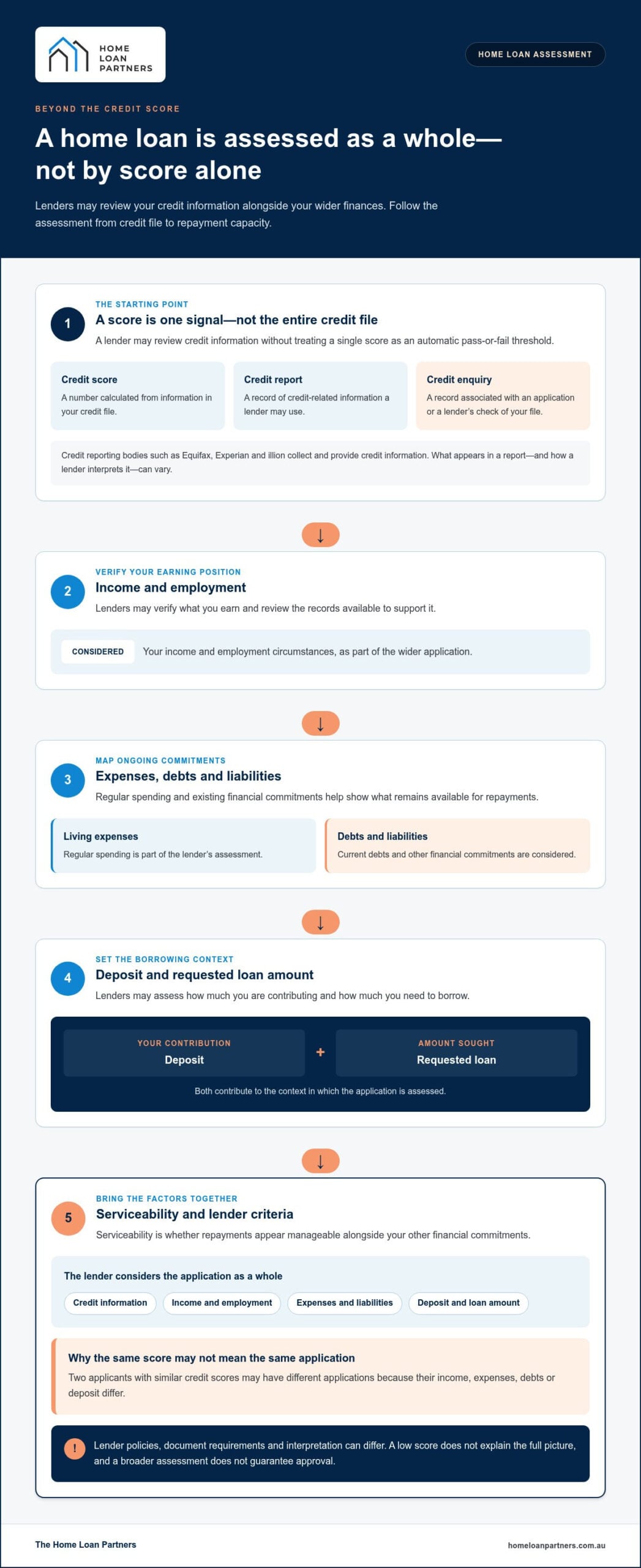
A home loan assessment considers whether repayments appear manageable in light of your finances, not just what a credit score says. Lenders may review credit-report information and weigh it alongside your income, employment, expenses, debts, deposit and requested loan amount. A score may inform the decision without determining it.
There’s no single formula every lender follows. Policies differ, as do document requirements and how lenders interpret an applicant’s circumstances. Searching for lenders that don’t credit score in australia shouldn’t mean assuming credit history is irrelevant. Instead, find out how a lender assesses the whole application.
What may appear in an Australian credit report?
Credit reporting bodies such as Equifax, Experian and illion collect and provide credit information. A report may show credit enquiries and repayment-history information, though the details available and how a lender interprets them can vary. The Office of the Australian Information Commissioner explains the Australian credit reporting system and the privacy framework around credit reporting.
A lender’s review of a report is separate from its decision criteria. The same information may be considered differently depending on the lender, the loan sought and the rest of your application. If you’re concerned about an earlier application or repayment issue, review your credit file to understand what information may be considered.
What else can shape a home loan decision?
Lenders may verify your income and employment circumstances, examine regular living expenses and consider existing debts or other liabilities. They also assess your deposit and the size of the loan you’re requesting. Together, these details help them consider serviceability, or whether you’re likely to manage repayments while meeting your other financial commitments.
For example, two applicants with similar credit scores may have different applications because their income, expenses, debts or deposit differ. A lower score also doesn’t explain the full picture on its own. Lenders assess the application as a whole, in line with their policies and applicable requirements.
- Income and employment: what you earn and the records available to verify it.
- Expenses and liabilities: regular spending, current debts and other financial commitments.
- Deposit and loan amount: how much you’re contributing and how much you need to borrow.
- Credit information: relevant report details, considered alongside the wider application.
Organising these details can make your position clearer before you apply. A broker can help compare assessment approaches across a panel of more than 36 lenders and identify home loan options that align with your circumstances and goals. Explore home loan guidance as part of that process.
Compare no-score, bad-credit, no-credit-check loan claims
Promotional phrases can sound similar while describing different things. For a home loan, “no-score” may mean a lender gives less weight to a particular numerical score. “Bad-credit” messaging usually refers to applicants with adverse credit circumstances. A “no-credit-check” claim suggests something more sweeping, so read it carefully. Make sure you’re comparing a home loan with another home loan, not with a short-term cash or personal loan.
| Claim | What it may mean | What it doesn’t guarantee |
|---|---|---|
| No-score or score-free | A lender may use other criteria and consider the wider application rather than relying on a particular numerical score as a decisive threshold. | It doesn’t mean the lender won’t review your credit report, that your credit history is irrelevant, or that you’ll qualify. |
| Bad credit | The product or assessment may be positioned for applicants with past repayment issues or other adverse credit circumstances. | It doesn’t mean every type of credit issue will be accepted, or that the loan’s terms will match those available to other borrowers. |
| No credit check | This wording may appear in promotions for short-term or other types of borrowing. The product may not be a home loan. | It shouldn’t be taken as a promise that a regulated home loan lender will skip assessment or approve an application. |
How can you interpret ‘no credit score’ wording?
Think of “no credit score” as a description of how a lender might weigh information, not proof of eligibility. The phrase alone can’t tell you whether the loan is a mortgage, what evidence the lender reviews, or how your circumstances fit its criteria. Compare the product type, assessment process, repayments and other obligations before deciding whether an option suits your plans.
What is the difference between bad-credit and no-credit-check claims?
Bad-credit messaging acknowledges that an applicant may have an adverse credit history. It doesn’t mean the lender ignores that history. No-credit-check wording implies that credit information may not be reviewed, which needs especially careful interpretation for a home loan. Australian licensed credit providers must assess a borrower’s ability to repay regulated credit. Don’t treat a claim suggesting this assessment can be bypassed as a home loan approval promise.
Searches for lenders that don’t credit score in australia can also surface personal cash loans. These aren’t interchangeable with mortgages: the loan purpose, repayment structure and assessment may differ. Confirm what kind of borrowing a claim refers to, then compare like with like. A broker can help you understand lender assessment approaches and compare home loan pathways based on your circumstances, rather than promotional wording alone.
How to compare lenders and prepare a stronger home loan application
Preparation can help you compare home loan options on more than a headline claim about credit scores. Use this checklist to organise your position before an application moves forward:
- Review your credit file. Check that the details look accurate. If you spot an error, contact the relevant credit reporting body about the process for correcting it.
- Gather income evidence. Collect recent payslips or other records that show your income, along with relevant account information. Requirements differ by lender and employment circumstances.
- Map your expenses. Review regular household spending and account activity so you can describe your ongoing commitments clearly and consistently.
- List your debts and liabilities. Include existing credit commitments and repayment obligations. Note any changes or unusual circumstances that help explain the information in your application.
- Record your deposit and savings. Keep relevant savings records together and be clear about the deposit available and the loan amount you’re seeking.
If a past credit issue or recent change needs context, prepare a straightforward explanation and keep it consistent across your documents. Before submitting applications, understand the likely credit-enquiry process. Lender procedures differ, so clarify when a credit enquiry may occur and avoid making multiple formal applications without considering their potential impact. Lender policies and credit-reporting practices can change, so use current information when comparing options.
Compare options on suitability, not approval alone. Consider likely repayments, fees, loan features and conditions, as well as how the lender’s assessment approach fits your circumstances. An option that appears accessible still needs to work for your budget and longer-term plans.
How can a broker help compare home loan pathways?
The Home Loan Partners can compare home loan options across a panel of more than 36 lenders, taking your goals, application context and lender criteria into account. A broker can help organise the details before you apply and explain differences between pathways, without promising approval or a lender that ignores credit history.
For a clearer view of how a broker can support your comparison, explore the finance broker guide and discuss a home loan pathway tailored to your circumstances.
Finding a suitable home loan pathway with credit concerns
A credit score can be part of a lender’s assessment, but it doesn’t tell your whole financial story. Income, regular commitments, deposit, repayment capacity and the circumstances behind credit issues may also shape how an application is considered. That doesn’t mean every lender will assess the same way, or that a particular option will lead to approval. It does mean you can compare suitable home loan pathways instead of ruling yourself out based on one number.
What can a borrower expect from a tailored discussion?
A useful conversation starts with your goals: are you buying a home, refinancing, or planning another property move? Then you can talk through your income, regular expenses and debts, available deposit, and relevant credit circumstances. Bringing documents together helps clarify your position and supports a more practical comparison.
The Home Loan Partners can compare options across a panel of more than 36 lenders, considering how different lender criteria may relate to your circumstances. The aim is to help you understand potential home loan pathways, not to promise that a lender will disregard a credit report or approve an application. A broker can also help you prepare for the next steps and support your lending journey over time.
What is a sensible next step?
Before moving ahead, check that you can explain your plans and finances clearly. Use this simple checklist to prepare:
- Clarify your goals: Know what you want the loan to help you achieve and the amount you may need.
- Organise your documents: Gather income evidence, account information, details of debts and records of your deposit.
- Compare options: Look beyond score-related claims to lender criteria, product features and suitability for your circumstances.
- Understand obligations: Consider repayments, fees, conditions and how the loan fits your budget over the longer term.
If you’re preparing to buy, a buying a house in Australia guide can also help you think through the wider steps involved. When you’re ready, discuss your home loan goals and circumstances with The Home Loan Partners. A considered comparison can help you move forward with greater clarity, even when your credit history raises questions.
Discuss your home loan options with our team
Take your next home loan step with a clearer picture
A credit score is one part of a home loan application, not the whole story. The phrase lenders that don’t credit score in australia doesn’t mean a lender will ignore credit history or skip assessment. Your income, commitments, deposit and broader circumstances can also matter, and lender criteria vary.
Preparing clear documents and comparing home loan options by suitability, repayments and conditions can help you move forward with more confidence. The Home Loan Partners provides personalised guidance shaped around your circumstances and long-term goals, with access to a panel of more than 36 lenders and national service coverage across Australia.
You don’t have to work through every lender’s criteria alone. Discuss your home loan options with our team and take a considered next step towards your property goals.
Frequently Asked Questions
Are there lenders in Australia that do not use credit scores?
Some lenders may place less weight on a particular credit score, but that doesn’t mean they ignore credit information. They may consider your credit report alongside income, expenses, debts, deposit and repayment capacity. The phrase lenders that don’t credit score in australia is a search term, not a guarantee of a particular lender policy or approval. Criteria vary, so compare how the home loan assessment works, not just the promotional wording.
Can I get a home loan in Australia with bad credit?
It may be possible, but bad credit doesn’t guarantee approval or rule it out automatically. Some specialist lenders consider applications with adverse credit circumstances while assessing the wider financial position and the reasons behind past issues. Your current income, debts, deposit and repayment capacity can also matter. Compare the lender’s criteria and the loan’s overall terms carefully, as options for borrowers with credit concerns may come with different conditions.
Does no credit score mean the lender will not check my credit report?
No. A lender may review your credit report without treating a single score as the deciding factor. A report can contain information relevant to the application, and each lender may interpret it according to its own criteria. “No score” shouldn’t be read as “no credit check.” Be cautious of claims suggesting a home loan lender won’t assess your credit history or financial position at all.
What do Australian home loan lenders assess besides a credit score?
Lenders commonly consider verified income, employment circumstances, living expenses, existing debts, deposit and the amount you want to borrow. These details help them assess serviceability, or whether repayments appear manageable alongside your other commitments. They may also consider credit-report information and its context. Assessment methods and required documents vary between lenders, so there isn’t one universal formula for every home loan application.
Can I apply for a home loan without a credit history?
Yes, you can apply, though having little or no Australian credit history may mean the lender has less credit information to consider. A thin file isn’t the same as a poor repayment record, but it doesn’t guarantee approval either. Lenders may look closely at other evidence, such as income, employment, expenses and banking history. Organising clear documents can help explain your financial position and support the application assessment.
Will applying to several lenders affect my credit file?
It can. A formal application may lead to a credit enquiry being recorded on your file, and lenders reviewing your application may consider multiple enquiries. The process and timing can vary, so understand when a lender may make an enquiry before submitting applications. Comparing potential options first can help you avoid applying broadly without a clear plan. A broker can help you understand lender pathways before proceeding.
How can a mortgage broker help if I have credit concerns?
A mortgage broker can discuss your goals, financial position and credit circumstances, then help compare home loan assessment approaches. The Home Loan Partners has access to a panel of more than 36 lenders and provides personalised guidance based on individual circumstances and long-term goals. A broker can help organise application details and explain options, but can’t promise approval or that a lender will disregard your credit report.