

What if being discharged from bankruptcy is neither an automatic green light nor a permanent barrier to a home loan? Getting a mortgage with a past bankruptcy may be possible, but lenders can look beyond the discharge date and consider how your finances have recovered since.
It’s understandable to worry that a credit report entry will stop every lender from considering your application, or that you need to wait without knowing what to prepare. Discharge doesn’t guarantee approval, and lender policies differ. Some specialist lenders may consider applications from discharge, while major banks commonly expect a longer period of demonstrated financial stability.
This 2026 guide explains the personal and financial factors lenders may assess, how to prepare your records, and practical steps to take before applying. A clear picture of your income, regular expenses, savings and repayment history can help you understand how your finances may be viewed. You’ll also compare possible pathways and the trade-offs that can come with specialist lending, so you can decide what to explore and when.
Key Takeaways
- Getting a mortgage with a past bankruptcy depends on more than discharge status. Your current finances, deposit and lender criteria may also shape the assessment.
- A bankruptcy discharge and information remaining on your credit report are separate considerations, so check both before planning your next steps.
- Compare your options before applying. You could seek preliminary guidance, build stronger financial evidence or explore a lender assessment.
- Gather clear records of your income, expenses, liabilities, savings and deposit to help present a well-prepared application.
- The Home Loan Partners can help you explore options across its panel of over 36 lenders, while recognising that criteria and outcomes vary.
Can you get a mortgage after a past bankruptcy in Australia?
Yes, it may be possible, but a past bankruptcy doesn’t automatically mean you’ll be approved or rejected for a home loan. Lenders may consider whether you’ve been discharged, your current income and expenses, your deposit, other liabilities and their own lending criteria. The time since discharge and how you’ve managed your finances since may also be relevant.
In brief: Eligibility after bankruptcy depends on the lender and your circumstances. Discharge alone doesn’t guarantee approval, and a credit-file listing doesn’t mean every lender will reach the same decision.
This is general information, not an assessment of your application or legal advice. A lender or mortgage broker can help you understand which criteria may be relevant before you decide whether to apply. Since policies and outcomes vary, get a clear picture of your options rather than assuming every lender will assess you in the same way.
What does a past bankruptcy mean for a home loan application?
Bankruptcy is a formal process for dealing with debts a person can’t repay. Discharge marks the end of the bankruptcy period, but it doesn’t necessarily remove information about the bankruptcy from your credit file. The legal process and its key organisations are outlined in this Bankruptcy in Australia overview. For a home-loan application, discharge status and credit-file information are related, but they aren’t the same thing.
If you’re considering getting a mortgage with a past bankruptcy, the next question is how a lender may view your complete application. A lender may consider the circumstances around the bankruptcy alongside your current ability to manage repayments. Your income stability, regular commitments, savings and deposit can help provide context, although lenders vary in the weight they give each factor.
Why can one lender consider an application when another may not?
Lenders set their own criteria, evidence requirements and approaches to assessing risk. One may be willing to review an application with a particular credit history, while another may not consider it at that point. Even if a lender is prepared to assess your application, it may ask questions about the bankruptcy, your finances since discharge, or the size and source of your deposit.
Lender policy determines individual assessment outcomes. A past bankruptcy alone can’t tell you whether an application will succeed. Your full financial position matters too, including your income, expenses, existing debts, savings and repayment conduct. Before proceeding, check what information a lender may need and whether its criteria appear relevant to your circumstances.
How discharge status and credit reporting affect a mortgage application
Discharge and credit reporting answer different questions. Discharge confirms that your bankruptcy period has ended; it doesn’t necessarily mean related information has disappeared from your credit report. A report may still show a bankruptcy after discharge, so don’t rely on the date alone when planning a home-loan application.
Credit-file visibility and lender assessment are connected, but they aren’t identical. A credit report is one part of the information a lender may consider, not a decision by itself. Reporting timeframes and correction procedures can depend on the record and current rules. Confirm them with the Australian Financial Security Authority (AFSA) and the relevant credit-reporting body before acting on a timeline. For general consumer guidance on how you can still get a home loan, you can also review Savings.com.au’s overview.
How can you confirm your bankruptcy and discharge details?
Check your bankruptcy status and relevant dates against official information, including AFSA records. If a record appears incomplete or doesn’t match your documents, ask the relevant authority how to clarify it. Resolve any discrepancy before using a date to plan an application, as an incorrect assumption could affect which lender criteria you explore.
What should you check on your credit report?
Review your reports from credit-reporting bodies such as Equifax and Experian. Check that your personal details are accurate and that the bankruptcy information and other entries are consistent with your records. If something looks outdated or incorrect, follow the reporting body’s current process for requesting a correction. Confirm the applicable timeframe and required evidence directly with the body, rather than assuming the same timeframe applies to every record.
Before discussing an application, check:
- Your bankruptcy status and discharge date against AFSA information.
- Whether the details on your credit reports match your records.
- Any inaccurate, outdated or inconsistent information, and the current process for querying it.
- The current reporting timeframe that applies to the specific entry.
Once you’ve checked these details, you can discuss your circumstances with a broker and explore which lender criteria may be relevant. The Home Loan Partners can help you consider lender options. Policies and individual outcomes vary.
Compare mortgage pathways after bankruptcy without assuming approval
Discharge alone doesn’t guarantee acceptance, but rejection isn’t inevitable either. If you’re getting a mortgage with a past bankruptcy, you could first seek guidance, take time to strengthen your finances, or ask whether a lender may assess your circumstances. The right next step depends on your readiness and the criteria of any lender you consider.
Specialist and non-bank lenders may assess applications differently from other lenders, but they don’t all use the same rules or accept the same evidence. Confirm current criteria directly or through a broker before proceeding. Use this comparison to frame your questions, not as a promise of eligibility.
| Pathway | Criteria to consider | Potential advantage | Limitations | Questions to ask |
|---|---|---|---|---|
| Seek preliminary guidance | Whether your discharge details and current finances may be relevant to potential lender criteria | May help clarify what to prepare before deciding whether to apply | Guidance isn’t lender approval or a guarantee that an application will be assessed | Can you outline likely lender requirements before an application? What information do you need from me? |
| Strengthen finances first | Income stability, regular expenses, savings and existing credit commitments | Gives you time to organise evidence and improve your financial position | Waiting doesn’t change every lender’s policy, and there’s no universal waiting period that suits everyone | Which parts of my finances should I address, and what evidence could demonstrate progress? |
| Explore lender assessment | How the lender treats discharged bankruptcy, your deposit and supporting documents | Lets you understand a specific lender’s approach and possible loan features | Criteria, limitations and costs can differ; an application may not be accepted | What are the trade-offs, and what are the implications of an enquiry or formal application? |
When might it help to wait before applying?
Consider pausing if your income is changing, your budget is difficult to track, your savings are still building or existing credit commitments feel hard to manage. Preparation can help you organise clearer evidence and understand what repayments may mean for your budget. It won’t automatically make you eligible or guarantee that a lender will change its criteria. Focus on readiness rather than an arbitrary deadline.
What questions help compare lender options?
Ask how a lender treats discharged bankruptcy and which documents it needs to review your circumstances. Compare assessment requirements alongside the loan’s features and foreseeable trade-offs, not just whether an application might be considered. Before sharing information or proceeding, ask whether an enquiry is preliminary or formal, what checks may be made, and how an application could be recorded. Take time to understand the answers before deciding.
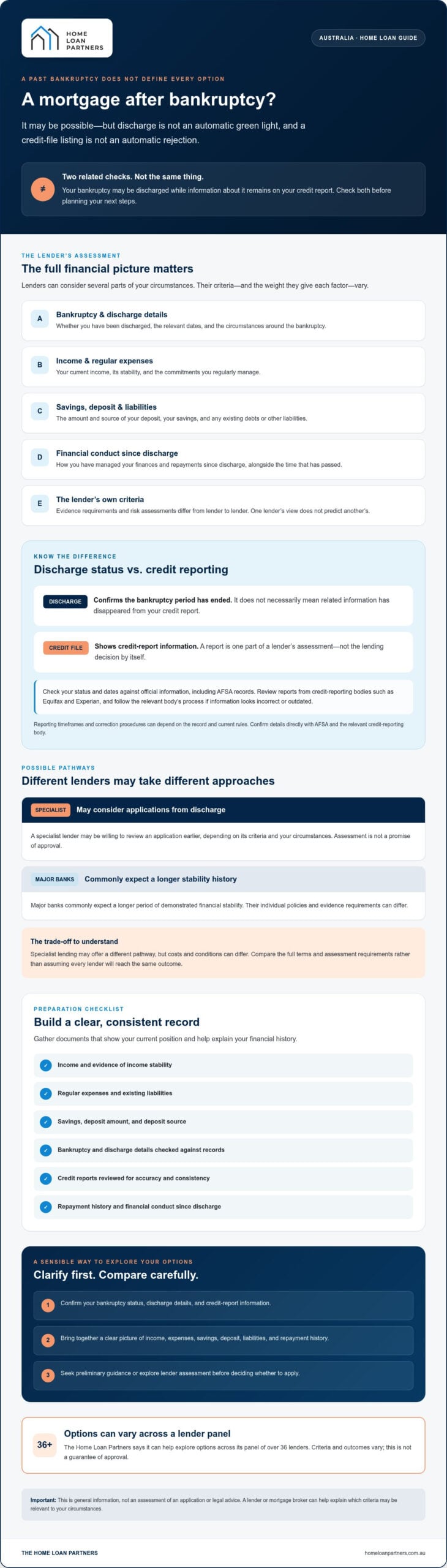
How to prepare a stronger home-loan application after bankruptcy
A clear, well-organised application helps a lender understand your current position and the steps you’ve taken since bankruptcy. You don’t need to hide the past or guess what a lender wants to see. Start with accurate information, then confirm which documents are relevant to the lender being considered.
Which documents and financial details should you organise?
Requirements vary, so ask for the lender’s current document list before lodging an application. Depending on your circumstances, you may need identification, income and employment records, evidence of regular expenses and liabilities, savings history, and documents showing where your deposit came from. Keep any available bankruptcy and discharge records ready in case they’re relevant to the lender’s assessment.
A practical preparation sequence
- Check your records. Confirm your bankruptcy and discharge details, then review your credit information for inconsistencies that may need attention.
- Gather income evidence. Organise recent payslips or other relevant records that show your income and employment situation. If your income varies, ask what evidence may help explain it.
- Map your regular expenses and liabilities. Prepare a realistic picture of household spending, existing credit commitments and other debts. Make sure the figures reflect your current circumstances.
- Document savings and your deposit. Keep statements and other relevant records together so you can explain your savings pattern and the source of the funds.
- Explain relevant changes clearly. If your circumstances have changed since bankruptcy, describe what changed and when. Keep the explanation accurate and consistent with your records; don’t minimise or speculate about details.
- Discuss lender fit before applying. Check what evidence a lender may require and whether its criteria appear relevant to your situation. Confirm any lender-specific requirements before lodging an application.
How can a broker help you prepare before applying?
A mortgage broker can discuss your circumstances, help you organise the information needed to understand your position, and explore lender criteria that may be relevant. A broker can guide you, but can’t override lender policy or promise approval. For more context on working with a broker, read this Australian finance broker guide.
These steps can make getting a mortgage with a past bankruptcy a more considered process, even though lender requirements and assessments differ. The Home Loan Partners can help you explore lender fit and prepare for the next step when you’re ready.
Your next steps towards a mortgage after bankruptcy
There’s no need to rush straight into an application. A steady plan can help you understand your position, identify what needs attention and decide whether the next step feels right. Getting a mortgage with a past bankruptcy depends on your circumstances and current lender criteria, so treat early discussions as a way to explore possibilities, not a promise of approval.
A practical next-step plan is to:
- Check your records: confirm your bankruptcy and discharge details, then review any relevant credit-report information.
- Assess your readiness: consider whether your income, regular expenses, liabilities, savings and deposit are clearly documented and manageable.
- Compare possible pathways: ask about relevant lender criteria, required evidence and any trade-offs before moving forward.
- Decide whether to apply: proceed only when you understand the requirements and are comfortable with the next step. You can also choose to prepare further first.
What happens in an initial mortgage conversation?
An initial conversation is an opportunity to discuss your home-buying goals, current finances, bankruptcy and discharge status, and preferred timing. Its purpose is to understand your circumstances and explore potential pathways, not to promise an outcome or commit you to applying. Prepare questions and relevant records to make the discussion more useful, such as income details, a summary of expenses and liabilities, savings information, and any available bankruptcy or discharge documents.
The Home Loan Partners can help you explore options across a panel of over 36 lenders and understand which criteria may be relevant to your situation. Lender policies differ, and available options depend on both your circumstances and the criteria in effect when you enquire. A conversation can clarify what may be worth investigating, but only the lender can assess an application under its own policies.
How do you move from preparation to a considered application?
Before applying, make sure you understand which documents the lender expects, how it may assess your circumstances and what the application process involves. Ask about anything that’s unclear, then take time to decide whether to proceed or continue preparing. If you’re also planning the broader purchase, this Australian home-buying step-by-step guide can help you consider the journey beyond finance.
When you’re ready, discuss your home-loan options with our team. You can talk through your situation and possible next steps at a pace that feels comfortable, without assuming you need to apply immediately.
Take your next step with a clear plan
Getting a mortgage with a past bankruptcy starts with understanding your current position, not assuming the answer is yes or no. Confirm your bankruptcy and discharge details, then review your credit information separately. Discharge doesn’t guarantee a loan, and a credit-file entry alone doesn’t tell you how every lender will assess you.
Before applying, take stock of your income, expenses, liabilities, savings and deposit evidence. Comparing lender criteria and preparing clear, consistent documents can help you decide whether to proceed now or strengthen your position first. Your circumstances and each lender’s requirements will shape the options available.
The Home Loan Partners offers personalised guidance to borrowers across Australia and access to a panel of over 36 lenders. A conversation can help you explore relevant criteria and possible next steps without assuming you’re ready to apply. Talk through your home-loan options with our team when you’re ready. You can move forward at a pace that feels right.
Frequently Asked Questions
Can I get a mortgage in Australia after bankruptcy?
It may be possible, but bankruptcy doesn’t automatically mean a home loan will be approved or declined. Lenders can consider your discharge status, income, expenses, liabilities, savings, deposit and credit history, as well as their own criteria. Getting a mortgage with a past bankruptcy is an individual assessment, not a guaranteed outcome. Before applying, check your records and ask what evidence a lender may need to understand your current financial position.
How long after bankruptcy can I apply for a home loan?
There’s no single waiting period that applies to every lender. Some specialist lenders may consider an application from the date of discharge, while major banks commonly expect a longer period, often at least two years after discharge. These are broad indications, not universal rules. Confirm current eligibility criteria directly or with a broker before applying, and consider whether your income, savings and repayment history are ready to support an application.
Does bankruptcy stay on your credit report after discharge?
It can. Discharge ends the bankruptcy period, but it doesn’t necessarily remove the listing from your credit report. Under current Australian reporting timeframes, a bankruptcy listing generally remains for five years from the bankruptcy date or two years from discharge, whichever is later. Check the current rules with the relevant credit-reporting body and review your own report. A credit-file listing and a lender’s assessment are related, but they’re not the same decision.
Will every lender reject a home-loan application after bankruptcy?
No. Lenders have different policies, evidence requirements and approaches to assessing risk, so one lender’s response doesn’t establish what every lender will decide. Some specialist lenders may consider applications after discharge, while others may require more time or evidence of financial stability. Acceptance is never assured. Before lodging an application, ask how the lender treats discharged bankruptcy, what information it needs, and whether an initial enquiry differs from a formal application.
What documents do lenders ask for after bankruptcy?
Document lists vary, but a lender may ask for identification, income and employment evidence, details of regular expenses and liabilities, savings statements, and records showing the source of your deposit. Available bankruptcy and discharge documents may also be relevant. Keep your information accurate and consistent, including any explanation of changes since bankruptcy. Ask the lender or broker for its current requirements before lodging an application, so you can prepare the right records.
Can a mortgage broker help me apply after bankruptcy?
Yes. A mortgage broker can discuss your circumstances, help you understand lender criteria and identify information that may be needed before you decide whether to apply. The Home Loan Partners offers personalised guidance and access to a panel of over 36 lenders. A broker isn’t the lender and can’t override lender policy or promise approval. Ask how the broker will compare options and explain the requirements and trade-offs relevant to your situation.
Should I check my credit report before applying for a home loan?
Yes. Reviewing your report before applying can help you spot incorrect personal details, outdated entries or information that doesn’t match your records. Check reports from relevant credit-reporting bodies, such as Equifax and Experian, and follow their current process if you need to query an entry. Also confirm your bankruptcy and discharge details through appropriate official records. Addressing discrepancies early can help you discuss your circumstances with a clearer picture.