

Treating your mortgage as an all-or-nothing choice between fixed and variable rates is one of the easiest ways to lose sleep over shifting economic conditions. Far from an indecisive compromise, splitting your debt serves as an intentional hedging strategy. Understanding the real split home loan pros and cons will help you determine whether setting up two distinct loan accounts is genuinely worth the extra administration and potential account fees.
It’s completely natural to feel torn between the steady reassurance of locked-in repayments and the freedom of an offset account that keeps your cash accessible. When rate movements create uncertainty for your monthly household budget, wanting predictable expenses without forfeiting the ability to make unlimited extra repayments makes total sense.
This 2026 guide breaks down how split facilities operate day to day, weighs the clear trade-offs against the advantages, and helps you identify the right balance for your financial position. We’ll walk you through the essential mechanics so you can design a loan structure that supports your property goals with lasting confidence.
Key Takeaways
- Discover how dividing your mortgage into separate sub-accounts functions as an intentional hedging strategy against unpredictable rate cycles.
- Carefully weighing the split home loan pros and cons allows you to enjoy predictable budgeting without sacrificing offset account savings or extra repayments.
- Unpack the real trade-offs before committing, from fixed-rate break fees and repayment caps to potential dual account fees.
- Move beyond the default 50/50 split by using a practical four-step process to tailor loan proportions to your specific income and savings habits.
- Learn how lender policies vary widely regarding multiple offset features, and why broad market access prevents restrictive loan traps.
What Is a Split Home Loan and How Does It Work in Australia?
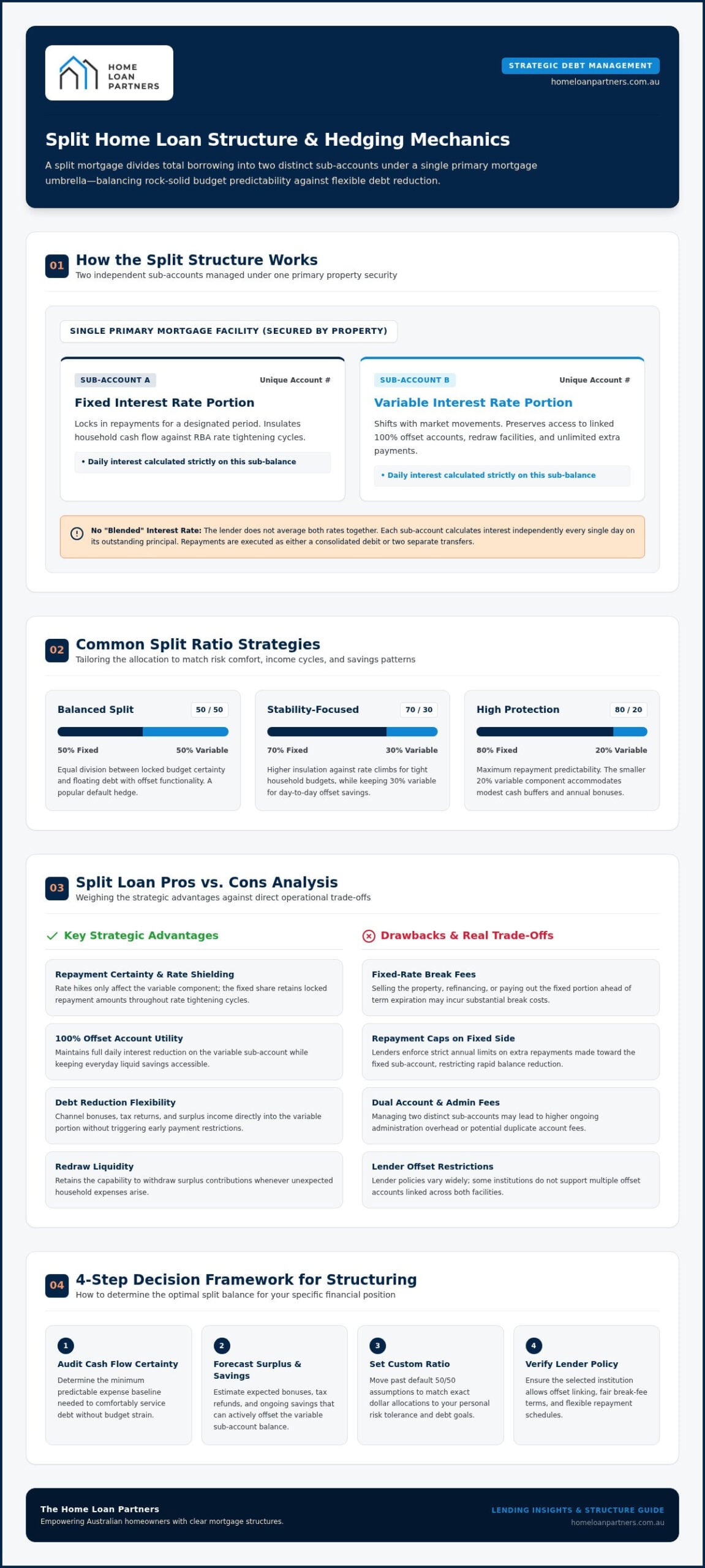
A split home loan divides your total borrowing into two distinct sub-accounts managed under a single primary mortgage umbrella. Rather than committing entirely to one pricing structure, you determine the exact proportion allocated to a fixed interest rate versus a variable rate. Borrowers frequently tailor these portions to match their risk comfort, choosing arrangements like 50/50, 70/30, or 80/20. Understanding what is a mortgage split requires looking beyond basic product labels; it isn’t a complex third product category. Instead, it is an intentional strategy that balances rock-solid budget predictability against flexible debt reduction. Evaluating the split home loan pros and cons starts with exploring how these twin accounts operate side by side.
The Mechanics of Dividing Your Mortgage
When your lender sets up a split structure, they assign individual account numbers to each portion of your debt. Even though both balances share the same underlying security over your property, they function as independent facilities. Depending on the lender, your repayments might be deducted as a single consolidated monthly debit or through two separate transfers. Because each portion maintains separate loan terms and conditions, you have the flexibility to align different repayment schedules to your income cycle without disrupting either balance.
Fixed vs Variable Portions: The Core Differences
Each half of your loan serves a targeted financial purpose. The fixed portion locks in your repayment amounts for a designated period, granting complete stability if benchmark rates climb. Meanwhile, the variable portion shifts alongside market trends. This floating side preserves access to valuable loan features, such as linked offset accounts, redraw capabilities, and fee-free lump-sum payments.
A frequent borrower misconception involves thinking the bank averages both accounts into a single “blended” interest rate. In reality, each sub-account calculates interest independently on its remaining principal each day. You never pay a blended figure; you simply manage two distinct rates across two separate balances. Examining these split home loan pros and cons ensures your mortgage design accurately reflects your everyday cash flow.
The Major Advantages of Splitting Your Home Loan
Adopting a dual-component mortgage creates an intentional financial buffer against shifting economic cycles. Rather than trying to predict cash rate movements, you establish a resilient foundation that supports both stability and growth. When weighing split home loan pros and cons, the most compelling upside is how effectively this strategy balances peace of mind with everyday utility, giving you control over your household balance sheet.
Repayment Certainty and Rate Protection
Fixing a dedicated segment of your debt provides absolute repayment certainty. If the Reserve Bank of Australia enters a tightening cycle, the fixed share remains completely unaffected. This arrangement cushions your household cash flow, ensuring any rate increases apply only to the variable portion rather than your total debt. For risk-averse borrowers, establishing this predictable baseline removes the constant stress of fluctuating living expenses and keeps essential living costs manageable.
Retaining Key Variable Loan Features and Offset Accounts
A completely fixed loan often restricts how quickly you can pay off principal. In contrast, maintaining a variable component preserves high-value loan functionality:
- 100% Offset Accounts: Linking your everyday savings to the variable sub-account reduces daily interest accrual while keeping funds accessible.
- Repayment Flexibility: You can channel bonuses, tax returns, or surplus income straight into the variable portion without triggering early payment fees.
- Redraw Capabilities: You retain the security of withdrawing extra contributions whenever unexpected expenses arise.
For existing property owners, understanding what does refinancing a home loan mean provides practical clarity on converting a standard loan into a versatile split facility. Recent lending insights highlight that Australian households increasingly favor this combination to hedge against rate uncertainty while protecting lifestyle liquidity. When tailoring your finances toward major milestones, partnering with The Home Loan Partners can help structure your debt proportions to suit your exact lifestyle and future targets.
The Potential Drawbacks and Hidden Risks of Split Loans
Balancing certainty against flexibility sounds ideal on paper, but splitting debt introduces specific trade-offs that deserve clear scrutiny. If market interest rates decrease substantially, you remain tied to a fixed rate on that portion of the balance, missing out on potential interest savings. Fully grasping the split home loan pros and cons requires an unvarnished look at the exit penalties, operational friction, and added costs that some institutions quietly attach to multi-part structures.
Economic Break Costs and Reduced Flexibility
Lenders enforce strict rules around the fixed portion of your split arrangement. If you sell your property, refinance to another provider, or attempt to pay out the debt before the fixed term expires, you could face economic break costs. Banks calculate these penalties by comparing original wholesale money-market rates with current wholesale yields across your remaining term and balance. If wholesale rates drop significantly after you fix, those exit fees can climb into thousands of dollars.
Fixed sub-accounts also restrict aggressive debt reduction. Most Australian lenders place tight caps on extra lump-sum repayments during the fixed period, often limiting surplus contributions to between $10,000 and $30,000 across the entire fixed term or per year. Breaching these thresholds can inadvertently trigger costly early payment adjustments, undermining your debt reduction strategy during major career or life transitions.
Administrative Fees and Management Complexity
Operating dual loan accounts inevitably increases administrative oversight. Rather than reviewing one transaction trail, you must track two separate statements, balance schedules, and direct debits every month. This split structure can also invite unexpected charges:
- Duplicated Account Fees: Basic loan products often levy monthly service fees against each individual sub-account, silently doubling your ongoing account maintenance expenses.
- Rate Lock Expenses: Securing your chosen fixed rate during the application window can incur upfront administration charges, depending on lender policy.
- Restricted Offset Linking: Several lenders only permit a 100% offset facility against the variable portion, while others charge extra account maintenance fees to connect multiple accounts.
To keep costs contained, many borrowers utilize packaged loan facilities that bundle multiple accounts under one consolidated annual fee. Reviewing these split home loan pros and cons with your advisor ensures administrative fees never erode your rate savings.
How to Choose the Right Split Ratio for Your Circumstances
Defaulting to a 50/50 division is a common instinct, but your mortgage should mirror your actual spending, earning, and saving patterns. Rather than picking arbitrary round numbers, an effective split aligns directly with your cash flow realities. Weighing the split home loan pros and cons becomes far more practical once you run the numbers through a structured personal assessment.
Matching Your Split to Cash Flow and Surplus Savings
Determining your split comes down to a clear four-step process:
- Step 1: Audit liquid reserves. Calculate the funds you plan to deposit immediately into an offset account to reduce non-deductible interest from day one.
- Step 2: Forecast annual surplus cash. Estimate how much extra capital you can realistically contribute over the next one to three years through regular savings, bonuses, or commissions.
- Step 3: Size the variable component. Ensure the variable portion equals at least the sum of your liquid reserves plus your projected extra repayments. Sizing it smaller means your spare cash sits idle without offsetting interest.
- Step 4: Protect your baseline budget. Allocate the remaining debt to a fixed rate to establish your absolute non-negotiable living threshold.
Modelling different interest scenarios through an interactive home loan calculator allows you to see how shifting these proportions alters your monthly commitments under varying rate conditions.
Common Split Allocation Scenarios
Different life stages require different loan structures. Here are three tested allocations:
The Balanced Stance (50/50 Split): This setup suits households seeking middle ground. You capture moderate certainty against rate spikes while maintaining enough variable balance to offset everyday income.
The Protection-Led Framework (70/30 or 80/20 Fixed): Ideal for growing families, single-income households, or buyers on strict budgets. Fixing 70% to 80% guarantees that your largest monthly commitment remains completely predictable, leaving a manageable variable slice for emergency liquidity.
The Wealth-Building Strategy (70/30 Variable): Designed for disciplined savers or property investors with substantial liquid capital. Placing 70% in the variable bucket allows an offset facility to cancel out substantial interest charges, while the 30% fixed portion hedges against extreme market shifts.
Assessing these split home loan pros and cons ensures you avoid restrictive setups that hinder your debt reduction goals. To design a tailored split ratio that matches your specific property ambitions, connect with the team at The Home Loan Partners to explore your loan options.
Structuring Your Split Loan: Bank Direct vs. Mortgage Broker Guidance
Approaching a single bank directly for a split mortgage often limits you to one institution’s credit appetite and internal policy manual. If that lender’s product guidelines restrict offset features on split accounts or impose hefty variation fees, you are forced to adapt your plans to their boundaries. Weighing split home loan pros and cons involves not only analyzing interest rate figures, but also evaluating how different credit providers manage dual-account operations behind the scenes.
Why Lender Policies on Split Loans Differ Widely
Credit policies across Australian lenders diverge significantly once you look past headline products. While one institution allows multiple 100% offset accounts linked across both split facilities, another may strictly restrict offset functionality to the variable sub-account alone. Fee models also fluctuate dramatically between institutions:
- Rate Lock Terms: Some lenders charge flat administrative fees to guarantee a fixed rate during assessment, while others calculate this as a percentage of your total approved borrowing.
- Account Variation Costs: Modifying your split ratio mid-loan can incur administrative costs at certain retail banks, whereas others process balance reallocations without penalties.
- Package Rules: Certain lenders mandate high annual package fees to maintain dual sub-accounts, while boutique lenders provide clean fee-free structures.
Consulting our comprehensive guide on hiring a finance broker reveals how expert representation protects your portfolio from restrictive lending fine print.
Navigating Your Loan Structure with Ongoing Professional Support
Working with an accredited broker turns loan selection into an objective, data-led collaboration. Rather than fitting your finances into a single bank’s pre-packaged template, an experienced broker scans a wide panel of over 36 bank and non-bank lenders. This extensive market reach helps identify institutions whose split rules match your specific income cycle and savings patterns.
Your mortgage journey also doesn’t end at settlement. When a fixed-rate term concludes after two, three, or five years, that portion automatically rolls onto the bank’s standard variable reference rate. A dedicated broker conducts regular post-settlement reviews well before this expiration occurs. This ongoing support ensures you can renegotiate competitive terms, reset your split ratios, or execute refinancing strategies that reflect your evolving household milestones.
Structuring Your Mortgage for Long-Term Confidence
Splitting your mortgage isn’t about outsmarting the cash rate cycle; it’s about building a dependable framework that safeguards your everyday lifestyle. By evaluating the split home loan pros and cons against your unique cash flow, you can secure predictable repayments without losing the flexibility of offset accounts and fee-free extra contributions.
You don’t have to navigate these complex lending policies on your own. The Home Loan Partners acts as your dedicated advocate, accessing a panel of over 36 bank and non-bank Australian lenders to identify loan features that genuinely support your goals. We design tailored mortgage structures built around your individual property ambitions, managing lender negotiations, handling all paperwork, and conducting post-settlement reviews as your financial journey evolves.
Ready to establish a well-balanced loan structure? Explore your split loan options with our accredited mortgage team and move forward with absolute clarity and peace of mind.
Frequently Asked Questions
Can I change my split ratio after my home loan has settled?
Yes, you can adjust your loan split ratio post-settlement, but the process depends heavily on your current loan terms. Altering the variable portion is generally straightforward. In contrast, changing or reducing the fixed balance before the agreed term expires can trigger lender break costs and loan variation administration fees. Most lenders require a formal loan variation request to redistribute the balances across your accounts.
Can I attach an offset account to both the fixed and variable portions of a split loan?
Typically, Australian lenders only permit full 100% offset accounts against the variable portion of a split facility. While a handful of non-bank and specialist lenders offer offset functionality on fixed accounts, they often apply partial offset calculations or charge extra package fees. When reviewing split home loan pros and cons, pairing your offset exclusively with the floating component usually delivers the cleanest interest-saving outcome.
What happens when the fixed-rate portion of my split loan expires?
When your fixed term concludes, that specific sub-account automatically reverts to your lender’s standard reference variable rate. At that point, you gain total freedom over that portion without the risk of early exit penalties. You can choose to refix that portion for another term, combine it with your existing variable balance, or explore refinancing the entire debt facility across another lender on our panel.
Are split home loans more expensive due to extra account fees?
Split facilities can become more expensive if your credit provider charges separate monthly maintenance or establishment fees for each sub-account. You can easily avoid these redundant charges by selecting a packaged loan structure or working with lenders that provide complimentary split sub-accounts. Assessing fee structures upfront prevents unexpected account maintenance costs from quietly eroding your interest savings over time.
Can I make extra repayments on the fixed portion of my split mortgage?
You can make extra repayments on a fixed sub-account, but banks impose strict annual thresholds. Major Australian lenders typically cap surplus fixed payments between $10,000 and $30,000 over the fixed duration or per year. Paying above those designated limits triggers economic break penalties. If you expect lump-sum windfalls, allocating a higher ratio to the unrestricted variable split ensures you can pay down principal freely.
Is a split home loan suitable for an investment property?
Splitting an investment loan can be a powerful risk management tool for property portfolios. It locks in dependable interest deduction numbers on the fixed component, simplifying your rental yield and cash flow forecasting. Concurrently, retaining a variable component gives you room to link offset funds from rental income or make rapid principal deductions without rigid contractual restrictions, balancing tax planning with balance sheet flexibility.
How many times can I split my home loan with an Australian lender?
Most Australian lenders permit borrowers to divide their borrowing into two sub-accounts, but several major banks allow up to four or five distinct splits. Multiple splits let you stagger various fixed terms, such as running a two-year and a five-year fixed portion alongside a variable balance. Evaluating these detailed split home loan pros and cons ensures you don’t overcomplicate your banking without clear financial justification.