

Did you know that bank valuations in Australia are often 3% to 8% lower than the actual market price you’ve agreed to pay? It’s a heart-sinking moment when you realize your dream home might slip away because of a technical report that feels disconnected from reality. If you’re feeling the intense pressure of a looming settlement date while staring at a funding shortfall, learning how to challenge a low bank valuation australia is your most critical next step.
We understand the stress of facing a potential loss of your deposit just as you’re ready to start your next chapter. It’s a complex situation, but you don’t have to navigate these technical hurdles alone. This guide outlines the exact steps to dispute an undervalued property and explores the strategic alternatives that can save your loan approval. We’ll preview the data-heavy dispute process, explain how to interpret valuation reports, and show you how a tactical pivot to a different lender can bridge the gap to secure your home.
Key Takeaways
- Understand the “shortfall” between your contract price and the bank’s assessment to protect your deposit and keep your home loan approval on track.
- Learn how to identify common data errors and misaligned comparable sales within a valuation report that may be unfairly impacting your property’s worth.
- Master the “3 Comparables” rule and the specific technical steps for how to challenge a low bank valuation australia to improve your chances of a successful dispute.
- Discover “valuation shopping” strategies that leverage access to over 36 lenders to find more favorable assessments when a formal challenge isn’t successful.
- Explore how ordering upfront valuations and using a data-driven approach can help you bypass settlement stress and secure your property with confidence.
What Is a Low Bank Valuation and Why Does It Happen?
It’s a common misconception that the price you agree to pay for a home is its definitive market value. In the eyes of a lender, the contract price is simply a starting point. A low bank valuation occurs when a professional valuer assesses the property at a figure lower than your purchase price. This discrepancy creates what we call a “shortfall.” This is the gap between the amount you planned to borrow and the amount the bank is actually willing to lend based on their Loan-to-Value Ratio (LVR) limits.
To help navigate these complexities and secure a property at the right price, many buyers choose to visit Anna O’Neill Buyer’s Agent for expert advice on market value and acquisition strategy.
Understanding the real estate appraisal process is vital because it highlights that banks view property as collateral first and a home second. Their primary goal is risk mitigation. Throughout 2026, banks have become increasingly conservative. With the RBA cash rate holding at 4.35% as of August and significant tax changes affecting investment properties, lenders are hyper-focused on ensuring they don’t over-leverage. If you’re caught in this situation, knowing how to challenge a low bank valuation australia becomes a priority to keep your purchase on track.
Lenders use various methods to determine value, and the type of valuation ordered can impact the result. These include:
- Full Physical Valuation: A valuer visits the property in person to inspect its condition and features.
- Desktop Valuation: A valuer uses online data and photos without visiting the site.
- Automated Valuation Model (AVM): An algorithm generates a value based on historical data and local trends.
Common Reasons for an Undervalued Property
Valuers rely heavily on hard evidence. If your neighborhood hasn’t seen many sales in the last three months, they may use older, lower-priced data that doesn’t reflect current demand. Specialized property features, like high-end sustainable upgrades or unique architectural layouts, often fail to show up in standard “comparable sales.” For a professional perspective on how local experts highlight these unique value drivers, you can visit Ollie James Real Estate to see their approach to property marketing. Additionally, during market cooling periods, valuer sentiment often turns cautious to protect the bank against potential future price drops.
The Mathematical Reality: How a Shortfall Affects Your Loan
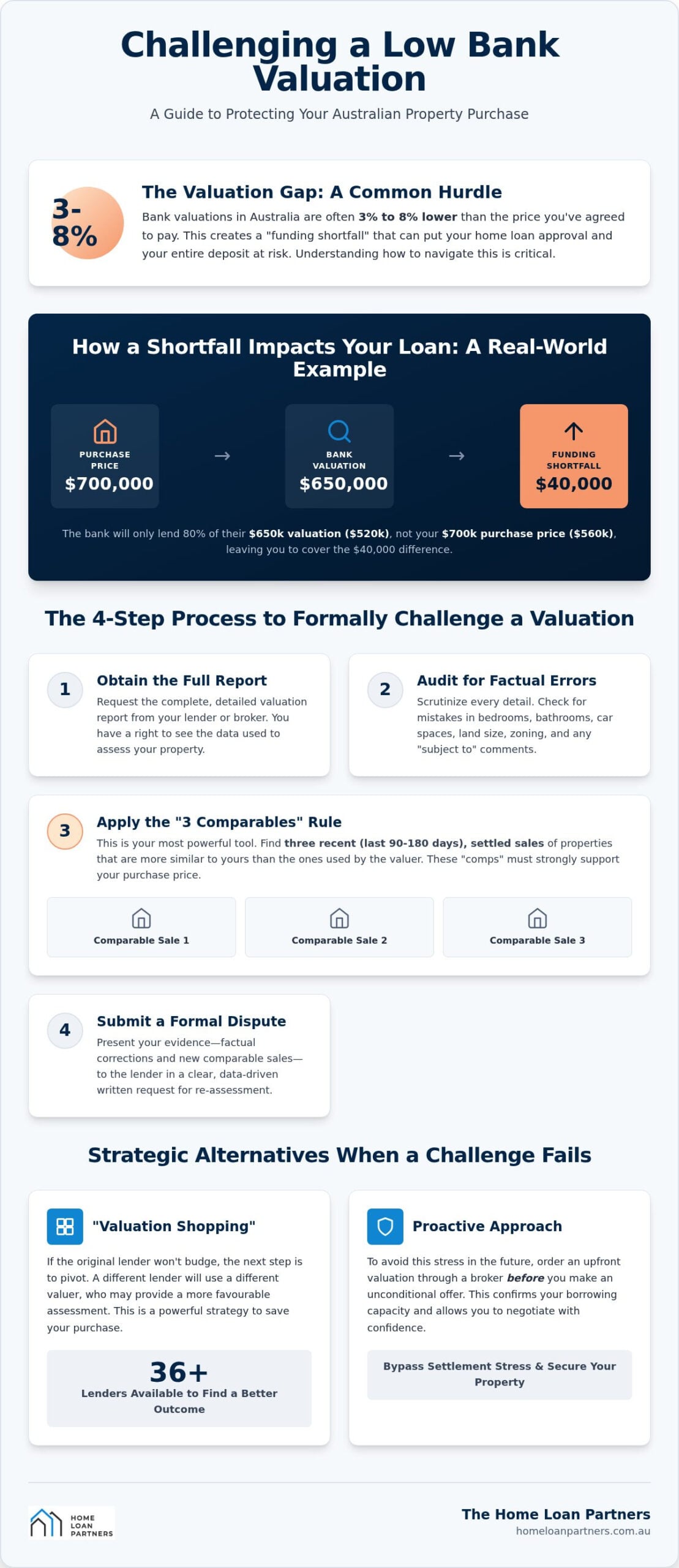
Let’s look at a practical example. Imagine you purchase a property for $700,000 and plan to borrow 80% ($560,000). If the bank valuation comes back at $650,000, they will only lend you 80% of that lower figure, which is $520,000. You now face a $40,000 shortfall that you must cover from your own savings. If you can’t find the extra cash, you might have to increase your LVR, which could trigger Lenders Mortgage Insurance (LMI) costs. With home loan fees rising by 17% in the 2024-2025 financial year, these extra expenses can significantly strain your budget.
How to Identify Errors in Your Property Valuation Report
Finding out your property has been undervalued is frustrating, but the report itself often contains the clues you need to fix it. Valuers are highly trained professionals, yet they are human and work under tight deadlines. Data entry errors are more common than you might expect, especially when dealing with high-volume desktop or automated assessments. Before you decide how to challenge a low bank valuation australia, you must treat the report like a legal document and audit every single detail for accuracy.
Small mistakes can have a massive impact on the final figure. If a valuer misses a recent renovation or miscalculates the internal floor area, the bank’s risk assessment will be skewed. It’s your right to see this report, and you should review it with a critical eye to ensure your property is being judged on its true merits rather than a clerical slip-up.
Technical Checklist for Valuation Reports
Start with the basics. Does the report accurately reflect the number of bedrooms, bathrooms, and car spaces? A missing ensuite or a garage listed as a carport can strip tens of thousands from the final figure. Zoning is another critical area to verify. If a valuer incorrectly classifies a residential property as mixed-use, they might be inadvertently limiting the perceived buyer pool in their analysis. Also, look for “subject to” comments. Valuers sometimes make assumptions about unfinished renovations or structural issues that don’t actually exist. If you feel the bank has been unfair and won’t correct obvious factual errors, you can eventually escalate the matter to the Australian Financial Complaints Authority (AFCA), though checking the data first is always the best path.
Assessing the Quality of Comparable Sales
The most common reason for a low valuation is the selection of poor comparable sales. A valid comparable is a settled sale of a similar property within the last 90 to 180 days. If the report uses sales older than six months, they are likely outdated, especially given the market shifts we’ve seen throughout 2026. Check the radius of these sales; ideally, they should be within 1km to 5km of your property. If the valuer picked a home 10km away in a different school catchment, that’s a material error. You should also ensure the comparables share similar land size and topography. A flat 600sqm block isn’t the same as a 600sqm block on a steep incline. If you’re feeling overwhelmed by the technical jargon in your report, our expert brokers can help you review the data to spot these discrepancies.
The Step-by-Step Process to Formally Challenge a Valuation
If you’ve identified factual errors or missed data in your report, the next stage is a formal dispute. It’s important to be realistic about this process. Industry data from sources like ValEx suggests the success rate for overturning a valuation is less than 5%. While this sounds daunting, a well-structured case backed by hard data gives you the best fighting chance to bridge the gap. Knowing how to challenge a low bank valuation australia effectively requires a shift from emotional attachment to clinical, data-driven evidence.
Most Australian banks have a strict “one challenge” policy per application. You don’t get multiple attempts to convince a valuer, so your submission must be perfect the first time. The industry standard for a dispute is the “3 Comparables” rule. This requires you to provide three superior settled sales that the original valuer didn’t include in their assessment. Once your broker submits the formal “Valuation Dispute Form,” the turnaround is usually quite fast. You can typically expect a response within 24 to 48 hours, which is vital when you’re racing against a settlement deadline.
Selecting the Right Comparables for Your Dispute
The biggest mistake buyers make is using “asking prices” or properties currently “under offer” as evidence. Valuers only consider settled sales where the final price is a matter of public record. You’ll need to use property data tools to find sales the valuer might have overlooked, focusing specifically on properties sold within the last 90 to 180 days. Your goal is to prove superiority. If the valuer used a comparable with an original 1980s kitchen and yours was renovated last year, that is a material fact that justifies a higher price point. Working with local real estate professionals, such as The Agency Coffs Coast, can provide the necessary market intelligence to find these specific, high-value comparables.
Constructing a Professional Argument
When writing your dispute, leave emotions at the door. Telling a valuer that you “love the feel of the home” won’t move the needle. Instead, focus on material facts like specific land size differences, superior zoning, or high-end finishes like solar systems and premium stone benchtops. A mortgage broker Greenwich NSW specializes in presenting this data in a way that lenders respect. We handle the technical paperwork and ensure your argument is framed around the lender’s specific risk policies rather than just your purchase price.
Strategic Alternatives: When a Challenge Isn’t Successful
While learning how to challenge a low bank valuation australia is the logical first step, the reality is that many formal disputes don’t result in a higher figure. If the valuer stands by their original assessment, it isn’t the end of your home ownership journey. It simply means we need to pivot to a more flexible strategy. This is where “valuation shopping” becomes your most powerful tool to save your settlement. Because every lender has a different risk appetite, one bank’s “low” valuation might be another bank’s “fair” market price.
You don’t have to accept a single opinion as the final word on your property’s worth. Our role is to act as your steady guide through these hurdles, navigating the technical requirements of different lenders to find a path forward. By looking beyond the initial rejection, we can often find a solution that keeps your deposit safe and your property goals within reach.
Why Different Lenders Get Different Valuations
It might seem strange that two different banks can look at the same house and see two different prices. This happens because lenders use different valuation firms, and each firm has its own internal data sets and risk appetite. Bank A might use a valuer who is hyper-conservative about your specific suburb, while Bank B uses a firm with a more optimistic outlook on local growth. An experienced finance broker can order multiple upfront valuations from different lenders simultaneously. This proactive approach allows us to find the most “valuation-friendly” lender before you even submit a full application, effectively bypassing the shortfall trap entirely.
Covering the Shortfall: Practical Financial Moves
If switching lenders isn’t the right move for your situation, there are several ways to bridge the equity gap. You might use the low valuation as a negotiation tool with the vendor. If a professional valuer says the home is worth $50,000 less than the contract price, the vendor may be willing to lower their expectations to ensure the sale proceeds. Alternatively, you can explore a Family Guarantee. This allows a family member to use their own property equity to secure the shortfall, which removes the need for you to find a larger cash deposit. For some, the “LMI pivot” is the most efficient path. By paying Lenders Mortgage Insurance, you can borrow a higher percentage of the bank’s lower value, which may cover the contract price without requiring you to dip further into your savings. If you’re facing a shortfall right now, contact our team to explore your alternative lending options.
How The Home Loan Partners Navigate Valuation Hurdles
At The Home Loan Partners, we don’t wait for a crisis to happen; we work to prevent it. Our proactive strategy involves ordering upfront valuations before you even commit to a specific lender. This allows us to see how different firms view your property’s worth in real-time, removing the guesswork and protecting your deposit from the start. If a report does come back lower than expected, we step in as your expert collaborator to manage the technical heavy lifting. We handle the data-heavy research and the complex paperwork required for a formal dispute, ensuring you have a clear understanding of how to challenge a low bank valuation australia with the best possible evidence.
With access to a panel of over 36 lenders, we have the flexibility to pivot if one bank’s policy is too restrictive. This is particularly vital for complex scenarios like bridging finance, where accurate valuations are the linchpin for a smooth transition between homes. We stay by your side throughout the entire journey, providing a steady hand to ensure your loan settles on time and without unnecessary stress.
Your Expert Guide in a Stressful Market
Going direct to a bank often leaves you at the mercy of a single valuer’s opinion. If that one valuation comes in low, your options are limited and the pressure from vendors or agents can become overwhelming. We act as your protective shield, managing the difficult conversations and technical disputes so you can focus on your move. The Home Loan Partners provide national expertise to help you overcome valuation shortfalls. We believe in building long-term relationships, which means our commitment to your financial security continues well after your loan is approved.
Ready to Secure Your Home Loan?
Speed is your greatest asset when a valuation comes in low. With settlement deadlines looming, every hour counts. We invite you to reach out for a complimentary review of your current situation. We’ll look at the data, assess the feasibility of a challenge, and explore alternative lenders that may better suit your property’s unique profile. Don’t let a conservative report derail your plans. Book a consultation with The Home Loan Partners today and let’s secure your path forward together.
Taking Control of Your Property Success
Facing an undervalued property report doesn’t have to be the end of your home ownership aspirations. By auditing your report for technical errors and identifying superior comparable sales, you can build a data-driven case that lenders respect. Remember that a single conservative assessment is often just one firm’s opinion. Strategic alternatives like valuation shopping can reveal a more favorable path forward with a lender whose risk appetite better aligns with your property’s true worth.
Understanding how to challenge a low bank valuation australia gives you the power to advocate for your financial future. You don’t have to carry the heavy lifting of technical disputes alone. With national expert guidance and access to a panel of 36+ Australian lenders, we are specialists in complex loan structures who work to ensure your goals remain on track. We handle the research and the technical paperwork, providing a steady hand to navigate the hurdles of the current market.
Secure your property journey with a partner who fights for your valuation. We are here to provide the expertise and support you need to move forward with absolute confidence and clarity.
Frequently Asked Questions
Can I cancel my property contract if the bank valuation is too low?
You can generally only cancel a contract if it includes a “subject to finance” clause and the low valuation leads to a formal loan rejection. If you’ve signed an unconditional contract, you are legally required to complete the purchase regardless of the bank’s assessment. It’s vital to have your broker order an upfront valuation before you commit to avoid this high-pressure situation and protect your deposit.
How much does it cost to challenge a bank valuation in Australia?
Most lenders don’t charge a specific fee to submit a dispute form, but you might choose to pay for a new independent valuation to support your case. In 2026, a standard residential valuation from an independent valuer typically costs between $350 and $650 plus GST. We help you weigh these costs against the potential benefit of a successful challenge to ensure it’s a sound financial move for your situation.
Will a second valuation from the same bank be different?
It’s very unlikely that a second valuation from the same lender will produce a different result. Most Australian banks rely on a specific panel of valuers and maintain a “one challenge” policy per application. Instead of asking for a re-valuation at the same bank, we often find it’s more effective to pivot to a different lender who uses a different valuation firm with a more favorable risk appetite.
Is a bank valuation the same as a real estate agent’s appraisal?
No, these are two very different documents with entirely different purposes. A real estate agent provides an appraisal as a marketing estimate to attract sellers, while a bank valuation is a formal risk assessment used to protect the lender’s interests. This explains why bank figures are often 3% to 8% lower than the optimistic prices quoted by agents or the figures seen in contract prices.
What happens if I can’t cover the shortfall from a low valuation?
If you can’t bridge the gap with extra savings, you might need to increase your Loan-to-Value Ratio (LVR) and pay Lenders Mortgage Insurance (LMI). Other options include using a Family Guarantee or renegotiating the purchase price with the vendor. Learning how to challenge a low bank valuation australia is another path, though the success rate is historically low, making these financial alternatives essential to your strategy.
Do all lenders use the same property valuers?
Lenders use different panels of valuation firms, which is why results can vary significantly between banks. One bank might use a firm with a conservative outlook on your specific suburb, while another uses a valuer who recognizes the growth potential of your street. This variation is exactly why “valuation shopping” across our panel of 36+ lenders is such a successful strategy for our clients.
How long does a valuation dispute typically take to resolve?
Once we submit a formal “Valuation Dispute Form” with your three comparable sales, the response time is typically 24 to 48 hours. Valuers understand that settlement deadlines are often tight, so they usually prioritize these reviews to provide a quick answer. However, you should factor in the time needed to research and select the right data before we make the formal submission.
Can a low valuation affect my refinancing application?
Yes, a low valuation can significantly impact your ability to refinance by reducing your available equity. If the new valuation pushes your LVR above 80%, you might be hit with LMI costs or find that you no longer qualify for the market’s lowest interest rates. We specialize in navigating these technical hurdles to find lenders who value your property accurately for your refinancing and future security goals.