

For decades, negative gearing in Australia was the ultimate “set and forget” tax strategy; however, as of May 12, 2026, that era has officially ended. You might feel a sense of unease or confusion about how the new grandfathering rules apply to your portfolio, especially with the July 1, 2027, deadline approaching. It’s completely natural to worry about how reduced tax offsets on established homes will affect your cash flow or whether your next move should be a new build or an existing property.
We understand that these legislative shifts can feel overwhelming, but we’re here to act as your reliable guide through this transition. This guide will help you master the 2026 reforms so you can structure your investment loans for maximum tax efficiency and growth. We will explore the specific exemptions for new housing, explain the upcoming changes to capital gains tax, and provide a clear strategy for choosing between property types. By the end, you’ll have the confidence to navigate these complex rules and secure a prosperous long term journey for your investment portfolio.
Key Takeaways
- Understand how the new 2027 restrictions on negative gearing australia apply based on the specific date you signed your property contract.
- Compare the tax benefits of new builds against established properties to decide which path offers the best growth for your unique portfolio.
- Learn how lenders evaluate your surplus income and borrowing power under the updated tax “add-back” rules to plan your next acquisition.
- Discover how a tailored loan structure and access to 36+ lenders can help you maintain financial stability during these legislative shifts.
What is Negative Gearing in Australia? The 2026 Fundamentals
At its core, negative gearing occurs when the annual costs of owning an investment property are higher than the rental income it generates. This results in what experts call a net rental loss. In the context of negative gearing australia, this loss is generally deductible against your other taxable income, such as your salary or business earnings. It’s a strategic tool because it reduces your total tax bill while you hold an asset you expect to appreciate. Essentially, you’re using a short-term cash flow deficit to build long-term wealth.
Interestingly, the specific term “negative gearing” doesn’t actually appear in Australian tax legislation. Instead, the practice relies on general tax principles that allow individuals to claim deductions for expenses incurred in the process of earning assessable income. For a comprehensive overview of negative gearing and its historical context, it’s helpful to see how these rules have evolved within the Australian tax system. It is fundamentally a timing strategy; you accept a current loss with the expectation that future capital growth will eventually outweigh those accumulated costs.
The Role of Deductible Expenses
To understand how a property becomes negatively geared, we need to look at the ongoing costs of ownership. These typically include:
- Loan Interest: This is usually the largest expense for most investors.
- Property Management Fees: Costs paid to agents for managing tenants and rent collection.
- Maintenance and Repairs: Necessary work to keep the property in a tenantable condition.
- Depreciation: A non-cash deduction that accounts for the wear and tear of the building and its fixtures.
While interest and management fees are cash outgoings that leave your bank account, depreciation is unique. It allows you to claim a tax deduction without actually spending money in that specific financial year. Differentiating between these cash expenses and non-cash deductions is vital for your cash flow planning and overall tax efficiency.
Why Investors Choose to Make a Loss
It might seem counterintuitive to intentionally lose money on an investment. However, the strategy relies on the Capital Growth thesis. Investors accept a manageable loss in the short term because they anticipate the property’s value will grow significantly over several years. The goal is for the eventual profit from the sale to far exceed the total of the annual losses incurred during ownership. This long-term journey requires a steady hand and a clear understanding of your financial limits.
The immediate tax benefit acts as a supportive buffer. By reducing your taxable income and overall tax liability, the government effectively offsets a portion of your investment costs. A net loss is simply the financial foundation of this strategy, where your total deductible outgoings exceed your gross rental receipts.
The 2026 Budget Reforms: Navigating the New Rules
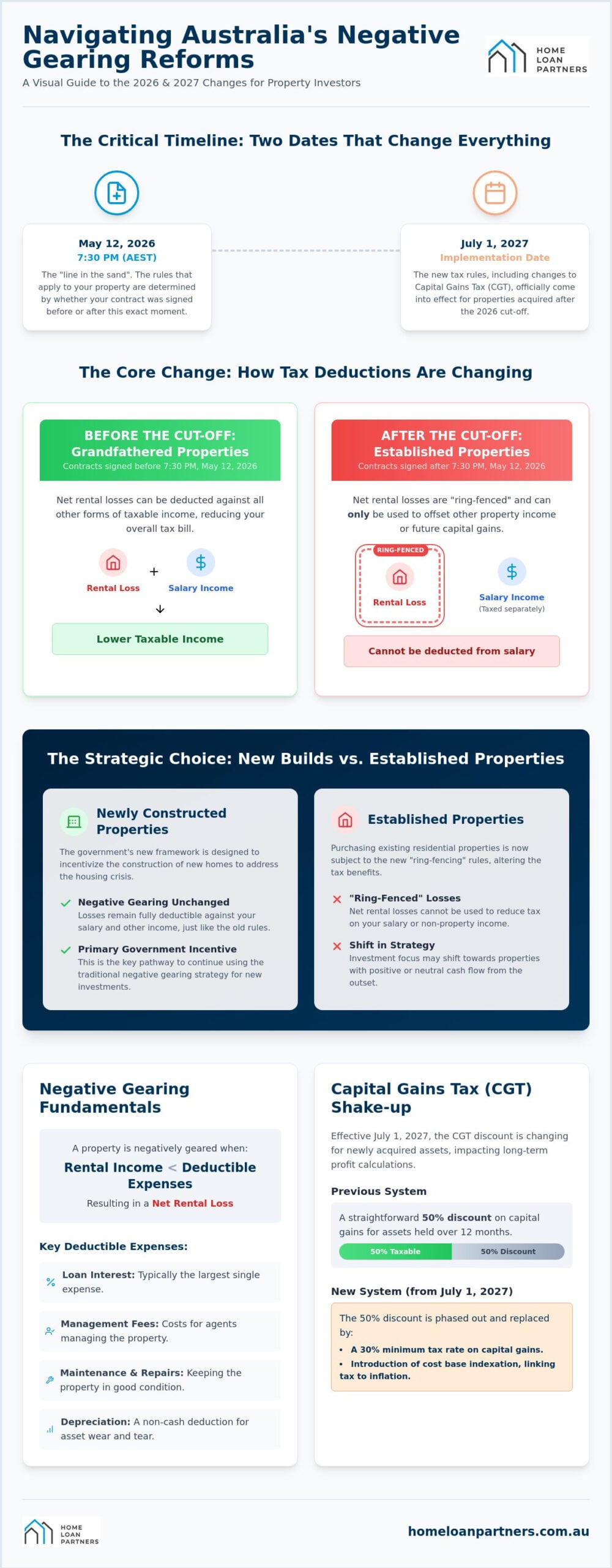
The 2026 Federal Budget introduced the most significant changes to the property investment landscape in a generation. While the headline implementation date is July 1, 2027, the real “line in the sand” occurred much earlier. For many investors, the most critical moment was 7:30 pm (AEST) on May 12, 2026. This specific timestamp determines which rules apply to your property and how your future tax returns will look. It’s the difference between business as usual and a completely new way of managing your portfolio.
The 2026 Budget reforms to negative gearing aim to balance the scales for first home buyers. Alongside these changes, the government introduced the Working Australians Tax Offset, a $250 credit designed to provide modest relief to middle income earners. While this offset helps, the bigger shift involves Capital Gains Tax (CGT). From July 1, 2027, the familiar 50% CGT discount will be phased out for new acquisitions. It’s being replaced by a 30% minimum tax rate and cost base indexation. This means your tax obligations will be tied more closely to actual inflation rather than a flat percentage discount.
The Shift to New Housing Supply
The government’s primary objective is to solve the housing crisis by incentivising new builds. Under the new framework, negative gearing australia remains fully accessible for newly constructed properties. This distinction is vital for your future strategy. If you purchase an established residential property after the May 2026 cutoff, your net rental losses are “ring fenced.” You won’t be able to deduct these losses against your salary. Instead, you can only use them to offset other rental income or future capital gains from residential assets. This change effectively turns established houses into a different asset class for tax purposes.
Grandfathering: Protecting Existing Investors
If you already own an investment property, there’s a significant silver lining. Properties acquired before the Budget night cutoff are “grandfathered.” This means your existing tax arrangements remain unchanged until you sell the asset. You can continue to claim net rental losses against your total income just as you’ve always done. A common concern for our clients is whether refinancing an investment property loan will void this grandfathered status. Generally, switching lenders to secure a better rate doesn’t trigger the new rules; provided the purpose of the loan remains the same and you don’t increase the debt for non investment purposes. It’s about maintaining your current position while optimising your costs.
New Builds vs. Established Property: A Strategic Comparison
Choosing between a brand new construction and a classic established home has always been a primary debate for investors. Now, the 2026 reforms have added a layer of tax complexity that fundamentally changes the math. For any property purchased after the May 2026 cutoff, your choice of asset type dictates how you can interact with negative gearing australia. It is no longer just a matter of maintenance costs or tenant appeal; it is about which income stream you are allowed to offset your losses against.
The core difference lies in the “ring fencing” of losses. If you purchase an established home today, you can no longer use its net rental losses to reduce the tax you pay on your salary or wages. Instead, these losses are carried forward. They remain on your “books” until you either generate a profit from another residential rental property or sell an asset and trigger a capital gain. While this delay might impact your weekly cash flow, it doesn’t mean the tax benefit is gone; it’s simply deferred to a later stage of your investment journey.
Investing in New Builds After July 2027
New builds remain the only pathway for investors to deduct rental losses directly against their personal salary and wages. This ongoing exemption makes new construction a powerful tool for high income earners looking to manage their tax liability. However, this strategy comes with specific risks. Construction delays can push out your move-in date, and valuation gaps sometimes appear between the contract price and the bank’s final assessment. Off-the-plan purchases require a steady hand and specific finance expertise to ensure your loan remains secure from the initial deposit through to the final settlement.
The Future of Established Property Investment
Established properties still offer significant value, but the strategy has shifted toward portfolio balance. If you own multiple properties, the losses from a newer established purchase can still be used to offset the positive “residential property income” from your older, debt-free assets. This makes established homes a viable choice for seasoned investors with existing cash flow. You should also consider your exit strategy; the new 30% minimum tax on capital gains means that carrying forward your losses to offset that final bill is more important than ever. To maximise your net returns when divesting, utilizing a commission-free marketing platform like Kincade International Direct Sales can help you retain more of your equity. We help you look at the long term horizon to ensure your portfolio remains resilient, regardless of which property type you choose.
How Negative Gearing Affects Your Borrowing Power
When you apply for an investment loan, lenders don’t just look at the rent hitting your bank account. They perform a deep dive into your “serviceability,” which is a bank’s way of measuring whether you can comfortably afford your mortgage repayments. For years, negative gearing australia has acted as a secret weapon for borrowing power. Lenders have traditionally used “tax add-backs” to boost your income profile. By factoring in the tax refund you receive from your rental losses, banks see you as having more surplus income, which often allows you to borrow more than a standard income assessment would suggest.
The 2027 rules introduce a significant hurdle for this calculation. If you purchase an established property after the May 2026 cutoff, your losses are ring-fenced and cannot be deducted against your salary. Because you aren’t receiving that immediate tax relief in your weekly or monthly pay, many lenders will likely stop “adding back” those tax benefits into your serviceability assessment. This shift means that a loss that isn’t tax-deductible against your wages could directly lower your total borrowing capacity. Professional loan structuring is now the most vital tool in your kit to ensure you don’t hit a financing ceiling prematurely, and exploring specialized resources like Simplified Commercial Lending can reveal how alternative loan products might support investment goals without the need for traditional tax returns.
Lender Policies and the ‘New Era’ of Assessment
Every bank has a different appetite for risk, and our panel of over 36 lenders reflects a wide variety of assessment styles. Some lenders remain highly investor-friendly, while others have already tightened their surplus income requirements in anticipation of the 2027 deadline. It’s important to distinguish between your actual cash flow and the “bank-calculated” serviceability, as they rarely match up. If you’re looking to upgrade or expand your portfolio during this transition, using bridging finance can provide a strategic pathway to secure your next asset before selling an existing one.
Managing Cash Flow Without the Full Offset
Maintaining liquidity is essential when you can’t rely on an immediate tax offset. Interest-only loans remain a popular choice for negatively geared properties because they keep your mandatory outgoings as low as possible while you wait for capital growth to do the heavy lifting. Pairing this with a well-utilised offset account allows you to keep cash accessible for maintenance or future deposits while reducing the interest you pay. Using a home loan calculator is vital for 2026 cash flow planning to ensure your strategy remains sustainable under the new tax framework.
If you’re unsure how these serviceability changes will impact your next purchase, we can help you find a tailored investment property loan that fits your long-term goals.
Structuring Your Investment Journey with The Home Loan Partners
The environment for negative gearing australia is shifting from a broad tax reduction tool toward a targeted incentive for increasing housing supply. This transition can feel like a significant emotional hurdle, especially if you’ve spent years viewing property primarily through the lens of annual tax offsets. We understand that moving toward a supply-driven model requires a fundamental change in mindset. It’s no longer just about the immediate loss; it’s about finding the right asset and a tailored loan structure that supports your specific lifestyle goals and future security.
As your expert collaborator, we act as the essential bridge between complex tax legislation and ever-changing bank policies. Our team provides a sense of calm, steady expertise during what can be a stressful period of reform. With access to a panel of over 36 lenders, we identify the investor-friendly models that still value your portfolio’s growth potential. Our specialised knowledge of negative gearing australia allows us to translate these new industry standards into practical steps for your portfolio. Whether you’re a seasoned investor or a first-home buyer looking to enter the market before the 2027 restrictions, our role is to offer protective guidance that prioritises your understanding above all else.
We view our involvement as a long-term partnership rather than a single transaction. This means we don’t just set up your loan and walk away. We stay by your side throughout the duration of your investment journey, reviewing your loan structure as tax laws and market conditions evolve. This commitment to longevity ensures that your portfolio remains resilient and aligned with the core values of your financial plan.
Tailored Loan Structures for 2026 and Beyond
We focus on customising your loan to align with the current incentives for new builds. This might involve specific construction loan products or interest-only periods that protect your cash flow while your asset is being completed. Having an unbiased expert on your side is crucial when you’re buying a house in Australia, as we look beyond the marketing hype to find a solution that fits your unique needs. Our team manages the heavy lifting of the application process, translating technical jargon into practical language so you can stay focused on your family and your future.
Your Next Steps: Stress-Free Investment Finance
The lead-up to July 1, 2027, represents a critical window for your investment strategy. Booking a strategy session now allows us to review your current portfolio and plan your next acquisition with precision before the new rules take full effect. We’ll help you prepare the necessary documentation, from rental appraisals to updated income statements, ensuring a smooth and predictable path to approval. Our goal is to alleviate the inherent stress of these complex financial processes, providing you with a clear way forward.
Contact The Home Loan Partners for a personalised investment strategy today and take the first step toward a more confident and secure investment future.
Securing Your Future in a Changing Market
The landscape of negative gearing australia is undeniably entering a new era, but these reforms don’t have to stall your investment goals. By understanding the critical distinction between new builds and established properties, you can align your portfolio with the government’s latest incentives. The May 2026 cutoff and the upcoming July 2027 implementation are your guideposts for action. While the rules for established homes have shifted toward ring-fenced losses, savvy loan structuring remains the most effective way to protect your borrowing power and maintain liquidity.
You don’t need to navigate these legislative complexities alone. With access to a panel of 36+ Australian lenders and expert guidance on the 2026 tax reforms, we provide the steady hand you need to move forward. We specialise in personalised loan structuring for long-term growth, ensuring your strategy is as resilient as it is profitable. It’s time to turn uncertainty into a clear, actionable plan for your next major life milestone.
Take the first step toward a confident tomorrow. Book a stress-free investment strategy session with our expert brokers and let’s build your long-term journey together. Your aspirations are within reach, and we’re here to help you secure them.
Frequently Asked Questions
Is negative gearing being abolished in Australia in 2026?
No, negative gearing isn’t being abolished. The 2026 Budget reforms introduce restrictions rather than a total ban. Negative gearing remains fully available for newly built properties. For established homes bought after May 12, 2026, losses are ring-fenced. This means you can still claim deductions, but only against other rental income or capital gains rather than your personal salary.
Can I still negatively gear an established house after July 2027?
Yes, you can still claim losses, but the method of deduction has changed. If the property was purchased after the May 2026 budget cutoff, you can only offset losses against other residential rental income. These losses can also be carried forward to reduce your future capital gains tax. This “ring-fencing” represents a major shift in how negative gearing australia operates for established residential assets.
What happens to my current negatively geared property after the 2026 Budget?
Your existing investment is protected by grandfathering rules. If you signed your contract before 7:30 pm on May 12, 2026, the old rules continue to apply until the property is sold. This means you can still deduct net rental losses against your salary or other income. We can help you review your current loan structure to ensure it remains efficient as you continue your long-term journey.
Does negative gearing apply to new builds only?
No, the strategy still applies to established homes, but the tax benefits are more targeted. New builds are now the only property type where you can deduct rental losses against your personal salary. For established homes purchased after the 2026 cutoff, negative gearing australia is restricted to offsetting rental profits or capital gains. This distinction is designed to encourage investors to support the supply of new housing across the country.
How do the 2026 negative gearing changes affect first home buyers?
These reforms are designed to level the playing field for those entering the property market. By limiting the tax advantages for investors buying established homes, the government aims to reduce competition for existing housing. First home buyers might find more opportunities to purchase established properties without being outbid by investors who previously relied on broad tax offsets. We can assist you in finding the right loan to make your first purchase a reality.
What is the 30% minimum tax on capital gains mentioned in the 2026 Budget?
This is a new tax framework starting July 1, 2027, that replaces the previous 50 percent discount. Instead of a flat discount, capital gains will be subject to a 30 percent minimum tax rate. To keep it fair, the government is introducing cost base indexation. This allows you to adjust the purchase price for inflation so you only pay tax on the “real” gain above the rising cost of living.
Should I buy an investment property before July 2027?
The best time to buy depends on your specific financial goals and the type of property you’re considering. While the grandfathering window for established homes has passed, new builds still offer significant tax advantages under the 2027 rules. We recommend booking a strategy session to look at your borrowing power. Understanding how these changes impact your cash flow is the first step toward a confident investment decision.