

What if your home loan was designed to protect your bank balance while your walls go up, rather than draining it? With close to $6.7 billion in construction loans recently settled across the country, it’s clear that many Australians are choosing to build, yet mastering the construction loan process australia remains a source of significant stress for most. You might feel overwhelmed by the thought of managing two mortgages at once or worry that builder delays will throw your financial plan into chaos. It’s completely natural to feel this way when you’re balancing a vision for your future with the technicalities of progressive drawdowns and lender requirements.
We believe you deserve a steady hand to guide you through these complexities so you can focus on the excitement of your new home. This guide will help you master the Australian construction loan journey, providing you with the clarity and confidence to manage your cashflow from the first application to the final handover. We’ll walk through a clear timeline of the process, explain how to handle the lender-builder liaison, and show you how to keep your project moving forward without the financial headache.
Key Takeaways
- Understand how the construction loan process australia utilizes progressive drawdowns to release funds in stages, ensuring you only pay interest on what you’ve actually used.
- Learn how to navigate the application journey by gathering critical documents like council-approved plans and fixed-price contracts before you start on-site.
- Gain confidence in managing your project’s cashflow by mastering the drawdown request process for each major building milestone.
- Protect your budget from common pitfalls such as variations and provisional sum items by establishing a strategic financial buffer.
- Discover the requirements for a successful final handover, from obtaining the Certificate of Occupancy to transitioning your loan into its permanent structure.
What is a Construction Loan and How Does it Differ from a Standard Mortgage?
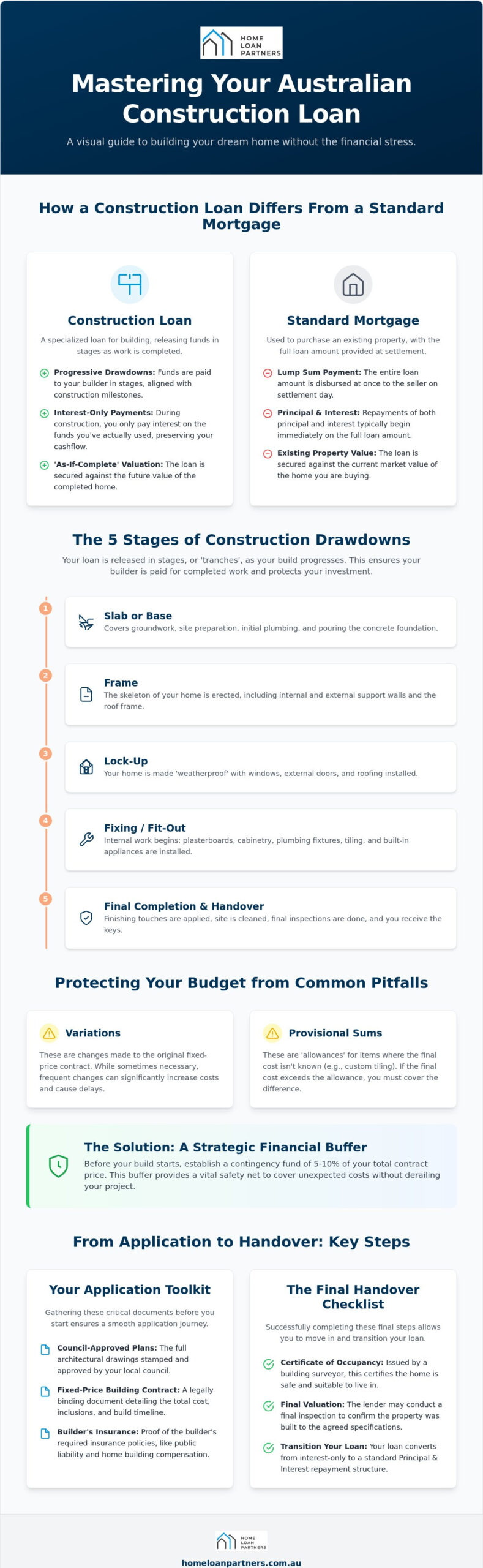
At its core, a construction loan is a specialized credit facility tailored for building a new home or undertaking major structural renovations. To understand What is a Construction Loan and how it differs from a standard mortgage, you have to look at how the money moves. While a standard mortgage provides a lump sum at settlement to purchase an existing property, the construction loan process australia works through a series of progressive drawdowns. This means the lender releases funds in smaller portions, or tranches, only when specific stages of the build are finished. These stages typically include the deposit, base or slab, frame, lock-up, fixing, and final completion.
The foundation of this entire arrangement is a Fixed Price Building Contract. This document outlines exactly what the builder will deliver and for what price. It gives both you and the lender the security of knowing the total cost upfront, which is vital for managing your long-term financial commitments. We act as your steady hand during this phase, ensuring the contract aligns with the bank’s requirements so your project can start without unnecessary delays.
Why You Can’t Use a Standard Home Loan for Building
Standard home loans rely on the current value of an existing house as security. If you’re building, there is no house yet. This creates a gap that a standard loan simply can’t bridge. Instead, construction lenders perform an “as-if-complete” valuation. They look at your architectural plans and the land to estimate what the property will be worth once the last nail is driven in. This proactive approach allows the lender to manage risk while ensuring your builder is paid accurately for the work they perform. It’s a protective layer for you, too, as the bank won’t release funds until they’re satisfied the work meets the required standard.
The Benefit of Interest-Only Payments During Construction
One of the most reassuring features of this loan type is the interest-only period. During the build, you aren’t required to pay back the principal amount of the loan. You only pay interest on the funds that have actually been drawn down. If your total loan is $500,000 but you’ve only used $50,000 for the slab, you only pay interest on that $50,000. This structure preserves your cashflow, which is vital if you’re still paying rent or another mortgage while your new home is under construction. This strategic arrangement prevents significant financial strain during the most expensive and demanding part of the building journey.
Understanding the Progressive Drawdown Process in 2026
Unlike a standard property purchase where funds are handed over in one lump sum, the construction loan process australia relies on a series of staged payments known as tranches. This structure ensures that your builder receives payment only after they’ve physically completed specific milestones on your site. It acts as a built-in safety net for your investment. By releasing funds in increments, the lender confirms that the value of the security (your future home) is growing alongside the debt.
You play a central role in this cycle as the primary gatekeeper. When a stage is finished, your builder will issue an invoice. You’ll then need to sign a Drawdown Request Form to authorize the lender to pay that invoice from your loan account. In many cases, especially during the 2026 building climate, lenders may send a professional valuer to your site before releasing the funds. They do this to verify that the work matches the invoice. This extra layer of oversight might involve a small valuation fee, but it provides peace of mind that your project is moving forward exactly as planned.
Maintaining a collaborative relationship between your broker, builder, and lender is the key to a smooth build. We act as your steady hand, translating the bank’s technical requirements into clear, actionable steps. If you’re unsure how to align your builder’s schedule with your bank’s criteria, you can explore our construction loans to find a structure that supports your specific project goals.
The 5 Standard Stages of a Construction Drawdown
- Slab or Base: This initial stage covers the groundwork, including plumbing, waterproof membranes, and the pouring of the concrete foundation.
- Frame: Here, the skeleton of your home is erected. This includes the internal and external walls, along with the roof trusses and window frames.
- Lock-up: Your house becomes “sealed” from the elements. This stage is reached once the external walls are finished, and all doors and windows are installed.
- Fixing: The focus shifts to the interior. Plasterboard is hung, internal doors are fitted, and cabinetry, tiling, and skirting boards are completed.
- Practical Completion: This is the final stretch. All painting, electrical, and plumbing “fit-outs” are done. The builder provides a final invoice once the site is clean and ready for your inspection.
Managing the Deposit and First Drawdown
Your initial contribution, typically a 5% to 10% deposit, is usually the first money to enter the project. Lenders generally require you to exhaust your own personal equity before they begin drawing from the loan facility. Before that first dollar is released, you must ensure your council permits are approved and your builder’s insurance is active. Having these documents ready prevents frustrating delays at the very start of your journey.
The Application Journey: From Pre-Approval to Site Start
Mastering the construction loan process australia begins long before the first shovel hits the dirt. Before you sign a building contract, obtaining a professional pre-approval is your most vital safety net. This step establishes exactly how much you can afford to spend, which prevents the heartbreak of falling in love with a design that exceeds your financial capacity. It also gives you the leverage to negotiate with builders, as you can demonstrate that you’re a serious, qualified client with the backing of a lender. For those in the Mid North Coast of NSW, partnering with an experienced team like Clarke Regional Pty Ltd can help ensure your building contract and specifications are ready for a smooth lender valuation.
Once you have a design in mind, the bank requires a specific documentation package to move from pre-approval to formal approval. You’ll need council-approved plans, a detailed list of specifications, and the builder’s license. The lender uses these to perform an “As-if-Complete” valuation. Instead of looking at the current state of your vacant lot, a professional valuer assesses the future value of the property based on the proposed construction. This ensures the bank is comfortable with the security of the loan once the house is finished.
If you already own your land, we help you manage the transition from a standard land loan to a construction facility. This often involves folding your existing land debt into the new construction loan so you have one streamlined arrangement. This proactive structure keeps your finances tidy and ensures you’re only managing one set of repayments as the build commences.
Crucial Documents Your Broker Will Manage
Your building contract is the heart of your application. Lenders almost exclusively require a Fixed Price Building Contract, as it provides certainty regarding the total cost. “Cost-plus” arrangements, where the price fluctuates based on materials and labor, are rarely accepted because they pose too much risk to your project’s completion. We also ensure you have Home Warranty Insurance in place, which protects your investment if the builder is unable to finish the work. Finally, we verify that the builder’s Schedule of Progress Payments aligns with the lender’s standard stages to prevent payment disputes later on.
Navigating the Valuation Gap
A common hurdle in the construction journey is the “valuation gap.” This occurs when the bank’s valuer estimates the future value of the home to be lower than the combined cost of the land and the building quote. This doesn’t mean your project isn’t viable, but it does mean you might need to bridge the gap using existing equity in another property or by increasing your cash deposit. The Home Loan Partners act as your expert advocate in these situations. We negotiate directly with lenders to secure fair valuations and explore alternative structures that keep your dream home within reach without compromising your financial security.
Common Pitfalls and How to Avoid a Stressful Build
While the construction loan process australia provides a structured path to your dream home, certain financial traps can create unnecessary friction if you aren’t prepared. One of the most common issues arises from “Variations.” A Variation is any change to the original approved plans and specifications after the contract has been signed. Whether you’re upgrading your kitchen benchtops or adding extra power points, these changes often require you to pay the builder in cash. Lenders usually won’t increase your loan amount mid-build, so even small changes can quickly drain your personal savings if you haven’t budgeted for them.
You must also keep a close eye on Prime Cost (PC) and Provisional Sum (PS) items. PC items are allowances for specific materials like tiles or tapware, while PS items are estimates for labor where the final cost isn’t yet certain, such as site excavation. If the actual cost exceeds the allowance in your contract, you’ll need to cover the shortfall. Maintaining a financial buffer of at least 10% of your total contract value is a smart way to manage these potential blowouts without losing sleep. If you’re feeling overwhelmed by these technical details, our team at The Home Loan Partners can review your contract to help you identify potential financial gaps before you commit.
Builder delays are another reality in the current market. Most construction loans include a set interest-only period, typically lasting 12 to 24 months. If your build drags on longer than expected, your loan might automatically switch to principal and interest repayments while you’re still paying rent or a mortgage elsewhere. We proactively monitor your timeline to help you request extensions from the lender if your builder falls behind, ensuring your cashflow remains protected.
Finally, don’t forget that many building contracts exclude “finishings” like landscaping, driveways, and boundary fences. If these aren’t included in your initial loan valuation, the bank won’t provide funds for them. We recommend identifying these costs early so you can include them in your initial application or set aside a separate contingency fund to ensure your home is truly move-in ready.
Managing Variations and Cost Overruns
To minimize surprises, try to finalize every detail before signing your contract. If you must make changes, ensure they’re documented clearly and check with us first to see how they impact your loan structure. Structuring your contract with fewer Provisional Sums and more fixed-price items gives you and your lender greater certainty throughout the journey. This proactive approach ensures your builder is paid on time and your project stays on track.
The Importance of Post-Settlement Support
Your relationship with your broker doesn’t end when the slab is poured. In fact, our most valuable work often happens during the build as we manage the liaison between your builder and the bank’s valuation team. Once your home is finished, we help you manage the final payment and transition your loan to a standard principal and interest structure. Understanding Why Use a Mortgage Broker means recognizing the value of having an advocate who stays with you for the entire journey, ensuring your long-term debt remains manageable and competitive.
Final Handover and Transitioning to Your Permanent Loan
The final stage of the construction loan process australia is often the most emotional and rewarding part of the journey. Once your builder reaches “Practical Completion,” the house is legally considered liveable, but your financial obligations require a final round of precision. This stage involves a thorough walk-through with your builder to identify any minor defects or outstanding items. You should never sign the final drawdown request until you’re satisfied that the work matches the quality promised in your contract. This final payment, often referred to as the retention payment, is the builder’s last incentive to ensure every detail is perfect before they hand over the keys.
Before the lender releases this final tranche of funds, you’ll need to provide a Certificate of Occupancy or its equivalent in your state. This document confirms the building meets all safety standards and is ready for residents. At this moment, your relationship with the project changes from “builder’s risk” to “homeowner.” You must update your building insurance to a standard residential policy before you move in. Lenders won’t release the final payment without proof that the completed structure is fully insured under your name.
The Final Inspection and Valuation
Lenders usually require a final inspection by a professional valuer before they release the last payment. They want to verify that the house exists as planned and matches the “as-if-complete” valuation performed at the start of the application. This is your opportunity to double-check for defects. If you find issues, don’t feel pressured to sign the final drawdown form immediately. It’s your right to ensure the property is finished to the agreed standard before the bank pays the builder the remaining balance of your loan.
Optimizing Your Loan Post-Build
Now that your home is finished, your risk profile to the lender has decreased significantly. A completed home is a much stronger security than a half-finished construction site. This is the perfect time to review your interest rate and ensure your loan structure still serves your goals. Many of our clients choose to implement an offset account at this stage to reduce the interest charged on their now-full loan balance. To see how your new repayments will look as you move into this next chapter, you can use our Home Loan Calculator Guide to plan your future cashflow with confidence.
Build Your Future with Confidence and Clarity
Building a home is a major life milestone that shouldn’t be overshadowed by financial jargon or complex paperwork. By mastering the construction loan process australia, you’ve already taken the most important step toward a successful project. You now understand how progressive drawdowns protect your cashflow and why a fixed-price contract serves as your financial foundation. These insights allow you to approach your build with a sense of calm, knowing exactly what to expect from the first slab pour to the final handover.
We specialize in managing the heavy lifting so you can focus on the design and excitement of your new property. With access to over 36 Australian lenders, we provide the steady hand you need through every drawdown stage. We professionally manage the builder-lender relationship, ensuring payments are smooth and your project stays on track. Start your stress-free building journey with The Home Loan Partners today. Your dream home is a significant long-term investment, and we’re here to ensure the financial foundation of that journey is as solid as the house itself. We look forward to helping you move into your new home with total peace of mind.
Frequently Asked Questions
How much deposit do I need for a construction loan in Australia?
You typically need a deposit of at least 5% to 10% of the total “as-if-complete” value of your project. However, contributing 20% allows you to avoid the additional cost of Lenders Mortgage Insurance (LMI). Your deposit is generally the first money spent on the project, and lenders will require you to use your own funds before they begin the progressive drawdown process for your build.
Can I get a construction loan as an owner-builder?
Securing a loan as an owner-builder is significantly more challenging than using a licensed professional. Most Australian lenders view owner-builder projects as higher risk and may require a much larger deposit, often 30% to 50% of the project value. You’ll need to provide extensive documentation, including a detailed cost breakdown and proof of your project management experience, to satisfy strict credit criteria in the 2026 market.
Do I pay interest on the whole construction loan amount from the start?
No, you only pay interest on the portion of the loan that has been physically released to your builder. This is a core benefit of the construction loan process australia, as it keeps your monthly costs manageable while you’re still living elsewhere. Your repayments will gradually increase as each stage of the build is completed and more funds are drawn from your total loan facility.
What happens if my builder goes bust during the construction process?
Your Home Warranty Insurance is the primary protection if your builder becomes insolvent. If this happens, you must notify your lender immediately so they can pause further payments. You’ll then work with the insurer to find a new builder to complete the project. Having a steady hand to manage the communication between the insurer and the bank helps ensure your loan remains viable throughout the transition.
Can I use the First Home Owner Grant (FHOG) for a construction loan?
Yes, you can use the First Home Owner Grant as part of your deposit or to help cover construction costs. In most cases, the grant is released by the government at the slab or base stage of the construction loan process australia. We help you coordinate the timing of this grant with your lender so the funds are available exactly when your builder issues the first major invoice.
How long does it take to get a construction loan approved?
You should allow between four to eight weeks for formal approval, depending on the complexity of your project. The timeline relies heavily on how quickly your local council approves your plans and how soon the bank can perform its “as-if-complete” valuation. Providing a complete documentation package, including your signed fixed-price contract and insurance certificates, is the best way to speed up this essential phase.
Can I make extra repayments during the construction phase?
Most variable-rate construction loans allow you to make extra repayments, which can help reduce the interest you pay as the build progresses. However, it’s important to check if your specific loan product includes an offset account. Using an offset account is often a more flexible strategy, as it keeps your extra cash accessible for unexpected “variations” or landscaping costs that might arise before the final handover.
What is a ‘Fixed Price Building Contract’ and why is it important?
A Fixed Price Building Contract is a legal agreement where the builder commits to completing your home for a specific, set price. This document is the foundation of your loan because it provides the lender with certainty regarding the total project cost. Without a fixed price, lenders are exposed to the risk of cost blowouts, which is why “cost-plus” contracts are rarely accepted by major Australian banks.