

The strategy that puts the most cash in your pocket today might actually be the biggest hurdle to your financial freedom tomorrow. We understand that managing a mortgage in 2026 often feels like a delicate balancing act. With variable rates for interest-only loans currently averaging 7.24% for owner-occupiers, it’s completely natural to feel a bit overwhelmed by high monthly outgoings. You might also be navigating the confusion of tax implications for an investment property or feeling the quiet weight of a potential 30% jump in monthly costs when an interest-only period concludes.
This guide will help you weigh the strategic differences of interest only vs principal and interest repayments. Our goal is to ensure you can choose a structure that protects your immediate cash flow while still building the long-term equity you deserve. We’ll explore how to maximise tax efficiencies for your investments, the reality of interest premiums, and how to navigate APRA’s latest debt-to-income limits with a steady, informed hand. By the end, you’ll have a clear, stress-free path forward that aligns with your personal milestones and future security.
Key Takeaways
- Understand the core distinction between reducing your loan balance and simply managing borrowing costs to better align with your financial timeline.
- Evaluate the strategic trade-offs of interest only vs principal and interest repayments to decide whether you should prioritise lower monthly outgoings or faster equity growth.
- Explore how a 100% offset account acts as a powerful tool to mimic the flexibility of interest-only structures while still protecting your long-term wealth.
- Identify the signs of a ‘repayment cliff’ and learn how to navigate the transition to higher monthly commitments once an interest-only period ends.
- Gain insight into how a personalised, strategy-first approach can help you access flexible lending policies that match your specific investment or home-ownership goals.
Principal and Interest vs. Interest Only: The Fundamental Differences
Choosing between interest only vs principal and interest begins with understanding exactly what makes up your mortgage payment. Every home loan consists of two primary components. The principal is the core amount of money you borrowed from your lender to purchase the property. Interest is the ongoing fee the bank charges you for the privilege of using their funds. While every borrower eventually deals with both, the way you schedule these payments can fundamentally change your financial trajectory over the next few years.
Most Australian homeowners use a principal and interest (P&I) structure. With this method, your regular repayments cover the interest for that month while also chipping away at the principal balance. It’s a disciplined approach that ensures your debt steadily decreases until it reaches zero at the end of your loan term. It provides a sense of certainty, as you’re actively buying back your home with every cent you pay.
An Interest-only loan works differently by allowing you to pause principal repayments for a specific window, usually between one and five years. During this time, your bank only requires you to cover the interest charges. Because you aren’t paying down the actual debt, your loan balance remains exactly the same as the day you started the interest-only period. This structure is often a strategic choice for investors looking to maximise cash flow or manage tax deductible debt.
How Each Structure Impacts Your Monthly Budget
The most immediate difference you’ll notice is the impact on your wallet. Interest-only payments are significantly lower in the short term because you’re ignoring the principal component entirely. This can provide much needed breathing room if your household budget is tight or if you’re directing funds toward other life goals. Amortisation is the process of paying off a debt over time through regular payments that cover both the principal and interest until the balance reaches zero. Because P&I loans use this process from day one, they require a higher monthly commitment.
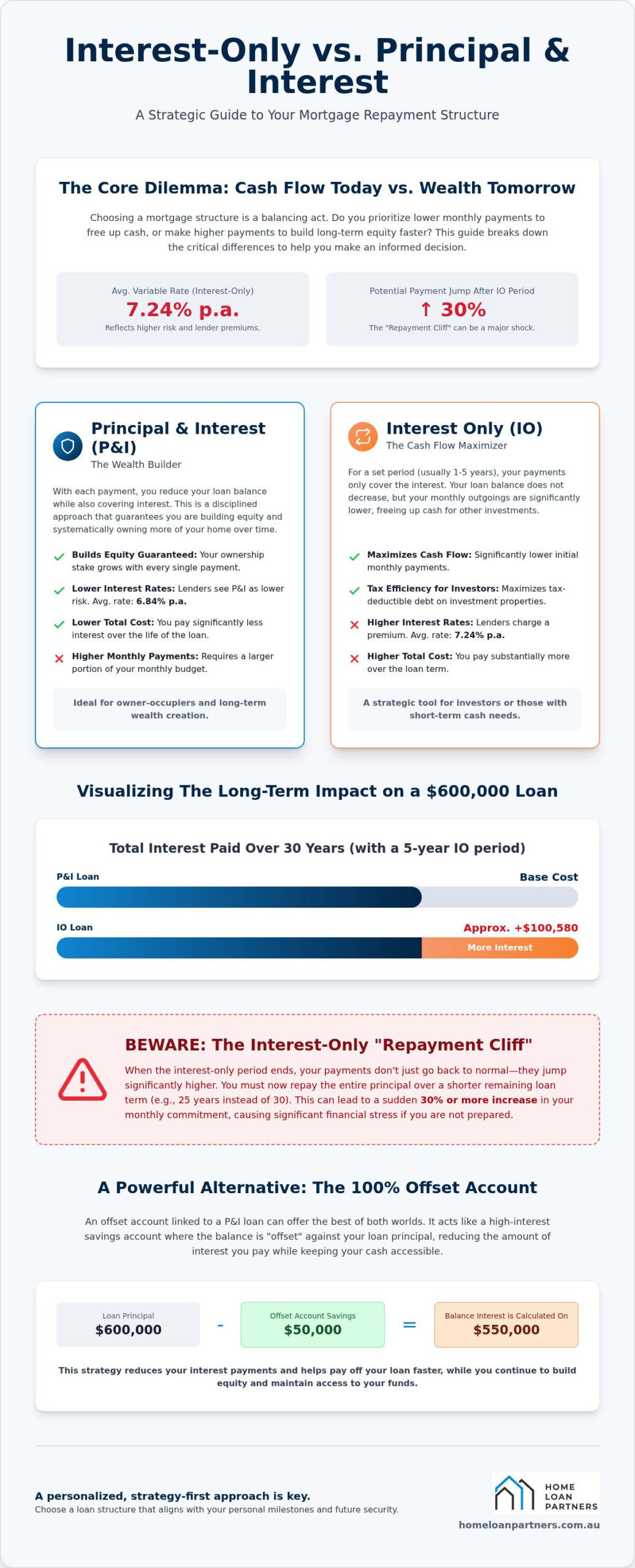
It’s vital to look beyond the immediate monthly saving to avoid the total cost trap. While interest-only payments feel easier now, they actually increase the total cost of your home over a 30 year term. For a $600,000 loan, a five year interest-only period can result in approximately $100,580 more in total interest paid compared to a standard P&I loan. You’re effectively paying for the flexibility of lower current outgoings with higher future costs.
Equity Building: Slow and Steady vs. Market Reliant
Equity is the portion of the property you actually own, and P&I loans offer a guaranteed way to build it. Even if the property market remains flat, your ownership stake grows every month as you reduce the principal. This provides a protective buffer against market volatility and ensures you’re building real wealth regardless of external economic shifts.
Relying on an interest-only structure means your equity growth is almost entirely dependent on capital gains. If property prices rise, your equity increases; however, if the market remains stagnant, your debt stays exactly where it started. Lenders also view these loans as higher risk, which is why they typically charge a premium. You’ll often find that interest-only rates are 0.30% to 0.40% higher than P&I rates, reflecting the bank’s requirement for a steady hand in managing these more complex arrangements.
The Strategic Advantages and Trade-offs of Each Method
Every financial choice involves a trade-off. When comparing interest only vs principal and interest, the right path depends entirely on whether you value immediate liquidity or long-term debt elimination. Principal and interest (P&I) is the standard choice for wealth building. Because you’re paying down the balance, you secure the lowest possible interest rates from lenders. In June 2026, the average variable rate for an owner-occupier P&I loan sat at 6.84% p.a., while interest-only (IO) alternatives were notably higher at 7.24% p.a. The main downside is the higher monthly commitment, which leaves less cash available for other investments or lifestyle needs.
Conversely, interest-only (IO) loans are designed for flexibility. They allow you to keep your monthly outgoings as low as possible, which is a significant advantage if you’re managing irregular income or multiple properties. However, you must prepare for the eventual “repayment shock.” When the IO period ends, your monthly costs can jump by 30% or more as you begin repaying the principal over a shorter remaining term. For example, a $600,000 loan could see payments jump from $3,620 to $4,739 per month. Using an Interest-Only Mortgage Calculator can help you visualise exactly how much your payments will increase once that initial period concludes.
Why Owner-Occupiers Usually Choose Principal and Interest
For most families, the psychological peace of mind that comes with owning more of their home each month is invaluable. P&I loans act as a forced savings plan, ensuring you’re building a safety net of equity from your very first payment. This is especially critical for those learning how to buy a house in Australia, as it protects you against future interest rate rises or market dips. It’s about securing your foundation for the long term.
The Power of Interest-Only for Property Investors
Investors often view debt through a different lens. By choosing an interest-only structure, they can maximise tax-deductible interest payments while preserving cash for non-deductible debt, like their own home mortgage. This strategy, often paired with negative gearing, can also improve serviceability. By keeping current repayments low, investors may find it easier to qualify for additional investment property loans through our panel of 36+ lenders. It’s a strategic way to grow a portfolio while keeping cash flow manageable. If you’re unsure which path fits your current portfolio, our team can help you model the outcomes for both scenarios.
Repayment Structures and the Role of Offset Accounts
An offset account acts like a regular transaction account linked directly to your mortgage. The magic happens in the way interest is calculated. Every dollar sitting in this account reduces the balance the bank uses to charge you interest. If you have a $500,000 mortgage and $50,000 in your offset account, you only pay interest on $450,000. This tool is a game changer for anyone weighing up interest only vs principal and interest because it allows you to create a hybrid strategy that offers the best of both worlds.
Many of our clients choose an interest-only structure but then “mimic” a principal and interest payment by putting the extra cash into their offset account. This approach gives you the disciplined interest savings of a P&I loan while maintaining the ultimate flexibility of an interest-only commitment. If your circumstances change, you aren’t locked into a higher mandatory payment. You can use our Home Loan Calculator Guide to model how different offset balances can drastically shorten your loan term and save you thousands in interest over the coming years.
Preserving Future Tax Benefits
If you plan to turn your current home into an investment property in the future, paying down the principal today might be a permanent financial mistake. Once you reduce the principal balance on a loan, you cannot simply redraw those funds later for a personal use and expect the interest to remain tax-deductible. By using an offset account instead of making extra principal payments, you keep the “original” loan balance high. This ensures that when the property eventually becomes an investment, your tax-deductible interest is maximised. We always encourage you to speak with a qualified accountant to ensure your loan structure aligns perfectly with your long-term tax goals.
Cash Flow Buffers for Renovations or Life Events
Life rarely follows a perfectly straight line, and having accessible cash is often more valuable than having equity locked away in a house. Using an interest-only structure with an offset account creates a liquid buffer for major life events. Whether you’re planning a career change, navigating a period of maternity leave, or funding essential renovation loans, having that cash ready is vital. While a “redraw” facility offers some similar benefits, it can be less flexible. Lenders sometimes have the right to restrict redraw access, and moving funds in and out of a loan can create “mixed purpose” debt that complicates your tax situation. An offset account keeps your funds separate, accessible, and entirely under your control.
Managing the Transition: What Happens When Interest-Only Periods End?
The transition from interest-only payments back to a standard structure is a moment that requires a steady hand and proactive planning. In the Australian market, most owner-occupiers are restricted to interest-only periods of between one and five years. When this window closes, you hit what is often called the “repayment cliff.” This isn’t just a return to normal; it’s a step into a higher cost bracket because you’ve effectively shortened the time you have left to pay off the house. We recommend starting your preparations at least six months before your current arrangement expires to avoid any sudden financial strain.
The reality of interest only vs principal and interest becomes most apparent during this shift. While your initial monthly outgoings were low, the bank now requires you to make up for lost time. If you have a $600,000 loan, your monthly commitment could jump from $3,620 to $4,739 almost overnight. This 30% increase happens because the principal must now be repaid over the remaining 25 years of your loan term rather than the original 30. It’s a significant change that demands a clear strategy to ensure your household budget remains secure.
Calculating the ‘New’ Repayment
Your new repayment amount isn’t just based on your current balance. It’s heavily influenced by any interest rate changes that occurred while you were only paying the interest component. If rates rose during those five years, you’ll feel the double impact of a higher rate and the start of principal repayments. You should carefully check your loan contract for any “automatic conversion” clauses. These clauses mean your lender will switch you to P&I repayments on a set date without needing your permission, often at their standard variable rate which might not be the most competitive option available.
Proactive Refinancing Strategies
You don’t have to simply accept the first offer your current bank provides. As your interest-only period nears its end, it’s the perfect time to explore your options. A broker can help you shop around for a lower P&I rate or even negotiate an extension of the interest-only period if your strategy requires it. However, be aware that as of 2026, APRA maintains a limit that restricts interest-only lending to 30% of a lender’s new residential mortgage loans. This means banks are more selective than ever about who they allow to stay on an interest-only path.
If your current lender isn’t offering the flexibility you need, it might be time to move. You can learn more about how this works in our guide on what does refinancing a home loan mean. Our team can help you navigate the new Debt-to-Income (DTI) limits introduced in February 2026 to find a lender whose appetite matches your goals. If you’re concerned about your upcoming transition, contact us for a refinancing health check to secure a smoother path forward.
How The Home Loan Partners Help You Structure Your Debt
At The Home Loan Partners, we believe your mortgage should serve your life, not the other way around. Deciding between interest only vs principal and interest isn’t just a matter of picking a box on a form; it’s a strategic decision that impacts your wealth for decades. We take a “strategy first, product second” approach. This means we sit down with you to understand your goals before we ever look at a lender’s interest rate. Our team acts as a steady hand, ensuring your loan structure supports your personal milestones rather than hindering them.
With access to a panel of over 36 lenders, we provide a breadth of options that a single bank simply can’t match. This is especially vital when looking for flexible interest-only policies in a market where APRA’s 30% limit makes banks more selective. We navigate the heavy lifting for you, identifying the lenders whose current appetites align with your specific needs. Whether you are a first home buyer looking for stability or an investor seeking to maximise tax efficiency, we find the precision-oriented solution that fits your portfolio.
Personalised Financial Guidance
One-size-fits-all advice often leaves borrowers exposed to unnecessary risk. A single bank can only offer you their specific products, which might not be the most efficient way to structure your debt. Our role as your expert collaborator is to translate complex jargon into clear, actionable plans. We understand the nuances of the national property market and how to protect your interests across the long-term journey. You can learn more about how we advocate for you in The Ultimate Guide to Hiring a Finance Broker.
Our commitment doesn’t end when your loan settles. As we discussed earlier, the transition from interest-only to principal and interest is a critical milestone that requires foresight. We stay by your side throughout the duration of our relationship, reaching out well before your IO period expires to manage the switch. We help you prepare for the “repayment cliff” by reviewing your options, whether that’s negotiating a better P&I rate with your current bank or exploring a new lender through a refinancing strategy.
Next Steps: Your 2026 Property Plan
Ready to take control of your loan structure? The first step is a comprehensive loan health check. We’ll perform a detailed serviceability assessment based on your current gross annual income and the latest debt-to-income limits. To get started, gather your recent payslips and existing loan statements so we can build an accurate picture of your financial position. Speak with The Home Loan Partners today to ensure your home loan strategy is built for 2026 and beyond.
Securing Your Path to Long-Term Wealth
Understanding the nuances of interest only vs principal and interest is a vital step in aligning your mortgage with your broader life goals. Your choice should balance immediate cash flow needs with the long-term goal of building equity. By using smart tools like offset accounts and preparing early for repayment transitions, you can turn your home loan into a powerful instrument for financial security rather than just another monthly bill.
At The Home Loan Partners, we act as your steady hand in a complex market. With access to a panel of over 36 lenders, we provide the unbiased, client-centric mortgage advice you need to make an informed decision. Whether you’re a first home buyer or a seasoned investor, we’re here to manage the heavy lifting and guide you through every stage of your property journey.
Your future security starts with a clear plan. We look forward to partnering with you to achieve your milestones with confidence and ease.
Frequently Asked Questions
Can I switch from principal and interest to interest-only later?
You can certainly apply to switch later, but it isn’t an automatic right. Most lenders treat this as a significant loan variation or a new application. They’ll perform a full credit assessment to ensure you can afford the eventual jump in repayments once the interest-only period concludes. It’s often easier to secure this change if you have a low loan-to-value ratio or a clear investment strategy behind the request.
Is interest-only always more expensive in the long run?
Yes, interest-only loans generally cost more over the full life of the mortgage. Because you aren’t reducing the principal balance during the initial years, you pay interest on a larger amount for a longer duration. Additionally, interest-only rates are typically 0.30% to 0.40% higher than standard rates. For a $600,000 loan, a five-year interest-only window can add approximately $100,580 in total interest costs compared to a standard repayment plan.
Does an interest-only loan affect my ability to borrow more in the future?
It can definitely impact your future borrowing capacity. When you apply for a new loan, banks stress-test your existing debt based on the principal and interest repayments you’ll eventually have to make. Because these future payments are squeezed into a shorter remaining term, they appear higher in the bank’s calculations. If you’re comparing interest only vs principal and interest to build a portfolio, it’s vital to model how this affects your long-term serviceability.
Why do banks charge higher interest rates for interest-only loans?
Lenders view interest-only loans as higher risk because the debt balance doesn’t decrease over time. If property prices fall, the bank has a smaller equity buffer to protect their investment. To manage this risk and comply with APRA’s regulatory limits, banks apply a rate premium. This premium encourages borrowers to choose principal and interest structures, which are seen as more stable for the broader Australian financial system.
Can first home buyers get interest-only home loans?
First home buyers can technically access these loans, but it’s quite rare. Most banks prefer first-time owners to start with principal and interest repayments to build immediate equity in their new asset. To qualify, you’ll likely need a substantial deposit and a high income that comfortably meets 2026 serviceability standards. If you’re using a government grant, check with your broker, as some grant-linked loans have strict repayment requirements.
What happens if I can’t afford the repayments when the interest-only period ends?
If you’re concerned about the upcoming “repayment cliff,” it’s vital to act at least six months before the switch. We can help you explore refinancing options to secure a lower interest rate or potentially extend the loan term to reduce monthly costs. While applying for another interest-only period is possible, it requires meeting strict new lending criteria. Proactive planning is the best way to maintain your financial security during this transition.
Are interest-only repayments tax-deductible for my own home?
No, interest payments on your primary place of residence are not tax-deductible in Australia. Deductions are generally reserved for debt used to purchase income-producing assets, such as investment properties. This is why the debate of interest only vs principal and interest is so different for investors. They often use interest-only structures to maximise their tax-deductible debt while using their extra cash flow to pay down the non-deductible mortgage on their own home.
How long can an interest-only period typically last in Australia?
For owner-occupiers, interest-only periods are usually limited to a maximum of five years. Investors can sometimes access longer periods, occasionally up to ten years, though these come with much higher interest rates and stricter eligibility checks. Once the initial period ends, your loan will automatically revert to principal and interest repayments unless you’ve successfully negotiated an extension or refinanced with a new lender before the expiry date.