

What if the wealth you’ve built in your family home could do more than just provide a roof over your head? Most homeowners feel a mix of pride and hesitation when they look at their property’s rising value. You’ve worked hard to pay down your mortgage, so the idea of drawing against it can feel like taking a step backward. It’s completely natural to worry about over-leveraging or getting tangled in the complex lending criteria of 2026. We understand that your home is your sanctuary, not just a balance sheet on a screen.
That’s why we’ve developed this strategic roadmap. You’ll learn exactly how to use equity in home to invest safely, helping you move from a single-asset owner to a diversified investor with confidence. We’ll simplify the process of unlocking your home’s value to build a multi-asset portfolio using expert Australian lending strategies. This guide previews the crucial difference between total and usable equity, explains the nuances of tax implications like negative gearing, and outlines the protective loan structures that ensure your long-term security. Let’s turn your property’s potential into a steady, stress-free path forward.
Key Takeaways
- Identify the critical difference between raw property value and usable equity, including how to calculate the 80% Loan-to-Value Ratio (LVR) threshold used by Australian banks in 2026.
- Learn exactly how to use equity in home to invest by leveraging your current property to fund a second home deposit or build a portfolio of ETFs and managed funds.
- Protect your financial future by understanding why separate sub-accounts are superior to loan top-ups for tax efficiency and why you must avoid the risks of cross-collateralisation.
- Discover how a strategic comparison of 36+ lenders ensures you find an equity release policy tailored to your specific investment goals and long-term security.
- Follow a structured five-step roadmap that simplifies the transition from a single-asset owner to a diversified investor with a steady, professional hand to guide you.
Understanding Home Equity: Your Secret Weapon for Wealth Creation
In 2026, home equity isn’t just a figure on your annual bank statement. It represents the portion of your property you truly own. It’s the difference between your home’s current market value and the remaining balance on your mortgage. As property values across Australia have matured, many homeowners find themselves sitting on a substantial financial reserve without even realizing it. This wealth builds quietly through two main channels: your consistent principal repayments and the natural capital growth of the Australian market. This “hidden” wealth is often the key to moving from owning a home to building a lasting legacy.
There’s a vital distinction between “raw equity” and equity as a leverage tool. Raw equity is static; it’s simply your net worth on paper. However, when you understand how to use equity in home to invest, that value becomes an active engine for growth. It is often the most cost-effective way to fund new ventures for several reasons:
- Equity-backed loans typically offer much lower interest rates than unsecured personal loans or credit cards.
- You can access significant capital without needing to save a fresh cash deposit from your salary.
- The setup costs are often lower than other forms of specialized investment financing.
You’re essentially using your own property’s success to bankroll your future. It’s about turning a dormant asset into a proactive financial partner. This strategy allows you to maintain your lifestyle while your property works in the background to create new opportunities.
The Psychology of Leveraging Equity
Transitioning from a “debt-free” mindset to one of strategic wealth management can feel daunting. We often view our home as a sanctuary to be protected from debt at all costs. However, successful investors distinguish between “bad debt” used for depreciating items and “good debt” used to acquire income-producing assets. Borrowing against your home to buy a second property or a share portfolio can be a safe, calculated move when structured correctly. It’s about making your money work as hard as you do, shifting the focus from simply paying off a loan to managing a growing, healthy portfolio.
Why 2026 is a Strategic Time to Evaluate Your Equity
The Australian property market in 2026 has entered a phase where regular equity reviews are essential. Leaving your capital untouched can result in “lazy capital” that fails to keep pace with your long-term goals. Understanding home equity investments allows you to see your property as a flexible asset rather than a locked box. With recent interest rate shifts and evolving borrowing capacities, a professional review helps you stay ahead of the curve. It ensures you have the liquidity needed to diversify your wealth beyond a single rooftop while the market continues its steady trajectory. We manage the heavy lifting of these reviews, ensuring your equity is always positioned for its best use.
Calculating Your Usable Equity: How Much Can You Actually Borrow?
Understanding the numbers is the first step toward financial freedom. While your property’s market value might be high, your “usable equity” is what actually dictates how to use equity in home to invest. This figure represents the amount you can borrow without selling your home or significantly increasing your risk profile. It’s the bridge between where you are now and the multi-asset portfolio you’re aiming to build.
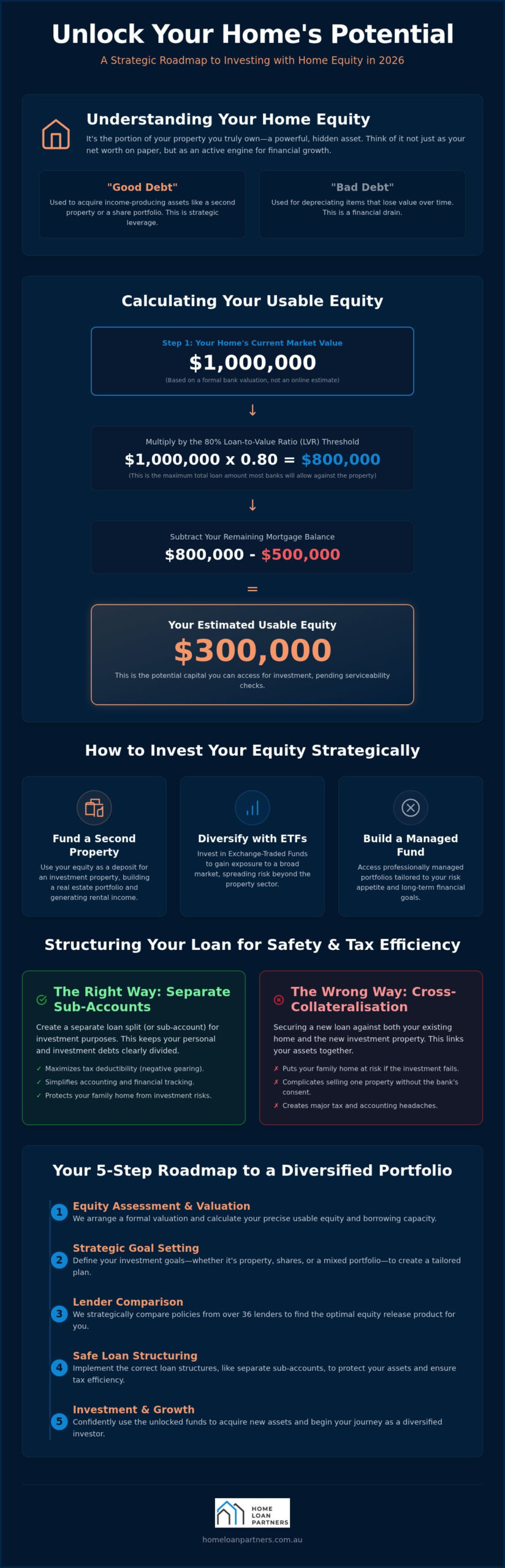
The process begins with a formal bank valuation. Online estimators often provide inflated figures that don’t reflect current 2026 lending standards. We manage the process of ordering these valuations through our panel of 36+ lenders to ensure we get an accurate assessment of your security. Once we have a value, we apply the 80% rule. If your home is worth $1,000,000, most lenders will cap your total debt at $800,000. By subtracting your current mortgage balance, say $500,000, you’re left with $300,000 in usable equity. Finally, we must confirm your “serviceability.” This is your actual capacity to repay the new loan based on your current income and expenses.
The 80% Rule and the Role of LMI
Most Australian lenders prefer a Loan-to-Value Ratio (LVR) of 80% or less. Going beyond this often triggers Lenders Mortgage Insurance (LMI). This is an additional cost that protects the bank, not the borrower. For some high-growth investment opportunities, paying LMI might be a strategic choice to secure an asset sooner. Often, refinancing your existing mortgage allows you to reset this baseline. It can help you access more competitive rates for the investment portion of your debt while keeping your family home secure.
How Different Lenders View Your Equity
Not all banks see your home the same way. One lender might value your property conservatively, while another recognizes its full market potential. Lender policies on “cash out” also vary wildly. Some institutions require strict proof of purchase for shares or property, while others offer more flexibility. This is where an expert finance broker becomes an essential partner. We compare specific policies to find the lender that offers the most generous valuation and the best structure for how to use equity in home to invest. If you’re curious about your current capacity, it’s worth checking in with The Home Loan Partners for a tailored assessment of your position.
Strategic Ways to Invest Your Equity in 2026
Once you’ve identified your usable equity, the focus shifts to deployment. In 2026, diversification is the cornerstone of a resilient wealth strategy. Relying solely on your primary residence leaves your net worth vulnerable to localized property cycles. Learning how to use equity in home to invest across different asset classes helps protect your financial future while accelerating growth. Whether you’re looking to acquire more real estate or enter the share market, your home’s value acts as the catalyst.
Property Investment: The Multiplier Effect
Leverage is perhaps the most powerful tool for Australian homeowners. By using $200,000 of your usable equity as a 20% deposit plus purchasing costs, you can effectively control a $1,000,000 investment property. This multiplier effect means you benefit from capital growth on the full asset value, not just the portion you contributed. To succeed in the current market, you should prioritize high-yield or high-growth locations nationally, ensuring the rental income supports the loan repayments. For a deeper look at the acquisition process, see our guide on how to buy a house in Australia.
Diversifying into Shares and Business
Not every investor wants more property. You can also use your equity to enter the share market through Exchange Traded Funds (ETFs) or managed funds. This provides instant diversification across hundreds of companies, often with higher liquidity than real estate. Additionally, many clients use their equity to fund a startup or expand an existing business. This is often a strategic way to bypass the higher interest rates and stricter terms of unsecured business loans. By using your home as security, you can often access the capital needed for expansion at a much lower cost of borrowing.
Debt Recycling: Turning Non-Deductible Debt into Tax-Deductible Debt
One of the most effective ways to optimize how to use equity in home to invest is through debt recycling. Most homeowners carry a “non-deductible” mortgage on their family home, meaning interest payments offer no tax relief. Debt recycling involves paying down this personal debt and immediately redrawing the funds into a separate investment loan account. Because these redrawn funds are used to buy income-producing assets, the interest becomes tax-deductible. This strategy requires a precise “split account” structure to ensure the Australian Taxation Office can clearly distinguish between personal and investment debt. We manage the heavy lifting of setting up these complex arrangements, ensuring your path to wealth is both safe and efficient.
Structuring Your Loan for Safety and Tax Efficiency
Securing the funds is only half the battle. The way your debt is structured determines whether your investment strategy is a smooth journey or a tax-time nightmare. Understanding how to use equity in home to invest requires a shift in focus from “how much” to “how.” A poorly structured loan can lead to missed tax deductions and a loss of control over your assets. We prioritize structures that keep your family home protected while maximizing the efficiency of your investment capital.
Many homeowners are tempted by a simple “loan top-up.” While this is often the easiest path offered by big banks, it’s rarely the best. A top-up often mixes your private mortgage with your investment debt in a single account. This makes it incredibly difficult to track which portion of the interest is tax-deductible. Instead, we advocate for “New Sub-accounts” or loan splits. By creating a separate account for your investment funds, you provide a clean paper trail for the Australian Taxation Office. This ensures every cent of interest on your investment debt is clearly identifiable and deductible.
Stand-Alone vs. Cross-Collateralised Structures
Cross-collateralisation is a common “Bank Trap” where a lender uses both your family home and your new investment property as security for a single loan. While this might seem convenient, it gives the bank immense power. If you decide to sell one property, the bank can dictate how much of the sale proceeds must be used to pay down the remaining debt. It can also make refinancing much more difficult. We prefer “stand-alone” structures. By keeping your properties as separate securities, you maintain total control. If one property grows in value, you can access that equity without the bank re-evaluating your entire portfolio. In many cases, we even suggest using different lenders for your home and your investments to further decouple your risks.
Interest-Only vs. Principal and Interest for Investors
Cash flow management is vital for a growing portfolio. Many Australian investors choose Interest-Only periods for their investment loans. This strategy keeps your required repayments lower, which can be helpful when you’re first building your asset base. More importantly, it keeps the tax-deductible debt at its maximum level for longer. You can then use any surplus cash to pay down your non-deductible home loan instead. You can see the difference this makes by using our home loan calculator to model different repayment scenarios. It’s essential to have a clear exit strategy for when the Interest-Only period ends, as repayments will increase significantly. If you want to ensure your debt is structured for long-term safety, contact The Home Loan Partners to discuss a tailored solution for your portfolio.
The Roadmap: 5 Steps to Unlocking Your Equity with The Home Loan Partners
Navigating the path to property investment doesn’t have to be a solo journey. We’ve refined a five-step process designed to take the weight off your shoulders while ensuring your strategy is robust and compliant. By following this roadmap, you’ll gain total clarity on how to use equity in home to invest while protecting your most valuable asset. We manage the heavy lifting so you can focus on your future.
- Step 1: Strategic Consultation. We start by listening. We define your long-term goals, whether you’re seeking retirement income or capital growth, and assess your current position to see what’s possible.
- Step 2: Market Comparison. We don’t just look at one bank. We analyze 36+ lenders to find the specific equity release policies and interest rates that align with your unique needs.
- Step 3: Valuation Management. We order upfront valuations from multiple lenders. This confirms your usable equity before you even lodge an application, saving you time and avoiding unnecessary credit hits.
- Step 4: Structural Design. We design the specific sub-account or split loan structures discussed earlier. This ensures your investment debt remains separate for maximum tax efficiency and ease of tracking.
- Step 5: Settlement and Beyond. We manage the entire application through to settlement. Our partnership continues with annual reviews to ensure your loans remain competitive as the 2026 market evolves.
Why a Broker Beats a Bank for Equity Release
When you walk into a bank, they can only show you their own products. They won’t tell you if a competitor has a more generous valuation policy or a lower interest rate for your specific scenario. A broker provides a panoramic view of the market. We act as your expert guide and advocate, negotiating better terms even when you’re increasing your overall debt. Our role is to translate complex industry jargon into practical language so you always feel in control. We handle the bank liaisons and technical hurdles, making the entire experience stress-free and predictable.
Your Next Steps Toward Financial Freedom
Equity is a dynamic asset. In the 2026 market, it can be a perishable opportunity if property values shift or lending criteria tighten. Waiting too long might mean missing the window to secure your next investment at a favorable rate. We encourage you to take advantage of a no-obligation equity health check to see exactly where you stand. It’s the first step toward turning your “hidden” wealth into a tangible, multi-asset future. You don’t have to guess your borrowing capacity when you have a professional team ready to do the math for you. Book a strategic equity review with The Home Loan Partners today.
Your Future Portfolio Starts with Today’s Equity
Your home is more than just a place to live; it’s a powerful foundation for long-term financial security. By understanding how to use equity in home to invest, you can transform static property value into a dynamic, multi-asset portfolio. We’ve explored how identifying your usable equity and implementing safe, tax-effective loan structures can protect your family home while accelerating your wealth. Whether you’re targeting property, shares, or business expansion, the right structure is what ensures your success in the 2026 market.
Our team provides access to 36+ Australian lenders and specializes in investment and tax-effective loan structures. We offer personalized, stress-free mortgage guidance to help you navigate every technical detail with confidence. We’re here to ensure your debt is structured for longevity and growth. Book Your Strategic Equity Review with The Home Loan Partners today to begin your journey.
You’ve done the hard work of building equity. Now, let us handle the heavy lifting of putting it to work for you. Your path toward a diversified financial future and lasting wealth is just one conversation away. We look forward to being your partner on this long-term journey.
Frequently Asked Questions
Is it a good idea to use equity to buy shares in 2026?
Yes, using equity to buy shares can be a strategic move for diversification. With 2026 outlooks for stocks and ETFs remaining generally positive, this strategy allows you to access capital at lower mortgage rates rather than expensive margin loans. It requires a long-term horizon to weather market volatility. We help you structure this through a separate sub-account to keep your tax deductions clean and your financial journey manageable.
What is the difference between equity and usable equity?
Equity is the total value of your home minus your loan, while usable equity is the amount a bank will actually let you borrow. Most Australian lenders in 2026 limit borrowing to 80% of the property’s value. If your home is worth $1 million and you owe $500,000, your total equity is $500,000. Understanding this distinction is vital when learning how to use equity in home to invest safely without over-leveraging.
Do I need a deposit if I use equity to buy an investment property?
No, your usable equity effectively acts as the deposit for your new purchase. You can use the redrawn funds to cover the 20% deposit and associated costs like stamp duty or legal fees. This is a primary reason why homeowners look for how to use equity in home to invest, as it removes the need to save a cash deposit. We manage the application process to ensure both loans are structured safely.
Can I use equity if I have a fixed-rate home loan?
Yes, you can, but it typically involves creating a separate loan split rather than altering your existing fixed-rate account. Modifying a fixed-rate loan directly can trigger significant break costs. By setting up a new variable-rate sub-account for your investment funds, you protect your current low rate while accessing the capital you need. We compare 36+ lenders to find the most flexible options for your specific fixed-rate situation and long-term goals.
What are the risks of borrowing against my home to invest?
The primary risk is that your family home serves as security for the investment debt. If your investment fails or you cannot meet repayments, your home could be at risk of foreclosure. Additionally, interest rates may rise or the value of your investments could fall. We help mitigate these risks by advocating for stand-alone loan structures and ensuring you maintain a comfortable serviceability buffer for your 2026 financial aspirations.
How much does it cost to access the equity in my home?
Costs typically include property valuation fees, loan application or settlement fees, and government mortgage registration charges. While we don’t quote specific bank fees, these are generally much lower than the costs of saving a new deposit or taking out a personal loan. We manage the heavy lifting of the application process and negotiate with lenders to minimize these setup costs wherever possible, ensuring a smooth and transparent experience for you.
Will using my equity increase my monthly mortgage repayments?
Yes, because you are increasing your total debt level. Even if the interest rate is competitive, borrowing more money results in higher monthly commitments. Many investors manage this by choosing interest-only repayments for the investment portion of their debt. This keeps the immediate cash flow impact lower while maximizing potential tax deductions. We can model these scenarios for you to ensure the repayments remain well within your personal budget and comfort zone.
What happens if my property value decreases after I access equity?
A decrease in property value won’t typically affect your current loan as long as you continue making your repayments. However, it will reduce your remaining equity and could increase your Loan-to-Value Ratio (LVR). This might make it harder to refinance or access more funds in the future. Regular annual reviews are a core part of our service, helping you stay ahead of market shifts and maintain a steady, secure financial path.