

What if a lower payslip puts your home purchase at risk just days after you’ve received pre-approval? If you’re wondering, “what if my income drops after pre-approval”, it’s understandable to worry that your lender might change or withdraw its decision, or that you could lose the property you’re hoping to buy.
A change in income doesn’t automatically determine the outcome, but it may prompt a reassessment. Pre-approval is conditional and based on your circumstances at a particular point in time. Each lender has its own requirements, so tell your broker or lender promptly and give them time to explain what happens next.
This guide explains how a pay cut, reduced hours, redundancy or variable income may affect your application. You’ll learn what information to gather, who to update and what to consider before making a commitment. The Home Loan Partners provides personalised guidance and can help you explore options across a panel of more than 36 lenders. Approval is always subject to the lender’s assessment.
Key Takeaways
- Pre-approval is conditional. An income change may prompt a review, but it doesn’t determine the outcome by itself.
- If you’re asking “what if my income drops after pre-approval”, record what changed and promptly tell your broker or lender.
- Reduced hours, redundancy, a job change and variable income can each call for different evidence during reassessment.
- Gather current details about your income, employment, expenses and liabilities so the lender can assess your position.
- Depending on the lender’s assessment, you may be able to update your application, adjust your plans or reconsider timing. A broker can help you explore potential pathways across a panel of lenders.
Income Drops After Pre-Approval: Understanding the Basics
A change in income doesn’t automatically end your home-buying plans. What matters is how the lender reassesses your current circumstances and whether the loan still meets its requirements. If you’re asking, “what if my income drops after pre-approval”, remember that pre-approval is an early step, not a final lending decision.
Pre-approval is a conditional indication that a lender may be willing to lend, based on the information available at the time. Formal loan approval is the lender’s later decision after assessing the application and relevant details of the property and loan. A mortgage loan involves an assessment of the borrower and proposed borrowing, but the precise checks and conditions depend on the lender.
Why pre-approval may not be the final decision
Pre-approval reflects a snapshot of your finances and may rely on assumptions about your income, expenses, debts and employment. If your pay falls, your hours change or you take on a new liability, the lender may reassess whether the requested loan remains affordable. It may ask for updated payslips or other evidence.
There isn’t one process that applies to every Australian lender. Conditions, validity periods and evidence requirements differ. Review the details of your pre-approval with your broker or lender, and don’t assume that being within its stated period means your circumstances won’t be reviewed.
When an income change could matter most
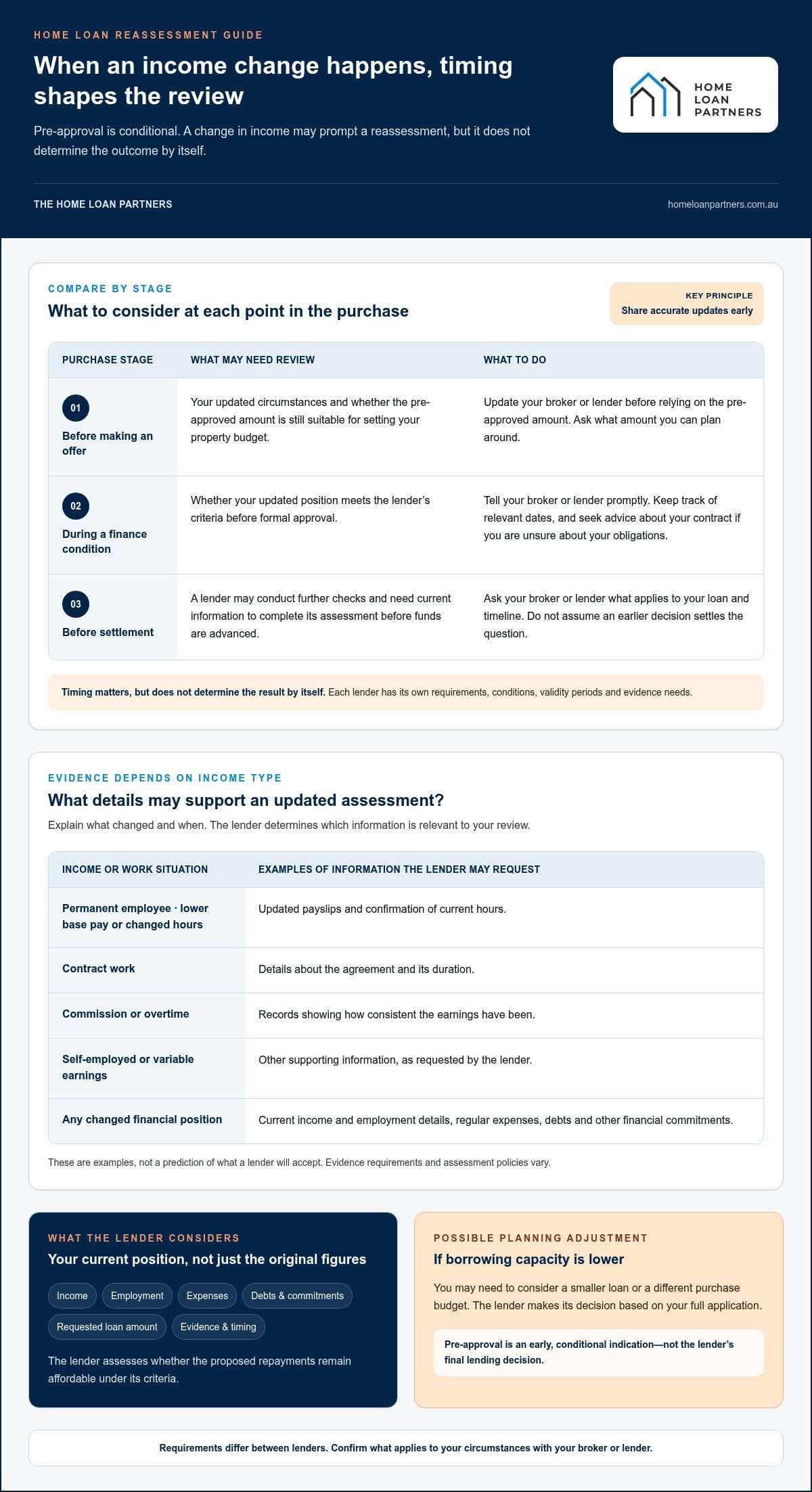
Before making an offer: Update your broker or lender before relying on the pre-approved amount to set your property budget. Ask whether the change affects the amount you can plan around.
During a finance condition: If you’ve made an offer and your income changes before formal approval, tell your broker or lender promptly. The lender may need to review your updated position before deciding whether the application meets its criteria. Keep track of relevant dates and seek advice about your contract if you’re unsure what the change could mean for your obligations.
Before settlement: A lender may conduct further checks before funds are advanced. If your circumstances have changed since approval, it may need current information to complete its assessment. Ask your broker or lender what applies to your loan and timeline rather than assuming the earlier decision settles the question.
Timing can affect what needs review, but it doesn’t determine the result by itself. Share accurate information early so your broker can clarify what the lender needs and discuss possible next steps.
How a lender may reassess your home loan after an income change
If you’re wondering, “what if my income drops after pre-approval”, the lender will need to understand your current financial position, not just the figures in your original application. A review may cover your income, employment, regular expenses, debts and other commitments, along with the amount you want to borrow. Together, these details help the lender assess whether the proposed repayments remain affordable under its criteria.
The lender’s response depends on its assessment criteria, the type and continuity of your income, your updated expenses and liabilities, the evidence available, the requested loan amount and the timing of its review. If the reassessment indicates lower borrowing capacity, you may need to consider a smaller loan or a different purchase budget. The lender makes its decision based on your full application.
What financial information may need updating?
Be ready to explain what changed and when. Depending on your circumstances and the lender’s request, evidence may include recent payslips, updated employment details, an employment contract or records of other income. If you’re self-employed or your earnings vary, the lender may ask for different supporting information.
Also note any changes to household spending, new debts or other financial commitments. When you speak with your broker or lender, give a clear summary of what has changed since you applied. They can clarify which documents are relevant to your review.
Why income type and timing can change the assessment
Income from different work arrangements may be assessed differently. A permanent employee whose base pay has fallen may be asked for updated payslips and confirmation of current hours. Someone working on contract may need to provide details about the agreement and its duration. For commission or overtime, the lender may seek records showing how consistent the earnings have been. Policies vary, so these examples don’t predict what a lender will accept.
A recent change may prompt questions about whether your current income is likely to continue. A temporary interruption may need different context from an ongoing pay reduction, but the lender determines how each affects its assessment. Explain the circumstances accurately and provide evidence rather than estimating what income will count.
If you need help discussing your updated position and potential lender pathways, discuss your home loan options with The Home Loan Partners. Personalised guidance across a panel of more than 36 lenders can help you consider alternatives, subject to lender assessment.
Could a pay cut, redundancy, or variable income affect approval differently?
Not every income reduction automatically cancels pre-approval. The lender will consider what changed, how it affects your household finances and what evidence supports your updated position. If you’re asking, “what if my income drops after pre-approval”, the details matter: reduced hours, a job loss and fluctuating commission can raise different questions during reassessment.
| Change | Information the lender may review |
|---|---|
| Reduced hours | Updated payslips, current hours and whether the reduction is temporary or ongoing. |
| Lower base pay | Evidence of your new salary, when it took effect and confirmation of your current employment arrangements. |
| Redundancy | Employment end date, any new role or income, and details of redundancy payments if relevant to the application. |
| Job change | New employment details, role, pay and available evidence that the income has commenced or is expected to continue. |
| Variable income | Records of commission, overtime or other variable earnings, alongside evidence of any ongoing contract or self-employed income. |
These are examples, not a universal document checklist. The lender may request other information depending on its policies and your application.
If your hours or regular pay have decreased
Explain what changed, when it happened and whether you expect the new arrangement to continue. Recent payslips or updated employer information may help show your current position if the lender requests them. If you expect to return to your usual hours, explain when and provide supporting details where available rather than assuming the lender will count that income. Savings may form part of the wider financial picture, but they aren’t an automatic substitute for reduced earnings. The lender needs to reassess your application.
If you have lost a job or your earnings vary
Redundancy or a move between roles can lead to questions about your current employment and continuity of income. If you’ve started a new job, share the details and evidence available. For commission, overtime, contract work or self-employment, the lender may assess records and income patterns differently from regular wages. A co-borrower’s income or household savings may also form part of the broader assessment, subject to the lender’s criteria and your full application.
There’s no single outcome for every case. Share accurate updates promptly so your broker can help explain the circumstances and clarify what the lender needs to review.
What to do if your income falls after pre-approval
If you’re asking, “what if my income drops after pre-approval”, focus on clear information and timely communication. A lender may need to reassess your application, but an income change doesn’t automatically mean pre-approval will be withdrawn. These steps can help you work out what needs attention next.
Gather clear evidence before discussing next steps
Before you call, make a short timeline of what changed and when. Note whether the reduction is expected to continue, and collect relevant employer or income information you already have. This helps you explain the situation clearly without guessing how it may affect the lender’s decision.
Summarise your current income, regular expenses, debts and any financial commitments that have changed since you applied. Your broker or lender can clarify which documents are relevant to the review.
Protect your purchase while the lender reviews your situation
Keep communication open and don’t delay an update while waiting for every document. Give your broker or lender accurate information, and don’t conceal or misrepresent a change. Prompt disclosure gives them the opportunity to explain what the lender needs and discuss possible next steps.
- Record the change. Write down what happened, when it took effect and whether it’s temporary or ongoing.
- Contact your broker or lender. Explain the change and ask what updated evidence they need to assess your application.
- Check your contract dates. Review any finance-condition and settlement dates. For contract-specific questions, speak with your conveyancer or solicitor, who can advise you on your obligations and available options under the contract.
- Be cautious with new commitments. Before taking on new debt or making a major financial change, consider how it could affect your application and discuss it with your broker or lender.
Keep copies of messages and documents, and note any follow-up dates the lender gives you. Pre-approval doesn’t guarantee settlement, but an income change doesn’t mean the lender will automatically withdraw it. The outcome depends on its assessment of your updated circumstances and application.
If you’d like help communicating the change and understanding potential lender pathways, discuss your home loan options with The Home Loan Partners. Personalised guidance across a panel of more than 36 lenders can help you consider alternatives, subject to lender assessment.
Your next steps: explore home-loan options with a clear picture
A change in income may call for an updated assessment, a revised application or, depending on the lender and your circumstances, a rethink of timing. There’s no single pathway for every borrower. Start by finding out what the lender’s current position means for your application and purchase plans.
Questions to clarify before making a decision
Ask your broker or lender which parts of your pre-approval still apply and what information needs updating. Clarify whether the proposed loan amount, approval conditions or expected timeline need to be reviewed. The answers depend on your lender, application and contract circumstances, so seek guidance specific to your situation.
If you’re still planning your purchase, the Australian home-buying guide offers broader context for the steps involved. If you’ve signed a contract, keep track of its dates and seek contract-specific advice from your solicitor or conveyancer.
How a broker can help you assess the way forward
A broker can help you organise an accurate picture of your changed income and commitments, communicate the update to the lender and understand what evidence may be needed. Depending on the lender’s response, next steps might include continuing with updated evidence, revising the application or reassessing your timing. None of these pathways guarantees approval.
The Home Loan Partners can help you discuss your circumstances and consider suitable options across a panel of more than 36 lenders. Comparing lender pathways can help you understand alternatives in light of your updated position. For more background on a broker’s role, read the Australian finance broker guide.
If you’re still asking, “what if my income drops after pre-approval”, you don’t have to work through the questions alone. Share what’s changed and what stage your purchase has reached, then discuss a practical next step with a broker. A clear picture of your current position can help you make considered decisions as your plans move forward.
Move forward with a clearer home-loan plan
If you’re still asking, “what if my income drops after pre-approval”, remember that a change doesn’t decide the outcome by itself. Pre-approval is conditional, and the lender may reassess your current income, commitments and employment before making a formal decision. Prompt, accurate communication helps clarify what may need updating.
Your next step may be to provide new evidence, discuss a revised loan amount or reconsider your timing. The right path depends on your lender’s requirements and your circumstances, so don’t rely on the original pre-approval as a guarantee. If you’re buying a home, keep relevant contract dates in view while you clarify your finance position.
The Home Loan Partners provides personalised guidance to borrowers across Australia and can help you discuss your changed circumstances with a lender. Access to a panel of more than 36 lenders can also help you explore other potential pathways, subject to the lender’s assessment.
Talk through your home-loan options with The Home Loan Partners and take the next step with a clearer understanding of your choices. You can work through an income change one informed decision at a time.
Frequently Asked Questions
Can a lender withdraw pre-approval if my income drops?
Yes, a lender may change or withdraw pre-approval after reassessing your circumstances, but an income drop doesn’t automatically lead to that result. Pre-approval is conditional and based on information available at the time. The lender may consider your updated income, expenses, debts and employment before making a formal decision. Ask your broker or lender which conditions apply and what the change means for your application.
Do I have to tell the lender if my income changes after pre-approval?
Tell your broker or lender promptly and provide an accurate account of the change. Your application and pre-approval conditions may set out what information you need to update, and requirements can vary between lenders. Don’t assume the lender will discover the change later or wait until it requests documents. Early communication gives the lender a chance to explain what evidence it needs and how it will reassess your application.
What happens if I lose my job before my home loan settles?
If you lose your job before settlement, contact your broker or lender as soon as possible. The lender may reassess your application based on your current employment and income, and may ask about a new role or other income. The outcome depends on its criteria and your full circumstances. Keep track of your finance and settlement dates, and speak with your solicitor or conveyancer about contract questions.
Can I still get a home loan if my salary is reduced?
Possibly. A lower salary may reduce the amount a lender considers affordable, but it doesn’t automatically rule out a home loan. The lender may review your updated pay, expenses, debts and requested loan amount, then decide whether the application meets its criteria. Depending on the assessment, you may need to discuss a revised loan amount or purchase budget. Share current information rather than relying on the figures used for pre-approval.
Will a new job affect my mortgage pre-approval?
A new job may affect your pre-approval because the lender may want to understand your current role, pay and employment arrangements. The evidence it requests depends on your circumstances and its policies. Tell your broker or lender about the change and ask what information is needed, such as updated employment details or payslips if available. A job change doesn’t determine the outcome by itself; the lender assesses the updated application as a whole.
Can a mortgage broker help if my income drops after pre-approval?
Yes. A mortgage broker can help you explain the change to the lender, organise relevant updated information and understand possible next steps. If you’re asking, “what if my income drops after pre-approval”, a broker can help clarify whether the lender may continue assessing your application, review the requested loan or require a different approach. The Home Loan Partners provides personalised guidance and can compare potential pathways across a panel of more than 36 lenders. Approval remains subject to the lender’s assessment.