

Your investment property might generate strong, reliable cash flow each week, but to a bank credit assessor, up to 30% of that revenue doesn’t exist. It’s deeply frustrating to prepare for your next purchase, only to watch your borrowing power shrink because different lenders apply varying shading haircuts and conflicting document rules. Successfully proving rental income for investment property loan approval isn’t just about showing money in an account. It requires matching your specific tenancy setup to underwriting policies that recognise your true earnings.
You don’t have to let conservative bank calculations derail your investment strategy. In this guide, you’ll discover the exact paperwork checklists lenders demand, how underwriters assess long-term versus holiday letting cash flows, and how current serviceability buffers affect your borrowing limits. Here is your clear roadmap to packaging your rental evidence, protecting your borrowing capacity, and securing pre-approval without unexpected surprises.
Key Takeaways
- Understand how credit assessors calculate assessable cash flow and why standard gross yields are heavily adjusted during loan underwriting.
- Learn why bank shading policies automatically discount rental revenue by 20% to 30% to factor in maintenance, council rates, and potential vacancies.
- Access an audit-ready paperwork checklist for proving rental income for investment property loan approval across both existing holdings and incoming purchases.
- Uncover the precise verification steps and historical statements required for complex income streams, including holiday letting, granny flats, and private leases.
- Discover how strategic loan packaging and lender policy comparison can protect your borrowing capacity from unnecessary serviceability cuts.
How Australian Lenders Assess and Verify Rental Income
When you apply for an investment property loan, credit underwriters do not treat rental revenue the same way they treat your standard salary. In Australian home loan serviceability formulas, assessable rental income refers strictly to the net cash flow a bank decides is dependable enough to service debt over the life of a loan. Underwriters scrutinise this reliability because tenancies fluctuate, tenants vacate, and properties demand ongoing repairs. Showing consistent cash flow protects both you and the credit provider from sudden financial strain.
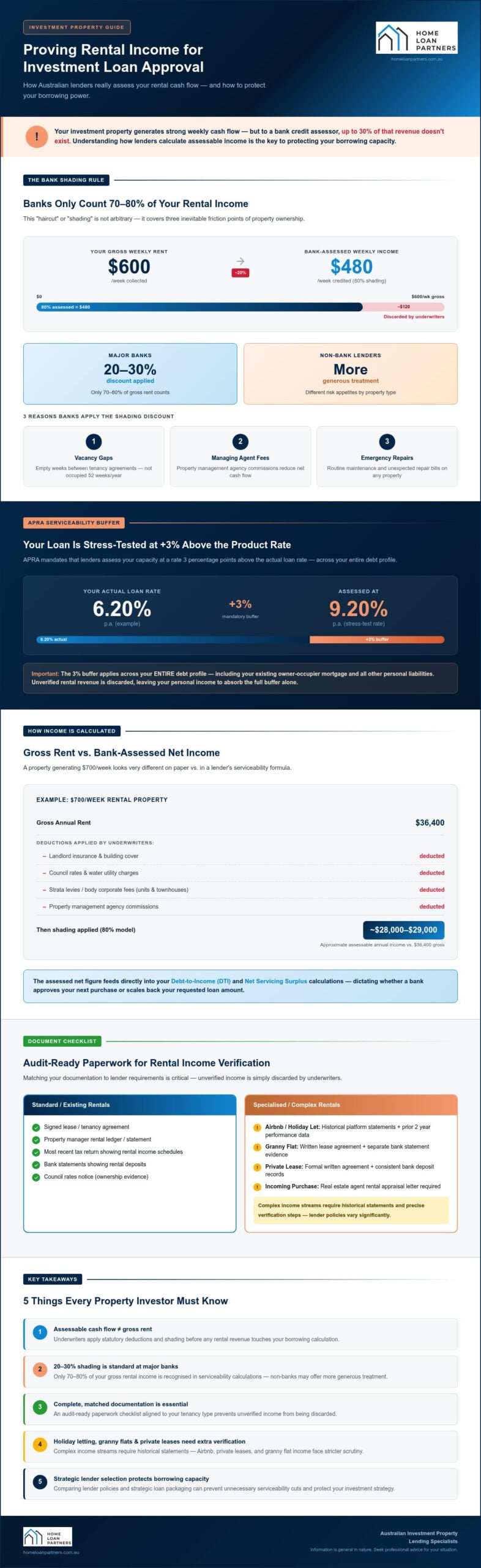
There is a substantial difference between gross rental yields and lender-recognised net cash flow. A property generating $700 per week might seem like an immediate $36,400 annual boost to your bottom line. However, lenders strip away projected overheads before that figure touches your application. When proving rental income for investment property loan applications, your gross yield is merely the starting point. The assessed net figure feeds directly into your debt-to-income (DTI) and Net Servicing Surplus calculations, dictating whether a bank approves your next purchase or scales back your requested loan amount.
Gross Rental Income vs Net Serviceability Calculations
Gross annual rent represents the headline figure agreed upon in your tenancy contract. Before factoring this cash flow into your borrowing power, credit assessors apply baseline statutory reductions. These deductions account for ongoing ownership liabilities such as:
- Landlord insurance and building cover
- Council rates and water utility charges
- Strata levies or body corporate fees (for units and townhouses)
- Ongoing property management agency commissions
These adjustments ensure that your serviceability model reflects true running costs rather than optimistic gross receipts. Even if an investor relies on a traditional Negative Gearing Strategy to balance out-of-pocket holding costs come tax time, credit underwriters assess current servicing capacity on cash flow alone.
The Role of APRA Serviceability Buffers in Investment Lending
Lenders do not assess investment property loans at the contract interest rate you pay. Under Australian Prudential Regulation Authority (APRA) standards, banks stress-test your finances using a mandatory serviceability buffer of 3 percentage points above the product rate. If your investment loan carries an interest rate of 6.20% p.a., your application is assessed at 9.20% p.a.
Crucially, this stress test applies across your entire debt profile, including your existing owner-occupier mortgage and other personal liabilities. If you are preparing your finances, using an Australian home loan calculator helps you model how these higher buffer rates interact with adjusted yields. That is why proving rental income for investment property loan success demands complete accuracy. Any unverified revenue gets discarded by the assessor, leaving your personal earned income to absorb the rigorous 3% buffer alone.
Understanding the Bank Rental Shading Rule and Haircuts
Most borrowers assume that if their property earns $40,000 in annual rent, that entire amount counts toward their borrowing capacity. Australian credit assessors, however, apply what the industry calls a “haircut” or “shading” rule. Across major banks, the standard practice is to shade gross receipts by 20% to 30%, meaning underwriters include only 70% to 80% of your earnings in serviceability calculations. Non-bank lenders often maintain different risk appetites, occasionally offering more generous treatment depending on property type and loan structure.
Shading is not an arbitrary penalty. It serves as an underwriting buffer designed to cover three inevitable friction points of property ownership: tenant vacancy gaps, standard managing agent fees, and emergency repair bills. If an investor collects $600 weekly, an 80% shading model credits them with just $480 per week. For anyone proving rental income for investment property loan applications, understanding these adjustments ahead of time prevents unexpected borrowing shortfalls.
Why Banks Apply a 70% to 80% Assessment Cap
Underwriting models assume your rental asset will not remain occupied 52 weeks a year forever. Banks use shading to insulate loan servicing against empty weeks between tenancy agreements, rising strata levies, and routine maintenance costs. If macroeconomic pressures lead to local oversupply or softer yields, credit teams need assurance that your cash flow can weather the transition. While standard suburban rentals typically receive an 80% assessment rate, lenders routinely drop assessable income down to 70% for short-term stays or volatile postcodes.
Factoring Negative Gearing into Your Borrowing Capacity
While shading reduces your incoming cash flow, allowable tax deductions can work in the other direction. Many lenders add projected tax savings back into your servicing calculations if your property operates at an accounting loss. To substantiate these benefits, assessors evaluate past personal tax returns alongside official ATO rental income guidelines to confirm reported yields and historical costs.
Some conservative institutions ignore negative gearing tax offsets entirely, choosing to stress-test your file solely on discounted cash earnings. Choosing the right credit policy makes all the difference when proving rental income for investment property loan success. If you want to see how different lender benchmarks treat your portfolio, reviewing your borrowing capacity with an experienced specialist through The Home Loan Partners can reveal clear pathways to protect your purchasing power.
Essential Document Checklist for Proving Investment Rental Income
Securing investment property loan approval requires presenting an organised, audit-ready paper trail. When proving rental income for investment property loan assessments, underwriters reject estimates and generic summaries. They need verifiable proof that funds arrive regularly and legally. The specific paperwork you must provide depends heavily on whether you are verifying earnings from an existing portfolio or projecting yields on a new purchase.
Recent RBA investor data highlights that portfolio gearing levels and overall debt leverage receive ongoing scrutiny from credit teams. Supplying complete, dated records from day one prevents delays, keeps your application moving forward, and ensures underwriters credit every allowable dollar of yield to your profile.
Paperwork for Currently Tenanted Investment Properties
For existing properties already generating income, credit teams cross-examine lease terms against actual transaction history. You will need to gather:
- Current Residential Tenancy Agreement: A fully executed, in-date lease showing tenant names, weekly or monthly rental amounts, and term dates.
- Managing Agent Statements: The last two to three consecutive monthly rental statements, or a comprehensive 12-month annual summary from your licensed property manager.
- Transaction Bank Statements: Three to six months of official transaction account statements confirming regular, unbroken electronic transfers matching the reported rental figures.
Verifying Projected Rent on Newly Purchased Properties
Purchasing a vacant property or acquiring off-the-plan assets means you cannot rely on past bank deposits. In these scenarios, lenders rely on certified market appraisals. You must secure a formal rental estimate letter from a licensed real estate agent operating in that local postcode. This letter must outline the expected weekly yield based on current comparable properties and must be signed and dated within the last 30 to 90 days.
During underwriting, the bank also orders an independent property valuation. If the bank valuer estimates market rent at $650 per week while your sales agent’s appraisal letter suggests $720, credit teams almost universally adopt the lower conservative valuation figure for serviceability testing.
Tax Returns and Notice of Assessments Explained
Lenders cross-check stated property earnings against official Australian Taxation Office (ATO) records. You must supply your complete individual tax return, specifically the Supplementary Section showing the individual rental property schedules for each asset owned. Credit assessors require the corresponding ATO Notice of Assessment to verify taxable figures. If your rental income increased significantly over the past six months, providing a fresh tenancy lease alongside recent bank records allows your broker to argue for current market yield rather than relying on outdated tax returns.
Proving Income for Specialised Rentals: Airbnb, Private Leases, and Granny Flats
Specialised rental arrangements often yield higher cash flow than traditional long-term tenancies, but they introduce unique hurdles during credit assessment. Major banks view short-term platforms, family agreements, and secondary dwellings with heightened caution. Successfully proving rental income for investment property loan applications involving non-standard setups means showing that these revenue streams are stable, legal, and sustainable over the long haul.
Underwriting policies for unconventional properties differ significantly across Australian lenders. While one conservative institution might write off unverified platform earnings entirely, another lender on our panel may accept up to 80% of historical net yields. Meeting these benchmarks comes down to matching the right documents to the right credit team.
Short-Term and Holiday Rental Platforms (Airbnb and Stayz)
Short-term holiday letting creates distinct volatility that bank credit models instinctively resist. To accept Airbnb or Stayz income, most mainstream lenders demand a consistent 12-to-24-month trading history on the platform. Assessors cross-reference annual hosting summaries against matched electronic deposits in your bank statements, alongside your most recent individual tax return schedules.
Due to off-peak periods, credit teams often apply deeper shading to holiday lets, discounting gross figures down to 70%. When an investor cannot supply a two-year record for an Airbnb property, progressive lenders may permit a standard market rent appraisal instead, valuing the property as if it were leased on an ordinary 12-month residential contract.
Self-Managed and Private Tenancy Agreements
Renting directly to private tenants or family members without an intermediary agent triggers automated red flags during underwriting. Lenders worry that informal arrangements invite missed payments, below-market pricing, or untracked cash transactions. To validate private tenancy receipts, you must produce:
- A formal, signed state or territory tenancy agreement
- Official state residential tenancy authority bond lodgement receipts
- Six consecutive months of bank statements confirming regular, exact rental transfers
If private arrangements lack clear paper trails, credit assessors will bypass your stated figures and order an independent valuation report, adopting that conservative estimate instead.
Secondary Dwellings, Granny Flats, and Dual-Key Properties
Adding a granny flat or investing in dual-occupancy properties can significantly enhance gross yield, but lenders scrutinise legal compliance before adding that cash flow to your servicing. The secondary dwelling must hold formal local council approval as an independent, rentable asset. Assessors require individual tenancy agreements or dual-income appraisal letters confirming separate market rates.
Properties sharing a single utility meter or lacking separate access paths often encounter policy restrictions from major banks. If you hold complex or dual-income properties, you can speak with the team at The Home Loan Partners to find specialist lenders who recognise your total incoming revenue.
Strategies to Maximise Your Borrowing Power with a Mortgage Broker
Lender policies are never uniform. A scenario that triggers a decline or a severe serviceability cut at one retail bank might breeze through underwriting at another. When you evaluate your financing options across multiple credit providers, subtle variations in rental shading, liability treatment, and living expense benchmarks can alter your borrowing power by hundreds of thousands of dollars.
Experienced brokers bridge this gap by identifying which institutions view your portfolio most favourably. Instead of guessing how an assessor might interpret your tenancy cash flow, you can strategically position your application to match lenders whose credit policies reward your investment structure.
Leveraging Lender Policy Differences Across 36+ Credit Panels
Every credit provider sets its own underwriting boundaries. While conservative lenders cap assessable rent at 70% or demand two full financial years of tax returns, others shade at a generous 80% or accept a single year of strong returns alongside a current residential lease. Engaging an accredited finance broker gives you direct access to over 36 bank and non-bank lenders nationwide. This extensive panel allows you to target institutions whose underwriting guidelines support your specific tenancy profile and long-term financial ambitions.
Packaging an Audit-Ready Application to Prevent Delays
Credit teams move quickly when an application is clean, consistent, and logically presented. Submitting mismatched paperwork, such as expired lease dates, conflicting deposit accounts, or appraisals that contradict bank valuations, triggers immediate conditional delays. Successfully proving rental income for investment property loan approval requires aligning every document beforehand. Your broker pre-assesses your tenancy contracts, agent ledgers, and transaction accounts into a cohesive file that satisfies strict underwriting benchmarks on the first pass.
Long-Term Portfolio Structuring and Ongoing Credit Support
Building a resilient property portfolio requires ongoing strategy rather than one-off loan approvals. As market conditions and interest rates shift, understanding what refinancing a home loan means for your debt structure allows you to release equity, renegotiate uncompetitive terms, and eliminate restrictive cross-securitisation. Partnering with a specialist ensures your investment property loans remain tailored to protect your borrowing capacity as you expand your holdings across Australia.
Secure Your Next Investment Approval with Complete Confidence
Successfully proving rental income for investment property loan approval comes down to preparation and policy alignment. When you understand how underwriters calculate net cash flow, prepare an audit-ready paper trail, and anticipate shading haircuts, you protect your borrowing capacity from unexpected setbacks. Every tenancy setup, whether it involves traditional residential agreements, dual-occupancy dwellings, or holiday letting platforms, deserves a lending strategy that reflects its genuine earning potential.
You don’t have to navigate strict credit assessment benchmarks on your own. With access to a comprehensive panel of over 36 Australian bank and non-bank lenders, our team delivers specialised credit expertise to manage the heavy lifting and package your portfolio for sustainable growth. If you are ready for calm, dedicated mortgage guidance focused on your future security, speak with The Home Loan Partners to explore tailored investment loan options and move forward with total peace of mind.
Frequently Asked Questions
Can I use future rental income to qualify for an investment property loan?
Yes, you can use projected rental income to support your borrowing power when purchasing an investment property. Lenders verify this anticipated revenue by requesting a certified rental appraisal letter from a licensed real estate agent or reviewing the independent valuer’s rental estimate. This figure is then shaded according to lender policy before credit assessors factor it into your overall debt serviceability calculation.
How much does the bank shade or discount my rental earnings?
Most Australian lenders shade gross rental income by 20% to 30%, assessing only 70% to 80% of your earnings. This haircut acts as an essential buffer against property vacancies, council rates, insurance costs, and regular maintenance expenses. Standard residential leases typically receive an 80% assessment rate, while short-term holiday letting or higher-risk assets are often discounted down to 70%.
What happens if my investment property is currently vacant when I apply?
If your investment property is currently vacant, you can still secure loan approval by providing a certified market rental appraisal letter. A licensed real estate agent must inspect the dwelling and produce a formal estimate of current market rent. The bank’s credit assessor will compare this letter against an independent property valuation report and apply their standard shading haircut to the lower figure.
Can I prove rental income using bank statements instead of tax returns?
Yes, several lenders allow you to prove rental income using recent bank statements and a current lease agreement instead of lodging full tax returns. This approach is helpful if you recently acquired the property or increased weekly rent after your last tax return. Proving rental income for investment property loan approval this way requires continuous, exact bank deposits matching your lease over several months.
Will banks accept Airbnb or short-term holiday rental income for servicing?
Yes, many lenders accept Airbnb and holiday letting earnings, but they enforce stricter verification rules than traditional long-term tenancies. Underwriters generally require 12 to 24 months of platform earnings statements alongside tax returns and matching bank records to confirm cash flow consistency. Because holiday letting fluctuates seasonally, credit teams frequently apply a steeper 30% shading haircut or default to standard residential appraisals.
How do lenders verify rental income from a family member or private lease?
Lenders verify private or family tenancies by requiring formal residential tenancy agreements, proof of bond lodgement, and six months of bank statements. Because private agreements carry higher perceived credit risk, underwriters require a clear, unbroken audit trail of exact deposits. If private records lack proof of bond lodgement or show irregular deposits, assessors will discard the agreement and order a conservative independent market appraisal.
Do all Australian lenders treat rental income the same way?
No, Australian lenders vary dramatically in their credit underwriting policies for assessable rental revenue. While some major retail banks apply conservative 70% shading caps and ignore negative gearing benefits, flexible non-bank lenders frequently assess 80% of gross earnings. Proving rental income for investment property loan approval becomes far easier when you work with a broker who can compare policies across more than 36 lenders nationwide.