

What if the safety net designed to protect your finances is actually the barrier keeping you trapped in a high-interest loan? For many homeowners, the mortgage stress test australia 2026 has evolved from a simple bank requirement into a source of genuine anxiety, often referred to as a “mortgage prison.” It’s exhausting to manage your household budget perfectly only to be told you cannot refinance because of a technicality in how serviceability is calculated. We understand that the current financial climate feels heavy, but we’re here to act as your steady guide through this complexity.
We promise to demystify the math and show you that passing the stress test is a matter of strategic positioning rather than luck. This guide will explain exactly how the confirmed 3% APRA buffer impacts your specific situation and provide actionable strategies to improve your borrowing profile. You’ll learn how to present your finances in the best possible light and discover why different lenders might view your application very differently. We’ll explore how to navigate these hurdles to find a path toward lower monthly repayments and long-term financial security.
Key Takeaways
- Understand how the 30% pre-tax income threshold defines financial strain and why 2026 has seen record highs in household pressure.
- Learn the precise math behind the mortgage stress test australia 2026, including how the APRA 3% buffer impacts your ability to refinance.
- Recognise early indicators of mortgage stress, such as a reliance on credit cards or the inability to build a buffer in your offset account.
- Discover actionable steps to ‘clean up’ your financial profile three months before applying to improve your serviceability results.
- See how access to 36+ lenders through a broker can help you find tailored loan structures that accommodate tighter serviceability requirements.
The 2026 Mortgage Stress Landscape in Australia
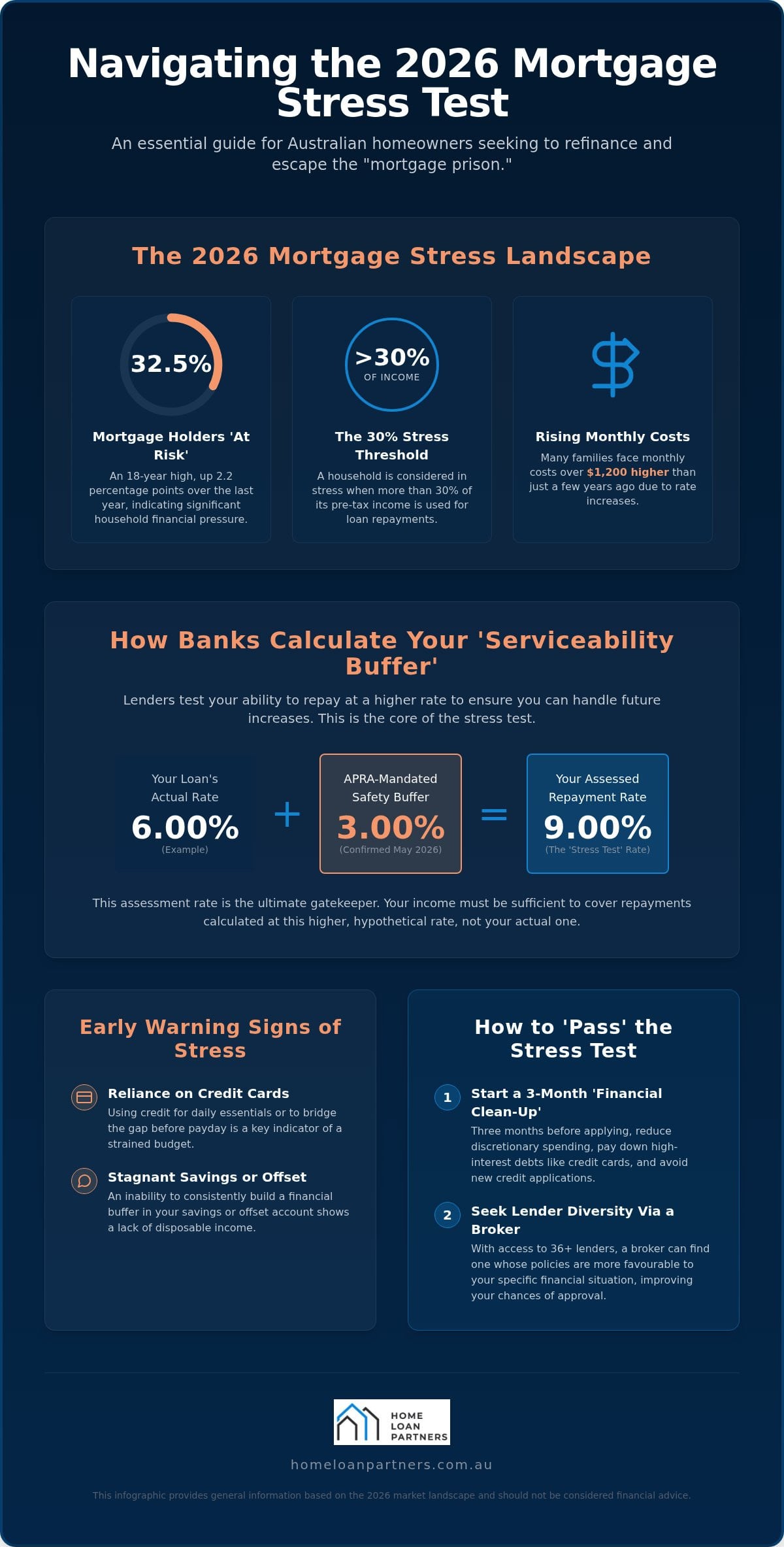
The current financial climate has left many Australians feeling the weight of their monthly repayments. According to Roy Morgan data from July 2026, mortgage stress reached an 18-year high, with 32.5% of mortgage holders considered “at risk.” This rise of 2.2 percentage points over the last year highlights why understanding the mortgage stress test australia 2026 is so critical for your financial health. While the headlines can feel overwhelming, it’s vital to remember that being in “stress” is a mathematical indicator, not a definitive sign that you’ll lose your home. It simply means your budget has less room for error than it used to.
To understand The 2026 Mortgage Stress Landscape in Australia, we first need to look at how the industry defines this pressure. Traditionally, a household is in mortgage stress when more than 30% of its pre-tax income goes toward loan repayments. With the RBA cash rate sitting at 4.35% through much of 2026, many families have seen their monthly costs jump by over $1,200 compared to just a few years ago. This shift has pushed many beyond that 30% threshold, turning what was once a comfortable lifestyle into a monthly balancing act.
The 30% Rule: Is It Still Relevant?
While the 30% benchmark is a helpful guide, its impact isn’t uniform across all households. For high earners, spending 30% of a large salary still leaves plenty of “fat” in the budget for lifestyle and savings. However, for low-to-middle income earners in 2026, that same 30% is much more punishing. The rising cost of essentials like groceries and utilities means that disposable income is shrinking from both ends. This makes passing a new serviceability test particularly challenging, as lenders are scrutinizing living expenses more closely than ever before.
Current Market Pulse: Rates and Dwelling Values
The broader property market is also adding a layer of complexity to the refinancing conversation. In July 2026, the National Home Value Index showed a slight dip of 0.7%, which can directly impact your Loan-to-Value Ratio (LVR). If your property’s value decreases while your debt remains the same, your equity shrinks, potentially making you a higher risk in the eyes of a new lender. Higher interest rates in 2026 directly reduce the maximum amount lenders are willing to provide, as a larger portion of your income is diverted to interest repayments rather than principal.
How Banks Calculate Your ‘Serviceability Buffer’ in 2026
When you apply for a loan or attempt to switch lenders, banks don’t just look at whether you can afford your repayments today. They use a “stress test” rate to ensure you can still manage your debt if interest rates climb even higher. This process is the core of How Banks Calculate Your ‘Serviceability Buffer’ in 2026. As of mid-2026, the standard buffer remains set at 3.0 percentage points. This means if your actual interest rate is 6%, the bank assesses your application as if you were paying 9%. It’s a significant hurdle that determines your borrowing capacity.
Lenders calculate your “Net Adjusted Income” by taking your take-home pay and subtracting existing commitments like car loans or personal debt. They also use the Household Expenditure Measure (HEM) to estimate your baseline costs for essentials like groceries and utilities. If your actual spending is higher than the HEM benchmark, the bank will use your real figures instead. This makes the mortgage stress test australia 2026 a highly personal calculation that goes far beyond a simple income-to-debt ratio.
The Role of APRA in Your Loan Application
APRA is the prudential regulator responsible for maintaining the stability of the Australian financial system. On May 28, 2026, APRA confirmed that the mortgage serviceability buffer would remain at 3% to protect against high household debt levels. While policy shifts are possible for late 2026, lenders currently use this strict floor as their primary safety margin. Different lenders have varying ways of interpreting “discretionary spending,” such as how they treat private health insurance or school fees, which can change the outcome of your mortgage stress test australia 2026 depending on which bank you choose.
Calculating Your Own Assessment Rate
You can run these numbers yourself to see where you stand. The formula is straightforward: your current interest rate plus the 3% buffer equals your assessment rate. This figure acts as the ultimate gatekeeper for your financial goals. If you’re curious about how these numbers look for your specific budget, our home loan calculator can help you visualize the impact of different rates. Understanding this math is the first step toward moving out of a “mortgage prison.” If your current assessment feels too tight, it might be time to explore refinancing options with a lender that has a more flexible approach to living expense assessments.
Are You in Mortgage Stress? Warning Signs and Indicators
Identifying financial strain isn’t always about a single number on a spreadsheet. It’s often found in the small, daily shifts in how you manage your cash flow. If you find yourself leaning on credit cards or “Buy Now, Pay Later” services to bridge the gap before payday, your mortgage is likely consuming too much of your income. This cycle creates a precarious situation where a single unexpected expense, like a car repair or medical bill, can derail your entire month. We see many clients who are managing their repayments but feel like they’re running on a treadmill that’s moving just a bit too fast.
There are several practical red flags that suggest you might be struggling with the mortgage stress test australia 2026 in your everyday life. These include:
- Stagnant Savings: Your offset account or redraw facility hasn’t grown in months, or you’re consistently dipping into it to cover basic utilities.
- Rate Anxiety: You feel a genuine sense of dread or physical anxiety whenever an RBA meeting approaches or the news mentions inflation.
- High Debt Ratios: Your total household debt, including car loans and personal cards, exceeds six times your annual pre-tax salary.
While these signs are concerning, they don’t mean you’re out of options. Recognizing these indicators early allows us to act as your expert collaborator to find a more sustainable path forward. Whether it’s restructuring your current debt or looking at refinancing, there are ways to regain your sense of security.
The Difference Between “At Risk” and “In Stress”
In 2026, data from Roy Morgan classifies a significant portion of the population as “At Risk,” but it’s important to understand the nuance. Some households in this category remain safe because they have high equity or a significant inheritance acting as a safety net. The real danger is the “Mortgage Prison” phenomenon. This occurs when your current financial profile means you can’t pass a new mortgage stress test australia 2026 with a different lender. It effectively locks you into your current high rate because you don’t meet the serviceability requirements to switch, even if a new loan would be cheaper.
Debt-to-Income (DTI) Ratios in 2026
Lenders have become increasingly conservative regarding Debt-to-Income ratios. In the current market, a DTI over 6 is typically flagged as high risk by most major banks. This ratio is a major factor when you’re applying for Investment Property Loans, as lenders want to ensure your total debt load doesn’t compromise your stability. To see how your specific numbers compare to industry benchmarks, you can explore our Debt to Income Ratio guide for a more detailed breakdown of what lenders are looking for right now.
How to ‘Pass’ the Mortgage Stress Test When Refinancing
Passing the mortgage stress test australia 2026 isn’t about hiding your lifestyle. It’s about presenting your most efficient financial self to a potential lender. While the 3% buffer is a rigid rule, the data you feed into that calculation is within your control. By taking proactive steps months before you submit an application, you can significantly shift the needle in your favor. We recommend starting this process at least ninety days before you plan to move, giving you enough time to demonstrate a consistent and sustainable financial profile.
The 90-Day Living Expense Audit
Lenders typically request three months of bank statements to verify your spending patterns against the HEM benchmarks we discussed earlier. During this window, it’s wise to categorise your spending into fixed and negotiable costs. Fixed expenses like insurance or school fees are set, but negotiable costs like multiple streaming subscriptions, premium gym memberships, and frequent dining out can be paused. Reducing or cancelling your credit card limits can instantly boost your borrowing power because lenders calculate your serviceability based on the full limit rather than your actual balance. Even if you pay your card off every month, that $10,000 limit is viewed as a potential $10,000 debt.
Strategic Refinancing to Relieve Stress
Moving to a lower interest rate is one of the most effective ways to pass the 3% buffer test. If you’re currently on a 6.5% rate, you’re being tested at 9.5%. Shifting to a 6% rate drops that assessment to 9%, which might be the margin you need for approval. You might also consider extending your loan term back to 30 years. While this means paying more interest over the life of the loan, it reduces the monthly repayment figure in the bank’s eyes, which can be a vital survival strategy in a high-rate environment. To understand the mechanics of this move, read our guide on What Does Refinancing a Home Loan Mean?
Another powerful lever is improving your Loan-to-Value Ratio (LVR). If you can use savings to bring your loan below 80% of the property’s value, you’ll likely access lower interest rates and avoid costly Lenders Mortgage Insurance. This lower rate then feeds back into a more favourable mortgage stress test australia 2026 result. If you’re ready to see which lenders might offer the most generous terms for your situation, reach out to our team for a tailored serviceability assessment today.
Navigating High-Stress Markets with The Home Loan Partners
Managing the mortgage stress test australia 2026 is a complex task to undertake on your own. When serviceability is tight, having a professional partner who understands the nuances of various lender policies makes a world of difference. At The Home Loan Partners, we don’t just see numbers on a page; we see your aspirations and the hard work you’ve put into your home. We act as your expert collaborator, navigating the technical hurdles so you can focus on your future. Our role is to provide a steady hand, ensuring you feel supported through every calculation and document request.
Our access to a panel of over 36 lenders is your greatest advantage in this environment. While every bank must adhere to the core principles of the mortgage stress test australia 2026, their individual “appetite” for certain types of borrowers can vary significantly. One lender might be more flexible with how they view rental income, while another might offer a more generous assessment of your bonus or commission structure. We find the specific lender whose policy aligns with your unique borrowing profile, helping you avoid unnecessary rejections that could impact your credit score.
Beyond the Big Four Banks
Many Australians default to the major banks, but smaller lenders or non-bank institutions often provide the most viable path out of a mortgage prison. These lenders might have different criteria for assessing discretionary spending or how they treat specific debt types. We take care of the heavy lifting by translating complex bank jargon into practical steps you can understand. This ensures you feel empowered rather than overwhelmed by the application process. By looking beyond the traditional institutions, we often find tailored loan structures that prioritise your immediate cash flow needs without compromising your long-term goals.
Your Long-Term Financial Partnership
Our commitment to you doesn’t end when your loan is settled. We believe in building a relationship that lasts throughout your entire property journey. Whether you are looking at Refinancing to lower your current repayments or planning your next life milestone, we are here to provide steady guidance. If you’re considering a property upgrade or looking into Investment Property Loans, we help you structure your debt to ensure security and growth. For more on how to choose the right expert for your journey, see our Ultimate Guide to Hiring a Finance Broker. Our goal is to ensure your experience is as stress-free as possible, providing a clear path forward in even the most challenging markets.
Taking Control of Your Financial Future
Navigating the mortgage stress test australia 2026 doesn’t have to be a journey you take alone. By understanding how lenders calculate your serviceability and taking proactive steps to clean up your financial profile, you can move beyond the anxiety of high interest rates. Whether it’s auditing your living expenses or lowering your LVR, these small shifts create the foundation for long-term security. Remember that failing a serviceability test with one bank doesn’t mean you’re out of options; it just means you haven’t found the right fit yet.
At The Home Loan Partners, we specialise in finding those fits. With access to over 36 Australian lenders, we provide expert guidance tailored to the 2026 rate environment. Our national team takes a client-centric approach to manage the heavy lifting of your application, ensuring your experience is as smooth and predictable as possible. If you’re ready to explore your options and find a path out of mortgage prison, you can book a stress-free consultation with The Home Loan Partners today. We’re here to help you achieve your major life milestones with confidence and precision.
Frequently Asked Questions
What is the current mortgage stress test buffer in Australia for 2026?
APRA confirmed on May 28, 2026, that the mortgage serviceability buffer remains at 3.0 percentage points. Lenders use this to assess your ability to repay a loan at an interest rate 3% higher than your actual rate. If your loan is at 6%, the bank tests your budget against a 9% rate. This safety margin ensures you can manage repayments even if interest rates rise significantly.
Can I still refinance if I fail the bank’s serviceability test?
Failing one bank’s serviceability test doesn’t end your journey. Different lenders have varying methods for calculating living expenses and discretionary spending. While one lender might decline your application based on the mortgage stress test australia 2026, another might have a more flexible policy that suits your profile. We provide access to a panel of 36+ lenders to find the right match for your unique financial situation and goals.
How does an offset account help with mortgage stress?
An offset account acts as a financial cushion by reducing the interest you pay while keeping your cash accessible. Every dollar in your offset account reduces the principal amount the bank charges interest on. This effectively lowers your monthly interest costs and helps you build a buffer against future rate hikes. It provides a sense of security and flexibility, allowing you to manage your budget with confidence.
What happens if the RBA raises interest rates further in 2026?
If the RBA raises the cash rate beyond 4.35% in 2026, your variable mortgage repayments will likely increase. This can tighten your household budget and push your debt-to-income ratio higher. To prepare, we recommend reviewing your current loan structure and exploring refinancing options that might offer a more competitive rate. Having a clear plan in place helps alleviate the anxiety associated with rate announcements and ensures your security.
Is 30% of my income still the right benchmark for mortgage stress?
The 30% rule is a standard industry benchmark, but it’s now viewed as a starting point rather than a definitive rule. In 2026, the rising cost of living means that even households spending less than 30% of their pre-tax income might feel financial pressure. Your specific disposable income after all essentials are paid is a more accurate measure of your stability. We focus on your unique budget.
How do banks treat “Buy Now, Pay Later” in a stress test?
Lenders view “Buy Now, Pay Later” (BNPL) accounts as ongoing debt obligations, similar to credit cards. Even without an active balance, the bank may consider the total available limit as a potential debt. These commitments can negatively impact your mortgage stress test australia 2026 results by reducing your net adjusted income. Closing unused BNPL accounts at least three months before applying for a loan can significantly improve your borrowing profile.
Should I fix my interest rate in 2026 to avoid stress?
Fixing your rate provides repayment certainty, which can be a powerful tool for alleviating financial anxiety. It protects you from potential RBA rate hikes, allowing you to budget with precision for the duration of the fixed term. However, you might miss out on potential rate decreases and face higher break costs if you switch loans. We help you weigh these factors to decide if a fixed structure is appropriate.
What is a “mortgage prison” and how do I get out of one?
A “mortgage prison” occurs when a borrower cannot refinance to a lower rate because they fail the 3% serviceability buffer with a new lender. To escape, you can focus on reducing existing debt, lowering credit card limits, and auditing your living expenses to improve your profile. We can help you find lenders with more generous assessment criteria or negotiate a better rate with your current bank’s retention team.