

What if the key to your first home isn’t a six-figure salary, but a smarter strategy for the income you already have? You might feel that the dream of ownership is slipping away as you balance high rents with the challenge of saving a deposit. It’s natural to ask, “can i get a home loan earning 60k a year” when major banks seem to prioritize high-earners and complex calculators leave you with more questions than answers. We understand the weight of these concerns and are here to provide the steady, professional guidance you need.
In this 2026 guide, we’ll reveal the realistic borrowing power of a $60,000 salary and show you how to optimize your financial footprint for current lending standards. You’ll gain a clear dollar-figure estimate of your capacity and discover how government initiatives like the First Home Guarantee can bridge the gap. By the end, you’ll have a clear, stress-free path forward, moving you from uncertainty to a place of genuine empowerment in your property journey.
Key Takeaways
- Discover why a surgical approach to lender selection makes home ownership achievable even if you aren’t a high-earner.
- Understand how banks use the Household Expenditure Measure to assess your daily living costs and how this impacts your borrowing capacity.
- Learn how to answer the question, “can i get a home loan earning 60k a year” by leveraging government schemes that require as little as a 5% deposit.
- Master the essential steps to audit your credit report and demonstrate six months of genuine savings to present a robust application.
- Explore how a professional partnership provides access to over 36 lenders, including tier-2 options that often offer more flexibility than the major banks.
The Short Answer: Is a Home Loan Possible on a $60,000 Salary in 2026?
The straightforward answer is yes; it is absolutely possible to secure a mortgage on this income. However, the 2026 property market requires what we call a “surgical” approach to your application. Rather than applying to any lender and hoping for the best, success comes from identifying specific lenders whose policies favor your unique situation. Achieving the Great Australian Dream on a moderate income isn’t just about the number on your payslip; it’s about how you demonstrate financial discipline and how you leverage the right professional partnership to navigate the process.
When asking, “can i get a home loan earning 60k a year,” it’s vital to distinguish between your borrowing capacity and your total purchase price. Your borrowing capacity is the amount a bank is willing to lend you based on your income and expenses. Your purchase price, however, is that loan amount plus your deposit. For a $60,000 earner, a larger deposit acts as a powerful lever, allowing you to look at higher-quality properties while keeping your loan-to-value ratio within a range that lenders find comfortable.
Understanding the 2026 Serviceability Buffer
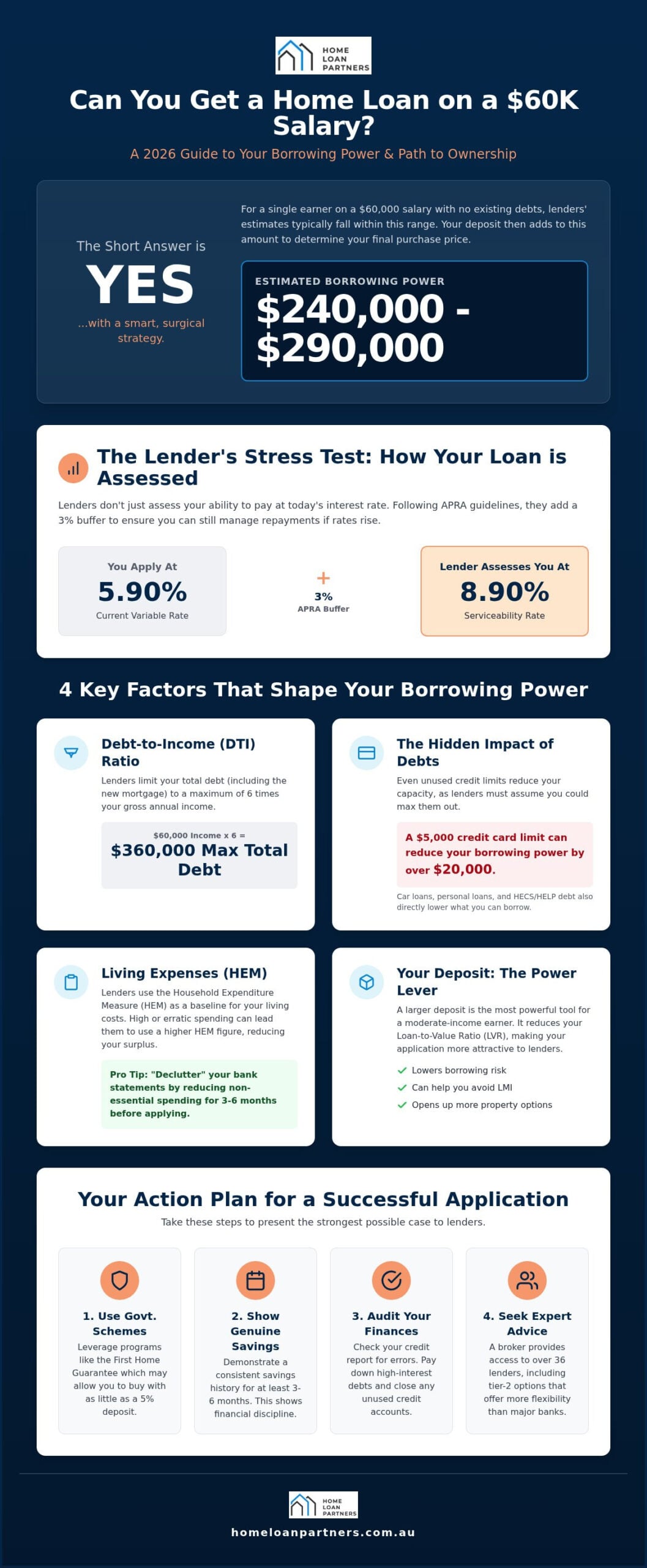
Lenders don’t just look at whether you can afford repayments at today’s rates. Following APRA guidelines, banks apply a 3% serviceability buffer. This means if you’re applying for a loan at a 5.90% variable rate, the bank tests your ability to manage the debt at 8.90%. Serviceability is the lender’s confidence in your monthly surplus. In 2026, lenders are particularly focused on cost-of-living adjustments, often using the Household Expenditure Measure (HEM) to estimate your bills. If your actual spending is lower than these averages, we can work together to highlight your genuine surplus and strengthen your case.
Realistic Borrowing Estimates for Single Earners
For a single earner on $60,000 with no existing debts, borrowing estimates typically sit between $240,000 and $290,000. However, this range shifts significantly if you have liabilities like a HECS debt, car loan, or credit card limits. Even an unused credit card with a $5,000 limit can reduce your borrowing power by tens of thousands of dollars. We recommend using a home loan calculator to model how different debt levels impact your bottom line. Remember, “maximum borrowing power” isn’t always the safest goal. We prioritize finding a loan structure that allows you to own your home without compromising your long-term financial security.
Factors That Determine Your Borrowing Power (Beyond Just Salary)
Your gross salary is only the first piece of the puzzle. When lenders evaluate whether you can afford a mortgage, they look at your Debt-to-Income (DTI) ratio to understand the total volume of your liabilities. In 2026, APRA guidelines limit the number of high-DTI loans banks can issue, making it harder to secure a mortgage if your total debts exceed six times your annual income. For someone asking, “can i get a home loan earning 60k a year,” this means your total debt ceiling, including the new mortgage, sits around $360,000. If you still have a HECS or HELP debt, your take-home pay is reduced by mandatory repayments, which directly lowers the amount a bank is willing to lend you.
The Hidden Impact of Existing Debts
Many first-home buyers are surprised to learn that credit card limits matter more than the actual balance. A lender assumes you could max out that card tomorrow; therefore, a $5,000 limit can slash $20,000 or more from your borrowing capacity. Car loans and personal loans are viewed through a similar lens. Because these often have high monthly repayments relative to the loan size, they eat into the surplus income needed to service a mortgage. If you’re preparing to apply, we often suggest a strategy of debt consolidation or closing unnecessary credit facilities to present the cleanest possible profile. You can find more detail on preparing your application in this Moneysmart guide to home loans.
Living Expenses and the 2026 HEM Benchmark
Lenders use the Household Expenditure Measure (HEM) as a benchmark to estimate your basic living costs, like groceries and utilities. If your bank statements show erratic spending or high discretionary costs, the bank might ignore your actual budget and use a higher HEM figure instead. This can be problematic on a $60,000 income where every dollar of surplus counts. We recommend “decluttering” your bank statements for at least three months before you apply. By reducing non-essential subscriptions and avoiding “buy now, pay later” services, you demonstrate the financial discipline lenders look for in a professional partnership. If you’re unsure how your current spending might be viewed by a bank, our team can help you perform a pre-application review to identify areas for improvement.
Overcoming the ‘Income Gap’: Grants, Schemes, and Strategies
Bridging the gap between a $60,000 salary and the current property market requires more than just frugal living. It requires strategic alignment with government initiatives designed to support modest earners. When you ask, “can i get a home loan earning 60k a year,” these schemes often provide the definitive “yes” by significantly lowering the upfront capital required. By leveraging these programs, you can transition from a renter to a homeowner far sooner than traditional savings methods would allow.
The 2026 First Home Guarantee (FHBG) is a cornerstone for many of our clients. It allows eligible buyers to enter the market with as little as a 5% deposit while the government guarantees the remaining 15%. This effectively removes the need for Lenders Mortgage Insurance (LMI), which can save you between $20,000 and $25,000 on a typical entry-level property. For single parents, the Family Home Guarantee is even more accessible, requiring only a 2% deposit. These programs are specifically tailored to ensure that those on moderate incomes aren’t permanently locked out of the market by rising deposit requirements.
Leveraging Government Support in 2026
The FHBG acts as a “virtual” 15% deposit, which is a game-changer for your serviceability. Because the government provides the guarantee, the lender views your application as a lower-risk 80% loan-to-value ratio (LVR) scenario. This often unlocks more competitive interest rates that are usually reserved for those with a full 20% deposit. For a broader view of how these pieces fit together, our guide on how do i buy a house in australia provides a comprehensive roadmap for the entire journey. In 2026, the Help to Buy shared equity scheme also offers a path for a 2% deposit for those earning under $100,000, which perfectly suits your current income level.
The Role of Lenders Mortgage Insurance (LMI)
If you don’t qualify for a government guarantee, LMI is typically the “cost of entry” for lower-income earners with small deposits. While it’s an added expense, it shouldn’t be viewed solely as a hurdle. For many, paying LMI is a calculated strategic move to enter the market now rather than waiting years to save a larger deposit while property values potentially increase. We often help our clients “capitalize” the LMI, which means adding the premium to the total loan amount. This preserves your cash for other upfront costs like legal fees and moving expenses. Additionally, on a $60,000 income, you’ll likely qualify for significant stamp duty concessions or full exemptions, depending on your state’s specific thresholds for first-home buyers.
Another powerful option is the guarantor strategy. If a family member has sufficient equity in their own home, they can provide a limited guarantee for a portion of your loan. This can bypass the deposit hurdle entirely and eliminate LMI, providing a smooth path to ownership through the strength of a family partnership.
Preparing Your Finances for a Successful Application
Success on a $60,000 income isn’t just about what you earn; it’s about the financial discipline you demonstrate. When you’re asking, “can i get a home loan earning 60k a year,” the answer often depends on the strength of your preparation. In 2026, Australian lenders utilize Comprehensive Credit Reporting (CCR), which means they see both your missed payments and your history of on-time behavior. Your first step should be a thorough audit of your credit report to ensure there are no forgotten defaults or administrative errors that could derail your application. This proactive audit allows us to address any concerns before a lender sees them.
Stability is the currency lenders value most. Beyond your credit score, you need to prove a consistent savings pattern over at least a six-month period. Banks aren’t just looking for a lump sum; they want to see that you can live within your means while setting aside money for your future. This behavior serves as a “stress test” for your future mortgage repayments. If you’re ready to see how your current financial habits stack up, you can book a financial health check with our team today.
Building a ‘Lender-Ready’ Profile
In the eyes of a 2026 lender, “genuine savings” typically refers to at least 5% of the property’s purchase price held in a bank account for three consecutive months. While a gift from parents is helpful for your deposit, most lenders still require you to demonstrate your own savings history to prove financial maturity. You should also address “buy now, pay later” services like Afterpay or Zip well before applying. Even if you don’t have an active balance, these accounts are often viewed as open credit facilities that can negatively impact your borrowing capacity. We recommend closing these accounts at least three months prior to your application to ensure your bank statements are clean and professional.
Employment Stability and Income Types
Lenders view permanent part-time income more favorably than casual work because of the perceived security. If you’re a casual worker on $60,000, most banks will require you to have been with the same employer for at least 12 months to prove income consistency. Overtime and bonuses are only sometimes counted at 100% capacity; many lenders will only take 80% of these earnings into account to provide a safety margin. If you’ve recently changed jobs but stayed within the same industry, we can often present this as “continuity of income” rather than a risk. However, being on a probation period is still a major red flag for most mainstream lenders, so it’s usually best to wait until your position is confirmed before submitting your final application.
How a Mortgage Broker Maximises Your Chances on a $60k Income
While a local bank branch can only offer products from their own shelf, a mortgage broker provides a gateway to a panel of over 36 lenders. When you’re asking, “can i get a home loan earning 60k a year,” this diversity is your greatest asset. A major “Big Four” bank might have rigid serviceability rules that result in a quick rejection. However, a tier-2 or non-bank lender might have policies specifically designed for single-income earners or those with smaller deposits. We take a collaborative partner approach to ensure your application isn’t just another file; it’s a strategically packaged case that highlights your financial strengths and mitigates any perceived risks.
Our role is to alleviate the inherent stress of the 2026 lending landscape by managing the heavy lifting for you. We don’t just find a loan; we navigate the entire process with patience and precision. This professional partnership doesn’t end when your loan settles. We continue to work with you throughout the duration of your mortgage, ensuring your structure remains aligned with your long-term life milestones. By acting as your steady hand, we help you transition from the frustration of high rent to the security of your own front door.
Finding the ‘Niche’ Lenders
Every lender has a “sweet spot” for the type of borrower they prefer. Some specialize in helping those with HECS debts, while others are more lenient with how they view casual income or overtime earnings. A professional finance broker identifies these policy niches so you don’t have to. Instead of risking multiple credit inquiries that could damage your score, we perform the research upfront to find the lender most likely to say yes. This targeted strategy saves you time and protects your credit reputation during this critical period.
Your Journey to Home Ownership Starts Here
Earning $60,000 a year is a significant milestone and a solid foundation for your property journey. To shop with genuine confidence, we recommend a pre-approval strategy. This gives you a clear, verified budget so you can make offers on properties knowing exactly where you stand. It transforms the experience from one of uncertainty to one of empowerment. We’re here to translate the industry jargon into practical language and guide you through every choice with clarity. Let’s start this journey together and turn your aspirations into a tangible reality. Your path to ownership is clear, and we’re ready to help you take that first successful step.
Your Path to Home Ownership in 2026
Securing your future doesn’t require an unreachable salary; it requires a precise roadmap and a steady hand to guide you. By understanding how lenders view your financial footprint and utilizing 2026 government initiatives like the First Home Guarantee, the answer to can i get a home loan earning 60k a year becomes a confident yes. We’ve explored how cleaning up credit facilities and demonstrating a consistent savings history can transform your application from a risk into a compelling case for approval.
You don’t have to navigate these complex financial waters alone. As specialists in First Home Buyer support, we provide national expert guidance and access to a panel of over 36 Australian lenders to find the specific niche that fits your goals. Our commitment is to manage the heavy lifting, translating industry jargon into a clear, stress-free journey toward your major life milestones. Start your home loan journey with a professional partner today and take the first step toward the security of your own home. Your aspirations are within reach, and we’re ready to help you achieve them.
Frequently Asked Questions
Is $60,000 a year considered a low income for a home loan in 2026?
In the 2026 property market, $60,000 is generally viewed as an entry-level or moderate income for mortgage assessments. While it sits below the national average, it does not prevent you from achieving home ownership. Lenders focus more on your net surplus after living expenses than your gross salary. By maintaining a lean budget and minimal liabilities, you can still present a strong application to various lenders on our panel.
How much can I borrow on a 60k salary with no deposit?
True no-deposit loans are rare, but you can borrow up to 98% of a property’s value through specific government initiatives or guarantor arrangements. On a $60,000 income, your borrowing capacity typically sits between $240,000 and $290,000. Without a cash deposit, you’ll need a family member to provide additional security or qualify for a shared equity scheme to bridge the gap between your loan amount and the purchase price.
Does having a HECS-HELP debt affect my borrowing power on 60k?
Yes, HECS-HELP debt reduces your borrowing power because mandatory repayments lower your take-home pay. Lenders deduct these repayments from your net income before calculating your maximum loan amount. On a $60,000 salary, even a standard HECS balance can reduce your borrowing capacity by several thousand dollars. This happens because the debt impacts your debt-to-income ratio and reduces the monthly surplus available to service a mortgage.
Can I get a home loan on $60,000 if I am self-employed?
You can secure a home loan while self-employed if you provide at least two years of tax returns showing consistent earnings. Lenders usually average your profit over the last two financial years to determine your stable income. If your business has recently reached the $60,000 threshold, some specialist lenders may consider a single year of tax returns, though this requires a more detailed professional partnership to package your application correctly.
What is the minimum deposit I need for a house if I earn 60k?
The standard minimum deposit is 5%, but certain government programs like the Family Home Guarantee allow eligible buyers to start with as little as 2%. For a $300,000 property, a 2% deposit is $6,000, while 5% is $15,000. You’ll also need to budget for upfront costs like legal fees and building inspections, which are generally not included in the loan amount and must be paid from your savings.
Will a bank reject my loan if I have a credit card balance?
A credit card balance won’t cause an automatic rejection, but the card’s total limit will definitely reduce your borrowing capacity. Banks assess the full limit as a potential debt, even if your balance is zero. When asking, “can i get a home loan earning 60k a year,” it’s often wise to reduce your limits or close the accounts entirely. This strategy maximizes your serviceability and shows lenders you have full control over your finances.
How do I use a guarantor to buy a home on a lower income?
A guarantor uses the equity in their own property to provide additional security for your mortgage. This allows you to borrow up to 100% of the purchase price plus costs without paying Lenders Mortgage Insurance. It’s an effective strategy for those on $60,000 incomes because it removes the hurdle of a large cash deposit. We recommend that all guarantors seek independent legal advice to understand their responsibilities before entering this collaborative arrangement.
Are there specific lenders that are better for low-income earners in Australia?
Yes, many tier-2 and non-bank lenders have more flexible serviceability models that favor single-income earners. While major banks often have rigid criteria, these specialist lenders may offer more generous assessments of your overtime, bonuses, or part-time work. We access a panel of over 36 lenders to identify the institutions that offer the most favorable policies for your unique situation, ensuring your journey to home ownership is as smooth as possible.