

Choosing the lowest interest rate on the market could actually be the most expensive mistake you make this year. With the RBA cash rate holding steady at 4.35% through August 2026, it is completely natural to feel a sense of hesitation. You are likely weighing the fear of future rate hikes against the dread of locking in a rate just as the market potentially softens. We understand that the pressure of monthly budgeting and the complexity of features like offset accounts can feel overwhelming. This is why the fixed vs variable home loan decision requires a strategy that looks beyond just the headline number.
Our goal is to act as your steady guide through these choices. This comparison will help you move past the surface-level debate to find a structure that truly aligns with your life milestones and financial security. We will break down the latest 2026 market data, explore the strategic benefits of split loans, and show you how to maintain the flexibility you need to make extra repayments. By the end, you will have a clear, stress-free path toward lower interest costs and greater peace of mind for your future.
Key Takeaways
- Understand how the 2026 economic environment influences the fixed vs variable home loan debate and what it means for your monthly budget.
- Evaluate the benefits of repayment certainty against the flexibility of variable features like offset accounts to see which aligns with your lifestyle.
- Learn why many proactive borrowers are choosing split loans as a strategic way to hedge against future interest rate movements.
- Discover how accessing a panel of over 36 lenders allows you to find niche products that go beyond the standard offerings of major banks.
- Gain clarity on how a tailored loan structure serves as a steady foundation for your long-term financial journey and major life milestones.
Fixed vs Variable Home Loans: Understanding the Basics in 2026
The decision between a fixed vs variable home loan is no longer just about chasing the lowest headline number; it’s about your personal comfort level in a shifting economy. In 2026, we’ve seen the Reserve Bank of Australia hold the cash rate at 4.35% following a period of intense inflation. This stability brings a unique challenge for homeowners. Do you lock in a rate now for peace of mind, or stay flexible to catch potential future cuts? Understanding these fundamentals is the first step toward a stress-free financial journey.
The choice between these two structures often comes down to your personality as much as your wallet. If you value knowing exactly what leaves your bank account each month, a fixed rate is your ally. If you’re a proactive wealth builder who wants to use features like offset accounts to pay down debt faster, a variable rate might be the better fit. We’re here to help you weigh these psychological and financial factors with precision.
How Fixed Interest Rates Work
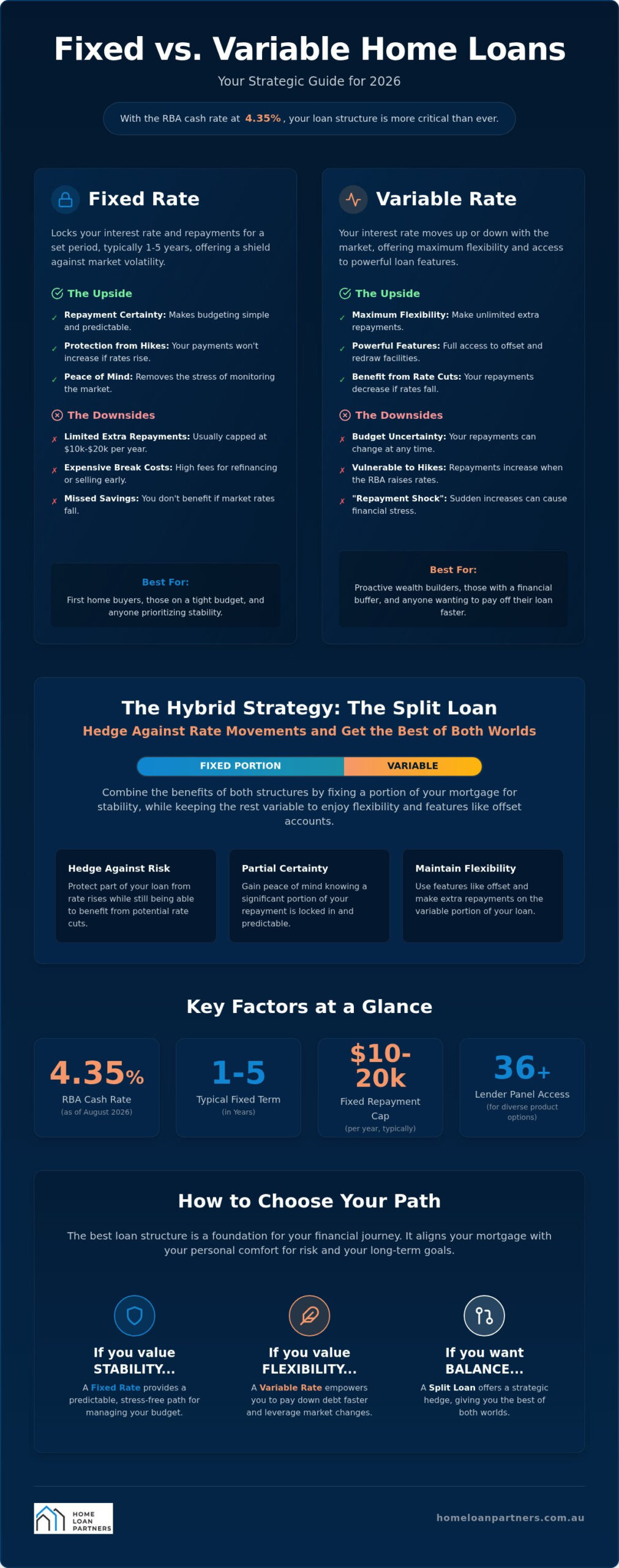
A fixed-rate loan locks your interest rate for a specific period, typically between one and five years. This structure acts as a protective shield. Even if the market fluctuates or the RBA raises rates, your repayments remain identical every single month. It’s a powerful tool for families who need absolute budget certainty to manage their household expenses. However, this security comes with specific constraints. You might face significant break costs if you decide to refinance or sell the property before the term ends. Most lenders also limit your ability to make large extra repayments, often capping them between $10,000 and $20,000 per year.
How Variable Interest Rates Work
A variable-rate loan, often referred to as an adjustable-rate mortgage in global contexts, is the more fluid choice for Australian borrowers. Your interest rate can move up or down based on the RBA’s decisions and your lender’s own funding costs. While this introduces some uncertainty into your monthly budget, it offers the greatest level of flexibility. You can usually make unlimited extra repayments and access full features like offset accounts and redraw facilities. In the context of Australian lending, the Standard Variable Rate is the benchmark interest rate set by a lender for their basic home loan products before any specific discounts or negotiated margins are applied. Choosing a fixed vs variable home loan requires looking at how these features can reduce your total interest over the life of the loan.
Fixed Rate Home Loans: When Is Certainty the Right Move?
For many Australians, especially first home buyers, the primary goal is stability. A fixed-rate loan provides a solid foundation by ensuring your repayments don’t change for a set term, usually between one and five years. This structure is particularly valuable if you’re working with a tight monthly budget. Fixed rates are often best for those with limited financial buffers who cannot afford for their living costs to spike overnight.
The Benefits of Predictability
When you choose a fixed rate, you’re effectively buying insurance against interest rate volatility. Even with the RBA cash rate held at 4.35% as of August 2026, the future remains uncertain. Knowing your exact commitment allows for precise long-term financial planning. It removes the stress of “repayment shock” that occurs when variable rates climb. Understanding the difference between a fixed-rate and adjustable-rate mortgage helps you decide if you’re willing to trade flexibility for this guaranteed calm. This predictability is a cornerstone for families who want to focus on their life milestones rather than monitoring central bank announcements.
Strategic Considerations for Fixed Loans
While certainty is comforting, it comes with specific trade-offs. The biggest risk is locking in a rate at the peak of a cycle, only to watch market rates drop later. If you need to exit the loan early due to a lifestyle change, such as selling your home or refinancing, you may face expensive break costs. These penalties are calculated based on complex market formulas and can reach thousands of dollars. Additionally, most lenders restrict your ability to pay down debt faster, often capping extra repayments at $10,000 to $20,000 per year. This limit can be frustrating if you receive a bonus or inheritance you want to put toward your mortgage.
You also need to plan for the “roll-to” date. When your fixed term ends, most loans automatically revert to a higher Standard Variable Rate, which often acts as a loyalty tax on unaware borrowers. Navigating the fixed vs variable home loan choice requires looking three to five years ahead, not just at today’s rate. Our team can help you evaluate your current loan structure to ensure you aren’t caught in a high-interest trap when your fixed term expires. By managing the heavy lifting of lender comparisons, we ensure your loan continues to serve your long-term journey.
Variable Rate Home Loans: Maximising Flexibility and Features
While fixed rates offer a safety net, variable rates provide the engine for long-term wealth creation. If your primary goal is to pay off your home as quickly as possible, this structure is often the superior choice for proactive borrowers. The fixed vs variable home loan decision frequently hinges on whether you want to set your budget in stone or maintain the agility to capitalize on financial windfalls. For those who expect their income to grow or who receive irregular bonuses, the variable path offers the freedom that fixed contracts lack.
The most significant advantage here is the ability to make unlimited extra repayments. Shaving even a few years off a thirty year mortgage can save you tens of thousands of dollars in interest costs. You can use our Home Loan Calculator Guide to model how small, consistent lump sums or increased monthly payments impact your total loan term. This proactive approach turns your mortgage into a manageable tool rather than a static debt.
The Role of Offset Accounts and Redraw
Understanding the mechanics of your loan features is essential for maximizing your savings. An offset account is a separate transaction account linked to your mortgage; the balance in this account is subtracted from your loan balance before interest is calculated. If you have a $500,000 loan and $50,000 in your offset, you only pay interest on $450,000. This effectively “lowers” your interest rate while keeping your cash accessible for emergencies or lifestyle needs. For a broader look at how these structures function, the Consumer Financial Protection Bureau guide on loan options provides a helpful foundation on different mortgage types.
Redraw facilities offer a similar benefit but work slightly differently. Instead of a separate account, you pay extra money directly into the loan and can “draw” it back out if needed. While offset accounts offer better liquidity and tax benefits for future investors, redraw facilities are often found on more basic, lower-cost variable products. Choosing between them depends on your specific cash flow requirements and long-term property goals.
Managing the Risks of Market Volatility
With the RBA cash rate held at 4.35% through August 2026, many borrowers feel the pressure of market uncertainty. A smart variable-rate strategy involves building a “repayment buffer.” By setting your actual repayments at a higher rate than the bank requires, you create a financial cushion that protects you if rates rise. This habit also helps you pay down the principal faster while rates remain steady. It’s also vital to monitor your rate regularly to avoid the “loyalty tax” where lenders offer better deals to new customers than to existing ones. Engaging a professional finance broker allows you to have an expert negotiator in your corner. We can compare your current rate against our panel of 36+ lenders to ensure you’re always positioned competitively in the market.
The Hybrid Strategy: Why Split Loans Are Trending in 2026
A split loan allows you to divide your mortgage into two separate parts: one with a fixed interest rate and one with a variable rate. This hybrid approach has become a standout trend in 2026 because it effectively hedges your bets against market movements. By splitting your debt, you gain the repayment certainty of a fixed term while retaining the powerful features of a variable loan, such as an offset account. It’s a strategic way to resolve the fixed vs variable home loan dilemma by simply choosing both.
The real power of this strategy lies in customization. You aren’t limited to a simple 50/50 split. Many of our clients choose a ratio that mirrors their specific financial goals and risk tolerance. For instance, you might fix 80% of your loan to lock in current rates while keeping 20% variable to ensure you can still make uncapped extra repayments. This ensures that even if rates rise, the majority of your debt is protected, yet you aren’t completely locked out of market-leading features.
Strategic Scenarios for Split Loans
Your life stage should dictate your split ratio. Consider a young family who needs to know exactly what their mortgage costs are to manage daycare and grocery bills. They might fix 70% of their loan for three years to ensure budget stability. The remaining 30% stays variable, allowing them to park their savings in an offset account to reduce interest charges. This provides a safety net while still rewarding their saving habits.
In contrast, an investor might use a split loan for tax-effective debt recycling. They could keep a larger variable portion to allow for aggressive pay-downs, which then frees up equity for their next investment property. When you decide to refinance your home loan, adjusting these ratios is a perfect time to realign your debt with your current life goals. We can help you model these different scenarios to find the exact balance that fits your journey.
Is a Split Loan Right for You?
Managing a split loan does require a bit more administration since you’ll technically have two loan accounts with two different interest rates. You’ll need to monitor when the fixed portion expires to avoid rolling onto a high default rate. However, for most, the benefits of flexibility and security far outweigh the minor extra paperwork. It’s about finding that “sweet spot” where you feel in control of your finances regardless of what the RBA decides at their next meeting.
Choosing the right ratio is a precision task. We recommend consulting an expert who can model different scenarios based on your income, savings habits, and future plans. As your dedicated collaborator, we do the heavy lifting by comparing options across our panel of 36+ lenders. This ensures your split isn’t just a guess, but a calculated move toward financial freedom and long-term security.
Choosing Your Path: How a Mortgage Broker Navigates the Choice
The decision between a fixed vs variable home loan is often the most stressful part of the property journey. Many borrowers start by visiting their current bank, only to find themselves limited by a narrow range of products. We believe you deserve a more comprehensive view. As your expert collaborator, we do the heavy lifting by comparing options across our panel of 36+ lenders. This ensures you aren’t just taking what’s offered, but choosing a structure that serves your specific goals.
While the “big four” banks dominate the headlines, they represent only a small fraction of the Australian lending market. We provide access to niche lenders and specialized products that often offer more competitive terms or features better suited to your lifestyle. We act as an intermediary, translating complex financial jargon into a clear, stress-free path forward. Our role is to provide a sense of calm and steady expertise while you focus on the excitement of your next move.
Beyond the Interest Rate
A low headline rate can be deceptive if it’s paired with high annual fees or restrictive terms. We look deeper than the percentage to evaluate how a loan’s features align with your life. For example, if you’re planning a career break or a major renovation, the flexibility to redraw funds might be more valuable than a slightly lower fixed rate. We also assess lender service levels to ensure you’re partnering with a provider that values your business as much as we do.
The lowest rate isn’t always the cheapest loan over a 30 year term. Hidden costs and lack of features can add up, which is why we prioritize transparency and long-term value. We view our involvement as a long-term journey partnership. Our support doesn’t end when your loan is settled; we continue to monitor the market to ensure your mortgage remains the right fit as your life evolves.
Next Steps in Your Property Journey
Starting your review is simpler than you might think. We’ll help you gather the necessary documents for a comprehensive financial review, from income statements to existing debt details. This level of precision allows us to find a tailored loan structure that supports your specific aspirations. If you’re currently wondering what does refinancing a home loan mean in the current 2026 market, we can clarify how a new structure could lower your costs or unlock equity for your next project.
Ready to start? Book a consultation with The Home Loan Partners today. We are here to guide you through every option with patience and precision, ensuring you feel confident in every choice you make.
Taking the Next Step Toward Your Property Goals
Navigating the fixed vs variable home loan landscape doesn’t have to be a source of stress. We’ve explored how fixed rates provide a necessary safety net for budget-conscious families, while variable rates offer the agility needed for proactive debt reduction. By considering a hybrid split loan strategy, you can even enjoy the best of both worlds, balancing protection with the power of an offset account. The key is ensuring your loan structure serves your life milestones rather than just following market trends.
Our team is here to act as your steady guide, managing the heavy lifting so you can focus on your future. With access to over 36 leading Australian lenders, we provide the unbiased advice and expert guidance you need to make an informed decision. We take the time to understand your unique financial goals, translating complex industry jargon into a clear, manageable path forward.
Let The Home Loan Partners find the perfect loan structure for your future. We look forward to supporting you through every step of this journey and helping you achieve the financial peace of mind you deserve.
Frequently Asked Questions
Is it better to have a fixed or variable home loan in 2026?
The better choice depends entirely on your financial goals and risk tolerance. With the RBA cash rate at 4.35% in August 2026, fixed rates currently average 6.70%, offering slightly lower entry points than the average variable rate of 6.92%. However, variable loans provide the flexibility of offset accounts and uncapped extra repayments. Choosing between a fixed vs variable home loan requires balancing immediate repayment certainty against the potential for future rate cuts predicted for 2027.
Can I switch from a fixed to a variable rate before my term ends?
Yes, you can switch, but it usually involves paying break costs. These fees compensate the lender for the loss of interest they expected to earn during your fixed term. Because fixed contracts are legal agreements, exiting early can be expensive, especially if market rates have dropped since you locked in. It’s vital to have a broker calculate these costs against the potential savings of a new variable rate to ensure the move makes financial sense for your journey.
How much can I save with an offset account on a variable loan?
You can save thousands of dollars in interest by keeping your savings in an offset account. Every dollar in the account reduces the principal amount on which interest is calculated. For example, if you have a $500,000 loan and $50,000 in your offset, you only pay interest on $450,000. Over a 30 year term, this can shave years off your mortgage and significantly lower your total interest costs without locking your cash away.
What are break costs and how are they calculated?
Break costs are fees charged when you pay off or refinance a fixed-rate loan before the term expires. Lenders calculate these based on the difference between the interest rate you locked in and the current market wholesale rates. If market rates have fallen significantly since you started your fixed term, your break costs will likely be higher. These fees are complex, so we recommend requesting a formal quote from your lender before making any sudden changes to your loan structure.
Can I have an offset account with a fixed-rate home loan?
Most traditional fixed-rate loans in Australia don’t offer full offset account features. While some specialized lenders on our panel of 36+ may offer partial offset facilities on fixed products, they’re much less common than on variable loans. If an offset account is a priority for your wealth strategy, you might consider a split loan. This allows you to keep a portion of your debt variable to utilize the offset feature while the rest remains fixed for certainty.
What happens when my fixed-rate period expires?
Your loan will typically roll over to the lender’s Standard Variable Rate once the fixed term ends. This rate is often higher than the most competitive deals available to new customers, which can lead to a significant jump in your monthly repayments. To avoid this loyalty tax, we suggest reviewing your options three months before your term expires. This gives us time to compare 36+ lenders and secure a more competitive fixed vs variable home loan for your next chapter.
How often do variable interest rates change in Australia?
Variable rates can change at any time, though they most frequently move following the Reserve Bank of Australia’s monthly cash rate announcements. While the RBA held the cash rate at 4.35% in August 2026, lenders sometimes adjust their rates independently based on their own funding costs or competitive strategy. Staying on a variable rate means your repayments will fluctuate, so it’s important to maintain a financial buffer to manage these shifts without unnecessary stress.
Is a split loan more expensive to set up than a standard loan?
Generally, a split loan doesn’t carry significantly higher setup costs, though some lenders may charge a small fee for managing two separate loan accounts. You might also see a monthly or annual package fee that covers both portions of the loan. The primary cost is the slightly more complex administration of tracking two different interest rates and expiry dates. Most borrowers find this small trade-off worthwhile for the balance of flexibility and repayment security it provides.