

What if the most stressful part of building your dream home wasn’t the weather or the council, but the way you paid for it? Most homeowners feel a natural sense of anxiety when it comes to managing builder payments and the fear of hidden fees. You likely already know that building a home is one of the biggest milestones you’ll ever achieve, but the financial mechanics behind the scenes can feel like a maze of technical jargon and high stakes. Securing construction loans nsw requires more than just a standard application; it’s about creating a steady financial partnership that protects your investment through every stage of the build.
We’re here to help you master the complexities of progress payments and building contracts so you can focus on the excitement of your new home. This guide provides a clear, stress-free path from your initial soil test to receiving your final completion approval under the 2026 regulations. You’ll gain a deep understanding of how progressive drawdowns work, how to navigate the latest government grants, and why choosing the right lender structure is the key to a successful build. We’ll explore the essential steps to managing your funds with confidence, ensuring your project stays on track and within budget from day one.
Key Takeaways
- Understand how construction loans nsw use progressive drawdowns to pay your builder in stages, ensuring you only pay interest on funds as they’re actually used.
- Learn about the five standard stages of a NSW building contract and how independent bank valuations protect your investment before funds are released.
- Discover the “as-if-complete” valuation method lenders use to determine your borrowing power based on your home’s future market value.
- Identify the essential builder documents and insurance requirements needed to create a robust application and avoid common delays during the approval process.
- Explore how a dedicated broker can manage the heavy lifting of payment requests and help you navigate tailored options from a panel of over 36 lenders.
What is a Construction Loan and How Does it Work in NSW?
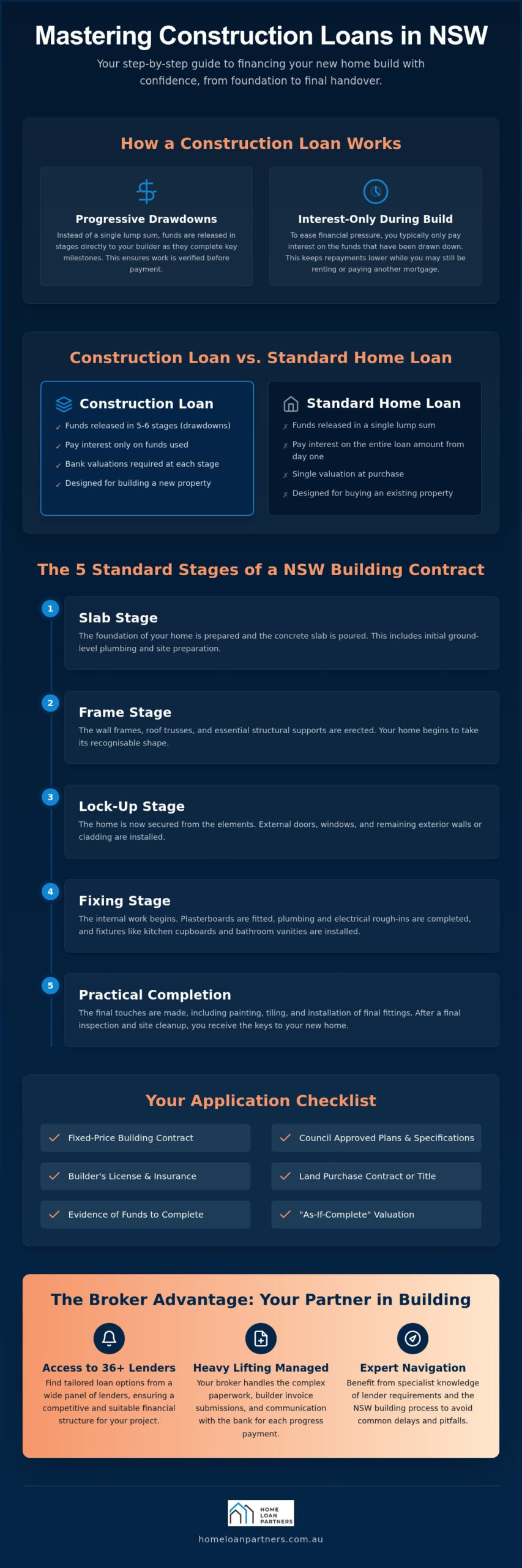
A construction loan is a specialized financial tool designed specifically for those building a new home or undertaking significant renovations. While a traditional mortgage loan provides a lump sum to purchase an existing property, construction loans nsw function as a flexible credit facility that grows alongside your project. This structure ensures your funds are managed safely, with payments made directly to your builder only as they complete specific milestones. It’s a protective measure that keeps your property journey secure from the first soil test to the day you receive your completion approval.
In the 2026 NSW market, this phased approach is more important than ever. With the introduction of the Building (Approvals and Practitioners) Act 2026, the certification process is more streamlined, and your loan needs to mirror these new regulatory stages. This alignment provides a sense of security, knowing that your financial releases are tied to verified progress on site. By using this structured method, you avoid the risk of paying for work that hasn’t been finished, protecting your equity throughout the entire construction process.
The Progressive Drawdown Mechanism
The most significant feature of this loan type is how the money leaves the bank. Instead of a single payment, funds are released through a series of drawdowns at key intervals. These typically include:
- Slab stage: Foundation and base plumbing are complete.
- Frame stage: Wall frames and roof trusses are standing.
- Lock-up stage: Windows, doors, and external walls are finished.
- Fixing stage: Internal cladding and plumbing are installed.
- Practical completion: The final handover and site cleanup.
Because you aren’t using the full loan amount from day one, you only pay interest on the portion that’s actually been paid to the builder. A progressive drawdown is the systematic release of funds triggered by building milestones.
Interest-Only Repayments While You Build
Managing your budget during a build is challenging if you’re still paying rent or a mortgage on your current home. To alleviate this pressure, most construction loans nsw offer an interest-only period during the building phase. This keeps your monthly repayments lower while the house is under construction, as you aren’t paying back the principal amount yet. This structure acts as a financial bridge, allowing you to maintain your lifestyle while your future home takes shape.
Once your builder reaches practical completion, the loan typically transitions into a standard Principal and Interest structure. This transition supports your long-term financial stability and helps you begin building equity in your new asset. By partnering with a guide who understands these 2026 requirements, you can navigate these transitions with precision and confidence.
The 5 Standard Stages of a NSW Building Contract
A building contract in New South Wales acts as a financial roadmap for your project. Most lenders require a fixed-price contract to ensure the build remains within a set budget, which provides a layer of security for both you and the bank. This document outlines exactly when your builder receives payments, and by extension, when your loan draws down. While you might initially ask What is a construction loan? to grasp the broad concept, the local NSW contract stages are what dictate the rhythm of your life during the construction phase. Understanding these milestones helps you prepare for the documentation required at every turn.
From Slab to Lock-Up: The Early Milestones
The journey typically begins with a deposit, followed quickly by the base or slab stage. Once the foundation is poured and the plumbing is set, the frame stage begins. For construction loans nsw, your lender won’t simply take your word that work is progressing. You must submit the builder’s official invoice along with a signed progress claim form. A bank-appointed valuer will often visit the site during these early milestones. Their role is to verify that the work described in the invoice is actually completed on the ground. This protective step ensures the bank only releases funds for tangible progress, keeping the project’s value aligned with the debt. If you’re planning your budget, our Home Loan Calculator Guide is an excellent resource for estimating your interest-only costs during these initial months.
Fixing and Practical Completion
As the house becomes weather-tight, you enter the fixing stage. This is when internal linings, cabinetry, and skirting boards are installed. The final hurdle is practical completion, where the house is ready for you to call home. Under the Building (Approvals and Practitioners) Act 2026, the process for final sign-off has been streamlined. The old occupancy certificate has been replaced by a “completion approval,” which is the legal document proving the home meets all safety and council standards. Your lender will require this approval before they release the final payment to the builder. A final inspection by the bank’s valuer also takes place to confirm the property matches the original “as-if-complete” valuation. If you find the coordination between the builder and the bank daunting, the team at Home Loan Partners can step in to manage the heavy lifting of these payment requests, ensuring a smooth transition to your new front door.
Construction Loan vs. Standard Home Loan: Key Differences
Choosing between an existing property and a custom build often comes down to your tolerance for detail. A standard home loan is relatively straightforward; the bank values a finished house and provides a lump sum at settlement. In contrast, construction loans nsw are dynamic facilities that require a more rigorous application process. You might wonder if the extra paperwork is truly worth the effort. The answer lies in the protection this structure provides. By requiring detailed plans and specifications upfront, the lender ensures your project is financially viable before a single brick is laid. This process effectively shields you from the risk of overcapitalizing or running out of funds mid-build.
Understanding how construction loans work reveals why they are more document-heavy. While a standard loan relies on historical sales data for a specific address, a construction loan relies on a vision of the future. This requires you to provide a signed fixed-price building contract, council-approved plans, and detailed specifications. This level of preparation might feel daunting, but it’s the foundation of a stress-free project. It allows the lender to assess the risk with precision, which often leads to more favorable terms for your long-term financial health.
The “As-If-Complete” Valuation
Lenders view a project that doesn’t exist yet through a different lens than a finished house. They perform an “as-if-complete” valuation, which estimates what the property will be worth once the builder hands over the keys in 2026. This figure is critical because it determines your Loan-to-Value Ratio (LVR) and your borrowing power. If the valuation comes in lower than expected, you might need a larger deposit to bridge the gap. We recommend using our borrowing power calculator to understand how these future valuations impact your current budget and deposit requirements.
Knock-down Rebuild (KDRB) Specifics
For many families in established NSW suburbs, the land is their greatest asset. A knock-down rebuild allows you to stay in the neighborhood you love while enjoying a modern, energy-efficient home. The financial structure here is unique because you can often use the existing equity in your land to finance the new construction. This means you might not need a massive cash deposit if your land has grown in value. However, managing the transition between two homes can be tricky. Many of our clients find that Bridging Finance in Australia provides the necessary flexibility to stay in your current home while the new one is being built, avoiding the need for double moves or expensive short-term rentals.
The Application Checklist: What NSW Lenders Look For
Preparation is the steady hand that guides your project toward a successful approval. While a standard loan application focuses primarily on your income and expenses, construction loans nsw require a deeper look into the project itself. Lenders view themselves as your financial partner in the build, so they need to be certain that the proposed home is viable, compliant, and likely to meet its future valuation. Gathering your documentation early doesn’t just reduce stress; it demonstrates to the lender that you’ve planned your property journey with precision.
If you’re a first-time builder, you might also be eligible for the 2026 NSW First Home Owner Grant (FHOG). As of August 2026, the $10,000 grant is available for new homes valued up to $600,000 or house and land packages up to $750,000. Additionally, the First Home Buyers Assistance Scheme (FHBAS) offers a full stamp duty exemption on new homes up to $800,000. Including these details in your application can significantly bolster your deposit position and overall borrowing power.
Builder Credentials and Contracts
Your choice of builder is just as important to the bank as your credit score. Lenders will carefully verify your builder’s license and ensure they have the necessary Home Building Compensation Fund (HBCF) insurance in place. This insurance is a mandatory requirement in NSW for residential work over $20,000, protecting you against losses if the builder cannot complete the work. NSW lenders require builders to hold valid HBCF insurance and public liability coverage to protect the project against insolvency or structural defects. Furthermore, a fixed-price contract is non-negotiable for most 2026 lenders. This contract locks in the costs, protecting you from the “hidden fees” that often cause anxiety during a build.
Council Approval and Permits
No funds can be released until the lender sees proof that your project is legal. This means having either a Development Application (DA) from your local council or a Complying Development Certificate (CDC) ready to go. Delays in council approval are a common hurdle, and because loan offers typically expire within three to six months, timing is everything. Having your council-approved plans and detailed specifications ready allows your broker to act as an expert collaborator, moving your application through the system before your builder’s quote expires. If you’re ready to organize your paperwork and take the next step, you can speak with an expert collaborator at Home Loan Partners to ensure your checklist is complete.
Beyond the builder and council documents, you’ll need to provide a detailed list of specifications. This includes everything from the type of flooring to the kitchen cabinetry. These details are what the valuer uses to determine that “as-if-complete” value we discussed earlier. The more specific you are, the more accurately the bank can value your future home, ensuring you have the funds needed to finish the project to the standard you envision.
Why Partner with a Mortgage Broker for Your Build?
When you walk into a major bank, they can only offer you their specific suite of construction products. If your project doesn’t fit their rigid criteria, you’ll likely receive a quick rejection. By partnering with a dedicated broker, you gain access to a panel of over 36 lenders. This breadth of choice is essential for construction loans nsw because every building project is unique. Whether you’re dealing with a steep block, a complex custom design, or a specific deposit requirement, there’s likely a lender on our panel whose policy aligns with your vision. We act as your advocate, ensuring you don’t have to settle for a “one-size-fits-all” solution.
Navigating 36+ Lenders for the Right Fit
Finding the right lender is about more than just comparing interest rates. It’s about finding a policy that supports your specific building timeline and payment structure. Some lenders might be hesitant about certain construction types or specific NSW council requirements, while others specialize in these areas. Our role as your expert collaborator is to filter through these options and present you with the most competitive and flexible solutions. If you want to understand the full scope of how we protect your interests, our guide on Hiring a Finance Broker in Australia explains the strategic advantage of having a professional in your corner.
Ongoing Support Beyond Settlement
The real work often begins after the loan is settled. Throughout the construction phase, which can last 12 months or longer, your builder will issue multiple progress claims. Managing the communication between the builder and the bank can be a major logistical headache for most homeowners. We manage the heavy lifting of these payment requests for you, ensuring the valuer is booked and the funds are released on time. This proactive approach prevents building delays and keeps your relationship with the builder on solid ground. We serve as the steady hand that keeps the financial gears turning while you focus on choosing your interior finishes.
Our commitment to your success doesn’t end when you move in. Unlike a cold, transactional bank encounter, we value the long-term journey. The trail commission structure in the Australian mortgage industry ensures we’re incentivized to provide ongoing support for the entire duration of your loan. We’ll regularly review your rate and structure to ensure it still meets your goals as your life evolves. As your reliable guide, Home Loan Partners stays by your side from the first soil test to your future refinancing needs. Securing construction loans nsw through a broker means you have a steady hand navigating every hurdle, allowing you to enjoy the process of building your dream home with total confidence.
Building Your Future with Confidence
Building a home is more than just a construction project; it’s a significant life milestone that deserves a steady, expert hand. You now have a clear understanding of how construction loans nsw provide the financial framework needed to turn your blueprints into a reality. By mastering the sequence of progress payments and preparing a robust application, you’ve already taken the first step toward a stress-free build. The complexity of managing builder invoices and lender requirements doesn’t have to rest on your shoulders alone.
With access to over 36 lenders and deep expertise in the 2026 regulatory landscape, our team provides a personalized financial partnership that lasts long after you receive your final completion approval. We handle the heavy lifting of progress payments and coordination, ensuring your project stays on track while you focus on the excitement of your new space. Let our expert brokers navigate your NSW construction journey today. Your dream home is within reach, and we look forward to being the reliable guide that helps you achieve it with total peace of mind.
Frequently Asked Questions
How is a construction loan different from a standard home loan?
A construction loan differs from a standard loan by releasing funds in stages rather than a single lump sum at settlement. This allows you to pay interest only on the funds that have been drawn down to pay your builder. It’s a specialized facility designed to protect your cash flow during the building process. You only begin paying back the principal once the construction is finished and the home is ready for occupancy.
Can I get a construction loan for a knock-down rebuild in NSW?
You can definitely get a construction loan for a knock-down rebuild project in New South Wales. This strategy is ideal for those who want to stay in their current neighborhood while upgrading to a modern home. You can often leverage the equity in your existing land to secure the loan. This often means you don’t need a large cash deposit to start the new construction project.
What are progress payments and how do they work?
Progress payments are staged releases of money to your builder as they hit specific milestones. In a typical NSW contract, these stages include the slab, frame, lock-up, fixing, and practical completion. construction loans nsw require you to submit an invoice and a signed claim form for each stage. This ensures the bank only pays for work that’s actually been completed, providing a layer of security for your investment.
Do I need a bigger deposit for a construction loan in 2026?
The deposit required in 2026 usually starts at 5% to 20% of the total property value. While a 20% deposit helps you avoid Lenders Mortgage Insurance, many lenders offer flexible options for smaller amounts. You can also use the $10,000 First Home Owner Grant as part of your deposit if you’re eligible. We help you calculate the exact amount needed based on the “as-if-complete” valuation of your future home and land.
Can I use an offset account with my construction loan?
Many lenders allow you to link an offset account to your construction loan once the first drawdown occurs. This is an excellent way to manage your cash flow, as the balance in your offset account reduces the amount of interest you pay. Since you’re only making interest-only payments during the build, an offset account can significantly lower your monthly costs. It provides a steady way to save money while your new home is being built.
What happens if the building costs increase during the project?
If costs increase, you’ll typically need to pay for variations using your own savings or request a loan top-up from your lender. Because most lenders require a fixed-price contract, large cost increases are less common. However, if a variation is necessary, the bank will need to approve the change and may require a new valuation. We’ll guide you through this process to ensure your funding remains secure and your project stays on track.
How long do I have to complete the build under a construction loan?
Lenders generally require you to finish your home within 12 to 24 months of the first payment to your builder. This timeline ensures the project moves forward at a steady pace. If you encounter delays with council or labor shortages, it’s important to let us know. We can work with the lender to request an extension, keeping your financial arrangements stable until you receive your final completion approval and can move in.
Can I get a construction loan if I am an owner-builder?
Getting construction loans nsw as an owner-builder is possible but requires a more specialized approach. Traditional banks often view owner-builders as higher risk, so they may require a larger deposit, often around 20% to 30%. You’ll also need to provide detailed costings and evidence of your building permits. We can navigate our panel of 36+ lenders to find those who offer the right policies and support for those managing their own build.