

Your mortgage application isn’t decided the day you sign the contract. It is actually won or lost three months before you even step into a bank. In a 2026 market where the RBA cash rate sits at 4.35%, many borrowers unknowingly make common mortgage application mistakes to avoid while they are still in the saving phase. It is natural to feel a sense of dread when facing intense lender scrutiny. You might worry that a single missed detail or a forgotten Buy Now, Pay Later account could lead to a quick rejection. We understand that the pressure of high interest rates and complex serviceability buffers can make the journey feel overwhelming.
Our goal is to act as your steady hand, turning that confusion into a clear, stress-free path forward. We promise to help you transform your financial presentation into something lenders find irresistible. This guide provides a transparent look at how modern Australian banks assess your lifestyle. We will walk you through the impact of recent credit regulations, explain how to manage your debt-to-income ratio, and show you exactly how to prepare your accounts for a successful result from one of Australia’s 36+ lenders.
Key Takeaways
- Understand why preparing your finances three months early is vital to meeting the strict living expense assessments used by Australian lenders in 2026.
- Discover how to navigate common mortgage application mistakes to avoid, such as the “credit file trap” caused by making multiple direct inquiries.
- Learn the critical difference between a system-generated pre-approval and a fully assessed one to ensure your “Yes” holds up when bidding.
- Identify the documentation inconsistencies that trigger red flags and learn how to correctly present bonuses or overtime to maximise your borrowing capacity.
- See how partnering with a steady guide provides access to over 36 lenders, ensuring you find a tailored policy fit while protecting your long-term financial health.
The 2026 Lending Landscape: Why Mortgage Applications Fail
The Australian lending environment has shifted significantly over the last few years. In 2026, banks aren’t just checking if you have a deposit; they are deep-diving into your digital footprint and daily spending habits. Many applicants get caught out because they assume a high salary guarantees an approval. However, with the Reserve Bank of Australia maintaining a cash rate of 4.35%, the gap between what you think you can afford and what a bank is willing to lend has widened. Understanding What is a mortgage? from a lender’s perspective is the first step in identifying common mortgage application mistakes to avoid.
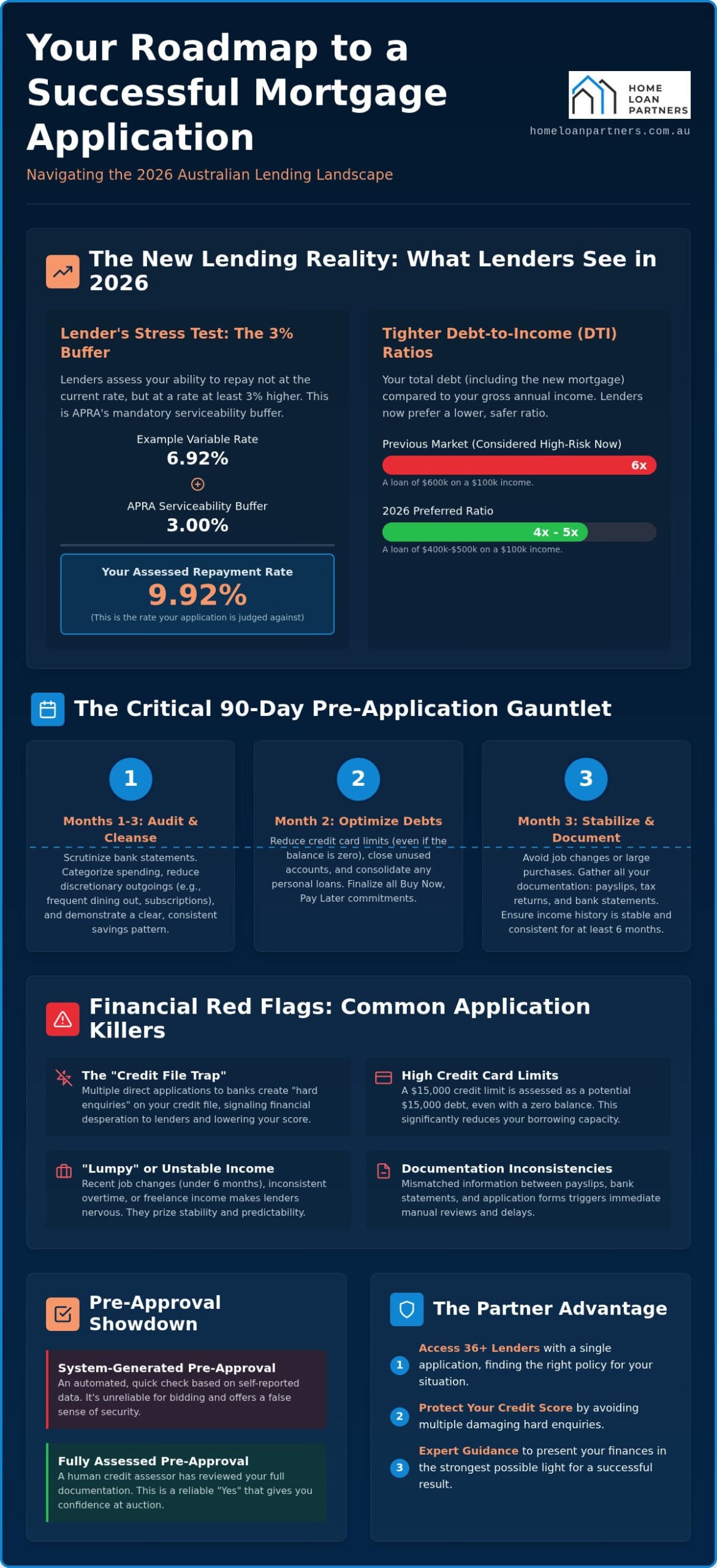
Lenders are scrutinising living expenses more than ever. They want to ensure your lifestyle doesn’t compromise your ability to service a loan in a higher interest rate environment. The “safe” debt-to-income ratio has also tightened. While a ratio of six times your income might have passed in previous years, most lenders now prefer to see ratios closer to four or five. This change reflects a market where more of your monthly income is consumed by interest costs rather than principal reduction. Banks are looking for a safety margin that protects both you and their capital.
The Role of Serviceability Buffers
The Australian Prudential Regulation Authority (APRA) remains firm on its 3% serviceability buffer. This means if you apply for a loan with an average variable rate of 6.92%, the bank assesses your application as if the rate were 9.92%. It’s a safety net for the bank, but it can be a hurdle for your borrowing power. Even if you’ve been comfortably paying rent that exceeds a potential mortgage repayment, the bank’s math is intentionally conservative. Serviceability is the lender’s measure of your future repayment capacity. This strict calculation often leads to one of the most common mortgage application mistakes to avoid: overestimating your capacity based on your current take-home pay.
Lender Psychology: The Search for Stability
Lenders are looking for stability and longevity. While the gig economy offers freedom, it often creates “lumpy” income that makes banks nervous. If you’ve recently switched to contracting or have been in your job for less than six months, you might face extra hurdles. They are looking for “boring” finances. This means a steady employment history, a clear track record of savings, and an absence of recent large debts or Buy Now, Pay Later commitments. A stable financial history suggests you are a low-risk partner for the long-term journey. Our role is to help you present this stability clearly, ensuring the lender sees a reliable collaborator rather than a collection of financial risks.
Financial Red Flags: Credit Scores and Spending Habits
Lenders in 2026 are forensic in their approach. They don’t just look at what you earn; they look at how you behave with what you have. One of the most common mortgage application mistakes to avoid is falling into the “Credit File Trap.” This occurs when you apply to multiple banks in a short window to compare rates. Every formal application triggers a “hard enquiry” on your report. To a bank’s automated system, this looks like credit hunger or financial desperation. It can lower your score and lead to an automatic rejection before a human ever reviews your file.
Your credit card limits also play a silent, destructive role. Even if you pay your balance in full every fortnight, the bank assesses your borrowing capacity based on the total limit, not the balance. An A$15,000 limit is viewed as a potential A$15,000 debt. Reducing these limits or closing unused accounts is a simple way to boost your “Yes” potential during the home loan application process. Understanding these nuances helps you navigate the common mortgage application mistakes to avoid that often trip up even the most diligent savers.
Managing Your Credit Reputation
Distinguishing between “soft” and “hard” enquiries is a vital part of your strategy. A soft enquiry, like checking your own score, won’t harm your standing. However, a hard enquiry is a permanent mark. We recommend cleaning up your credit file at least six months before you plan to buy. This gives you ample time to dispute errors or close dormant accounts that linger on your record. If you aren’t sure how your current debts might impact your chances, our team can help you review your financial position to ensure your file is lender-ready without risking unnecessary enquiries.
The Spending Audit: HEM and Beyond
Banks now use sophisticated AI to categorise every transaction on your digital statements. They compare your actual spending against the Household Expenditure Method (HEM), which is a benchmark for modest living costs in Australia. If your Uber Eats habit, luxury subscriptions, or frequent gambling transactions push you far above the HEM, it flags you as a high-risk borrower. We suggest a “three-month rule”: tighten your belt for 90 days before submitting your application. This demonstrates financial discipline and ensures your bank statements reflect a borrower who is ready for the responsibility of a mortgage. Since the regulation change on June 10, 2025, Buy Now Pay Later (BNPL) services are also treated as formal credit. Those small, automated payments are no longer invisible; they are now formal debts that can stall your home ownership dreams if not managed correctly.
Structural Blunders: Pre-Approval and Loan Choice
Choosing a loan is about more than just finding the lowest percentage on a digital screen. One of the most common mortgage application mistakes to avoid is rushing into a structure that doesn’t align with your five-year financial plan. Many buyers focus solely on the headline interest rate while ignoring the flexibility that different loan types provide. This narrow focus can lead to significant costs later if you need to refinance or change your living situation unexpectedly.
Failing to account for the “hidden costs” of a purchase is another frequent hurdle. Beyond your deposit, you must budget for Stamp Duty, legal fees, and potentially Lenders Mortgage Insurance (LMI) if your deposit is less than 20% of the property value. These costs can easily add A$30,000 to A$60,000 to your total requirement. Consulting an Australian government guide to buying a home can help you map out these expenses early so they don’t derail your application at the final hurdle.
The Pre-Approval Pitfall
Not all pre-approvals are created equal. A “system-generated” pre-approval is often just a computer’s best guess based on limited data. In contrast, a “fully assessed” pre-approval involves a credit officer manually reviewing your documents. Bidding at an auction without a fully assessed document is a dangerous gamble. Most pre-approvals expire after 90 days. Any major life change, such as a new job or a new car loan, can trigger a full re-assessment and potentially lower your borrowing capacity. We act as your steady hand to ensure your pre-approval is reliable before you start making offers.
Loan Features vs. Interest Rates
The lowest rate isn’t always the “best” loan for building long-term wealth. For example, fixed rates offer repayment certainty but often lack the flexibility of offset accounts. These accounts allow you to use your savings to reduce the interest you pay every single day. If you have specific investment property goals, you might require an interest-only period or a split-loan structure to manage your cash flow and tax position. Matching your loan structure to your personal milestones is a core part of our collaborative process, ensuring your mortgage works for you rather than against you. Avoiding these common mortgage application mistakes to avoid requires looking past the interest rate and focusing on how the loan features support your future security.
The Pre-Submission Checklist: Avoiding Documentation Errors
Precision is your best ally when it’s time to submit your file. Banks look for reasons to say “no,” and documentation errors are the easiest way for them to do so. One of the most common mortgage application mistakes to avoid is providing inconsistent data that triggers a manual review or an outright decline. If your tax return shows a different income level than your most recent payslips, the bank sees a red flag. This often happens with non-standard income such as bonuses, overtime, or dividends. Lenders typically “shade” these amounts, counting only a portion of the total to protect against future income fluctuations. We help you present these figures accurately to ensure your true borrowing power is recognised.
Large, unexplained deposits are another frequent hurdle. In the 2026 lending environment, banks are bound by strict anti-money laundering laws and “genuine savings” requirements. If a A$20,000 gift from a family member suddenly appears in your account without a statutory declaration, it can’t be used as evidence of your ability to save. Similarly, large withdrawals right before applying can signal undisclosed debts or lifestyle risks. Keeping your accounts “clean” for the months leading up to your application is essential for a smooth approval process.
A Step-by-Step Document Preparation Guide
- Step 1: Gather 3 to 6 months of genuine savings evidence. Lenders want to see a consistent pattern of accumulation, not just a lump sum.
- Step 2: Authenticate income for self-employed applicants. Most banks still require two years of tax returns to prove income stability, though some niche lenders offer more flexibility.
- Step 3: Verify all liabilities. This includes HECS/HELP debts, car loans, and even small personal loans you might have forgotten about.
- Step 4: Conduct a final cross-check. Ensure your address and name spelling match exactly across your driver’s licence, payslips, and bank statements.
Employment Stability and Timing
Timing is everything when you are planning a property purchase. Changing jobs right before an application is a high-risk move because many lenders are hesitant to approve loans for borrowers in a probation period. However, if you’ve stayed within the same industry, some banks on our panel of 36+ lenders may be more accommodating. For contractors and freelancers, proving reliability is key. You’ll need to demonstrate a consistent track record of contract renewals to overcome the perceived risk of “lumpy” income. Our team acts as your steady guide, helping you time your application for the best possible outcome. Let us help you organise your application documents so you can move forward with confidence.
Navigating the Process: How a Mortgage Broker Minimises Risk
The Australian lending market in 2026 is intricate. Successfully navigating it requires more than just a good salary; it requires a strategy. One of the most common mortgage application mistakes to avoid is attempting to manage the entire process alone, which often leads to missed opportunities or avoidable rejections. A broker acts as your steady hand, providing a protective barrier between you and the banks. By managing the initial assessment, we ensure your financial presentation is polished and meets the specific expectations of a lender before any formal enquiry is made.
The “One Application” advantage is perhaps the greatest benefit to your long-term financial health. When you apply directly to multiple banks, each one records a hard enquiry on your credit file, which can lower your score and flag you as a high-risk borrower. In contrast, a finance broker allows you to access a panel of 36+ lenders through a single point of contact. This collaborative approach protects your credit reputation while giving you the best chance of finding a policy that fits your unique situation. We act as your advocate, translating complex bank jargon into plain English and pushing for a “yes” when automated systems might otherwise say “no.”
Policy Matching: Finding the ‘Yes’
Lending is rarely a one-size-fits-all scenario. One bank might reject an application due to an internal cap on certain property types or industries, while another might view that same application as an ideal fit. We use advanced home loan calculators to pre-flight your application against the real-time serviceability buffers of various lenders. This proactive step helps identify potential common mortgage application mistakes to avoid before they impact your record. In a world increasingly driven by automated bank rejections, we prioritise a human assessment, ensuring your personal story and future goals are heard by the right credit officers.
Stress-Free Settlement
The journey from loan approval to final settlement involves significant coordination between solicitors, real estate agents, and bank back-office teams. We manage the heavy lifting of this paperwork, providing a calm and predictable experience during what is often a high-pressure time. Our partnership doesn’t end when you receive your keys; we remain your expert collaborator for the duration of your loan, helping you navigate future milestones like refinancing or property investment. If you are ready to move forward with a reliable guide by your side, Book a consultation with The Home Loan Partners today. We are committed to turning your property aspirations into a stress-free reality.
Take the First Step Toward Your New Home Today
Achieving home ownership in 2026 requires a proactive strategy that begins long before you attend an open home. By cleaning up your credit file, managing debt-to-income ratios, and ensuring your digital spending matches lender expectations, you effectively eliminate the common mortgage application mistakes to avoid. Remember that the current 3% serviceability buffer means your financial presentation must be precise and stable to secure a positive result from a lender.
You don’t have to navigate this complex journey alone. Our team provides expert guidance for first home buyers and investors across Australia, offering access to over 36 Australian lenders to find your perfect policy fit. We act as your steady hand, managing the heavy lifting so you can focus on your future. Book your stress-free mortgage consultation with The Home Loan Partners today to start your journey with a professional, client-centric partner by your side. We look forward to helping you achieve your property milestones with confidence and ease.
Frequently Asked Questions
What is the biggest red flag on a mortgage application in 2026?
Undisclosed financial liabilities and multiple credit enquiries in a short window are the most significant red flags for lenders in 2026. Banks use automated systems to scan your credit file for hard enquiries. If you have applied for several loans or credit cards recently, it suggests financial instability. They also flag any discrepancies between your declared expenses and your digital transaction history. Honesty and a clean credit report are your best tools for success.
Can I get a home loan if I just started a new job?
You can secure a home loan if you’ve recently started a new job, provided you remain in the same industry. Lenders generally prefer a two year employment history, but many will accept a new role if you’ve passed probation. If you are still in your probation period, we can help you find specific lenders on our panel of 36+ that are more flexible with their employment stability policies.
How much does a mortgage broker cost in Australia?
In Australia, mortgage brokers typically don’t charge the borrower a fee for their standard services. Instead, the lender you choose pays the broker a commission after your loan settles. This makes professional, client-centric advice accessible to everyone. It allows you to benefit from a steady hand throughout the process without adding to your upfront costs. Some brokers may charge a fee for complex commercial structures, but this is always disclosed upfront.
Does having a HECS debt affect my borrowing power?
Having a HECS or HELP debt significantly impacts your borrowing power because it reduces your net take-home pay. Lenders treat your mandatory repayments as a primary financial commitment. Even if your balance is small, the bank calculates your serviceability based on the percentage of your salary diverted to the ATO. Identifying how this debt affects your specific situation is one of the common mortgage application mistakes to avoid during the planning phase.
How many months of bank statements do lenders actually look at?
Most Australian lenders require between three and six months of bank statements to assess your spending patterns. They look for consistency in your living expenses and evidence of genuine savings. In 2026, banks use digital tools to categorise your transactions instantly. This means you should ensure your spending habits are disciplined for at least 90 days before you submit your formal application to avoid any unnecessary flags or manual reviews.
Is it a mistake to use Buy Now Pay Later (BNPL) before applying?
Using Buy Now Pay Later (BNPL) services right before an application is often a mistake. Since the June 2025 regulation change, these accounts are recorded as formal credit liabilities. Even small, interest-free payments reduce your disposable income in the eyes of a bank’s serviceability calculator. We recommend closing these accounts and ensuring all balances are cleared at least three months before you begin your property journey to present the cleanest possible financial profile.
What happens if my home loan application is declined?
If your application is declined, the first step is to stop making further enquiries to protect your credit score. Re-applying immediately at a different bank without fixing the underlying issue is one of the common mortgage application mistakes to avoid. You should request a copy of the lender’s assessment or work with a broker to identify why the rejection occurred. We can then help you pivot to a lender whose policies suit your profile.
Should I lower my credit card limits before applying for a mortgage?
You should definitely lower your credit card limits before applying for a mortgage. Lenders assess your borrowing capacity based on the total credit limit available to you, not the current balance. For example, a card with a A$10,000 limit is treated as a A$10,000 debt, even if you owe nothing. Reducing these limits increases your surplus income, which directly improves your chances of a positive result from the bank’s assessment.