

A successful build in 2026 is secured not just by your choice of builder, but by a finance structure that anticipates every progress payment hurdle before the first sod is turned. When you’re researching construction loans nsw, it’s natural to feel a sense of unease about “peak debt” or the complexities of the new Building (Approvals and Practitioners) Bill 2026. You want to focus on the excitement of your new home, not the stress of managing bank inspections and council requirements simultaneously. We understand that this journey represents a major life milestone, and we’re here to act as your steady guide through the entire process.
We’ll help you navigate the complexities of building finance with expert strategies on progress payments, lender requirements, and securing your long-term equity. You’ll learn how to structure a loan that matches your specific build timeline while keeping interest costs to a minimum. This guide provides a clear path forward, covering everything from the $10,000 First Home Owner Grant to the recent shift toward completion approvals. By the end, you’ll have the confidence to manage your build with precision and a professional partner by your side to handle the heavy lifting with lenders.
Key Takeaways
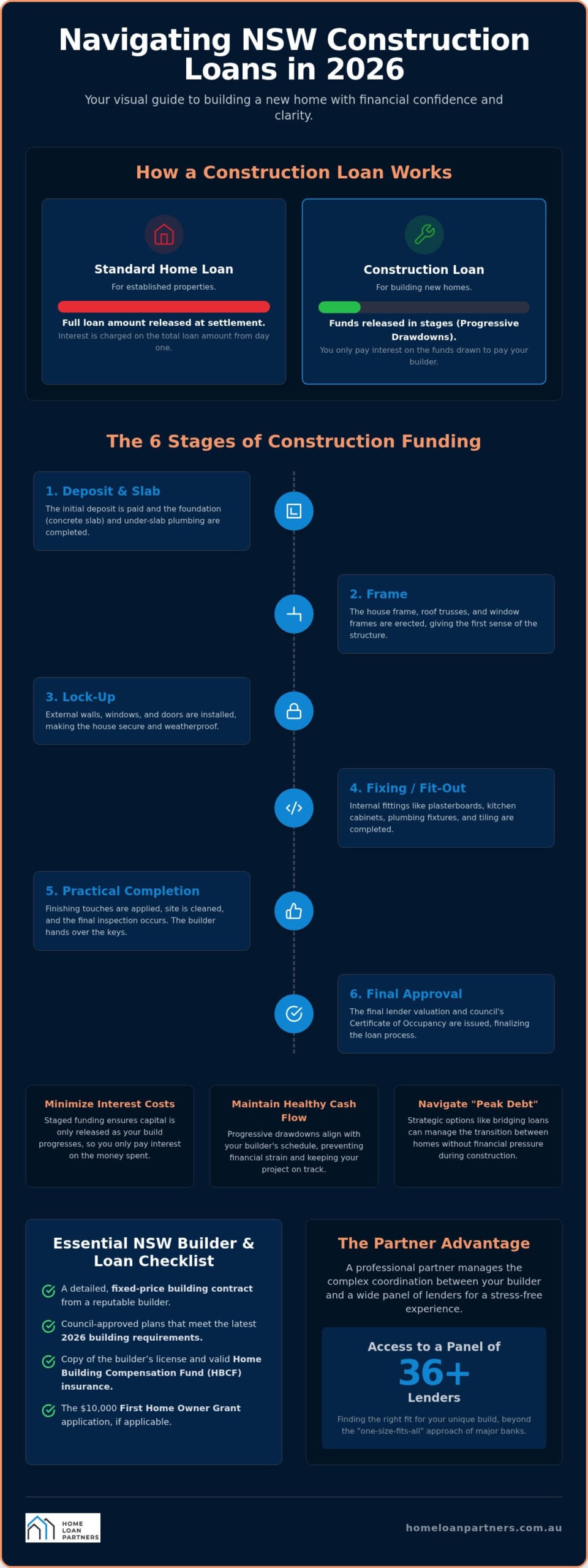
- Learn how staged funding releases capital only as your build progresses, ensuring you only pay interest on the amount actually spent.
- Identify the essential documentation needed for construction loans nsw, from fixed-price building contracts to the latest 2026 council approval requirements.
- Master the progressive drawdown process to maintain a healthy cash flow across all six major construction stages, from the slab to practical completion.
- Explore strategic finance options like bridging loans to manage the transition between homes without the financial strain of “peak debt” during your build.
- Benefit from a collaborative guide who manages the complex coordination between your builder and a panel of 36+ lenders for a stress-free experience.
What is a Construction Loan and How Does it Work in 2026?
A construction loan is a specialised finance product designed to fund the building of a new dwelling or major renovation. Unlike standard mortgages where you receive the full loan amount at settlement, these funds are released in stages to cover specific parts of the build. Simply put, a construction loan is a credit facility that uses ‘progressive drawdowns’ to pay builders as milestones are met. In the 2026 market, securing these funds requires a deeper understanding of lender serviceability buffers and current APRA regulations. It’s not just about the interest rate; it’s about having a structure that remains stable even if market conditions shift during your construction timeline.
The Core Difference: Construction vs. Established Property Loans
The process of buying a house in Australia typically involves a valuation based on the property’s current state. However, construction loans nsw require a different approach. Lenders focus on the “on-completion” value, which is an estimate of the property’s worth once the project is finished. This differs significantly from an “as-is” value, which only considers the land and any existing structures. Because this involves more variables, our role as your collaborator is to ensure the loan meets the Best Interest Duty. We look beyond the surface to find a finance structure that protects your long-term equity and supports your specific vision for the site.
Why 36+ Lenders Offer More Than Just a Rate
Choosing the right lender is a strategic decision that impacts your daily life during the build. While the “Big Four” banks have a strong presence, their policies can be restrictive when it comes to unique architectural designs or specific contract types. Some lenders are comfortable with cost-plus arrangements, while others strictly require fixed-price contracts to mitigate risk. The progressive drawdown process must be seamless to keep your builder on schedule. We leverage our panel of 36+ lenders to find a partner that aligns with your builder’s reputation and insurance requirements. This variety allows us to bypass the rigid “one size fits all” approach, giving you a tailored solution that acknowledges the nuances of the NSW building environment.
The Progressive Drawdown Process: Managing Cash Flow
Managing the financial flow of a build is often the most daunting part for our clients. Progressive drawdown is the mechanism that keeps your project moving while protecting your cash flow. Under this arrangement, your lender releases funds in increments as specific construction milestones are achieved. This structure is a core feature of construction loans nsw, ensuring you don’t pay interest on the full loan amount from day one. Instead, you only accrue interest on the capital actually paid to your builder. To get a clear picture of how these payments impact your monthly budget, using a home loan calculator can help you estimate your obligations at each stage. Before each payment is released, the lender may send a valuer to the site to confirm the work matches the builder’s invoice, providing an extra layer of oversight for your investment.
Navigating the 5 Common Build Stages
Most builds in New South Wales follow a predictable rhythm across five or six key stages. The process begins with the initial deposit and the ‘slab’ stage, which involves the foundation and underground plumbing. As you move into the ‘frame’ and ‘lock-up’ phases, your costs typically peak as the structure becomes enclosed and weather-proof. It’s vital that your builder’s payment schedule aligns with NSW building contract requirements to avoid payment disputes or delays. The final ‘fixing’ stage completes the interior, leading to the practical completion where you receive your Certificate of Occupancy. We manage the coordination between your bank’s valuer and your builder to ensure each drawdown is approved without delay, keeping your site active and your builder’s team on schedule.
Managing Interest-Only vs. Principal and Interest
During the high-cost construction phase, most lenders set your repayments to interest-only. This protects your liquidity while you might still be paying rent or a mortgage on your current home. It’s a strategic way to keep your monthly outgoings manageable until you’re ready to move in. Once the build is finished and the final payment is made, the loan typically reverts to a standard principal and interest structure. If you find yourself with surplus funds during the build, some lenders offer an offset account or a ‘redraw’ facility. This allows you to reduce your interest costs while keeping the cash accessible for unexpected landscaping or finishing touches. If you’re feeling overwhelmed by these options, our team can help you explore the best loan structures for your specific project. We’ll ensure the transition from a construction facility to a permanent home loan is seamless, allowing you to focus on the joy of your new space.
The Essential Construction Loan Checklist for NSW Borrowers
Securing approval for a build is more document-intensive than a standard home purchase. Lenders for construction loans nsw need to see a clear, low-risk roadmap for the project before they commit funds. We act as your collaborator during this phase, helping you gather the necessary paperwork to present a professional case to the bank. Your application must include:
- A signed, fixed-price building contract with a licensed builder.
- Council-approved plans and specifications (DA, CC, or CDC).
- Builders’ All Risk Insurance and Public Liability documentation.
- A detailed ‘Schedule of Progress Payments’ agreed upon by you and the builder.
The Importance of a Fixed-Price Contract
In the 2026 building environment, protecting yourself against rising material costs is a priority. Lenders strongly prefer fixed-price contracts because they provide certainty. They pay close attention to ‘prime cost’ (PC) and ‘provisional sum’ (PS) items. PC items are for specific fittings like tiles or taps, while PS items are estimates for work where the final cost isn’t yet known, such as complex excavation. We recommend keeping PS items to a minimum. High estimates in these categories can lead to lender caution. Any variations you make after the loan is approved can shift your loan-to-value ratio (LVR), potentially requiring you to contribute more of your own cash to cover the gap.
Valuations and Equity Requirements
Lenders don’t just look at what you’re spending; they look at what the property will be worth. An ‘As-If-Complete’ valuation is a critical step where the lender predicts the future asset value based on your plans and the land. If you already own the land, you can often use the equity you’ve built there as your deposit for the construction phase. This is a powerful way to leverage your existing assets to fund your new home. If your total equity is less than 20% of the predicted on-completion value, Lenders Mortgage Insurance (LMI) will likely apply. We’ll help you calculate these figures early so there are no surprises when the valuation report comes back.
Strategic Finance: Bridging and Investment Build Scenarios
Building a new home often involves a delicate financial overlap with your current property. This transition creates a period known as ‘peak debt’, where you are technically financing two properties simultaneously. It’s a stage that can cause significant stress if not managed with precision. An expert coordinator manages the complex overlap between two properties by aligning your existing mortgage with your new construction facility to ensure your household cash flow remains steady. By viewing your property journey as a single, continuous path, we help you avoid the pitfalls of fragmented finance.
Building Your Next Home While Living in Your Current One
Staying in your current home while your new one takes shape is a common goal for families in New South Wales. This strategy relies heavily on a well-structured bridging finance arrangement. During the construction phase, you shouldn’t have to worry about servicing two separate loans. Most lenders offer interest capitalisation, which means the interest on the bridging loan is added to the total balance. You only start making full repayments once your original home is sold and the build is complete. This expert coordination is vital to ensure you aren’t forced into a hurried sale at a lower price point just to satisfy a bank’s deadline. When seeking construction loans nsw, we ensure your timeline is protected from these external pressures.
Construction for Investors
Investors in 2026 are increasingly looking at construction as a way to manufacture equity and increase rental yield. Projects like dual-occupancy dwellings or high-quality granny flats are popular choices for those wanting to diversify their portfolio. Navigating the credit policies for these non-standard builds requires a deep understanding of lender appetites. Some banks are hesitant with multi-dwelling titles, while others welcome them. We help you structure these construction loans nsw to maximise your 2026 tax strategy, specifically focusing on the high depreciation benefits available for new structures. This proactive approach allows for a future equity release, providing the capital you need for your next investment milestone.
If you’re balancing a current mortgage with a new build vision, contact our collaborative team to design a finance structure that protects your lifestyle and your long-term goals.
The Home Loan Partners: Your Reassuring Guide Through the Build
Building a home is one of the most significant milestones you’ll ever achieve, but the financial architecture behind it can feel overwhelming. We act as your steady hand throughout this journey, navigating the intricacies of construction loans nsw to ensure your vision becomes a reality without the typical stress. Our role is that of a collaborative guide, sitting on your side of the table to translate complex industry jargon into practical, everyday language. With access to a national panel of 36+ lenders, we don’t just find a competitive rate. We find the specific credit policy that supports your builder’s schedule and protects your long-term financial security.
Our commitment to your project is rooted in a partnership approach rather than a cold, transactional encounter. We understand the emotional weight of your investment, which is why we provide a calm, steady expertise from the first application to the final progress payment. Because we operate on a lender-paid model for standard broking, you benefit from our professional coordination without direct cost. We’re here to manage the heavy lifting, allowing you to focus on the excitement of watching your new home take shape.
Managing the ‘Heavy Lifting’ of Progress Payments
The coordination between a lender’s valuation department and a builder’s invoice schedule is where most project delays occur. We manage this relationship with professional precision, ensuring that payments are released on time to keep your site active. If a valuation dispute arises or a lender requests additional documentation for a specific stage, we step in to resolve the issue. This proactive management is vital for maintaining a positive relationship with your builder. Whether you’re a first-time builder navigating your first slab pour or a seasoned developer managing a complex investment project, we provide the personalised guidance needed to keep your cash flow predictable and your project on track.
Ready to Start Your Construction Journey?
Planning a build in the 2026 market requires a forward-thinking strategy that accounts for the latest regulatory shifts and lender appetites. The first step in your journey should be a comprehensive rate and policy review to determine your true borrowing capacity. Our process is designed to be simple and transparent, providing you with a tailored construction loan quote that aligns with your specific timeline. We view ourselves as your partners for life, meaning our support doesn’t end when you receive the keys. We’ll continue to monitor your loan and support your milestones long after the construction is complete. If you’re ready to move forward with a team that values your future as much as you do, book a strategy session with The Home Loan Partners today.
Building Your Future with Confidence
Securing the right finance is the most critical foundation for your new home. Success in 2026 depends on a strategic approach to staged funding and the precise management of progress payments. By understanding the nuances of construction loans nsw, you protect your long-term equity and ensure your builder stays on schedule. Whether you’re navigating complex bridging timelines or coordinating your first investment build, you don’t have to manage these financial hurdles alone.
The Home Loan Partners act as your collaborative guide, providing professional support from your initial application through to settlement. We leverage our access to a panel of 36+ Australian lenders to find the perfect fit for your specific project. We take care of the heavy lifting with bank valuations and builder communication so you can focus on the milestones that matter most to your family. Ready to turn your plans into a reality? Secure your build’s future with a strategy session from The Home Loan Partners. We’re here to help you achieve your property goals with a steady hand and a partnership that lasts well beyond the day you move in.
Frequently Asked Questions
What is the difference between a construction loan and a standard home loan?
A construction loan releases funds in stages through progressive drawdowns rather than as a single lump sum at settlement. This allows you to pay interest only on the amount actually spent as your project moves through milestones like the slab or frame. Standard loans are designed for established properties where the full purchase price is paid at once, whereas building finance is a dynamic facility that grows with your home.
How do progress payments work on a construction loan?
Your builder will issue an invoice at the completion of each major stage, such as the lock-up or fixing phase. After you review and sign the claim form, your lender typically sends a valuer to the site to confirm the work matches the invoice. Once verified, the bank pays the builder directly from your loan facility. This process ensures your builder is paid promptly while protecting your capital until specific work is finished.
Can I use an owner-builder structure for my construction loan?
While it’s possible, few lenders on our panel of 36+ accept owner-builder projects because they carry a higher risk profile for the bank. Most lenders require a fixed-price contract with a licensed builder to approve construction loans nsw. If you’re planning to manage the build yourself, we can help you explore specialist lenders who may have specific credit policies that align with your experience and project vision.
What documents do I need to provide for a construction loan in NSW?
You must provide a signed fixed-price building contract, council-approved plans (DA/CC or CDC), and a detailed schedule of progress payments. Lenders also require the builder’s insurance certificates, including All Risk and Public Liability cover. Providing these documents early allows us to act as your steady guide, ensuring your application is professional and meets all lender requirements for a smooth approval process in the 2026 market.
Can I get a construction loan if I haven’t sold my current house yet?
Yes, we can structure a bridging loan that allows you to finance your new build while still living in your current home. This arrangement manages your debt during the transition period, so you don’t have to worry about two full mortgage payments simultaneously. We coordinate these complex timelines to ensure you have a clear path forward, allowing you to sell your original property only when the new one is ready for you.
How much deposit do I need for a construction loan in 2026?
Most lenders prefer a 20% deposit to avoid Lenders Mortgage Insurance, though some may accept as little as 5% depending on your financial position. If you already own the land, the equity you’ve built there often serves as your deposit for the construction phase. We’ll help you calculate your ‘as-if-complete’ valuation early in the process so you have a clear understanding of your required capital contribution before the build starts.
What happens if my builder increases the price during construction?
If a price increase occurs through a formal variation, you’ll need to submit the updated contract to your lender for a new valuation. Because construction loans nsw are typically based on the original fixed-price agreement, any significant cost increases might require you to pay the difference from your own savings. We help you navigate these negotiations with your lender to find a solution that keeps your project moving without financial strain.
Does a construction loan have a higher interest rate than a normal mortgage?
Interest rates for construction loans are generally comparable to standard variable rates, though they often remain interest-only during the building phase. Some lenders may apply a small premium until the project reaches practical completion. Once your home is finished and the final payment is made, the loan typically reverts to a standard mortgage. We’ll continue to monitor your loan to ensure you always have the most competitive structure for your long-term journey.