

Could an Australian earning $75,000 a year actually have more borrowing power than someone on a $140,000 salary? It sounds counterintuitive, but in the current credit environment, your gross pay is only one piece of a much larger puzzle. We know it’s easy to feel anxious as you watch the national median dwelling value climb to $928,000, wondering if the minimum income for home loan australia 2026 has finally moved out of your reach.
We believe that your homeownership goals deserve a steady, expert hand to guide you through the noise. While the 3% APRA serviceability buffer remains a hurdle, your success depends less on a fixed salary figure and more on your “residual income” after your unique expenses are met. This article will show you exactly how lenders evaluate your lifestyle, why your debt-to-income ratio matters, and how to find flexible lenders who see the full value of your financial situation. You’ll discover actionable steps to boost your borrowing capacity and gain the clarity needed to step forward with confidence.
Key Takeaways
- Understand why “serviceability” is the true metric lenders use instead of a flat salary figure, ensuring you focus on what actually drives your borrowing power.
- Learn how the 3% APRA buffer affects the minimum income for home loan australia 2026 and how to navigate these stress tests effectively.
- Identify the specific “income shrinkers,” such as credit card limits and HECS debt, that can unexpectedly reduce your eligibility in the eyes of major banks.
- Compare the unique challenges and advantages of single versus joint applications to better align your strategy with current market realities.
- Discover how accessing a panel of over 36 lenders can help you find a tailored loan structure when one bank’s criteria don’t quite fit your profile.
Is There a Hard Minimum Income for an Australian Home Loan in 2026?
Lenders aren’t bound by a single, rigid dollar figure when deciding who qualifies for a mortgage. There is no Australian law that dictates you must earn a specific salary to buy a house. Instead, credit providers focus on “serviceability.” This concept is the true heart of determining the minimum income for home loan australia 2026. While the national minimum wage provides a floor for workers, it doesn’t represent a “living wage” for a mortgage. Banks need to see that you can comfortably manage repayments without falling into financial hardship.
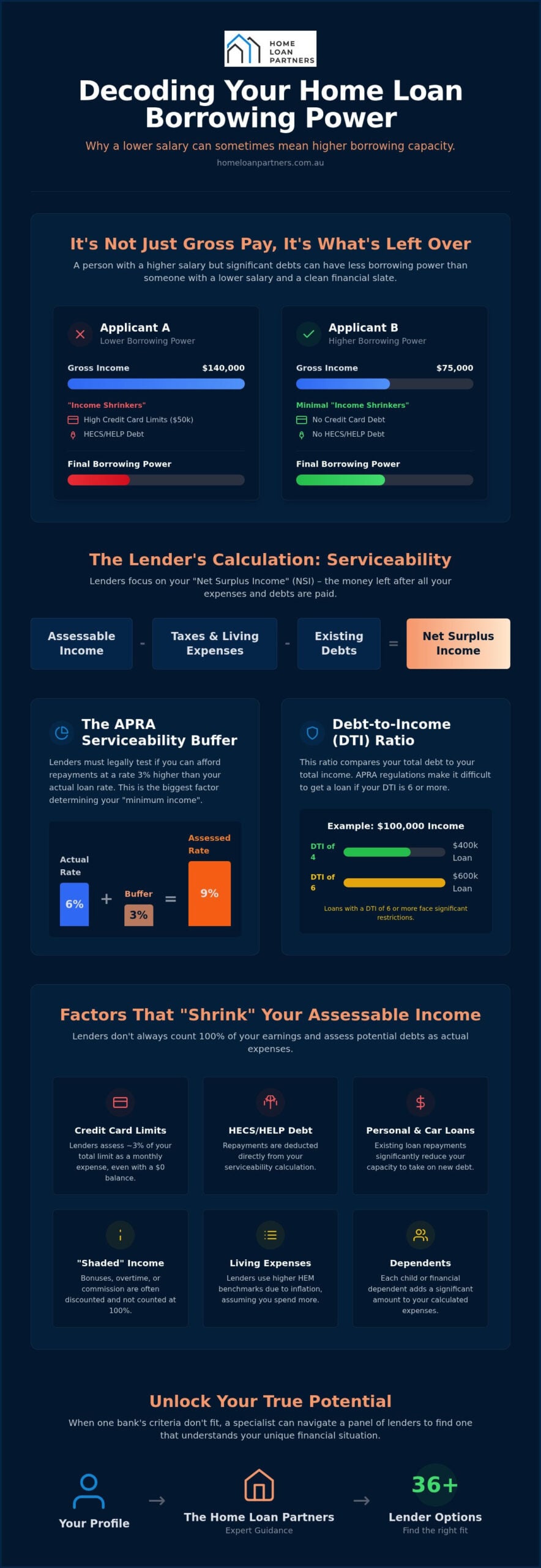
To find this balance, banks calculate your Net Surplus Income (NSI). This is the amount of money remaining after your taxes, living expenses, and existing debts are deducted from your gross pay. We view our role as helping you present this NSI in the best possible light. If your NSI remains positive after the bank “stress-tests” your finances, you’re much closer to an approval, regardless of whether your salary is $60,000 or $160,000. Understanding this nuance is vital to navigating the current state of home ownership in Australia.
The Relationship Between Income and Loan Amount
Your borrowing capacity is often viewed through the Debt-to-Income (DTI) ratio. As of February 2026, APRA has implemented strict caps, where only 20% of a lender’s new home loans can have a DTI of six or more. This means if you earn $100,000, securing a loan over $600,000 has become significantly more difficult. A $60,000 income might qualify you for a regional property if you have a substantial deposit, but it would likely fall short for a median-priced city dwelling. Your deposit acts as a powerful lever; the more equity you provide upfront, the less income you need to service the remaining debt.
Why 2026 Market Conditions Change the Calculation
The economic climate of 2026 has fundamentally shifted how banks estimate your spending. Lenders use the Household Expenditure Measure (HEM) to predict your costs. Because of recent inflation, these HEM benchmarks have risen. Banks now assume you’re spending more on essentials like groceries and energy than in previous years, which effectively “shrinks” your available income.
Current interest rates also dictate the “minimum” salary required. With the RBA cash rate at 4.35% and average variable rates near 5.98%, lenders apply a mandatory 3% serviceability buffer. They must prove you can afford repayments at nearly 9%. You can explore how these variables impact your specific situation by using our home loan calculator. This tool helps you visualize the path forward before you engage with a lender.
How Lenders Actually Calculate Your Borrowing Power
A bank’s assessment of your financial health goes far deeper than a quick glance at your annual salary. While you might focus on the minimum income for home loan australia 2026, lenders are busy “stress-testing” your entire life. They look at your consistent earnings, but they also use the Household Expenditure Measure (HEM) to estimate what it costs you to live. In 2026, these benchmarks have adjusted to reflect higher costs for utilities and groceries, meaning the same salary that qualified for a loan two years ago might face stricter scrutiny today.
Lenders want to ensure that if your circumstances change, you won’t be left struggling. They don’t just ask if you can afford the loan today; they ask if you can afford it when life gets expensive. To get a preliminary idea of where you stand, you can calculate your borrowing power using government resources, which often mirror the conservative logic banks apply during their internal reviews.
The APRA Serviceability Buffer Explained
The Australian Prudential Regulation Authority (APRA) currently mandates a 3% serviceability buffer. If your actual mortgage interest rate is 6%, the bank must legally assess your ability to pay as if the rate were 9%. This requirement is the primary reason why “minimum income” is a moving target. As interest rates fluctuate, the income required to pass this 3% stress test also moves. The serviceability buffer acts as a vital safety net that protects both the lender and the borrower from future financial shocks. Because of this buffer, a small increase in your pay can have a disproportionately positive impact on your total borrowing capacity.
Gross Income vs. Assessable Income
It’s a common surprise for many applicants that banks rarely count 100% of their total earnings. Lenders often “shade” or discount certain types of income that they perceive as less stable. If you rely heavily on overtime, annual bonuses, or sales commissions, most banks will only include 80% of those figures in their calculations. This 20% haircut is a standard safety margin to account for potential fluctuations in your take-home pay.
However, you can also add “assessable income” from other sources. If you are looking into investment property loans, the projected rental income from that property is added to your total. Typically, banks recognize about 80% of the expected rent to cover management fees and vacancies. By including these diversified streams, you effectively lower the “salary” requirement from your primary job. If you’re unsure how your specific mix of bonuses and base pay will be viewed, our team can help you find a lender whose policies align with your unique income structure.
Income Requirements for Different Buyer Profiles
The path to approval looks different for everyone. While we’ve discussed the technical side of serviceability, your personal circumstances play a major role in determining the minimum income for home loan australia 2026. Single applicants often face what we call the “single person tax.” Without a second income to share the burden of utilities and groceries, lenders assume higher individual living costs. According to official housing cost statistics, the typical Australian household now spends 45.9% of their income to cover a new mortgage. For a single person, this leaves a thinner margin for error in the eyes of a bank.
Conversely, joint applicants often find the entry bar lower on a per-person basis. Dual incomes provide a diversification of risk that lenders love. If you’re a casual or gig economy worker, don’t feel discouraged. While major banks traditionally preferred full-time contracts, many lenders in 2026 now accept 12 months of consistent history in the same industry. Self-employed borrowers still face the “two-year rule” for tax returns, but we can often find alternative-doc options for those with a strong 12-month track record and a healthy deposit.
First Home Buyers on a Budget
If you’re just starting out, your income doesn’t have to carry the full weight of the transaction. We recommend reviewing our First Home Buyer guide to see how various grants can lower your required deposit. Family guarantees are another powerful tool; by using a parent’s equity as security, you might bypass the need for Lenders Mortgage Insurance (LMI). This reduces your total loan amount and, consequently, the minimum income for home loan australia 2026 you need to satisfy the bank’s stress tests. Schemes like the Help to Buy program also support individuals earning up to $103,000, effectively boosting your purchasing power without requiring a pay rise.
Refinancing on a Tight Income
We often meet clients who fear they’re “mortgage prisoners” because their income has dipped or interest rates have risen since they first bought. However, 2026 market conditions have led some lenders to offer “exceptions to policy.” If you have a clean repayment history, certain lenders may assess your refinancing application using a lower serviceability buffer than the standard 3%. This can be a lifesaver for those looking to improve their monthly cash flow. We focus on finding these flexible pockets in the market to ensure your loan remains a tool for your future, not a source of stress.
Factors That “Shrink” Your Income in the Eyes of a Bank
Your gross salary is a starting point, but lenders quickly whittle that number down to find your true “disposable” income. Every financial commitment you have acts as a weight on your application. For example, the presence of dependents significantly shifts the minimum income for home loan australia 2026 requirements. Each child or adult dependent in your household adds a fixed amount to your estimated living expenses in the lender’s eyes, reducing the surplus cash available for mortgage repayments. Even your daily habits come under the microscope. Banks often audit three months of bank statements to see if frequent food delivery orders or high-end subscriptions suggest a lifestyle that conflicts with a long-term mortgage commitment.
HECS/HELP debt is another major factor in 2026. While student loans don’t require a deposit, the mandatory repayments are deducted from your take-home pay before the bank even starts its calculation. This reduces your net income, making it harder to pass the 3% serviceability buffer we discussed earlier. To a lender, your student loan is an ongoing liability that competes directly with your ability to service a home loan. This is why two people with the same salary can have vastly different borrowing capacities.
The “Credit Card Trap”
One of the most common hurdles we see is the “credit card trap.” Lenders don’t care if your balance is zero; they calculate your monthly obligations based on your total credit limit. They assume a repayment of roughly 3% of that limit every month. A $10,000 credit limit can reduce your total borrowing power by $50,000 or more, even if you never use the card. We often recommend closing unused cards or reducing limits well before you submit an application to instantly boost your assessable income.
Buy Now, Pay Later (BNPL) and Small Loans
In 2026, services like Afterpay and Zip are no longer viewed as harmless shopping tools. Banks treat these as ongoing credit liabilities. Frequent use of BNPL services can signal to a lender that you rely on credit for everyday lifestyle expenses. The real gold standard for any bank is your “uncommitted monthly income.” This is the money that isn’t already spoken for by debts, subscriptions, or essential costs. Maintaining “clean” bank statements for at least three months before applying is the best way to prove you have the discipline to manage a home loan. If you’re concerned about how your current debts might impact your eligibility, our team can help you structure your finances to maximize your borrowing potential.
Navigating Lender Criteria with The Home Loan Partners
Every lender in Australia has their own “appetite” for risk. One major bank might decline an application due to a high debt-to-income ratio, while a smaller lender might see the same minimum income for home loan australia 2026 as perfectly acceptable because they view bonus income or casual work history more favorably. This is where we step in as your dedicated collaborator. With access to over 36 lenders, we don’t just look for a “yes”; we look for the specific lender whose internal credit policies align with your unique financial story.
We believe that the role of a finance broker is to act as your translator. We take the complex jargon of the banking world and turn it into a clear, stress-free path forward. Instead of you spending hours researching individual credit policies, we handle the heavy lifting of the application process. We position your application to highlight your strengths, whether that’s a high savings rate or a stable employment history, ensuring the lender sees the full picture rather than just a single salary figure.
Customizing Your Loan Structure
Sometimes, the hurdle isn’t your income but the timing of your purchase. We often use strategic tools like bridging finance to help clients transition between homes without the pressure of an immediate sale. For those with variable incomes, we can explore interest-only periods or the implementation of offset accounts. These structures provide the flexibility you need to manage your cash flow effectively while still progressing toward your long-term milestones. Our goal is to create a loan structure that feels supportive, not restrictive, and adapts to your life as it changes.
Ready to See What You Can Borrow?
You might be much closer to your goal than you think. Even if you’ve been turned away by your current bank, it’s often just a matter of finding a lender with a different perspective on your income type or expenses. We view our relationship with you as a long-term partnership that extends far beyond the initial transaction. We’re here to guide you through every rate change and life milestone, providing a steady hand and expert advice whenever you need it.
The first step is a simple pre-assessment. We can review your situation and provide a clear estimate of your borrowing power without any impact on your credit score. This gives you the confidence to start your property search with a realistic budget in mind. If you’re ready to move past the confusion of 2026 credit markets, we’re ready to help. Book a consultation with our team today and let’s start planning your future together.
Securing Your Future with Confidence
The path to property ownership in 2026 is paved with nuance rather than rigid salary thresholds. We’ve explored how your borrowing power hinges on serviceability and how modern lenders stress-test your lifestyle against current economic pressures. Understanding that your minimum income for home loan australia 2026 is a dynamic figure allows you to take control of your financial narrative. By managing “income shrinkers” like credit card limits and student debt, you can actively improve your standing before you ever step into a bank.
Our team specializes in navigating these complexities for you. As NSW-based experts serving clients nationwide, we offer access to a panel of 36+ Australian lenders to find the specific criteria that suit your profile. Whether you’re a first home buyer seeking specialized support or looking to restructure an existing loan, we’re here to translate bank jargon into a clear, predictable plan. Let our expert brokers calculate your true borrowing power today. You don’t have to navigate this journey alone; we’re ready to act as your steady guide toward achieving your next major life milestone.
Frequently Asked Questions
What is the absolute minimum income for a home loan in Australia in 2026?
There’s no legal absolute minimum income for home loan australia 2026, as lenders focus on your surplus cash rather than a flat salary figure. Most banks find it difficult to approve loans for individuals earning less than $50,000 because basic living cost benchmarks often consume most of that income. Your eligibility ultimately depends on the specific loan size and your ability to meet the mandatory 3% serviceability buffer.
Can I get a home loan if I am on the national minimum wage?
Securing a mortgage on the national minimum wage is challenging but potentially possible with the right loan structure. While a single person on this wage may struggle with serviceability, joint applicants or those with a substantial deposit often find viable options. We frequently help low-income earners explore government initiatives like the First Home Guarantee, which can help you enter the market with a smaller deposit.
Does a pay rise immediately increase my borrowing power?
A pay rise can immediately increase your borrowing power as long as you can provide documentation. Lenders typically require two recent payslips or a signed employment contract to verify your new salary. Even a modest increase of $5,000 per year can noticeably improve your serviceability results. This extra cash goes directly toward your uncommitted monthly income, which is the gold standard for bank assessments.
How does HECS debt affect my minimum income requirement?
HECS debt reduces your borrowing power by lowering your net take-home pay every month. Because lenders calculate your eligibility based on your after-tax income, mandatory student loan repayments are viewed as a fixed liability. For some of our clients, paying off a small remaining HECS balance before applying is a strategic move. It often unlocks significantly more borrowing capacity than the cash value of the debt itself.
Can I include Centrelink payments as part of my income for a loan?
Many lenders accept specific Centrelink payments as supplementary income, including the Family Tax Benefit or Disability Support Pension. However, most banks won’t count temporary payments like JobSeeker in their calculations. Each lender has different rules regarding which benefits they recognize. It’s vital to partner with a broker who knows which banks on our panel of 36+ lenders are most flexible with diverse income sources.
How much can I borrow on a $70,000 salary in 2026?
On a $70,000 salary, you can typically expect to borrow between $280,000 and $350,000 depending on your unique financial profile. This calculation for the minimum income for home loan australia 2026 assumes you have minimal existing debts and standard living expenses. If you have a large deposit or access to a guarantor, your purchasing power increases. However, the loan size remains capped by your serviceability.
What happens if my income is high but my expenses are also high?
A high income doesn’t guarantee a loan approval if your lifestyle expenses consume the majority of your earnings. Lenders prioritize your Net Surplus Income, which is the cash remaining after your mortgage, bills, and discretionary spending are met. If your bank statements show high spending on luxury items or frequent food delivery, a bank may decline your application. Your salary is only half the story.
Do lenders care about the source of my income (e.g., dividends vs. salary)?
Lenders scrutinize the source of your income and often discount earnings that aren’t part of a base salary. While a standard salary is usually counted at 100%, income from dividends, bonuses, or commissions is often “shaded” by 20% to account for potential volatility. We help you present these varied income streams to the lenders who offer the most favorable assessment for your specific financial profile.