

What if your mortgage broker isn’t actually a lifelong partner, but a service provider who simply isn’t meeting your needs anymore? It’s common to feel a sense of loyalty, especially when you’ve shared intimate financial details. You might worry about the mountain of paperwork or the awkward conversation that comes with walking away. We understand that the fear of starting from scratch often keeps people stuck in a partnership that no longer serves their best interests.
Learning how to change mortgage brokers doesn’t have to be a source of anxiety. With the 2026 CFPB Personal Financial Data Rights Rule making data portability easier, you have more control over your information than ever before. Choosing a broker who prioritizes your goals is a standard business decision, not a personal slight. This guide provides the professional, step-by-step process to transition to a new expert without the awkwardness or financial stress.
We’ll walk you through the logistics of the switch, from managing your documentation to understanding how the Homebuyers Privacy Protection Act keeps your data secure during the move. You’ll discover how to protect your loan application and ensure your path to homeownership remains steady, clear, and focused on your future.
Key Takeaways
- Identify the critical warning signs, such as poor communication or limited lender access, that suggest your current partnership isn’t serving your best interests.
- Learn how to handle the transition professionally with a clear communication strategy that protects your reputation and your personal data.
- Discover the simplified logistics of how to change mortgage brokers in 2026 while maintaining the momentum of your loan application.
- Understand the truth about “clawbacks” and exit fees to ensure you make your next move with complete financial confidence.
- Explore the value of a long-term partnership that offers access to a diverse panel of over 36 lenders for a truly customized mortgage structure.
Signs It Is Time to Change Your Mortgage Broker
Your mortgage is likely your largest financial commitment, and the person guiding you through it should feel like a dedicated partner. While many people hesitate to switch because they’ve already shared sensitive data, staying with a broker who isn’t performing can cost you thousands in the long run. Understanding how to change mortgage brokers begins with recognizing when your current relationship has shifted from a supportive collaboration to a transactional burden.
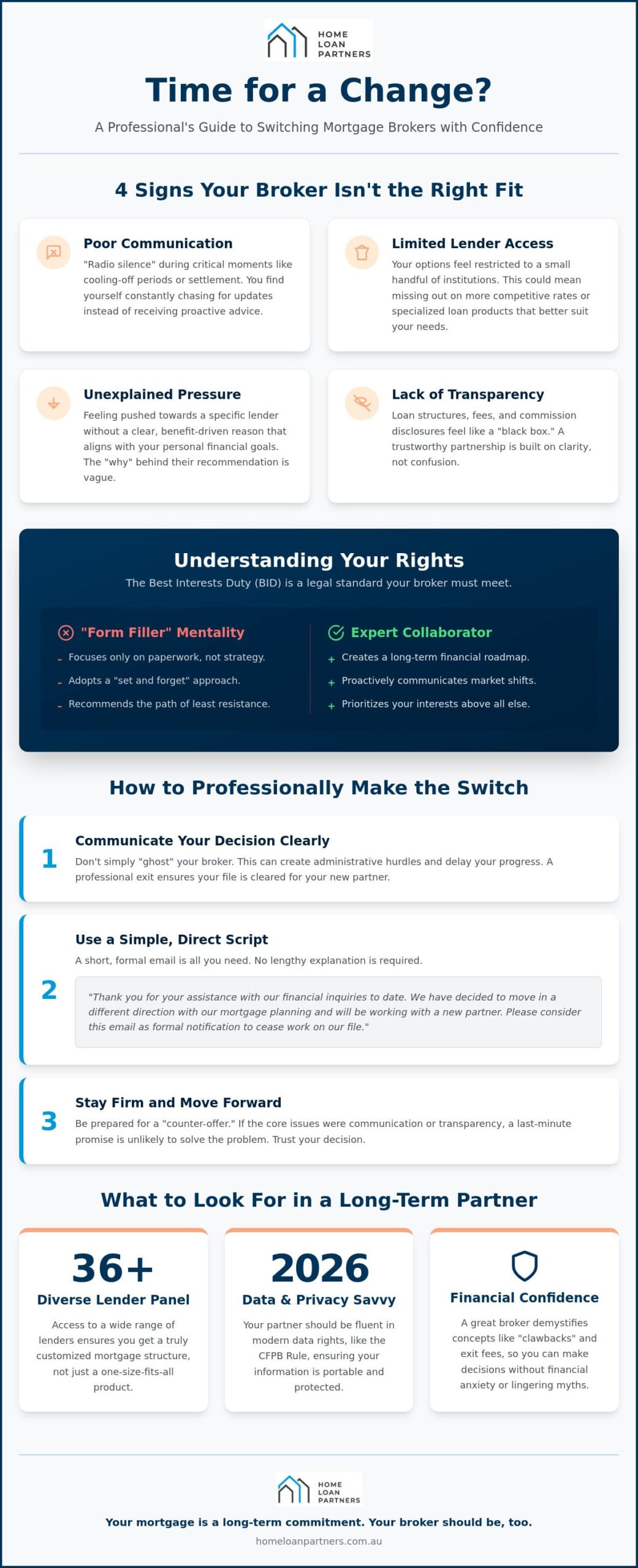
There are several clear indicators that your broker is no longer the right fit for your journey:
- Radio silence during critical windows: If you’re waiting days for a callback during a cooling-off period or as a settlement date approaches, your broker is failing to provide the steady hand you need.
- A limited lender panel: Some brokers only work with a handful of institutions. If your options feel restricted, you might be missing out on more competitive structures or specialized products like SMSF loans or construction finance.
- Unexplained pressure: You should never feel pushed toward a specific lender without a clear, benefit-driven justification that aligns with your personal goals.
- Lack of transparency: If loan structures, fees, or commission disclosures feel like a “black box,” the trust necessary for a long-term relationship is missing.
The Best Interests Duty (BID) Standard
In the 2026 lending environment, Australian brokers are held to the Best Interests Duty (BID) standard. This isn’t just a suggestion; it’s a legal requirement to prioritize your interests above their own. You can tell a broker is merely “filling a form” when they focus solely on the paperwork rather than the strategy. A true expert collaborator will look at your long-term roadmap, considering how a loan today impacts your ability to renovate or invest tomorrow. If your broker has a “set and forget” mentality, they’re likely failing the BID standard. Your financial situation is dynamic, and your mortgage strategy should be too.
Communication Breakdowns and Transparency
With the 30-year fixed mortgage rate averaging 6.54% as of July 3, 2026, proactive communication is more vital than ever. A reliable guide doesn’t wait for you to call them when rates shift; they reach out to you with a plan. When “no news” becomes the norm, it’s often a sign that your file isn’t a priority. This lack of transparency can lead to “lender bias,” where a broker recommends the path of least resistance for themselves rather than the most effective path for you. If you find yourself constantly chasing updates or feeling confused by industry jargon, it’s a strong signal that you need to learn how to change mortgage brokers to find a partner who values clarity and precision.
How to Professionally ‘Break Up’ with Your Broker
Ending a professional relationship can feel uncomfortable, but it’s important to remember that you are the employer in this scenario. You have the absolute right to seek a partner who aligns better with your current financial goals. While some online forums might suggest simply “ghosting” your broker, this can actually create administrative hurdles that delay your progress. A proactive, professional exit ensures that your file is cleared, allowing your new expert to step in without technical conflicts. Understanding how to change mortgage brokers with grace prevents unnecessary delays in your loan approval process.
When you announce your departure, your current broker might present a sudden “counter-offer” or a promise of better service. While this might be tempting, reflect on why you felt the need to make a change in the first place. If the communication or transparency wasn’t there when you needed it most, a last-minute promise rarely solves the underlying issue. Staying firm and polite allows you to move forward with a fresh perspective and a mortgage partner who prioritizes your journey from day one.
A Simple Script for Ending the Relationship
You don’t need to provide an exhaustive list of grievances to move on. A short, direct email is the most effective way to formalize your decision while maintaining a professional tone. Use this three-sentence template to keep the process stress-free:
“Thank you for your assistance with our financial inquiries to date. We have decided to move in a different direction with our mortgage planning and will be working with a new partner. Please consider this our formal request to close our file and cease any active applications on our behalf.”
This approach focuses on your “change in direction” rather than personal criticism. It also explicitly requests a file discharge, which is a crucial step in how to change mortgage brokers because it prevents duplicate applications from appearing on your credit report.
Managing Your Data and Privacy
Protecting your personal information is a top priority during any transition. Under the Homebuyers Privacy Protection Act, which became effective on March 4, 2026, you have significant protections against the unauthorized use of your inquiry data. Additionally, the CFPB’s Personal Financial Data Rights Rule now supports consumer-directed data portability. This means you have the right to request that your “fact find” data and supporting documents be handled securely. You should explicitly revoke the broker’s authority to act on your behalf in writing. This simple step ensures that your financial profile remains under your control as you transition to a more supportive expert collaborator.
The Step-by-Step Logistics of Switching Brokers in 2026
Moving from one expert to another is a logical progression when your needs evolve. The process of how to change mortgage brokers involves a few specific administrative steps designed to protect your credit standing and ensure your new partner has everything they need to advocate for you effectively. By following a structured path, you can transition without losing the momentum of your home loan journey.
The transition typically follows these five key stages:
- Step 1: Research and select your new partner. Look for a firm with broad lender access and a documented history of client-centric service.
- Step 2: Formalise the end of your previous relationship. As discussed in the previous section, a professional exit email clears the path for your new broker to act.
- Step 3: Provide updated financial documents. Gather your most recent pay slips and bank statements. The 2026 increase in Regulation Z thresholds to $73,400 means lenders are looking for precise, up-to-date figures.
- Step 4: Conduct a fresh review of your capacity. Your new broker will re-evaluate your borrowing power based on current 2026 rates, such as the 6.54% average for 30-year fixed mortgages.
- Step 5: Sign a new Privacy Act authority. This legal document allows your new firm to represent you and access the data required to secure your loan.
What Happens to Your Active Loan Application?
If you’re already mid-application, you don’t necessarily have to start from scratch. A “Broker of Record” change can often be processed with the lender. This administrative shift transfers your existing application to your new broker, preventing the need for duplicate credit “pings” that could lower your score. Under the Homebuyers Privacy Protection Act effective March 4, 2026, this process is more secure, as it limits the risk of your data being sold as a “trigger lead.” Most lenders can process this change within two to five business days, keeping your settlement timeline on track.
Evaluating the New Lender Panel
The primary benefit of knowing how to change mortgage brokers is gaining access to a wider array of financial products. A limited panel restricts your choices, but a partner with access to over 36 lenders can find structures that a smaller firm might miss. Modern 2026 comparison software allows your new broker to distill complex data into clear, manageable options. For more detail on what to look for in your next partnership, you can read our ultimate guide to hiring a finance broker. This ensures your new collaborator has the tools and the reach to secure your financial future.
Understanding the Financial Impact and ‘Clawback’ Myths
One of the biggest hurdles preventing people from seeking better advice is the fear of hidden costs. You might worry that your current broker will send you a bill for “breaking up” or that you’ll be penalized for moving your file. In reality, the vast majority of mortgage brokers in Australia don’t charge borrowers an exit fee. Understanding how to change mortgage brokers means looking past the myths and focusing on the actual financial structure of the industry.
The transition is often smoother than many expect because the relationship is built on service rather than a restrictive contract. While you’ve shared personal data, that doesn’t mean you’re locked into a partnership that no longer delivers value. Making a switch is a standard business decision that can lead to a more supportive and protective financial environment for your family.
Will I Be Charged a Fee for Switching?
Most brokers earn their income through commissions paid by the lender, not through direct fees charged to you. This means that if you decide to transition to a new expert, there’s usually no direct cost involved in closing your file. You might have heard the term “clawback” and worried it applies to your bank account. A clawback is a contractual matter between a lender and a broker that requires the broker to repay their commission if a loan is refinanced within a short period, such as 180 days, and it rarely involves the borrower directly.
While “fee-for-service” models do exist for complex scenarios like SMSF loans or intricate commercial structures, these should always be disclosed upfront with total transparency. If you’re simply looking for a better rate or a more proactive partner for your home loan, the cost of switching is often just the time it takes to sign a few documents. If you’re ready to see how a more tailored approach can benefit your bottom line, you can connect with our expert team to discuss your options.
The Long-Term ROI of a Better Loan Structure
The real financial risk isn’t the act of switching; it’s the cost of staying in a loan that no longer fits your aspirations. In the current market, where the 30-year fixed mortgage rate sits at 6.54% as of July 2026, even a small difference in your interest rate can have a massive impact. For example, a 0.25% reduction in your rate on a standard mortgage can save you tens of thousands of dollars over the life of the loan.
Beyond the interest rate, a better structure might include features like multiple offset accounts or more flexible repayment options that align with your career milestones. A steady hand can help you navigate these choices with patience and precision. To visualize how these changes impact your monthly budget, we recommend using our mortgage calculator guide. Investing a small amount of effort into how to change mortgage brokers today often leads to significantly greater financial security for your future.
Finding a Long-Term Partner: The Home Loan Partners Approach
At The Home Loan Partners, we believe the journey to homeownership is a marathon, not a sprint. We’ve refined our ‘Zero Stress’ transition process specifically for those who aren’t satisfied with their current representation but aren’t sure how to change mortgage brokers without disrupting their daily lives. Our team takes over the heavy lifting, managing the document transfer and administrative communication so you can focus on your future instead of the paperwork. We understand that your time is valuable, and our proactive approach ensures that every detail is handled with precision and care.
Our commitment to the ‘client for life’ philosophy means we don’t just settle your loan and disappear. We provide access to a diverse panel of over 36 lenders, ensuring that your financial structure is truly tailored to your unique goals. This broad access allows us to find solutions for complex needs, including SMSF loans or asset finance, that more limited brokers might overlook. We act as your steady hand through every market shift, providing the calm expertise you need to navigate the evolving 2026 lending environment, much like the gentle and transformative care provided by Livelovelife Chiropractic for your physical well-being.
Beyond the Transaction: Ongoing Support
Ongoing support is the cornerstone of our service. While some might view trail commissions as a secondary detail, we see them as a powerful motivator to keep your loan competitive for years to come. It ensures we’re incentivized to conduct annual health checks and proactively discuss refinancing a home loan whenever a better opportunity arises. In an increasingly digital finance world, we prioritize personal relationships, acting as an expert collaborator who understands the emotional weight of your investments. We don’t just manage transactions; we manage the milestones of your life.
Ready to Make the Switch?
If you’re ready to experience a more protective and guiding approach, booking an obligation-free discovery session is the first step toward clarity. You don’t need to have everything figured out yet. Simply bring your most recent loan statement and a basic summary of your current income. Our team will review your situation with precision and show you exactly how to change mortgage brokers while maintaining total security and momentum. Your path to a more supportive financial partnership starts with a simple, warm conversation. Contact The Home Loan Partners today to begin your stress-free transition and secure your financial future.
Secure Your Financial Future with a Dedicated Partner
Transitioning to a new expert is a standard step in managing your wealth effectively. You’ve learned that recognizing the signs of a stagnant relationship is the first step toward better results. By understanding how to change mortgage brokers, you’ve empowered yourself to move past the myths of exit fees and administrative hurdles. You deserve a collaborator who views your home loan as a long-term journey rather than a single transaction.
Our team is here to manage the heavy lifting, ensuring your transition is seamless and secure. We offer access to over 36 Australian lenders and operate with a strict commitment to the Best Interests Duty (BID) standard. This professional, non-transactional approach ensures your goals remain at the center of every decision we make together. We focus on building a relationship that evolves with your needs, providing the steady hand you require in a shifting market.
Book a Stress-Free Consultation with The Home Loan Partners to find the expertise and personal care your mortgage deserves. Your financial peace of mind is well within reach, and we’re ready to help you start this new chapter with confidence.
Frequently Asked Questions
Can I change mortgage brokers mid-application?
Yes, you can certainly switch partners even if your application is already in progress. Your new expert will typically initiate a Broker of Record change with the lender. This administrative transfer allows your new representative to take over the existing file. Under the Homebuyers Privacy Protection Act of March 2026, this process is designed to be secure and prevents your data from being flagged as a trigger lead by other institutions.
Does it cost money to switch mortgage brokers in Australia?
In most instances, transitioning to a new broker involves no direct cost to the borrower. Because most professionals earn their income through lender-paid commissions, they don’t charge an exit fee for closing your file. While some specialized scenarios like SMSF or complex commercial loans might involve a fee for service, these are always disclosed upfront. Learning how to change mortgage brokers is usually a cost free path to better service.
Will switching brokers affect my credit score?
Switching will not negatively impact your credit score if the transition is managed correctly. The key is to avoid submitting multiple new applications to different lenders simultaneously. By using the Broker of Record transfer process, you ensure that your new partner takes over the existing application without triggering a new credit inquiry. This steady approach protects your borrowing capacity while you seek a more supportive expert collaborator.
How do I tell my current broker I’m moving to someone else?
The most professional way to handle this is through a brief, direct email that formalizes your decision. You don’t need to provide a list of complaints or personal criticisms. Simply state that you’ve decided to move in a different direction and request that they close your file and cease any active applications. This clear communication ensures your data is handled properly and allows you to move forward with your new partnership immediately.
Do I have to provide all my documents again to a new broker?
You will typically need to provide updated versions of your financial documents to ensure accuracy. Lenders require the most recent data to assess your borrowing power, especially with the 2026 Regulation Z exemption thresholds increasing to $73,400. Providing fresh pay slips and bank statements allows your new broker to conduct a precise review of your situation. This ensures your loan structure is perfectly aligned with your current financial reality and future goals.
Can a new broker get me a better deal with the same lender?
A new broker can often secure a more effective structure or a more competitive rate with the same institution. Different firms have varying levels of experience in negotiating with specific credit departments. By looking at your situation with fresh eyes, an expert collaborator might identify offsets or repayment strategies that your previous broker overlooked. This is a primary reason why many borrowers research how to change mortgage brokers when their current loan feels stagnant.
What is a ‘clawback’ and will I have to pay it?
A clawback is a contractual agreement between a lender and a broker, not a debt that you owe. If a loan is repaid or refinanced within a specific window, often 180 days, the lender may require the broker to return their commission. It’s very rare for a broker to pass this cost on to the borrower. You should always check your initial credit quote for any specific fee disclosures, but for most standard home loans, this isn’t a cost you’ll ever see.
How long does the process of changing brokers take?
The administrative side of the switch is remarkably fast, often taking only two to five business days. Once you’ve sent your exit email and signed a new privacy authority, your new partner can begin advocating for you almost immediately. A full review of your borrowing capacity and the submission of a new or transferred application typically takes about one week. This short timeframe ensures your property journey stays on track without unnecessary delays.