

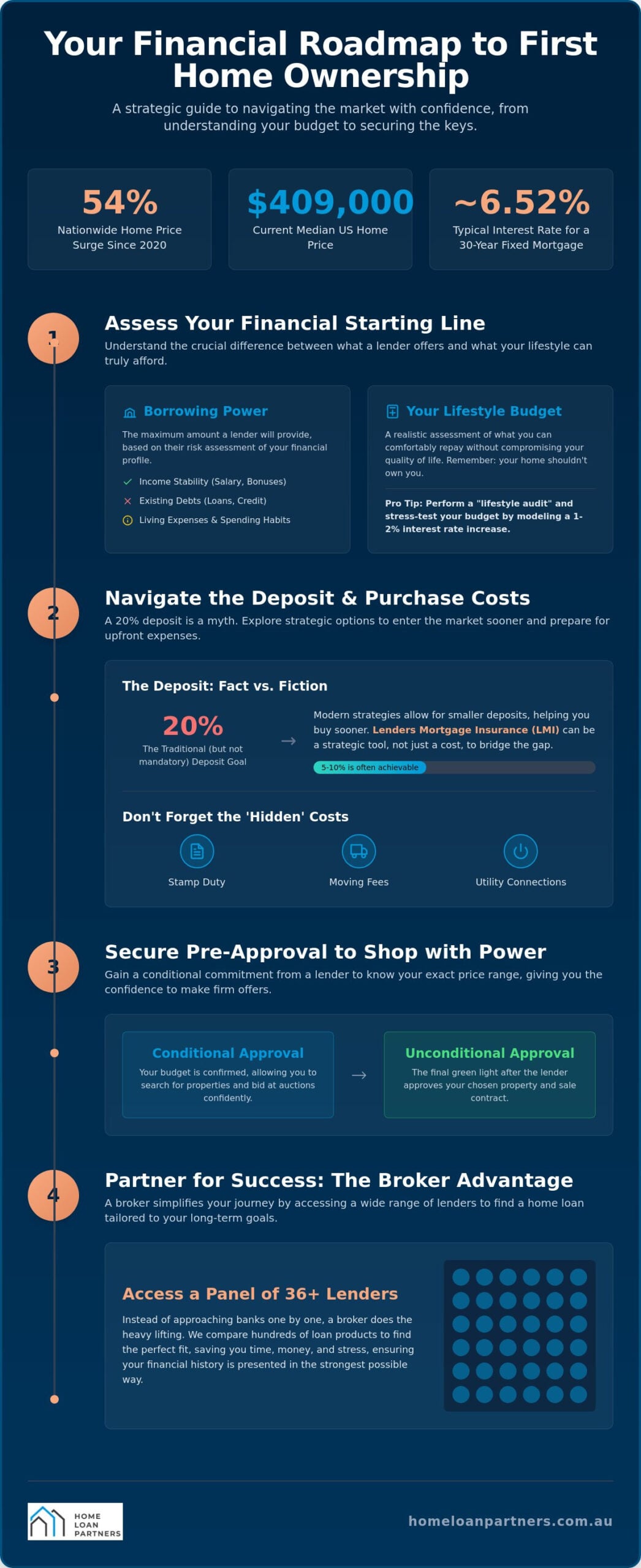
Did you know that nationwide home prices have surged by 54% since 2020? With the median US home price now hovering around $409,000, the path to ownership often feels like a moving target. Understanding the specific financial steps to buying your first home is no longer just about saving; it’s about strategic timing and expert precision. It’s completely natural to feel anxious about interest rates, which currently sit near 6.52% for a 30-year fixed mortgage, or to worry about hidden costs that might surface at the final hour.
We’re here to replace that uncertainty with a steady hand and a clear roadmap. We believe that financial readiness is a strategic partnership rather than just a solitary savings goal. This guide will help you master the essential milestones so you can transition from renter to homeowner with absolute confidence. We’ll walk through a definitive financial checklist, explain how to verify your true borrowing capacity, and explore the 2026 grant landscape to ensure your path to settlement is stress-free and predictable.
Key Takeaways
- Master the essential financial steps to buying your first home by distinguishing between what a lender will offer and what your lifestyle budget can comfortably sustain.
- Learn why a 20% deposit isn’t always necessary and how strategic tools like Lenders Mortgage Insurance can help you enter the market sooner.
- Discover how securing a pre-approval provides a conditional commitment from a lender, giving you the confidence to bid at auctions or make firm offers.
- Navigate the transition from conditional to unconditional approval while managing final hurdles like contract deposits and settlement requirements.
- Understand the advantage of partnering with a broker to access a panel of over 36 lenders, ensuring you find a solution tailored to your long-term goals.
Assessing Your Financial Starting Line: Borrowing Power vs. Budget
Identifying your baseline is one of the most critical financial steps to buying your first home. While it’s exciting to browse listings, your journey truly begins by understanding the difference between what a bank is willing to lend and what you can comfortably afford to live with. Borrowing power is the maximum amount a lender will provide based on your unique financial profile, including your income, assets, and liabilities. It’s a mathematical limit, but it doesn’t always account for your personal lifestyle goals or future plans.
Lenders in 2026 place a heavy emphasis on “serviceability,” which is their assessment of your ability to meet loan repayments without hardship. They’ll scrutinize your spending habits and credit history to ensure you’re a reliable partner. A solid foundation begins with understanding mortgage loans and how different institutions view risk. We take the heavy lifting out of this process by helping you present a “clean” financial history that highlights your strengths as a borrower.
Calculating Your True Borrowing Capacity
Your capacity isn’t just a reflection of your base salary. In the current lending environment, banks look closely at the stability of secondary income like bonuses, commissions, and overtime. They also factor in your existing commitments. High debt-to-income ratios can quickly shrink your options. Key factors that impact your capacity include:
- Existing Debts: Car loans, credit card limits, and HECS-HELP balances are viewed as ongoing obligations that reduce your available cash.
- Living Expenses: Lenders use benchmarks to estimate your costs, but they’ll also check your actual bank statements for recurring subscriptions or high-discretionary spending.
- Income Type: Full-time stability is often preferred, but we can help navigate how lenders view self-employed income or contract work.
Borrowing power is the intersection of your income, expenses, and lender risk appetite.
Budgeting for Repayments in 2026
With 30-year fixed mortgage rates currently sitting around 6.52%, it’s vital to look beyond the initial monthly payment. We encourage our clients to perform a “lifestyle audit” before committing to a loan. This ensures that your mortgage doesn’t compromise your quality of life or your ability to save for other major life events, such as a wedding. For those looking to browse luxury bridal accessories as part of their future planning, click here. It’s about finding a balance where you own your home, but your home doesn’t own you.
Strategic planning involves factoring in interest rate buffers. Even if rates are stable today, modeling a scenario where they rise by 1% or 2% provides a safety net for your peace of mind. You can use a home loan calculator to model different scenarios and see how variations in loan terms or interest rates impact your weekly budget. This clarity allows you to shop for your first home with absolute certainty.
Navigating the Deposit and ‘Hidden’ Purchase Costs
While saving a 20% deposit is a traditional goal, it’s no longer the only way to enter the property market in 2026. Many buyers now utilize low-deposit options or government-backed schemes like the First Home Guarantee to accelerate their timeline. Understanding these alternatives is one of the most vital financial steps to buying your first home. It’s about finding the right balance between the size of your upfront contribution and the speed at which you can stop paying rent. We help you weigh these options with a steady hand, ensuring your choice aligns with your long-term security.
Lenders Mortgage Insurance (LMI) is often viewed as an extra cost, but it can be a strategic tool. By paying LMI, you can secure a property with a smaller deposit, which might be the difference between buying now or waiting years while prices continue to climb. Beyond the deposit itself, you’ll need to account for upfront costs that often catch first-time buyers off guard. Citing expert steps to prepare for buying a home, it’s essential to maintain a “buffer” fund. This cash reserve protects you against immediate post-purchase expenses like moving fees, utility connections, or minor repairs that aren’t covered by your loan.
The Reality of Stamp Duty and Concessions
Stamp duty, also known as transfer duty, varies significantly across different Australian states and territories. In 2026, many regions offer generous concessions or full exemptions for first home buyers, provided the property value falls within specific thresholds. Stamp duty is often the largest upfront cost after the deposit. We’ll help you identify which grants you qualify for so you can maximize your savings and reduce your total out-of-pocket expenses. Our team can help you map out these state-specific costs to ensure your budget is precise and realistic.
Accounting for Professional Fees
Buying a home is a significant legal transaction that requires expert oversight. You’ll need to budget for conveyancing or legal fees to manage the title transfer and ensure the contract protects your interests. Financial protection also means investing in thorough building and pest inspections before you commit. These reports uncover structural issues or infestations that could cost thousands to fix later. To understand how specialized maintenance can further protect a home’s exterior value, you can discover Pressure Pros of Palm beach for professional roof and deck care. Don’t forget to include smaller but necessary items like valuation fees and mortgage registration costs, which are required by lenders to finalize your finance. By identifying these professional fees early, you can approach settlement with total clarity and no unexpected financial hurdles.
Securing Pre-Approval: The Strategic Step Before You Shop
Once you’ve mapped out your deposit and accounted for hidden costs, the next of the financial steps to buying your first home is securing a pre-approval. Think of this as your “license to shop.” A pre-approval is a conditional commitment from a lender to provide a specific amount of finance based on an assessment of your current financial health. While it isn’t a final guarantee, as the lender must still approve the specific property you choose, it provides a clear boundary for your search. Shopping without this in place often leads to heartbreak when you fall for a home that sits outside your true borrowing reach.
Most pre-approvals remain valid for 90 days. If you don’t find a property within that window, don’t panic. We can help you refresh the application by simply providing updated payslips or recent bank statements. It’s a steady, predictable process that keeps your buying power active until you find the right match. By having this step completed early, you transition from a curious browser to a prepared buyer ready to make a move.
Why Pre-Approval is Your Best Negotiation Tool
Real estate agents in 2026 prioritize certainty. When you walk into an inspection with a pre-approval in hand, you signal that you’re a serious contender who has already done the heavy lifting. This is particularly vital at auctions, where bidding is unconditional and you must have your finances in order before the hammer falls. To understand how these professional environments operate, you can visit Auction Property Ltd and explore their residential and commercial listings. Having your finance pre-assessed also reduces the risk of a seller rejecting your offer in favor of a “subject to finance” clause. It gives you the confidence to act quickly when the right property appears, which is often the deciding factor in a competitive market.
Comparing Loan Features, Not Just Rates
Many buyers make the mistake of only looking at the headline interest rate. While a low rate is attractive, the features of the loan often provide more long-term value and flexibility. For instance, an offset account allows your savings to work for you by reducing the interest charged on your loan balance daily. In contrast, a redraw facility lets you make extra payments and pull them back if needed, though it may lack the flexibility of a full offset.
You also need to decide between fixed rates for repayment certainty or variable rates that might offer more features. We always encourage looking at the comparison rate. This figure includes most fees and charges, revealing the true cost of the loan over time rather than just the initial interest. We help you compare these intricate details so you choose a structure that aligns with your risk tolerance and future aspirations. Our goal is to ensure your loan is a supportive tool for your life, not just a transaction.
From Offer to Settlement: Managing the Final Financial Hurdles
Once your offer is accepted, the pace of your journey accelerates. This is the stage where the theoretical financial steps to buying your first home become concrete legal obligations. You’ll move from “conditional” approval, which was based on your personal profile, to “unconditional” approval. This final green light only happens once the lender is satisfied with the specific property you’ve chosen, often following a professional valuation to ensure the purchase price aligns with market reality. It’s a high-stakes period, but we manage the heavy lifting to ensure your transition to ownership remains steady and predictable.
During this time, you’ll typically pay a contract deposit, which is usually between 5% and 10% of the purchase price. This money is held in a real estate agent’s or solicitor’s trust account rather than going directly to the seller. Most states provide a “cooling-off” period, a small window of a few business days where you can withdraw from the contract if needed, though this often incurs a small financial penalty. We work closely with you during these days to ensure your formal finance is locked in before this window closes, protecting your deposit and your peace of mind.
The Role of the Contract and Deposit Payment
The contract of sale is the roadmap for your transaction. It’s vital to ensure your finance is formally approved and all conditions are met before the cooling-off period ends. In some Australian states, you are legally responsible for the property from the moment the contract is signed, making it essential to arrange building insurance immediately. This protects your financial interest before you even move in. Settlement is the legal transfer of property ownership from seller to buyer.
Understanding the Settlement Process
The final week leading up to settlement involves a flurry of behind-the-scenes coordination. Your solicitor or conveyancer will work directly with your lender to organize the final payment. This isn’t just the loan amount; it includes “adjustments.” These are pro-rata payments for council rates, water charges, and land taxes that the seller may have already paid in advance. On settlement day, a final financial reconciliation occurs to ensure every cent is accounted for. Once the digital transfer is confirmed, you’ll receive the “keys in hand” notification. It’s the culmination of your hard work and strategic planning. If you’re ready to take the first step toward this milestone, you can enquire about our first home buyer loans today to start your journey with an expert collaborator by your side.
Partnering for Success: How a Broker Simplifies Your Journey
The final financial steps to buying your first home don’t have to be taken alone. While a single bank can only offer you their specific suite of products, a broker acts as your personal advocate with access to a panel of over 36 lenders. This diversity is your greatest advantage. It ensures that your loan isn’t just available, but actually optimized for your specific income structure and deposit size. Best of all, these professional services are provided at no direct cost to you, as the lender typically handles the remuneration once your loan settles.
We believe in managing the heavy lifting so you can focus on the excitement of your new home. This means we handle the dense paperwork, coordinate with solicitors, and negotiate directly with lenders on your behalf. If a hurdle arises during the application process, we’re the steady hand that finds the solution. Our role is to translate complex industry jargon into practical language, ensuring you feel empowered and informed at every turn.
Navigating the Complexity of First Home Loans
Every buyer has a unique set of circumstances. At The Home Loan Partners, we specialize in tailoring loan structures to meet your individual goals, whether that’s maximizing your offset account or securing a low comparison rate. We understand that the question of how do i buy a house in australia is about more than just a transaction; it’s a life milestone that deserves a calm and expert guide. By partnering with us, you gain a collaborator who stays by your side through the most stressful moments, from the initial budget audit to the final keys-in-hand celebration.
Your Long-Term Financial Ally
Our commitment to your success doesn’t end when you move in. The lending market is dynamic, and a loan that was perfect today might not be the most competitive option in two years. We provide ongoing support through annual reviews to ensure your interest rate remains sharp. As your life changes, your loan should too. Whether you’re planning future renovations or considering your first investment property—perhaps even looking at premier international opportunities through MaddisonV Properties—we help you future-proof your finances. This long-term relationship ensures your home loan remains a supportive tool for your evolving aspirations, providing security and clarity for years to come.
Your Journey to Homeownership Starts Today
Mastering the financial steps to buying your first home is about more than just checking boxes; it’s about building a foundation for your future security with clarity and intent. You now have a clear roadmap to assess your borrowing power, navigate hidden purchase costs, and secure the pre-approval needed to bid with confidence. While the path from offer to settlement has its hurdles, strategic planning and expert oversight turn these challenges into manageable milestones.
You don’t have to navigate this complexity alone. We offer personalized financial guidance tailored to your unique goals, providing access to a panel of over 36 lenders to ensure you find the right fit. Our team provides expert assistance with first home buyer grants and concessions, managing the heavy lifting so you can focus on finding the perfect property. Book a stress-free consultation with The Home Loan Partners today to begin your partnership with a dedicated guide. We’re ready to help you move forward with a steady hand and a clear path to your new front door.
Frequently Asked Questions
What is the very first financial step to buying a home?
The very first step is conducting a thorough audit of your financial starting line to distinguish between what a bank will lend and what you can comfortably afford to repay. This involves reviewing your stable income, existing debts, and daily spending habits to establish a realistic price range. Starting here ensures you don’t waste time on properties that sit outside your reach or compromise your lifestyle.
How much deposit do I really need for my first home in 2026?
While a 20% deposit is the traditional benchmark to avoid Lenders Mortgage Insurance, many buyers in 2026 enter the market with as little as 5% through government-backed schemes. Programs like the First Home Guarantee allow eligible buyers to bypass the 20% requirement without paying for LMI. We help you compare the long-term cost of a smaller deposit against the benefit of moving into your home sooner.
Can I buy a house if I have existing debts like a car loan?
You can certainly buy a home with existing debts like car loans or credit cards, but these obligations will reduce your overall borrowing power. Lenders view these as ongoing monthly commitments that limit the cash flow available for mortgage repayments. It’s often a strategic move to pay down high-interest debts before applying to maximize your capacity and present a cleaner financial profile to lenders.
What is the difference between pre-approval and formal approval?
Pre-approval is a conditional commitment from a lender based on your personal financial profile, while formal approval occurs only after a specific property is vetted. Once you find a home, the lender conducts a valuation to ensure the purchase price aligns with market value. Formal approval is the final green light that allows you to proceed to settlement and take legal ownership of the property.
Are there hidden costs I should budget for beyond the deposit?
Yes, you should budget for several upfront costs including stamp duty, conveyancing fees, and building and pest inspections. Stamp duty is often the largest expense after your deposit, though many first-home buyers qualify for significant concessions or exemptions. Accounting for these professional fees early is one of the most important financial steps to buying your first home and prevents stress during the final settlement phase.
How does a mortgage broker help first-home buyers specifically?
A mortgage broker provides a steady hand by navigating a panel of over 36 lenders to find the right fit for your unique goals. We manage the heavy lifting of paperwork and negotiations while ensuring you maximize available first-home buyer grants. This partnership simplifies the journey and provides access to a much wider range of loan products than a single bank could ever offer you.
What happens if my financial situation changes after I get pre-approval?
If your financial situation changes, such as a change in employment or taking on a new debt, you must notify your broker or lender immediately. Since pre-approvals typically last 90 days, any significant shift in your income or expenses may require a fresh assessment. We help you update your application to ensure your buying power remains accurate and that your eventual formal approval remains secure.
Is it better to have a fixed or variable interest rate for a first home?
Choosing between a fixed or variable rate depends on whether you prioritize repayment certainty or financial flexibility. Fixed rates protect you from interest rate fluctuations for a set period, while variable rates often include helpful features like offset accounts or redraw facilities. Understanding these different structures is among the essential financial steps to buying your first home and ensuring your loan supports your long-term security.