

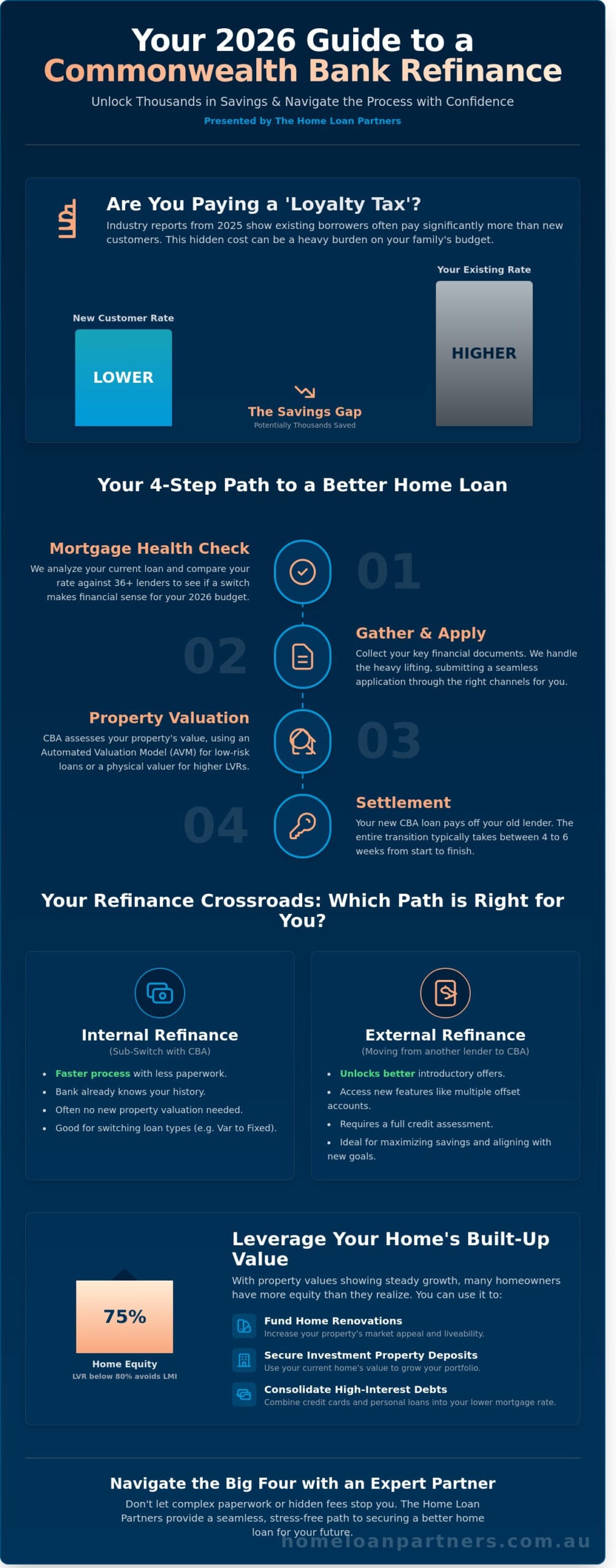
What if your long-term relationship with Australia’s largest lender is actually costing you thousands of dollars in missed savings? While many homeowners stay with their current bank for simplicity, industry reports from 2025 show that existing borrowers often pay significantly more than new customers. This loyalty tax can be a heavy burden on your family budget as we move through 2026. We understand that the thought of a commonwealth bank refinance feels overwhelming, especially when you’re already managing a busy life. It’s natural to worry about complex paperwork or hidden fees that might eat into your potential gains.
You deserve a home loan that works as hard as you do. We agree that your mortgage should be a tool for financial freedom, not a source of constant stress. This guide provides the exact steps to switch and save; helping you compare CBA’s current offerings against the broader market to ensure you’re getting the best possible value. You’ll learn how to secure lower monthly repayments and access helpful features like offset accounts without the typical headache. We’ve distilled the process into a clear, manageable path so you can move forward with confidence and security.
Key Takeaways
- Master the step-by-step process of a commonwealth bank refinance, from conducting a mortgage health check to gathering the essential documentation required for a smooth application.
- Compare the digital-first CBA Digi Home Loan against the traditional Wealth Package to determine which product structure aligns best with your specific financial goals.
- Uncover the truth about the “loyalty tax” and learn how to benchmark CBA’s rates against 36+ other Australian lenders to ensure you are receiving a truly competitive deal.
- Understand the strategic differences between internal and external switching and how these choices impact your total interest savings in the 2026 lending landscape.
- Discover how a dedicated expert partner can navigate the complexities of the Big Four banks to provide a seamless, stress-free path forward for your home loan.
Understanding the Commonwealth Bank Refinance Landscape in 2026
The Australian mortgage market underwent significant shifts leading into 2026. Borrowers now demand more than just low rates; they want digital speed and seamless integration. Commonwealth Bank (CBA) maintains its position as the nation’s largest lender, holding roughly 25% of the residential mortgage market as of late 2025. Choosing a commonwealth bank refinance allows you to partner with an institution that prioritizes technological innovation, making the application process significantly faster than traditional methods.
Market trends for the Big Four banks show a move toward hyper-personalized pricing. This means your specific financial health determines your rate more than ever before. CBA remains a top choice for tech-savvy homeowners because their digital tools, like the CommBank app, provide real-time updates on loan progress. It’s about more than just a transaction; it’s about finding a steady partner for your long-term property journey. We act as your guide to ensure the transition feels calm and controlled.
Internal vs. External Refinancing: What is the Difference?
An internal refinance happens when you switch products while staying with CBA. This is often a fast process, sometimes called a sub-switch, where you might move from a variable rate to a fixed-rate mortgage to gain repayment certainty. It’s often simpler because the bank already knows your history, reducing the need for extensive paperwork. You don’t usually need a full property valuation for these simple product swaps.
An external refinance involves moving your debt from another lender to CBA. While this requires a full credit assessment, it often unlocks better introductory offers or features like multiple offset accounts. Staying within the same institution offers convenience, but moving externally can often provide the fresh start needed to align with your 2026 financial goals. Our team does the heavy lifting to compare these paths for you.
The Role of Equity in Your 2026 Refinance
Equity is the difference between your property value and loan balance. Your Loan to Value Ratio (LVR) is the most critical number in any commonwealth bank refinance discussion. If your LVR is below 80%, you typically avoid Lenders Mortgage Insurance, which can save you thousands of dollars upfront. With Australian property values in major hubs showing steady 5% growth over the past year, many homeowners now sit on more equity than they realize.
You can use this built-up value for several purposes:
- Funding home renovations to increase your property’s market appeal.
- Accessing deposits for a new investment property loan.
- Consolidating high-interest debts into your lower mortgage rate.
We’re here to help you understand how much of your home you truly own and how to use that value effectively. By using plain English to explain these financial products, we ensure you feel confident and protected throughout the process. This supportive approach helps you move toward the Australian dream of homeownership with total clarity.
How to Refinance with Commonwealth Bank: A Step-by-Step Guide
Changing your mortgage doesn’t have to be a source of stress. When you choose a commonwealth bank refinance, the process follows a structured path designed for clarity. We start by conducting a mortgage health check to see if your current rate still serves your long-term goals. This involves comparing your existing terms against Moneysmart’s guide to switching home loans to ensure the move makes financial sense for your 2026 budget.
Once your goals are set, you’ll gather your financial history. You can submit your application directly through the CommBank app or partner with a mortgage broker who handles the heavy lifting for you. After submission, CBA initiates a valuation. They might use an Automated Valuation Model (AVM) for low-risk properties or send a physical valuer to your home if you’re borrowing more than 80% of the property value. Finally, settlement occurs when your new CBA loan pays off your old lender. This transition typically takes between four to six weeks from start to finish. Our team can help you assess your equity before you begin the application.
Navigating the Discharge Authority Process
The Discharge Authority form is the document that tells your current bank you’re leaving. It is often the primary bottleneck in any commonwealth bank refinance. Most lenders take between 14 to 21 days to process this request. Delays usually happen because of simple errors, such as mismatched signatures or incorrect account numbers. To keep things moving, ensure every person listed on the original loan signs the form. A single missing signature can reset your 21-day waiting period, pushing your settlement date further into the future.
Preparing Your Documentation for a Seamless Switch
Preparation is the key to a fast approval. For a standard 2026 application, you’ll need your two most recent payslips and your most recent Group Certificate or a Notice of Assessment from the ATO. If you earn non-standard income, such as performance bonuses or commissions, CBA typically requires a two-year history to calculate an average. They often only “shade” or count 80% of this income to ensure a safety buffer.
- Provide 90 days of consecutive bank statements for all credit cards and personal loans.
- Ensure your credit history is clean by paying all utility bills on time for at least six months prior.
- Include your most recent council rates notice to verify property ownership.
A clean paper trail shows the bank you’re a reliable partner. It simplifies the assessment process and helps secure your approval without unnecessary back-and-forth questions.
Evaluating CommBank Home Loan Products: Digi vs. Wealth Package
Choosing the right structure is the most critical step in a successful commonwealth bank refinance. Your choice determines how much interest you’ll save over the next decade. We see many homeowners struggle to decide between a stripped-back digital product and a feature-rich package. Our role is to act as your partner, helping you weigh the immediate savings of a lower rate against the long-term utility of flexible banking tools.
Before you switch, you should understand the costs involved. CBA typically requires a $600 upfront application fee for standard loans, though they sometimes waive this for specific digital products. You’ll also need to account for a $350 discharge fee from your current lender and roughly $300 in government registration charges. We’ll help you calculate your “break-even” point so you know exactly when your interest savings will cover these initial costs.
The Digi Home Loan: Low Rates vs. Limited Features
The Digi Home Loan is a streamlined option for borrowers who value simplicity. It’s designed for those who manage their finances primarily through the CommBank app and don’t require complex banking structures. While the interest rate is often CBA’s most competitive, it comes with specific trade-offs. You won’t have the option to link multiple offset accounts, which can be a hurdle if you like to bucket your savings for tax or personal reasons. This product suits homeowners with a straightforward “set and forget” mentality who want the lowest possible entry price for a commonwealth bank refinance.
Wealth Package Benefits: Offset Accounts and Redraw Facilities
The Wealth Package is a premium offering that functions as a comprehensive financial ecosystem. For an annual fee of $395, you gain access to features that can significantly reduce your interest bill over time. The standout benefit is the 100% offset account. Every dollar you keep in this account cancels out the interest on an equivalent dollar of your loan. If you maintain a $40,000 balance in your offset, you’ll stop paying interest on that portion of your debt immediately. Other perks include:
- Credit Card Savings: CBA often waives the annual fee on high-end credit cards like the Ultimate Rewards card.
- Insurance Discounts: You may receive up to 10% off home and contents insurance premiums.
- Redraw Flexibility: If you make extra payments directly into your loan, you can withdraw them later if your circumstances change.
In the 2026 economic climate, flexibility is your best defense against market volatility. Many of our clients are opting for a “split loan” strategy. By fixing 50% of your debt to protect against rate hikes and keeping 50% variable to utilize an offset account, you create a balanced safety net. We’ll guide you through these calculations to ensure your new loan serves your lifestyle as much as your wallet.
Avoiding the ‘Loyalty Tax’: Is CBA Still Your Best Option?
Staying with a familiar name provides comfort, but that comfort often comes with a hidden price tag. In the 2026 mortgage market, the gap between what long-term customers pay and what new borrowers receive has widened. This discrepancy is known as the loyalty tax. While a commonwealth bank refinance might seem like the easiest path, it’s vital to ensure you aren’t paying a premium just for staying put. Our team at Home Loan Partners acts as your guide to help you determine if your current rate still serves your long-term financial security.
Why Your Bank’s ‘Loyalty’ Discount Might Be Costing You
Lenders categorize loans into two groups: the “front-book” for new customers and the “back-book” for existing ones. Data from 2025 showed that back-book customers often paid up to 0.55% more than new applicants for the exact same product. Banks often reserve their best rates for new customers to win market share. This means your “loyalty discount” might actually be higher than the standard variable rate offered to someone walking off the street today.
Before you decide to switch, you can ask for a rate review. We often help our partners prepare for this conversation by benchmarking their current CBA rate against the broader market. If the bank refuses to budge, it’s a clear signal that they’ve stopped competing for your business. You deserve a lender that values your commitment to your mortgage journey.
Comparing CBA to Non-Bank and Smaller Lenders
The 2026 lending landscape has seen a significant rise in second-tier and non-bank lenders. These institutions now account for nearly 20% of new refinances because they operate with lower overheads than the big four. While CBA offers a seamless digital experience and a massive branch network, smaller lenders often provide lower interest rates or more flexible offset account structures. It’s a trade-off between high-tech convenience and pure interest savings.
Working with an expert broker is essential for comparing these “apples to oranges” options. We provide you with a side-by-side analysis of CBA’s features against 36+ other Australian lenders. Many of these lenders offer “unadvertised” rates to brokers that you won’t find on a comparison website. We do the heavy lifting to find the specific policy that fits your unique equity position and income type.
You should consider walking away from CBA if:
- Your current rate is more than 0.75% higher than the leading market offers.
- You’ve been denied a rate review despite having 20% or more equity.
- You need niche features, like specific construction loan terms, that the big banks don’t prioritize.
- The annual package fees no longer justify the rewards or credit card perks provided.
If you’re ready to see how your current deal stacks up against the rest of the market, book a free strategy session with our expert team today.
Partnering with The Home Loan Partners for Your CBA Refinance
Refinancing is more than just a transaction; it’s a strategic move for your financial future. When you choose to work with us, you gain a partner who understands the intricacies of the Australian lending market. We provide access to over 36 lenders. This allows our team to perform a true comparison, ensuring that a commonwealth bank refinance is actually the most beneficial path for your specific circumstances. Our goal is to provide a seamless experience that removes the typical stress associated with switching banks.
We act as your expert guide throughout the entire process. While CBA offers robust digital tools, we provide the human element that ensures your strategy fits your life. We look at the numbers and tell you straight if a move makes sense. Our support doesn’t stop at settlement, either. We monitor your loan long after the papers are signed. If the market shifts or a better opportunity arises, we’ll be the first to let you know. This long-term commitment is what sets us apart from a simple transactional service.
How a Mortgage Broker Simplifies the CBA Process
We handle the heavy lifting. This involves managing the mountain of paperwork and staying in constant contact with the bank’s credit team so you don’t have to. Beyond the admin, we focus on your loan structure. We ensure your debt is set up to support long-term goals like property investment or tax effectiveness. Having a professional negotiator on your side gives you an edge. We know how to present your application to highlight your strengths, making the approval process much smoother. Our team focuses on several key areas:
- Structure: Aligning your loan with investment or debt-reduction goals.
- Negotiation: Using our industry relationships to secure competitive terms.
- Efficiency: Cutting through bank bureaucracy to speed up your approval.
- Clarity: Translating complex financial jargon into plain English.
Ready to Explore Your Options?
Taking the first step is simple. We offer a complimentary mortgage health check to see if a commonwealth bank refinance or another lender provides the best value for your 2026 financial plan. During our first consultation, we’ll listen to your goals and analyze your current numbers. You’ll walk away with a clear roadmap and a sense of confidence about your next move. We pride ourselves on being a steady hand in a complex market, helping you achieve the Australian dream of homeownership with less stress and more savings.
Take Control of Your Mortgage Future
Refinancing isn’t just about finding a lower rate; it’s about ensuring your loan structure matches your 2026 financial goals. By comparing Digi products against traditional packages, you can sidestep the loyalty tax that impacts many CBA customers. Successfully executing a commonwealth bank refinance depends on having the right data and a clear step-by-step strategy to maximize your savings.
Our team brings a steady hand to the process, offering expert guidance for both first-time owners and property investors. We provide access to 36+ Australian lenders and deliver a national service that prioritizes your peace of mind. We view ourselves as your long-term partner, translating complex bank jargon into a clear plan that secures your family’s stability.
Get a Tailored Refinance Quote from Our Expert Team
You deserve a mortgage that supports your lifestyle without the added stress. We’re here to make that happen.
Frequently Asked Questions
Is it worth refinancing with Commonwealth Bank if I am already a customer?
Yes, internal refinancing or repricing can save you money without the paperwork of a full external switch. CBA often reserves its most competitive rates for new customers, so existing borrowers should request a rate review. According to the Reserve Bank of Australia 2024 data, existing borrowers often pay 0.5% more than new ones. We can help you negotiate this loyalty tax to ensure your commonwealth bank refinance keeps your interest costs as low as possible.
How long does a CBA refinance typically take in 2026?
A standard refinance with CBA generally takes between 14 and 21 days from application to settlement. This timeline depends on how quickly your current lender processes the discharge request. Digital documentation tools introduced in 2025 have streamlined the verification process significantly. We act as your partner to track every milestone, ensuring your transition remains on schedule and stress-free. Our team manages the communication to prevent any unnecessary delays.
What are the costs involved in switching my home loan to CommBank?
You should budget for discharge fees from your current lender and government registration charges. Most Australian states charge a mortgage registration fee of approximately $120 to $200 per document as of 2025. While CBA may waive some application fees during promotional periods, you’ll still need to cover the cost of a property valuation. We provide a clear breakdown of these expenses so you can calculate your exact break-even point before committing.
Can I refinance with CBA if I have a low deposit or high LVR?
You can refinance with a high Loan-to-Value Ratio (LVR), but you’ll likely incur Lenders Mortgage Insurance (LMI) if your equity is below 20%. CBA typically requires a minimum of 5% to 10% equity for most refinance applications. If your LVR exceeds 80%, the cost of new LMI may outweigh the interest savings. Our experts analyze your equity position to determine if a commonwealth bank refinance makes financial sense for your specific situation.
Does Commonwealth Bank offer cash-back incentives for refinancing?
CBA periodically offers cash-back incentives, which have historically ranged from $2,000 to $4,000 for eligible loans. These offers usually require a minimum loan amount of $250,000 and an LVR of 80% or less. You should check the current eligibility criteria on the CBA website or through your broker. While cash-back provides immediate relief, we always prioritize the long-term interest rate to ensure you save more over the life of the loan.
How does the CBA Digi Home Loan compare to their Standard Variable rate?
The Digi Home Loan is a low-frills, digital-only product that typically offers a lower interest rate than the Standard Variable rate. It’s designed for borrowers who don’t need features like a physical branch service or a dedicated relationship manager. In contrast, the Standard Variable rate provides greater flexibility and full offset functionality. We help you weigh these options to find the right balance between a cheaper rate and the features you actually need.
What is a Discharge Authority and how do I send it to CBA?
A Discharge Authority is a formal document that gives your current lender permission to release your mortgage to CBA. You must sign this form and submit it to your existing bank to start the exit process. Most lenders now accept digital signatures via secure portals, which can shave 5 days off the total processing time. Your partner at Home Loan Partners will handle the coordination of this paperwork to ensure a seamless handover between institutions.
Will a mortgage broker charge me a fee to help with my CBA refinance?
Most mortgage brokers don’t charge you a direct fee for a standard residential refinance. Instead, the lender pays the broker a commission after your loan settles. This means you receive expert guidance and personalized service at no out-of-pocket cost to you. We focus on your long-term financial health, acting as a steady hand to navigate the 30-plus lenders in the Australian market. Our goal is to find you the most suitable deal.