

What if your deposit is ready, but your bank statements don’t show a regular savings habit? Using a gift as a deposit with no savings history may be possible in Australia, but a family contribution alone doesn’t guarantee a lender will accept your application.
It’s understandable to worry that having little or no savings history could rule you out. Lenders assess gifted funds differently, and some may also look for evidence that you can manage repayments, such as a consistent rental payment record. What matters is how your full financial position fits the lender’s current requirements.
This guide explains how lenders may assess a gifted deposit, what to prepare and which alternatives could be worth exploring, including whether a government scheme may suit your circumstances. You’ll find out what a gift letter may need to confirm, why transfer records or donor statements may be requested, and what to ask when comparing lender policies. The Home Loan Partners can help first home buyers compare options across a panel of more than 36 lenders, so you can assess possible next steps with clearer information.
Key Takeaways
- Using a gift as a deposit with no savings history may be possible, but gifted-fund acceptance and genuine-savings rules are separate parts of a lender’s assessment.
- Compare a family gift, guarantor arrangement, continued saving and private loan by repayment obligations, family risk, paperwork and likely lender treatment.
- Prepare for lender-dependent requests such as a signed gift declaration, donor details and evidence showing where the funds came from and how they were transferred.
- Check whether your rental history or other evidence could help demonstrate financial management if you have limited savings records.
- A mortgage broker can compare lender policies against your wider financial position, though panel access doesn’t mean every lender or loan will suit your circumstances.
Can you use a gifted deposit with no savings history in Australia?
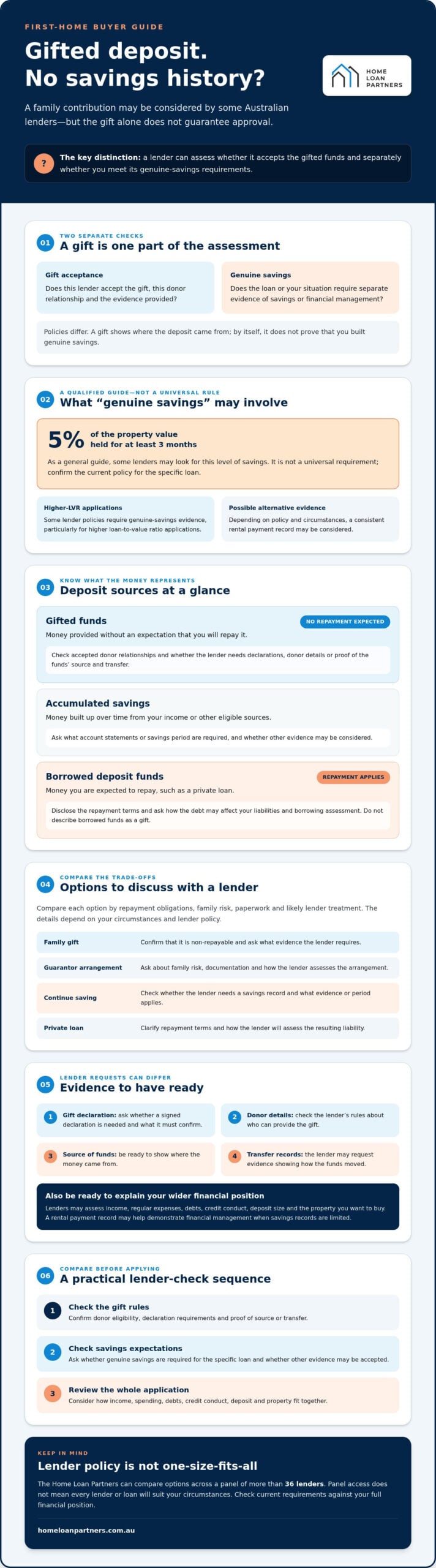
Yes, some lenders may consider a gifted deposit even if you don’t have a long savings record, but their policies differ. Lenders generally consider two separate questions: whether they accept the gifted funds, and whether your application must also meet a genuine-savings requirement. Using a gift as a deposit with no savings history may be an option, but the gift alone doesn’t determine the outcome.
A lender will also assess your wider application, including income, regular expenses, debts, credit conduct, deposit size and the property you want to buy. A substantial family contribution won’t automatically resolve concerns in other parts of the application. For a broader overview of preparing to buy, see this Australian home-buying guide.
What lenders may mean by a gifted deposit
Gifted funds are money provided without an expectation that you’ll repay it. A family member may be the donor, but lenders can set their own rules about which relationships they accept and what evidence they require. Before relying on a gift, check the specific lender’s definition and donor requirements.
A private loan is different. If you’re expected to repay the money, the lender may treat those repayments as a liability when assessing your finances. Be clear about the arrangement, and don’t describe borrowed funds as a gift.
A gifted contribution shows where your deposit came from; it doesn’t, by itself, prove that you’ve built genuine savings.
Does no savings history automatically mean a declined application?
No savings record doesn’t automatically mean an application will be declined, but it doesn’t guarantee a lender will make an exception either. “Genuine savings” is an assessment concept applied under lender policy, not one universal test with identical criteria across the market. Requirements may depend on the loan and your circumstances, so confirm the current rules before applying.
For some applicants, the key questions are whether a lender will accept the gift and whether it expects separate evidence of saving or financial management. For others, the deposit source may be only one part of a broader assessment. Be ready to explain where the funds came from and show how your income and spending support the proposed repayments.
Home-buying decisions also sit within wider homeownership trends in Australia, but your next step should be based on your own finances and the property details. Comparing lender requirements early can help you identify questions to resolve before submitting an application.
How lenders assess a gifted deposit and genuine savings
A lender may accept the source of your deposit but still assess whether you meet its genuine-savings policy. These are related, but separate, checks. Genuine-savings rules and acceptable alternatives vary, so confirm the current requirements for the specific loan instead of assuming one lender’s approach applies across the market.
Gifted funds, genuine savings, and borrowed money compared
| Deposit source | What it means | Evidence or questions to prepare |
|---|---|---|
| Gifted funds | Money provided without an expectation of repayment. | Ask whether the lender needs a signed gift declaration, donor details, source-of-funds evidence or transfer records. |
| Accumulated savings | Money you’ve built up over time from your own income or other eligible sources. | Ask what account statements or savings period are required, and whether regular rental payments or another form of evidence may be considered. |
| Borrowed deposit funds | Money you’re expected to repay, such as a private loan. | Disclose the repayment terms and ask how the debt will affect your liabilities and borrowing assessment. |
Some lender policies require evidence of genuine savings, particularly for higher loan-to-value ratio (LVR) applications. LVR compares the loan amount with the property’s assessed value. As a general guide, some lenders may look for savings equivalent to 5% of the property value, held for at least three months, but this isn’t a universal rule. Depending on current policy and your circumstances, a lender may consider alternatives, such as a consistent rental payment record.
A non-repayable gift doesn’t create the same repayment liability as a private loan. Borrowed funds, however, may affect your expenses and ability to service the home loan. Be transparent about where the money came from and whether you have an obligation to repay it.
How deposit size, LVR, and lender policy interact
A smaller deposit generally means a higher LVR, which can affect a lender’s requirements and whether Lenders Mortgage Insurance (LMI) applies. The outcome depends on the lender, loan structure and any applicable scheme. Don’t assume a particular deposit size will always avoid LMI or meet a genuine-savings test.
Government guarantee schemes have their own eligibility criteria and deposit rules. Check the current scheme name and conditions before relying on one as part of your plan.
Your deposit source alone doesn’t determine how much you can borrow; lenders assess it alongside your income, expenses, debts and the property. If you’re using a gift as a deposit with no savings history, comparing lender policies against your full financial picture can help you identify what to check. Learn more about how mortgage brokers work, or compare lender requirements with The Home Loan Partners, which has access to a panel of more than 36 lenders. Panel access doesn’t mean every lender or loan will suit your circumstances.
Gifted deposit versus other options: what should you compare?
A family gift can reduce the deposit gap and may help a buyer move sooner, but it isn’t the only path to consider. Each option brings different financial, family and lender implications. Compare whether you’ll need to repay the money, what evidence is required, when the funds will be available and whether another person may take on risk.
| Option | Repayment and family risk | Timing, documentation and lender considerations |
|---|---|---|
| Family gift | No repayment should be expected if it’s genuinely a gift. Consider whether the donor can afford to provide it and whether everyone agrees there are no repayment expectations. | Confirm the lender’s rules for donors and prepare any requested declaration and evidence of the funds. Acceptance doesn’t guarantee approval. |
| Guarantor arrangement | A guarantor may put their property or finances at risk if the borrower can’t meet their obligations. The exact exposure depends on the arrangement. | Ask what commitments and documentation are involved, how the lender assesses the arrangement and what conditions apply. |
| Continue saving | No family member takes on a financial commitment, and the buyer builds savings in their own name. | This may take longer, but a savings record could be relevant under some lender policies. Check how much history and what evidence a lender expects. |
| Private family loan | The money must be repaid, which can affect both family finances and the buyer’s regular commitments. | Document the terms clearly and ask how repayments may affect the lender’s assessment of liabilities and serviceability. |
When a gift may suit the buyer’s circumstances
A gift may suit someone whose family can comfortably contribute and who wants to reduce a deposit shortfall without taking on another repayment. Before accepting it, discuss whether the donor can afford the contribution, what everyone expects and whether repayment is genuinely not required. The buyer still needs to show they can manage the home loan. Income, expenses, debts and credit conduct all remain relevant to the application.
A common misconception is that a larger deposit settles the whole application. A gift may help you meet the deposit requirement, but it doesn’t guarantee loan approval. Lender policy and the buyer’s full financial position still matter, particularly if the contribution is actually repayable or another person is involved in the arrangement.
How a gift differs from a guarantor or family loan
A guarantor arrangement isn’t the same as receiving cash. The guarantor may provide security or support, potentially putting their property or finances at risk if the loan isn’t repaid. A family loan, by contrast, creates a repayment obligation that may affect serviceability. Make sure the arrangement reflects what everyone has agreed, then ask how the lender will assess it.
If you’re using a gift as a deposit with no savings history, compare the options by repayment duties, documentation, timing and family risk. For broader guidance on comparing finance choices, read this finance broker guide.
What documents can help when your deposit is gifted?
Clear, consistent paperwork can help a lender understand where the deposit came from and whether it’s a genuine gift. Document requirements vary by lender. If you’re using a gift as a deposit with no savings history, ask what evidence is needed before the funds move or you submit an application. Donor eligibility, declaration wording and statement periods can all differ.
Evidence the borrower and donor may be asked to provide
Depending on the lender and your circumstances, it may help to prepare:
- A signed gift declaration: It may need to state the amount, the donor’s relationship to you and whether repayment is expected.
- Donor identification and details: The lender may ask who provided the funds and whether the donor meets its relationship criteria.
- Bank statements: Statements from you, the donor, or both may be requested to show the funds’ source and movement.
- Transfer records: Keep transaction receipts or bank records that trace the money from the donor’s account to yours.
Where available, retain evidence from before and after the transfer. Check that the donor’s written confirmation, your application and the bank records all describe the same arrangement. If the money must be repaid, disclose that clearly. Describing a loan as a gift could create inconsistencies and affect how the lender assesses your application.
Steps to prepare before submitting an application
- Check the current policy. Ask the lender or your mortgage broker for its gifted-funds requirements and document checklist. Confirm accepted donors, required wording and any statement period.
- Confirm the arrangement. Discuss expectations with the donor and record the terms accurately. A genuine gift shouldn’t carry an undisclosed repayment obligation.
- Keep the transfer traceable. Save relevant statements and transaction records, and avoid unexplained transfers that could make the source of funds harder to follow.
- Review your wider position. Go through your budget, debts and potential purchase costs with a qualified professional. Gift documents explain the deposit, but they don’t replace assessment of the whole application.
Preparing these details in advance can make it easier to respond if the lender asks for clarification. The Home Loan Partners can help first home buyers compare lender requirements across a panel of more than 36 lenders. Panel access doesn’t mean every lender or loan will suit your circumstances. Discuss your gifted deposit and lender requirements.
How a mortgage broker can help compare lenders when savings are limited
A mortgage broker can help compare lender policies against your full financial profile, rather than focusing on the gifted deposit alone. That means considering the source and size of your deposit alongside your income, expenses, debts, credit conduct, proposed property and likely loan amount.
For someone using a gift as a deposit with no savings history, the practical requirements can differ from one lender to another. A broker can help identify policies worth exploring and information to confirm before you apply. The Home Loan Partners has access to a panel of more than 36 lenders, but panel access doesn’t mean every lender or loan is suitable or available for your circumstances. It also doesn’t guarantee approval.
Questions to ask before choosing a lender
Use these questions to guide a conversation with a broker or lender. Ask for answers based on your circumstances, and confirm that the information reflects current policy.
- Gift rules: Does the lender accept a gift from this donor, for this deposit amount and application type? What conditions apply?
- Evidence: What declaration, donor details, statements or transfer records will it require?
- Genuine savings: Does the application need to meet a genuine-savings requirement? Could the lender consider an alternative form of evidence?
- LVR and LMI: How will the proposed loan-to-value ratio affect the lender’s requirements, and could Lenders Mortgage Insurance apply?
- Serviceability: How will income, living costs and existing debts affect the lender’s assessment of repayments?
- Guarantee schemes: Could a relevant government scheme be an option, and what are its current eligibility and deposit rules?
These questions help distinguish what a lender may accept about your deposit from whether the overall application meets its criteria. A broker can explain how available options differ, helping you weigh requirements and trade-offs before deciding what to pursue.
A calm next step for buyers relying on family support
Before making commitments based on assumed approval, check the gift documentation and confirm the lender’s current requirements. Keep your budget and existing financial commitments in view. A deposit may address one part of the purchase, but the lender will assess the application as a whole.
If you’d like support comparing lender requirements, you can discuss your home-loan options with The Home Loan Partners. The aim is to help you understand possible next steps, not promise an outcome.
Take the next step with a clearer picture
Using a gift as a deposit with no savings history may be possible, but gifted-fund acceptance and genuine-savings requirements are separate parts of a lender’s assessment. The lender will also consider your broader financial position, including income, expenses, debts and the property you plan to buy.
Before applying, confirm the lender’s current rules and gather evidence that clearly shows whether the funds are a genuine gift. Compare the alternatives carefully, too. A family gift, guarantor arrangement, continued saving or private loan can each involve different obligations, risks and documentation.
The Home Loan Partners provides personalised guidance for first home buyers and can compare lender requirements through a panel of more than 36 lenders. The firm supports borrowers across Australia, but suitable options depend on your circumstances, and no outcome can be guaranteed.
Talk through your home-loan options with our team to understand possible next steps towards your home-buying plans.
Frequently Asked Questions
Can I get a home loan using a gifted deposit with no savings history?
Yes, some lenders may consider using a gift as a deposit with no savings history, but it depends on their policy and your complete application. Accepting gifted funds is separate from assessing whether you meet a genuine-savings requirement. Lenders also consider income, expenses, debts, credit conduct, deposit size and property details. Check the current requirements for your circumstances before relying on an assumed approval.
Do all Australian lenders require genuine savings?
No, genuine-savings policies aren’t identical across Australian lenders. Whether they apply may depend on the lender, your application and your deposit profile. A gifted deposit isn’t automatically exempt, and an alternative form of evidence may be acceptable to one lender but not another. Before applying, ask the lender or a mortgage broker what evidence it accepts and whether any alternative to genuine savings may apply to you.
What documents do I need for a gifted home deposit?
Depending on the lender, you may be asked for a signed gift declaration, donor identification, bank statements and proof of the transfer. The required declaration wording, statement periods and other evidence vary, so there isn’t one checklist that applies to every application. Ask the lender for its current document requirements, and keep a clear record of where the funds came from and how they moved into your account.
Does a gifted deposit have to be repaid?
A genuine gift is generally provided without an expectation of repayment, but lenders may define and document gifted funds differently. If the money is expected to be repaid, disclose that clearly. The lender may treat it as a liability and consider its effect on your ability to meet repayments. Describe the arrangement honestly in your application and any supporting declaration. Don’t label a private loan as a gift.
Can my parents gift me the whole deposit?
A lender may consider a substantial gift from your parents, but acceptance depends on its policy and your overall financial position. Ask whether your parents meet its donor requirements and what evidence it needs about the funds and transfer. The lender may also assess your loan-to-value ratio (LVR), affordability and other application details. A full deposit gift doesn’t guarantee approval or mean every lender will apply the same criteria.
Will a gifted deposit affect Lenders Mortgage Insurance?
Lenders Mortgage Insurance (LMI) is generally connected to the loan-to-value ratio (LVR) and lender criteria, rather than simply whether your deposit came from a gift. A gift may increase your contribution and change the LVR, but the outcome depends on the lender and loan details. Ask how the lender calculates LVR, whether LMI may apply, and whether you could be eligible for a relevant government guarantee scheme.
Can I use a gifted deposit under an Australian government home-buyer scheme?
Possibly, but gifted-deposit rules depend on the current scheme, its eligibility criteria and the participating lender’s requirements. Don’t assume every program accepts every gift arrangement or removes all genuine-savings conditions. Before making plans, check the scheme’s current deposit rules, eligibility criteria and lender requirements. A mortgage broker can help you understand which details to verify against your circumstances, though eligibility or loan approval can’t be guaranteed.