

The money in your everyday account could help reduce the interest charged on your home loan without being paid directly into the loan. If you’re searching “how does an offset account work australia?”, the key is the balance your lender uses to calculate interest each day. The benefit depends on how much you keep in the account and the terms of your loan.
It’s worth weighing potential interest savings against account fees, a different interest rate and how easily you can access your money. It can also be confusing to compare an offset account with redraw, or to know whether either option changes your scheduled repayments.
This guide explains how daily interest calculations work and what to check before choosing an offset account, including whether it offers a full or partial offset, how it’s linked to your loan, and any fees or rate differences. You’ll also learn how to compare an offset with redraw and assess whether it suits your balance, cash flow and longer-term goals. An offset account won’t be the right fit for every borrower.
Key Takeaways
- An eligible balance in a linked offset account can reduce the amount used to calculate home loan interest.
- Check whether the account offers a full or partial offset, which balances qualify, and what access or transaction conditions apply.
- Compare an offset account with redraw by checking where your money is held and the access terms for each option.
- Consider your likely balance, cash flow, loan rate and fees when assessing whether potential interest savings suit your circumstances.
- Before choosing, request clear loan terms and compare options with a lender or qualified mortgage professional.
How does an offset account work on an Australian home loan?
An offset account is an eligible transaction or savings account linked to a home loan. When the lender calculates interest, its balance is subtracted from some or all of the loan balance. Your money stays in the linked account, while the eligible balance may reduce the amount of the loan on which interest is charged. The details depend on your lender’s loan and account terms.
What is an offset account, in simple terms?
Think of an offset account as a separate account that works alongside an eligible home loan. The money in it isn’t usually paid into the loan itself. Instead, the lender uses the eligible balance to adjust the amount used for interest calculations. This overview of an offset loan explains the general concept.
Account access, transaction features and which funds count towards the offset can vary. Check your loan documents to confirm that the account is linked correctly and whether the arrangement offsets the full eligible balance or only part of it.
How does the daily interest calculation work?
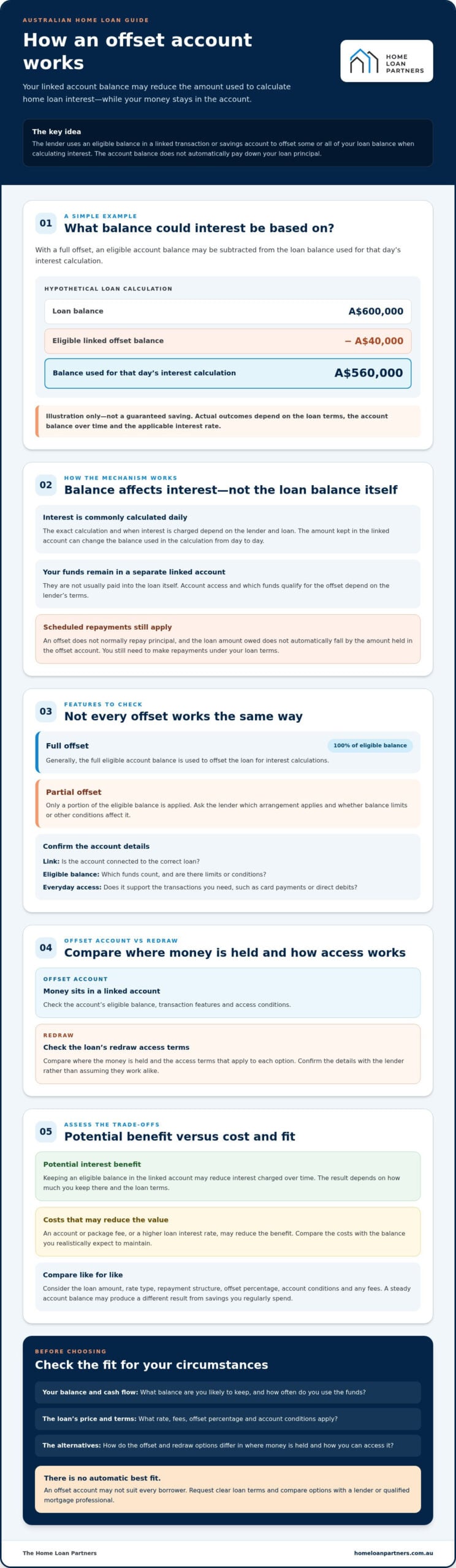
Home loan interest is commonly calculated daily, although the exact calculation and when interest is charged depend on the lender and loan. With a full offset, the lender may calculate interest using the loan balance minus the eligible offset balance. For example, if a hypothetical loan balance is A$600,000 and the linked account holds A$40,000, the balance used for that day’s interest calculation could be A$560,000. This illustrates the calculation only, not a guaranteed saving. Your actual outcome depends on the loan terms, account balance over time and applicable interest rate.
In brief: an eligible offset balance can reduce the amount of your home loan used to calculate interest while leaving the funds in a linked account.
Keeping money in the account may reduce interest charged over time, particularly if you maintain a balance. But the offset itself doesn’t normally repay loan principal. Your scheduled repayments still apply, and you’ll need to meet them under your loan terms. Interest may be calculated on a lower balance, but the amount you owe doesn’t automatically fall by the amount in your offset account.
Which offset account features and loan terms should you understand?
An offset account’s value depends on more than the product label. Check how it works with the specific home loan, what it costs and whether its features fit the way you manage money. Lender conditions differ, so confirm the current terms in the product documents before deciding.
Does every home loan offer a 100% offset account?
No. Offset availability and the percentage applied vary by lender and loan product. A 100% offset generally means the full eligible account balance is used to offset the loan for interest calculations. A partial offset applies only a portion. Ask the lender which arrangement applies and whether balance limits or other conditions affect the calculation.
Check that the account is linked to the correct loan and find out how you can access the funds. Confirm whether it supports the transactions you need, such as card payments or direct debits, and whether there are conditions on account use or eligible balances. Moneysmart’s guide to a mortgage offset account provides a useful Australian overview.
What fees or interest-rate differences should you check?
Compare the total cost of each loan option, not just whether it includes an offset. An account or package fee, or a higher loan interest rate, may reduce the value of the interest benefit. Ask for the applicable rate and all relevant fees, then compare them with the balance you realistically expect to keep in the account. A steady balance may produce a different result from savings you regularly spend.
For a fair comparison, use like-for-like loan details, including the loan amount, rate type, repayment structure, offset percentage and account conditions. Check whether fees apply to the account or wider loan package, and whether the rate or features could change under the lender’s terms. This helps you weigh the costs against the potential benefit without assuming an offset will automatically leave you better off.
- Offset percentage: Is it full or partial, and which balances qualify?
- Account access: Can you make the everyday transactions you need?
- Costs: What account or package fees apply, and how does the loan rate compare?
- Conditions: Are there limits or requirements that could affect how you use the account?
These details help you work out whether a particular loan’s features and costs match your cash-flow habits. If you’d like support comparing eligibility, loan structure and costs, you can explore your home loan options.
Offset account vs redraw: how do access and loan structure differ?
Both options can affect the interest on a home loan, but your money is held differently. An offset balance remains in a separate account linked to an eligible loan. Redraw generally means accessing extra repayments you’ve already paid into the loan, subject to the lender’s rules. Understanding this difference is an important part of comparing the two options.
How is an offset account different from redraw?
With an offset, the funds remain in your linked account and may be available for everyday transactions. With redraw, extra repayments are held against the loan, and access depends on the loan’s redraw terms. Processing times, access limits and conditions can differ by lender and product. Moneysmart explains how a mortgage offset account works and outlines points to consider when comparing the options.
| What to compare | Offset account | Redraw facility |
|---|---|---|
| Where the money sits | In a separate account linked to the home loan. | As extra repayments made into the loan. |
| How you access it | Through the account’s available transaction features and conditions. | By requesting access to eligible extra repayments under the lender’s rules. |
| What to verify | Eligible balances, account access, fees and offset percentage. | Redraw availability, access conditions, processing and any limits. |
Neither option is automatically better. Your choice may depend on whether you prefer keeping savings in a transaction account or making extra repayments, as well as the loan’s terms and costs. For a closer look at the trade-offs, read this redraw vs offset account comparison.
Can an offset account reduce monthly repayments?
An offset balance commonly reduces the amount used to calculate interest. It doesn’t usually change your scheduled repayment automatically. Check with your lender how repayments are calculated and whether your loan allows them to be adjusted.
If your scheduled repayment stays the same while less interest is charged, more of that payment may go towards reducing the loan principal. The effect depends on your loan terms and how the lender applies repayments. Confirm the details before relying on a particular repayment amount or timeline.
How can you work out whether an offset account suits your situation?
Assess an offset account against your real cash flow, not an idealised estimate of how much you might save. The balance can rise and fall as income arrives and bills are paid, so its value may change over time. Use these steps to make a practical comparison:
- Estimate your likely balance. Look at what you could usually keep in the account after regular expenses, rather than relying on a temporary high balance.
- Compare the loan costs. Weigh the likely interest effect against account or package fees and differences in the loan’s interest rate.
- Check access. Consider whether the account’s transaction features and conditions fit how you budget and pay expenses.
- Review the terms. Confirm which balances qualify, the offset percentage, and how the lender calculates interest and repayments.
What balance might you realistically keep in the account?
Use a typical month as your guide. For example, if your salary arrives in the account but bills and everyday spending draw the balance down, focus on what is likely to remain across the month, not just the amount on payday. A steady balance may contribute more consistently to the offset calculation than an occasional large deposit followed by withdrawals. Your own spending pattern is the useful measure.
When might the costs outweigh the offset benefit?
Consider an illustrative case: one borrower keeps a modest balance that falls after each pay cycle, while another regularly holds savings in the account. The offset may have a different value for each, even if both have similar loans. If the loan with an offset has a higher rate or extra account costs, compare those expenses with the estimated interest reduction based on your likely balance. Don’t assume the loan with an offset is automatically the better fit.
Compare suitable alternatives using the same loan amount, rate type and repayment assumptions. Your income, savings, spending and loan balance can all change, so review the comparison as your circumstances evolve. If you’re considering an offset for an investment loan, ask a qualified Australian tax professional about potential tax implications of the loan structure and how you use the funds. This is a prompt to seek advice, not a personal tax assessment.
If you want help reviewing loan structure, likely offset balances and competing costs, explore your home loan options with a mortgage professional. Understanding how an offset account works is a useful starting point, but the right decision depends on the loan terms and the way you manage your money.
What should you do before choosing an Australian offset home loan?
Before choosing, bring together the details that determine whether an offset account fits your finances: the loan’s offset terms, your likely account balance, the interest rate, fees and how you need to access your money. Use the questions below to turn your understanding of offset accounts into a practical comparison.
What questions should you ask a lender or broker?
Ask for answers based on the specific loan, not just a general description of offset accounts. Account conditions and loan features vary, so request clear details you can compare with other options.
- Does the loan support an offset account, and is it a full or partial offset?
- Which balances are eligible, and does the account need to be linked or set up in a particular way?
- What interest rate applies, and are there account or package fees?
- How can you access the account, and are there transaction conditions or limits?
- How are interest and scheduled repayments calculated under the loan contract?
Check the answers against your expected account balance and regular cash flow. A feature may sound useful, but its practical value depends on the balance you’re likely to maintain and the complete loan terms.
How can you compare loan options with confidence?
Compare the whole loan structure, not just the offset feature. Consider the rate, fees, repayment arrangements, access conditions and whether the account supports your budgeting habits and longer-term goals. Ask lenders or a qualified mortgage professional for comparable information so you can assess options on consistent terms.
If you already have a home loan, refinancing may be one option to review, but it isn’t automatically worthwhile. Consider the costs and terms of changing loans alongside the features you’d gain or give up. This Australian home loan refinancing guide can help you understand what to consider.
The Home Loan Partners is an Australian mortgage brokerage that can help borrowers review loan options across a panel of more than 36 lenders. Available options depend on individual circumstances, and comparing them doesn’t guarantee approval or a particular saving. For a considered review of your loan structure and offset requirements, talk through your home loan options.
Make your next home loan decision with confidence
Understanding how does an offset account work australia starts with one key idea: an eligible linked balance can reduce the amount used to calculate home loan interest, but it doesn’t normally replace your scheduled repayments. Whether an offset suits you depends on the balance you can realistically maintain, the loan’s rate and fees, and the account’s access conditions.
Before choosing, compare the full loan structure and confirm whether the offset is full or partial. Consider how an offset account differs from redraw, too, since your funds are held and accessed differently under each option. The right fit is the one that works with your cash flow and longer-term goals, not simply the one with the most features.
The Home Loan Partners provides personalised guidance to borrowers across Australia and has access to a panel of more than 36 lenders. If you’d like help reviewing options and comparing loan terms, talk through your home loan options. A clear comparison can help you take your next step with greater confidence.
Frequently Asked Questions
How does an offset account work in Australia?
An offset account can reduce the home loan balance used to calculate interest by the eligible amount held in a linked account. With a full offset, for example, the lender may subtract the account balance from the loan balance when calculating interest. Check whether your loan has a full or partial offset and confirm the lender’s calculation and account terms.
Does an offset account reduce your monthly home loan repayments?
Not usually automatically. An offset account commonly reduces the interest calculated on your loan, while your scheduled repayment stays the same unless your lender changes it under the loan terms. If the repayment remains unchanged while less interest is charged, more of that payment may go towards the principal. Ask your lender how it calculates repayments and whether you can request a repayment change.
Is money in an offset account still accessible?
Generally, the funds remain in a separate account linked to your home loan, rather than being paid directly into the loan. You may be able to access them using the account’s transaction features, but access depends on the lender’s conditions and account setup. Before relying on the funds for bills or everyday spending, check transaction options, any restrictions and which balances are eligible for the offset.
What is the difference between an offset account and redraw?
An offset account holds money separately from your home loan, and its eligible balance may reduce the amount used to calculate interest. Redraw generally lets you access extra repayments you’ve made into the loan, subject to lender rules. Access methods, conditions and processing can differ. Compare the specific loan terms and consider whether you prefer keeping savings in a transaction account or paying extra into your loan.
Is an offset account worth it if I have a small balance?
It depends on the likely balance and the loan’s total costs. A smaller or frequently changing balance may provide less interest reduction than a larger, steadier one, so compare the estimated benefit with any account or package fees and differences in the interest rate. There’s no universal balance threshold that makes an offset worthwhile. Use your normal cash flow and compare suitable loan options before deciding.
Can an offset account be used with an investment property loan?
Some investment property loans may offer an offset account, but eligibility and account terms depend on the lender and product. Confirm whether the loan supports an offset and which funds qualify. Loan structure and how you use funds may also have tax implications. Before deciding about an investment loan, seek advice from a qualified Australian tax professional rather than relying on general information.
Does an offset account save interest every day?
Home loan interest is commonly calculated daily, so an eligible offset balance may reduce the balance used in each day’s calculation. The effect changes as the account or loan balance changes, and the lender’s calculation and charging terms apply. Check whether your account provides a full or partial offset and how the lender treats eligible funds. The amount of interest affected depends on your loan and account terms.