

A lower payslip during parental leave doesn’t automatically mean a lender will assess your home loan application using that figure alone. How lenders view parental leave income can depend on your current payments, your documented plans to return to work and the lender’s assessment policies. That variation can make it difficult to know what your household may be able to borrow.
You may be wondering whether government or employer-paid parental leave will count, or whether a temporary drop in income could affect your plans. Some lenders may consider your return-to-work salary, but this isn’t universal. No single document or income figure guarantees approval. Lenders also look at your broader financial position and ability to manage repayments.
This guide explains the factors a lender may assess, the evidence that can help and the questions to prepare for a home loan conversation. You’ll also learn how to compare options and consider timing without making assumptions about approval. A clear picture of your income during leave and after your return can help you prepare for the next step.
Key Takeaways
- How lenders view parental leave income depends on their policies and your wider financial picture, not just your current pay.
- Ask whether a lender may consider your return-to-work income and what evidence it needs to assess your employment plans.
- Prepare documents covering your employment, leave payments, household finances and existing loan commitments.
- Paid leave, unpaid leave and documented future income may be assessed differently. Confirm how each applies to your circumstances.
- Compare lender policies, documentation requirements and loan features before deciding when to apply.
How do lenders view parental leave income on a home loan application?
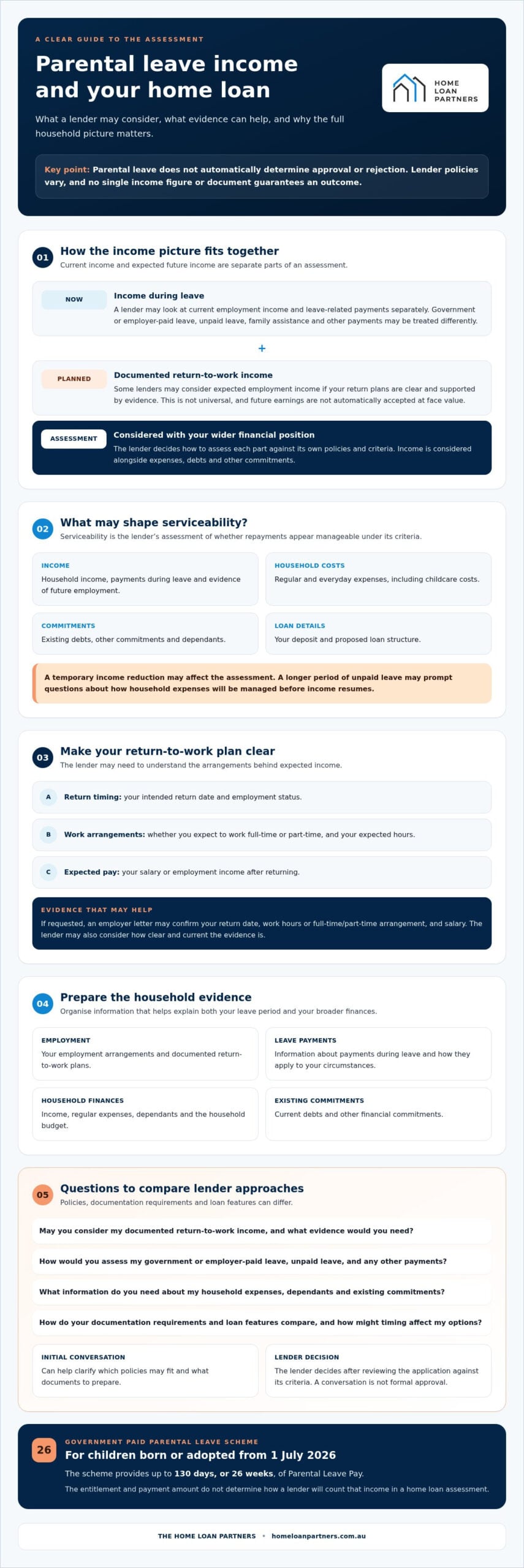
Being on parental leave doesn’t automatically decide the outcome of a home loan application. A lender considers your income alongside regular expenses, debts and other commitments to assess whether repayments appear manageable under its criteria. How lenders view parental leave income varies, so one lender’s approach isn’t a rule for every application.
Current income is what you receive now. Documented expected return-to-work income is employment income a lender may consider if your plans are clear and supported by evidence. These are separate parts of the assessment, and the lender decides whether and how to use each. For a general overview of parental leave frameworks, see Parental leave in Australia.
What income might a lender consider during parental leave?
A lender may look at your current employment income and leave-related payments separately. Australian Government Parental Leave Pay may form part of the income picture, but how it is treated depends on the lender’s policy and your circumstances. If you receive family assistance or other payments, don’t assume they’ll be assessed like wages. Ask how the lender treats each payment and what evidence it needs.
For children born or adopted from 1 July 2026, the Government scheme provides up to 130 days, or 26 weeks, of Parental Leave Pay. The entitlement and payment amount don’t determine how a lender will count that income in a home loan assessment.
Does parental leave automatically prevent home loan approval?
No. Parental leave alone doesn’t establish either approval or rejection. The lender assesses the full application, which may include household income, expenses, dependants, existing debts, deposit and proposed loan structure. A temporary income reduction may affect the assessment, while other parts of your financial position and evidence of future employment may also be relevant.
Keep the stages clear. An initial conversation can help you understand which policies may fit and what documents to prepare, but it isn’t a formal lender decision or approval. The lender decides after reviewing the application against its criteria. Comparing lender approaches with a broker can help you ask focused questions, but no particular income treatment guarantees an outcome.
How return-to-work plans and lender serviceability assessments fit together
A lender may consider your expected employment income after parental leave, but it will need to understand the arrangements behind that figure. Serviceability is the lender’s assessment of whether your income and financial position appear sufficient to manage repayments under its criteria. It isn’t a simple check of your future salary alone.
Lender assessment depends on your documented circumstances and the lender’s current policy, not one universal rule. The length of your leave, whether it’s paid or unpaid, and your return arrangements can all shape the review. Government Paid Parental Leave settings can also change over time. For current scheme context, refer to the Australian Government’s information on the major expansion of Paid Parental Leave.
How lenders may assess a planned return to work
Your intended return date, employment status and expected hours can help a lender understand whether future income is supported by your employment arrangements. If requested, an employer letter may confirm when you’ll return, whether you’ll work full-time or part-time, and your salary or hours. A return to the same role may be assessed differently from a move to a new position or a change in working hours.
Future earnings aren’t automatically accepted at face value. The lender may consider how clear and current the evidence is, alongside your income during leave and the rest of your application. If your plans are still being finalised, ask what the lender needs before it can consider your expected income.
Why household affordability still matters
Even with a documented return-to-work plan, the lender needs to consider the household budget. Childcare costs, dependants, existing debts and everyday expenses can affect how much income appears available for repayments. A longer period of unpaid leave may also prompt questions about how the household will manage expenses before your income resumes.
Lenders use their own criteria and methods to assess expenses and serviceability, so the same household details may not be treated identically across applications. Review your likely repayments and budget as part of your preparation. The home loan calculator guide offers a starting point for broader planning, not a guarantee of what a lender will approve.
A conversation with a broker can help you understand how lenders may apply their policies to your circumstances and identify questions to ask. You can also explore guidance on comparing home loan options as you prepare.
Paid leave, unpaid leave, and return-to-work income: what may differ?
Payment type can affect the evidence available to a lender, but it doesn’t determine how income will be assessed. When comparing how lenders view parental leave income, separate what you can document from what the lender still needs to decide. Policies vary, so confirm how each income source will be treated in your application.
| Income situation | Evidence that may help | What to confirm with the lender |
|---|---|---|
| Government or employer-paid leave | Payment records, leave approval and relevant Services Australia documentation for Government Parental Leave Pay | Whether each payment is accepted, how it is assessed and whether its expected duration affects the assessment |
| Unpaid leave | Employer confirmation of leave dates and return arrangements, plus information about household funds available during the unpaid period | How the lender will assess income while payments are paused and whether it may consider documented future earnings |
| Documented return-to-work income | An employer letter confirming the return date, role, employment status, expected hours and salary, where available | Whether the lender can use the expected income and what other evidence or conditions apply |
Paid parental leave and employer-paid leave
For paid leave, the payment source and expected duration help show what income is coming in now and when it may change. Keep records showing payment amounts and dates. Services Australia records may be relevant for Government Parental Leave Pay, while employer statements or payslips may help document employer-paid leave. Ask the lender how it treats each source rather than assuming all paid leave is assessed alike.
Unpaid leave and planned return to work
Unpaid leave can make current income evidence less straightforward because regular wages may pause. An employer letter confirming your role, expected return date and hours can help explain the plan, but it doesn’t guarantee the lender will accept future earnings or approve a loan. Fair Work Ombudsman guidance explains an employee’s right to return to the same job. Lenders still assess the evidence under their own current criteria.
For the wider purchase journey, the Australian home-buying guide sets out key steps beyond preparing your income information. As you plan, keep a clear record of each income source and ask how the lender will assess it in your specific application.
What documents can help lenders assess parental leave income?
A well-organised application helps a lender or broker understand how your income may change during leave and after you return to work. Requirements differ between lenders, so treat this as a preparation checklist, not a list of documents every lender will require. Before gathering everything, ask which records are relevant to your circumstances and how current they need to be.
Start by writing down your leave dates, current income and expected return arrangements. Then collect supporting records in four groups:
Employment and parental leave evidence to gather
- Employment: Recent payslips and employment confirmation can show your role and current earnings. Ask whether the lender needs an employer letter confirming your leave dates, expected return date, employment status, role, hours and salary on return.
- Leave payments: Gather available records of employer-paid leave and, where applicable, Services Australia documents or payment records for Government Parental Leave Pay. Ask how each payment will be treated rather than assuming different sources count the same way.
These documents can help clarify how lenders view parental leave income, but none guarantees that a particular income source will be accepted. Check that dates and amounts are consistent across your records. If your return-to-work arrangements have changed, explain that clearly instead of relying on outdated information.
Household finances and application preparation
- Household position: Prepare a summary of regular expenses, dependants, debts and savings. Include expected changes, such as childcare costs or a period with reduced income.
- Existing loans: List current loan balances, repayments and other credit commitments. Have relevant statements available if requested.
Compare your summary with bank statements and supporting records before sharing it. If figures differ, note why. Complete, consistent information gives a broker or lender a clearer view of your application, rather than leaving them to interpret parental leave income in isolation.
For ideas on what to ask as you prepare, see this finance broker guide. To discuss how your circumstances may fit different lender policies, speak with a home loan broker about preparing your application and comparing options.
How to compare lender options and plan your next step
A clear sequence can make your next home loan conversation easier to manage. First, set out your leave dates, current income and return-to-work plans. Next, organise the supporting documents you have. Then compare lender policies and ask how each lender may assess your circumstances. Once you understand the evidence and criteria involved, consider whether the timing of an application suits your plans.
There’s no single best time to apply before, during or after parental leave. The right timing depends on your household finances, how clearly your employment arrangements are documented and the requirements of lenders you’re considering. Rather than assuming how lenders view parental leave income will be the same everywhere, compare policy fit, assessment approach, requested documents and loan features relevant to your needs.
Questions to ask when comparing lenders
Use focused questions to understand how lender policies differ and how they may apply to your application:
- How will you assess each income source, including employer-paid leave, Government Parental Leave Pay and expected income after my return?
- Can you consider my planned return-to-work arrangements, and what evidence would you need?
- Which documents should I prepare, and could you request further information during the assessment?
- How might my household expenses, dependants, debts or changed work hours affect the serviceability assessment?
- Which loan features should I compare alongside the assessment policy?
The answers can help you compare options beyond an initial estimate. A policy that appears suitable still needs to be considered alongside your full application and the lender’s current criteria.
A calm path from preparation to lender discussion
Before requesting an assessment, bring together your employment and leave details, payment records and household financial summary. This gives a broker or lender a clearer starting point and can help you identify gaps early. The Home Loan Partners has access to a panel of over 36 lenders, which can support a discussion about policy differences and options to explore. It doesn’t guarantee that a lender will accept a particular income source or approve an application.
Take the process one step at a time. A broker conversation can help you discuss your circumstances, compare lender approaches and consider timing without assuming a particular borrowing amount or outcome. Talk through your home loan options and prepare for the next stage with a clearer understanding of what to ask.
Take your next home loan step with confidence
Parental leave doesn’t automatically determine a home loan outcome. How lenders view parental leave income depends on their current policies and your documented circumstances, including your income now, expected return-to-work arrangements and overall household finances. Paid leave, unpaid leave and future employment income may be assessed differently, so check how each lender treats the details of your application.
Before discussing timing, organise your employment and payment records, outline your household expenses and commitments, and prepare questions about serviceability and required evidence. Comparing lender approaches can help you make an informed plan without assuming a particular borrowing amount or approval outcome.
The Home Loan Partners offers personalised guidance for individual circumstances and access to a panel of over 36 lenders, giving you options to discuss and compare. Support can continue beyond settlement as your home loan journey progresses. Talk through your home loan options with The Home Loan Partners to discuss your circumstances and plan your next step.
Frequently Asked Questions
Will a bank count parental leave income for a home loan?
A bank may count some parental leave income, but how it treats each payment depends on its current policy and your circumstances. Government Parental Leave Pay and employer-paid leave may be assessed differently from your usual salary or documented return-to-work income. Ask the lender which income sources it can consider, how it will assess them and what evidence it needs. Your wider application, including expenses and debts, also matters.
Can I get a home loan while on unpaid parental leave?
You may be able to apply while on unpaid leave, but the lender will assess whether your household can manage repayments under its criteria. It may ask about your expected return date, role and hours, as well as how you’ll cover expenses while your regular pay is paused. Employer confirmation and a clear view of savings, debts and household costs can help explain your position, but they don’t guarantee approval.
Does a return-to-work letter help with a mortgage application?
A return-to-work letter can help a lender understand your future employment arrangements. If available, ask your employer to confirm your expected return date, role, employment status, hours and salary. The lender may use this information when assessing expected income, but it won’t necessarily accept future earnings in full or rely on the letter alone. Requirements differ, so check what details the lender needs and how recent the letter must be.
How does Services Australia Parental Leave Pay affect borrowing capacity?
Services Australia Parental Leave Pay may be considered as one part of your income, subject to the lender’s policy. Its effect on borrowing capacity depends on how the lender assesses the payment, how long it’s expected to continue and what other income is available. Payment records can help document it. A lender also assesses expenses, dependants, debts and any supported return-to-work income, so the payment alone won’t determine your borrowing capacity.
Should I apply for a home loan before or after parental leave?
There isn’t one timing that suits everyone. Applying before, during or after leave depends on your income evidence, leave arrangements, household budget and the lender’s requirements. Before choosing, ask how a lender may assess your current payments and planned return to work, and whether your application would benefit from additional documentation or a later review. A broker discussion can help you compare possible timing without treating an early assessment as formal approval.
What documents should I provide when applying for a home loan on parental leave?
Ask the lender or broker which documents apply to your situation, as requirements vary. Useful records to prepare may include recent payslips, employment confirmation, an employer letter outlining leave and return-to-work arrangements, and Services Australia payment records if relevant. Also organise information about regular expenses, dependants, debts, savings and existing loans. Check that figures in your application align with the supporting statements and records you provide.
Will parental leave reduce how much I can borrow?
It may affect how much a lender is prepared to lend, particularly if your current income is lower or household expenses have changed. The lender may also consider documented return-to-work income, depending on its policy and the evidence available. Childcare costs, dependants and existing debts can influence the assessment too. Because lenders assess the full application differently, parental leave doesn’t automatically mean your borrowing capacity will fall by a set amount.