

What if your monthly rent was actually the most powerful tool in your home loan application? Many Australians feel the weight of this question when they have a deposit ready but fall short of the traditional three-month holding rule. It’s frustrating to have your funds prepared, perhaps through a gift or tax refund, only to be told it doesn’t count. You feel ready to take this major life milestone, yet the rigid documentation required for proving genuine savings without a bank statement makes you fear an immediate rejection, particularly when you’re confused by the difference between genuine and non-genuine funds.
We’re here to act as your steady guide through this process. This article will show you exactly how to overcome these hurdles. You’ll discover how to satisfy lender requirements by using your rental history and alternative assets when you don’t have a traditional three-month bank statement history.
We’ll explore the ‘Rent as Genuine Savings’ policy, explain how to package a gifted deposit for success, and help you identify the specific Australian lenders that offer the flexibility you need. By focusing on your long-term financial discipline, we can help you find a clear, stress-free path to securing your mortgage.
Key Takeaways
- Understand why lenders require a three-month savings history as a stress test for your future mortgage repayments.
- Discover how a consistent rental ledger serves as a powerful tool for proving genuine savings without a bank statement.
- Explore how the First Home Super Saver Scheme (FHSSS) and other alternative assets can satisfy strict lender criteria.
- Learn how a specialist broker packages your non-standard application to access a panel of over 36 Australian lenders.
What Are Genuine Savings and Why Do Lenders Demand Proof?
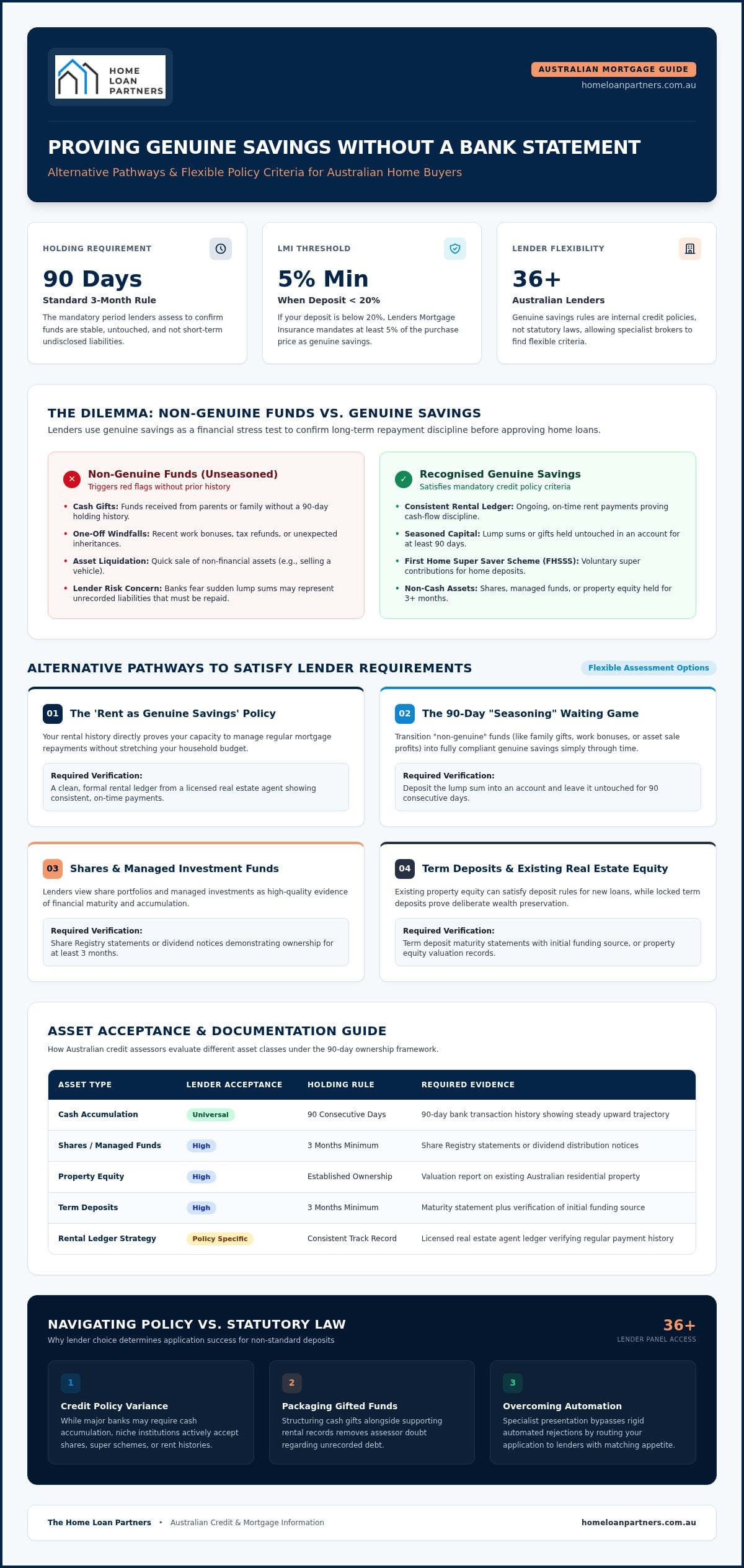
When you apply for a home loan in Australia, lenders look closely at how you obtained your deposit. Genuine savings represent funds you’ve personally accumulated or held in an account for at least three consecutive months. From a lender’s perspective, this requirement acts as a critical financial stress test. It proves you have the discipline to manage regular repayments on a mortgage loan over the long term without stretching your household budget to breaking point.
If your deposit’s value falls below the standard 20% mark, Lenders Mortgage Insurance providers generally mandate a minimum 5% genuine savings threshold. This rule protects the financial system against sudden defaults. It also creates a strict division between genuine savings and non-genuine sources. While one-off work bonuses, cash gifts, or an inheritance provide excellent capital, they don’t show the consistent, active accumulation habits that banks prefer to see during the assessment phase.
The 3-Month Rule: Why Bank Statements Are the Standard
A standard 90-day bank statement allows credit assessors to map your financial behavior clearly. They look for a steady upward trajectory or a large sum that has remained untouched for the entire period. In the current 2026 credit environment, with elevated interest rates keeping scrutiny incredibly high, assessors review these documents with absolute precision. Unexplained lump sum deposits without historical backing trigger immediate red flags because banks worry that the funds may be undisclosed liabilities you’re required to pay back.
When You Don’t Have the History: The Problem We’re Solving
Many capable buyers face a major hurdle when their deposit arrives all at once. You might have received a generous family gift, a sudden inheritance, or equity from selling a non-financial asset like a vehicle. Having the cash ready but failing the bank’s automated timeline test causes immense emotional stress, making you feel locked out of the property market despite your financial stability. Fortunately, genuine savings rules are flexible credit policies set by individual institutions rather than rigid statutory laws, which opens the door for proving genuine savings without a bank statement through alternative pathways.
Alternative Ways to Meet Genuine Savings Requirements
Not every Australian home buyer keeps their wealth in a standard transaction account. Lenders understand this, though their “appetite” for non-cash assets varies significantly across the market. While one major bank might insist on seeing a growing cash balance, another niche lender may accept a portfolio of shares as proof of your financial maturity. Identifying these flexible institutions is where a finance broker becomes an essential collaborator. They understand the nuances of lending criteria across dozens of different providers.
If you currently hold “non-genuine” funds, such as a cash gift from parents or a recent work bonus, you can transition these into “genuine” status through the passage of time. By placing these funds into an account and holding them for at least 90 days, you satisfy the core requirement of proving genuine savings without a bank statement that shows a slow accumulation. It’s a simple waiting game that transforms a red flag into a green light for credit assessors.
Acceptable Non-Cash Assets as Evidence
Lenders often view shares and managed funds as high-quality evidence. If you’ve held these assets for at least three months, a Share Registry statement or dividend notice acts as your primary paper trail. For those who already own property, the equity in your current Australian home can often satisfy the requirement for a new loan without needing a separate cash deposit. Term deposits are also highly respected. As long as you can show the source of the initial funds and provide the maturity statement, lenders view this as clear evidence of your saving capacity.
Comparison: Cash vs. Alternative Proof
The following table outlines how different asset classes are viewed by Australian lenders in 2026. Each category still follows the fundamental “90-day rule,” meaning you must have owned the asset for at least three months to prove it isn’t a temporary loan from a third party.
| Asset Type | Lender Acceptance | Required Documentation |
|---|---|---|
| Cash Savings | Universal | 90-day transaction history |
| Shares/Managed Funds | High | Share Registry or Dividend statements |
| Property Equity | High (for investors) | Current loan statements and valuations |
| Rental Ledger | Growing Trend | 12-month ledger from a licensed agent |
Navigating these various documentation requirements shouldn’t feel like a solo mission. You can speak with a specialist to see which asset class fits your chosen lender’s specific policy and how to best present your unique financial position.
The Rental Ledger Strategy: Proving Savings Without a Bank Statement
For many first-home buyers, the biggest hurdle isn’t the ability to manage a mortgage, but the rigid requirement to prove where their deposit came from. If you’ve spent years paying high rent while receiving a gifted deposit from family, you likely won’t have the traditional three-month savings history banks look for. This is where the “Rent as Genuine Savings” policy becomes your strongest asset. It acknowledges that your ability to meet significant weekly rent payments is a clear indicator of your future repayment capacity.
In the 2026 Australian lending market, this strategy is the primary solution for applicants who have the funds ready but lack the bank statement “paper trail.” Most lenders offering this flexibility require you to have been renting for at least 12 months. It’s important to note that this policy typically applies when your Loan-to-Value Ratio (LVR) is 90% or less. If you’re looking to borrow 95% of the property value, Lenders Mortgage Insurance (LMI) providers often insist on seeing cash savings instead, though some niche lenders on our panel of 36+ providers may offer more leeway.
How to Obtain and Present a Professional Rental Ledger
Your first step is to contact your property manager or real estate agent to request a formal rental ledger. This document tracks every payment you’ve made since the start of your tenancy. Credit assessors look for “perfect” payment history. In their eyes, “on-time” means the funds reached the agency’s account on or before the due date. A single payment made two days late can trigger a rejection, as it suggests a lack of financial organization.
- Professional Ledgers Only: Lenders almost exclusively require ledgers from licensed real estate agents.
- Private Pitfalls: Private rental agreements, such as paying cash to a family member or friend, are generally not accepted because they lack independent third-party verification.
- Consistency: Ensure the names on the ledger match the names on your home loan application exactly.
Lender Specifics: Who Accepts Rent as Proof?
While the “Big Four” banks have traditionally been more rigid, many non-bank and specialized lenders have embraced rental history as a valid form of evidence. To support your application, you’ll need to provide a current, signed lease agreement alongside your ledger. This ensures the lender can verify the rent amount matches the ledger entries. Effectively, a professional rental ledger serves as a surrogate for a savings plan, proving your financial discipline through your largest recurring expense. We help you identify which lenders currently favor this approach, ensuring your application goes to the right desk the first time.
Other Evidence Lenders May Accept in 2026
Lenders sometimes look beyond the obvious to find signs of financial maturity. While rare, some niche lenders might consider the equity in a motor vehicle or other trade-ins as a contributing factor, particularly for smaller loan amounts where the risk profile is lower. For self-employed applicants, providing two years of consistent tax returns can serve as a powerful secondary proof of discipline. It shows you’ve managed a business successfully while maintaining the cash flow necessary for a home deposit. If you aren’t sure how much you need to set aside, our home loan calculator guide helps you estimate that crucial 5% target.
Proving genuine savings without a bank statement becomes much easier when you leverage assets that banks already trust. Our role is to help you identify which of these alternative “paper trails” will satisfy a credit assessor’s specific requirements. By presenting a broader picture of your wealth, we move the conversation away from rigid 90-day transaction lists and toward your actual financial strength.
The Role of the FHSSS in Proving Savings
The First Home Super Saver Scheme (FHSSS) is often considered the gold standard for alternative evidence. Since these funds are deducted directly from your salary or contributed voluntarily into a regulated superannuation environment, lenders view them with high confidence. You’ll need to generate a Determination document from the Australian Taxation Office (ATO) to show exactly how much you’re eligible to release. In 2026, you can access up to $50,000 of these contributions plus associated earnings. Combining an FHSSS release with a gifted deposit is a strategic way to satisfy both the 5% genuine savings rule and the total deposit requirement simultaneously.
Using Dividends and Investment Income
If you’ve spent years building a portfolio, your history of reinvesting dividends is excellent proof of disciplined saving. Lenders will look for statements from platforms like CommSec or registry services like Computershare to verify your holdings have been held for at least 90 days. Be cautious with crypto-to-cash conversions, however. In the current 2026 credit environment, assessors apply extremely high scrutiny to digital asset profits due to their inherent volatility. If your deposit comes from crypto, you’ll likely need to hold those funds in a standard Australian bank account for three months to clear the assessment hurdles.
You can request a personalized document review to see which of your alternative assets will carry the most weight with our panel of 36+ lenders.
How a Mortgage Broker Packages Your ‘Non-Standard’ Application
Receiving a “No” from a major bank can feel like a devastating blow to your home ownership dreams. It’s vital to remember that a single rejection is rarely the end of the road. As a national brokerage with access to a panel of over 36 lenders, we know that different institutions have vastly different appetites for risk. While a traditional lender might struggle with proving genuine savings without a bank statement, a niche lender may welcome your application if the right narrative is presented. We act as your expert collaborator, finding the specific policy that aligns with your unique financial situation.
The most critical tool in our arsenal is the Credit Memorandum. This isn’t just a cover sheet; it’s a professional narrative we write to explain your savings history to the credit assessor. Instead of letting an automated system flag a gifted deposit as a risk, we provide the context. We detail your long-term rental history, your share portfolio growth, or your FHSSS contributions to build a comprehensive picture of your financial discipline. This human element often makes the difference between a rejection and an approval.
Securing a pre-approval based on alternative evidence is the best way to reduce anxiety before you start the journey of buying a house in Australia. It gives you the confidence to bid at auction or make an offer, knowing a lender has already reviewed your non-standard documentation and given a preliminary green light. We manage the heavy lifting of this process, ensuring your paperwork is polished and persuasive before it ever reaches a lender’s desk.
The Power of Choice: Accessing Niche Lender Policies
In the 2026 Australian market, credit policies shift almost daily. Some lenders now specialise in ‘alternative-doc’ genuine savings because they recognise that modern wealth takes many forms. We stay updated on these micro-changes so you don’t have to. Having a professional advocate talk directly to a credit assessor allows us to argue the merits of your case. We highlight your strengths, such as employment stability or a high income, to offset the lack of a traditional 90-day savings pattern. It’s about finding the right home for your loan, not just the most famous one.
Your Next Steps: Preparing for a Stress-Free Application
Preparation is the key to a smooth experience. Before our first meeting, gather your 12-month rental ledger, any share registry statements, and your latest ATO determination if using the FHSSS. A crucial tip: avoid moving large sums of money between accounts right before you apply. Sudden transfers, even between your own accounts, can trigger fresh documentation requests and delay your approval. Keep your funds steady while we work on proving genuine savings without a bank statement for you. When you’re ready to start, book a consultation with The Home Loan Partners to review your evidence and map out your path to success.
Take the Next Step Toward Your Australian Home
Your journey to home ownership doesn’t have to stall just because your deposit history doesn’t fit a standard bank box. As we’ve explored, your consistent rental history and diverse asset portfolio are powerful indicators of your financial strength. By leveraging policies like “Rent as Genuine Savings” or utilizing your FHSSS contributions, you can demonstrate the discipline lenders need to see. Proving genuine savings without a bank statement is a common challenge, but it’s one we solve every day by matching applicants with the right niche lenders.
We pride ourselves on being your steady guide through this complex landscape. With access to a panel of over 36 lenders, including specialist non-bank options, we tailor loan structures to suit complex financial histories. You don’t need to navigate these rigid requirements alone. Our team handles the heavy lifting, from drafting your Credit Memorandum to securing a pre-approval that gives you the confidence to bid.
Ready to move forward? Let our experts find the right lender for your unique situation. You’ve worked hard to build your future; now let’s ensure you reach that major life milestone with ease and precision.
Frequently Asked Questions
Can a gifted deposit count as genuine savings if I have a rental ledger?
Yes, a gifted deposit is accepted alongside a rental ledger by many specialist lenders on our panel. While the gift itself is considered non-genuine, the rental ledger acts as a surrogate for a savings plan by proving your ability to meet large, recurring financial commitments. This combination allows you to access loans that would otherwise require a three-month cash history. We help you package these two elements to satisfy strict credit assessment criteria.
How long do funds need to be in my account to be considered genuine savings?
Traditional lenders typically require funds to be held in a dedicated account for a minimum of three consecutive months. This 90-day period allows banks to verify that the money isn’t a short-term loan you need to repay. If you are proving genuine savings without a bank statement, other assets like shares or term deposits must also meet this three-month ownership threshold. We can guide you on the exact timing needed for your specific lender.
Does ‘Rent as Genuine Savings’ apply to private rentals or only through agents?
Most Australian lenders only accept rental history if it’s managed by a licensed real estate agent. Private rental agreements, such as paying cash to a landlord or family member, usually lack the independent third-party verification required by credit departments. You’ll need a formal ledger showing a clear 12-month history of on-time payments. If your current arrangement is private, we can explore other alternative assets to support your home loan application instead.
Can I use the sale of a car or boat to prove genuine savings?
Using the sale of a motor vehicle or boat is possible but remains a niche policy. You must provide a clear paper trail, including the original purchase receipt, the sale contract, and proof that the proceeds have been held in your account for at least 90 days. Some lenders may even accept a trade-in value for smaller loan amounts. We review these non-standard assets to determine which of our 36+ lenders will recognize their value.
What happens if my bank statements show irregular savings patterns?
Irregular patterns often trigger red flags because they suggest inconsistent financial discipline. If your statements show fluctuating balances or large, unexplained deposits, we can help by creating a Credit Memorandum. This document provides the necessary context to explain your financial behavior to the assessor. Alternatively, we might pivot your application toward a rental ledger strategy, which prioritizes your consistent housing payments over the specific flow of your transaction account.
Is Lenders Mortgage Insurance (LMI) always required if I use alternative proof?
Lenders Mortgage Insurance is generally required whenever you borrow more than 80% of a property’s value, regardless of your proof type. However, using alternative evidence doesn’t automatically trigger higher LMI costs. Eligible first-home buyers may also access the First Home Guarantee scheme, which allows for a 5% deposit without LMI. We analyze your eligibility for these government initiatives to ensure your path to property ownership remains as cost-effective and stress-free as possible.
Can I use my Superannuation as part of my genuine savings proof?
Superannuation is a highly respected form of evidence when accessed through the First Home Super Saver Scheme (FHSSS). Because these funds are deducted directly from your pre-tax or post-tax income, they represent a high level of financial discipline. You will need a formal Determination from the ATO to prove your eligibility. This is one of the most effective ways of proving genuine savings without a bank statement in the current Australian market.
How do lenders view cryptocurrency gains in a home loan application?
Cryptocurrency gains are treated with extreme caution by Australian credit assessors due to market volatility. Most lenders won’t accept digital assets as proof of savings while they remain in a crypto wallet. To use these funds, you typically need to convert them to Australian Dollars and hold them in a standard bank account for at least 90 days. We can help you navigate these specific timing requirements to ensure your profits are viewed favorably by credit assessors.